Procurement Software for Construction: A 2026 Guide
Only 21 percent of construction organizations use procurement software. The rest manage sourcing with spreadsheets, email, and disconnected bid portals.
In this article
Construction procurement software is still an early-stage category, with 21% of surveyed construction organizations reporting implementation of procurement and bid-process-management solutions. That leaves roughly four in five teams managing high-stakes sourcing through spreadsheets, email, shared drives, and disconnected bid portals.
Three weeks before bid close, the procurement lead has a problem that no generic purchasing dashboard can solve. Structural-steel quotes are above the estimate, an addendum has invalidated drawings that two suppliers used, and three subcontractors have returned bids against different revisions of the mechanical specification. An audit team is also scheduled to review the award record after handover.
This is the normal pressure point in capital-project sourcing. The team isn't just buying a product. It's deciding whether a technically acceptable offer can arrive on time, satisfy the governing specification, preserve warranty and commercial protections, and withstand a challenge years later.
The right procurement software for construction must survive that room. A polished supplier directory or automated award memo isn't enough. The system has to connect live design information, volatile materials, supplier evidence, evaluation logic, approvals, and the final decision record.
The Sourcing Moment Most Construction Teams Underestimate
Construction sourcing becomes difficult when the specification is still moving but the commercial clock is already running. A procurement lead may have to reconcile revised drawings, bidder questions, alternates, exclusions, delivery commitments, and internal budget pressure in the same afternoon. Each document can change the meaning of a quote without changing its headline price.
That creates a problem generic procurement systems rarely handle well. In office purchasing, the item is usually defined before the supplier event starts. On a capital project, design teams, owners, contractors, and suppliers work across separate organizations while requirements evolve through drawings, schedules, addenda, specifications, and clarifications.
Practical rule: If a reviewer can't identify which revision governed each bid line, the award record isn't finished.
The risk continues after award. A supplier may confirm compliance in a response, qualify the warranty in a manual, and promise delivery in an email. Those statements can conflict without anyone deliberately hiding the difference. A low price can then become an expensive substitution, a delayed fabrication slot, or a dispute over what the supplier actually committed to.
The record has to outlive the project team
Construction procurement software should preserve the locked specification, bidder questions, submitted documents, reviewer comments, scoring rationale, approvals, and award basis in one controlled record. It should also make the relationships visible, so a reviewer can move from an evaluated requirement to the supplier evidence supporting the answer.
That's why I treat the category as a defensibility layer, not a tender mailbox. The platform earns its place when it helps the team make a better decision before award and reconstructs that decision after the people involved have moved to another project.
The adoption gap confirms that most organizations are still building this capability. PwC's Construction Industry Vision 2025 survey found 21% implementation for procurement and bid-process-management solutions, alongside 22% for electronic document management, 19% for cost-estimation or bill-of-quantities software, and 18% for enterprise-resource-planning systems for cost management. Procurement software isn't an isolated experiment anymore, but many teams still need a reliable operating model.
What Construction Procurement Software Actually Does
Construction procurement software manages the chain from a project requirement to a defensible award. It brings specifications, drawings, bills of quantities, supplier discovery, RFQs and RFPs, responses, evaluations, approvals, and award records into a controlled workspace.
Think of it as a common data environment extended into sourcing, not a shopping cart. The analogy matters because construction teams need controlled information exchange across owners, designers, general contractors, subcontractors, suppliers, and operators. A simple vendor list with an approval workflow won't preserve the context behind a package decision.
A useful platform should let a team:
Create a package: Turn a specification, BoQ, schedule, and commercial instruction into a structured sourcing event.
Invite the market: Identify qualified suppliers, issue consistent RFx documents, and manage clarifications in one place.
Normalize responses: Map different quote formats to comparable line items, requirements, delivery terms, exclusions, and alternates.
Evaluate evidence: Record technical, commercial, schedule, and supplier-risk judgments with source documents attached.
Control the award: Route recommendations through role-based approvals and retain the final rationale.
Hand over the record: Export a complete file for project controls, finance, claims, public review, or future sourcing.
Generic spend-management and procure-to-pay suites still have a role. They're often strong at purchase orders, invoice processing, supplier master data, approval routing, and corporate spend controls. They usually aren't designed around model objects, drawing revisions, trade packages, site logistics, or competing interpretations of a live specification.
The boundary between procurement and purchasing
Purchasing executes an order. Procurement decides what should be bought, from whom, under which requirements, with what evidence and risk allocation. Construction organizations need both layers connected.
A construction platform should therefore integrate with estimating, ERP, project-management, scheduling, and project-controls systems rather than attempt to replace every system of record. Its distinctive job is to make the sourcing decision comparable, traceable, and usable by the people responsible for delivery.
Construction-Specific Features That Generic Suites Miss
The best buying decision starts with the failure you need to prevent. Don't begin with a feature catalogue. Begin with the package where a missed revision, undocumented substitution, or unsupported supplier claim could affect cost or schedule.
Treat BIM as information, not an attachment
A construction platform should map procurement requirements to model objects, classifications, quantities, delivery milestones, and approval states. EN ISO 19650 provides information-management principles and a Common Data Environment for controlled exchange, while open standards such as IFC, EN ISO 16739, support interoperability across design and operational systems.
That doesn't mean an IFC file automatically solves procurement. Research summarized in the construction BIM standardisation plan identifies the absence of dedicated procurement classes as an interoperability limitation. Your platform needs an explicit procurement layer with requirement IDs, bid-line mappings, compliance status, clarifications, alternates, commercial terms, evidence links, and revision history.
Make specification drift visible
A quote, product manual, warranty, delivery promise, and clarification should be tested against the locked requirement. The system should flag whether the supplier response is yes, no, or partial, then show the evidence behind that classification.
specification management software becomes more than document storage here. The useful question isn't whether a file was uploaded. It's whether the system can identify the precise clause, page, line, or revision that changes the commercial meaning of a bid.
Score the package as a capital decision
Weighted evaluation must reflect the project, not just price. A package may require technical compliance, delivery certainty, warranty coverage, fabrication capacity, local support, commercial terms, and supplier stability. The weights should be visible before responses are scored, and changes should leave an activity record.
Finally, connect the event to estimating and project controls. Approved commitments should flow into the systems that manage budget, schedule, change, and delivery. Software that creates a beautiful evaluation but leaves the award disconnected from execution has only automated the front half of the problem.
How AI Changes Construction Sourcing Workflows
AI is useful in construction sourcing when it reduces research and review effort without hiding the basis for a decision. It isn't useful when it produces an unexplained score that nobody can defend.
An AI-enabled workflow should handle four jobs. First, it can search catalogues, manuals, certifications, public reviews, forums, and supplier sites to build a market view. Second, it can inspect a draft specification for missing acceptance criteria, unclear service levels, restrictive clauses, or requirements that appear to point toward one supplier.
Third, it can compare supplier responses against the requirement and cite the source for each answer. Fourth, it can detect drift between the locked specification and the quote, manual, warranty, terms, or delivery commitment. The reviewer still owns the decision, but the reviewer shouldn't have to hunt through every document to find the deviation.
Bolt-on automation versus an evaluation record
A bolt-on assistant summarizes documents. An AI-first sourcing system structures the entire chain of reasoning:
Discovery: Which suppliers were considered, and why were others eliminated?
Specification analysis: Which gaps or single-bidder risks existed before the event?
Compliance: Is each requirement satisfied, partially satisfied, or unsupported?
Commercial impact: Does a substitution change price, lead time, warranty, installation, or operating obligations?
Accountability: Who reviewed the result, what did they approve, and which version did they approve?
Use the guide to AI agents changing procurement specification work as a useful prompt for vendor demonstrations, but don't accept marketing language as proof. Ask the vendor to process a real package with messy PDFs, addenda, supplier qualifications, and conflicting terms.
Then test the output. Can the system show the exact evidence for every answer? Can it explain an elimination? Can it preserve the source version? Can it quantify the effect of a substitution? If the answer is no, you're looking at document automation, not defensible sourcing intelligence.
Evaluating Vendors With a Construction-First Scorecard
The lowest software subscription is rarely the lowest project cost. A platform that misses a warranty qualification or delivery dependency can preserve a cheap bid while creating a much larger execution problem.
Evaluate vendors against the failure modes your team already recognizes. A single-bidder requirement should be visible before the specification locks. A supplier substitution should show its effect on installation and schedule. A reviewer should be able to reproduce the award without relying on an individual buyer's inbox.
Score the system, not the demonstration
Use a weighted scorecard and adjust the weights to your project portfolio. The suggested weights below are starting points, not a universal formula.
Criterion | What to verify | Suggested weight |
|---|---|---|
Construction-relevant features | RFx packages, BoQs, revisions, alternates, substitutions, delivery commitments, and multi-company collaboration | 25% |
BIM and estimating integration | CDE compatibility, model-linked requirements, structured quantities, ERP and project-controls connections | 15% |
Audit defensibility | Source citations, version history, reviewer identity, approval trail, exportable decision record | 20% |
Security and data governance | Role-based access, data residency, retention, external reviewer controls, segregation of duties | 15% |
Implementation model | Live-project onboarding, migration support, supplier adoption, training, and change support | 15% |
Total cost and scalability | Pricing relative to project volume, packages, users, storage, integrations, and audit needs | 10% |
Test the awkward package
Don't use a clean sample RFQ. Give each vendor a package with an addendum, a revised drawing, a long supplier manual, an alternate, and a delivery promise that conflicts with the schedule. Ask the vendor to identify every deviation and produce the award file.
A buyer evaluating external service partners can apply the same discipline to operational intermediaries. For example, this guide to vetting middle-mile carriers with Peak Transport reinforces the broader lesson: evaluate reliability, evidence, fit, and operating risk rather than choosing from a headline price alone.
The right question isn't “Can the platform compare bids?” It's “Can it explain why this bid remained acceptable after every relevant document was checked?”
Review the implementation assumptions closely. A tool that requires suppliers to change every behavior before the first benefit appears may fail even with strong functionality. Prefer a platform that can begin with one package, preserve existing project controls, and expand after the team proves the record quality.
Where Lowest-Compliant Bid Quietly Loses the Project
A technically compliant bid can still be commercially wrong. The problem appears when the compliance screen treats a substitution as a binary answer and ignores the consequences attached to it.
The supply environment makes that dangerous. Reported structural-steel costs rose 10–25% in 2025 in the United States and Canada, while copper, aluminum, drywall, and roofing increased 3–15% amid tariff and supply pressures; 68.7% of surveyed respondents reported ongoing disruption and 28.3% described conditions as stable, according to Turner & Townsend's construction cost trends. Those figures don't tell you which supplier to select, but they do show why price and availability can't be treated as static inputs.
A switchgear example
Suppose a supplier proposes switchgear that meets the electrical performance requirement. The quote looks lower, the compliance response says yes, and the evaluator marks the line acceptable.
A construction-aware review asks different questions:
Does the alternative fit the approved spatial and connection requirements?
Does its testing or certification process change the approval path?
Does the delivery promise extend beyond the installation milestone?
Does the warranty alter commissioning or maintenance obligations?
Does installation require different labor, accessories, or sequencing?
Does the substitution create a change-order or interface risk?
If the delivery window moves into a critical-path activity, the lower quote isn't the better award. The system should show the technical answer and the commercial consequence together, with evidence for both.
Roll out the control before the volume
Start by locking the governing specification and the evaluation model. Then require every proposed alternate to carry a reason, source evidence, affected requirement, price impact, schedule impact, and approval status. A practical construction contract management guide can help teams align the sourcing record with the obligations that will govern performance after award.
Don't configure the platform to reward the lowest compliant price by default. Configure it to expose deviations early enough for the project team to decide whether the tradeoff is acceptable.
Implementation and Change Management Across Project Teams
Implementation fails when the organization treats procurement software as a technical installation. The platform changes how owners, designers, estimators, buyers, suppliers, project managers, finance teams, and auditors create and trust evidence. Each group needs a reason to use the system and a clear boundary around its responsibility.
Start with one live package
Choose a package with meaningful complexity but a cooperative project team. Mechanical equipment, electrical materials, façade systems, or another specification-sensitive category often reveals whether the platform can handle requirements, supplier documents, alternates, approvals, and schedule commitments.
Before inviting suppliers, establish five controls:
The governing revision: Identify the specification, drawings, addenda, and clarifications that define the event.
The evaluation model: Set technical, commercial, schedule, and supplier criteria before responses arrive.
The evidence standard: Require source documents or citations for compliance claims and exclusions.
The approval path: Assign technical, commercial, project, and finance reviewers.
The archive rule: Define what gets exported and retained after award.
A package pilot should produce more than a selected supplier. It should produce a repeatable event template, a clean decision record, and a list of process exceptions. Use those findings to improve the next category rather than forcing enterprise-wide standardization immediately.
The guide to onboarding a procurement tool without disrupting active RFP cycles is useful because live projects can't pause while a new system is configured. Keep active events on a controlled path, define the migration boundary, and avoid moving half-complete evaluations between systems without a documented handoff.
Give each stakeholder a workable role
Owners need confidence that competition and technical judgment were applied consistently. Program managers need visibility into package status and exposure. Design teams need to review compliance without becoming procurement administrators. Trade contractors and suppliers need a simple response path that supports their documents and clarifications.
Finance needs approved commitments, commercial terms, and a reliable audit trail. Internal audit needs access to source evidence, version history, scoring rationale, and approvals. External reviewers need controlled sharing rather than unrestricted access to the project workspace.
Role-based access matters because visibility and authority aren't the same thing. A technical reviewer may comment on compliance but not change the commercial weight. A finance reviewer may approve a commitment but not rewrite the governing specification. The system should make those boundaries explicit.
Measure the opportunity without overstating it
McKinsey estimates that improving contracting and capital procurement can capture approximately 5–15% cost improvements on technology-focused capital projects, according to its analysis of construction productivity. Treat that as an opportunity range, not a guaranteed software return.
Build your own baseline before deployment:
Metric | What to capture |
|---|---|
Cycle time | Days from specification lock to award |
Bid coverage | Number and quality of credible responses per package |
Specification deviation | Count and type of quote-to-spec differences |
Change exposure | Changes linked to substitutions or clarification gaps |
Expediting activity | Escalations caused by supplier or delivery variance |
Awarded-price variance | Difference between estimate, bids, and final award by category |
Measure the same fields after rollout. Separate price movement caused by market conditions from savings created by competition or negotiation. Record avoided cost only when the team can explain the counterfactual and support it with evidence.
Prepare for the post-implementation review
Finance and audit reviewers will ask practical questions:
Which specification revision governed the event?
Why did the team eliminate each supplier?
Were all bidders evaluated against the same requirements?
Who approved the weights and the final recommendation?
What evidence supported a partial compliance answer?
Did an alternate change price, schedule, warranty, or installation?
Can the record be exported and read without platform access?
If the implementation team can't answer those questions from the system, adoption has created another information silo instead of removing one.
Security, Compliance, and the RFP Questions That Matter
Security review should test whether the platform protects both sensitive commercial information and the integrity of the decision record. Ask about data residency, role-based access, retention, audit-log completeness, export integrity, and segregation of duties. Confirm that external reviewers can see the material they need without gaining rights to alter requirements, scores, or approvals.
Put those controls into the RFP, then prove them in a live test. Give each vendor a real package in sanitized form and require an output that includes the locked requirements, supplier responses, evidence citations, deviations, reviewer actions, and award rationale.
Questions for the proof of concept
Ask vendors to demonstrate:
Evidence quality: Can the system cite the exact source for every compliance answer?
Drift detection: Can it identify a conflicting warranty, delivery term, exclusion, or substitution?
Version control: Can a reviewer see which document revision informed the score?
Decision integrity: Can the platform explain an elimination and preserve reviewer accountability?
Export defensibility: Does the exported file remain understandable without a live login?
Access control: Can internal and external reviewers have different permissions?
Data handling: What happens to test files, deleted records, and retained audit history?
Don't grade the demo on interface polish. Grade it on whether a skeptical reviewer can follow the decision from requirement to evidence to approval. A system that generates scores without source documents and rationale can increase governance risk, even if it speeds up the first review.
The winning product is the one that makes a difficult award easier to defend, not merely easier to submit.
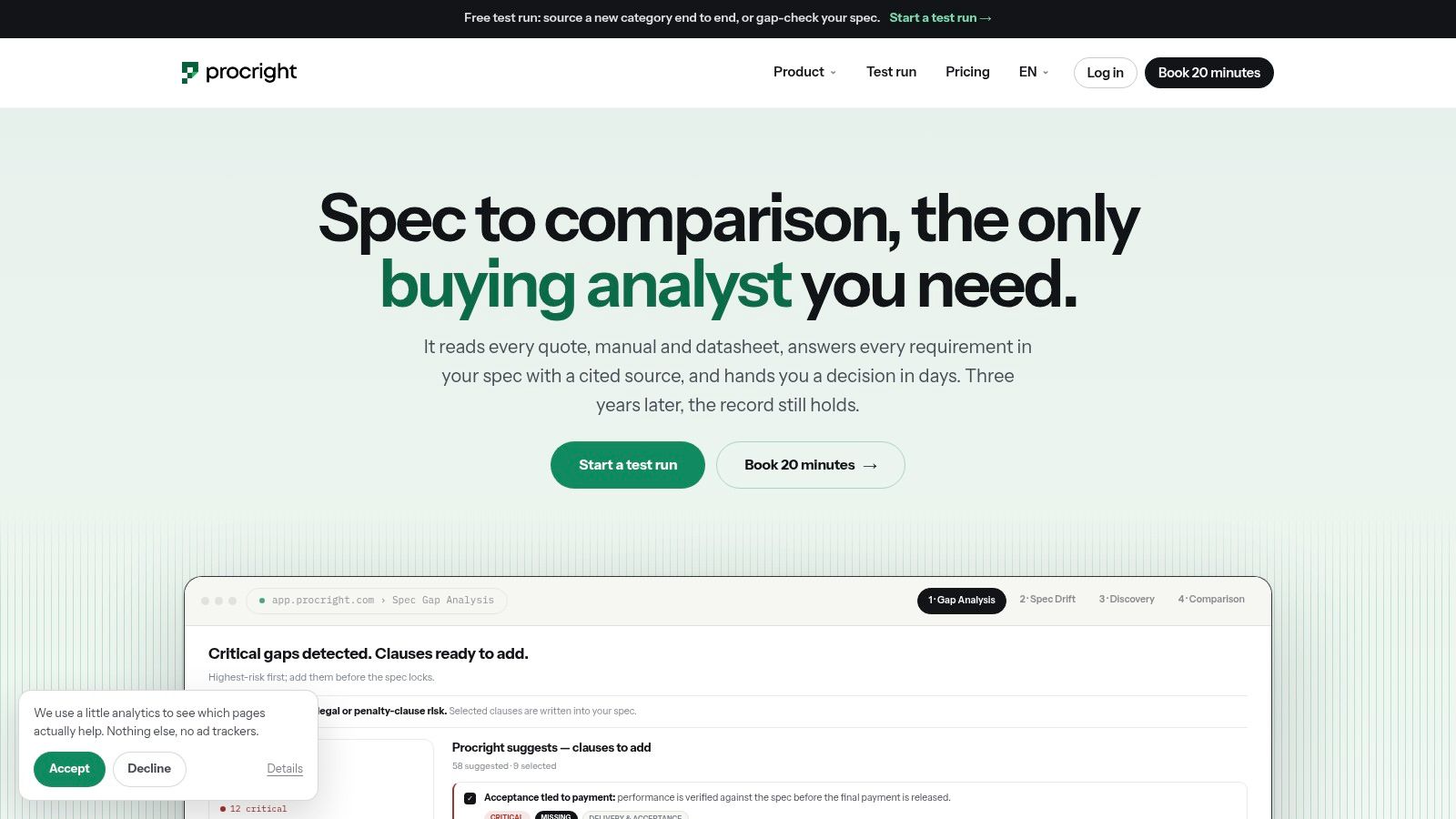
Procright supports construction sourcing from draft specification through final award, with gap analysis, supplier discovery, evidence-backed compliance comparisons, weighted scoring, and specification-drift detection. Visit Procright to test an audit-ready procurement workflow against the material volatility, BIM-linked requirements, and review standards your projects face.
Try it on a real buy
Bring one category. Watch where the flags land.
We use a little analytics to see which pages actually help. Nothing else, no ad trackers.