Purchase Order Collaboration: A Practical Workflow Guide
In this article
Most advice on purchase order collaboration treats it like a messaging problem. That framing is too soft. The hard part isn't getting people to talk faster, it's making sure every PO change is authorized, preserved, and still reconciles cleanly after the supplier responds, the approver weighs in, and the ERP closes the loop.
That's why the best collaboration rollouts don't start with chat features. They start with change control, supplier-side exception handling, and a record that can survive audit without someone reconstructing the story from inboxes. Modern procurement suites already treat PO collaboration as a controlled workflow with acknowledgments, edits, revisions, and change visibility, not just communication, and that's the right mental model for it SAP Supply Network Collaboration documentation.
Table of Contents
Why Purchase Order Collaboration Is Really a Controls Problem
The common story says PO collaboration makes procurement faster and more visible. That's true, but incomplete. Speed only matters if the change that moved faster still matches the contract, the vendor master, and the invoice trail.
The real failure isn't silence, it's drift
When a requester “just adds one line,” or a supplier “just confirms by email,” the PO often stops matching reality. The more people who touch the transaction, the easier it is for quantity, price, freight, lead time, or substitution terms to drift away from the approved record. Then AP gets a mismatch, the buyer spends time explaining the variance, and nobody is fully sure which version is authoritative.
Practical rule: if a PO change can't be traced back to a specific actor, timestamp, and approval state, it isn't collaboration. It's uncontrolled edit behavior.
That's why the right metric isn't whether emails disappeared. The better measure is whether PO changes reconcile cleanly against the source record and the three-way match, which is the discipline that keeps purchasing, receipt, and invoice aligned. If you want the mechanics behind that control point, the three-way match guide is the right companion reading.
Two control questions matter most
First, who was allowed to change what. Second, what evidence exists after the supplier answered. Those two questions define whether collaboration is operationally useful or just a nicer way to lose control.
A good rollout separates controlled change management from defensible supplier exception handling. The first protects the buyer from unauthorized edits. The second protects both sides when delivery windows, quantities, or commercial terms need to shift after the PO is sent. If your workflow can't answer those two questions quickly, it's going to fail in the exact way procurement teams hate most, with late spec drift, unauthorized substitutions, and orphan revisions sitting in inboxes.
Mapping Roles and Access for PO Collaboration
A collaborative PO only works when the permissions are narrow enough to be useful. In practice, four people touch most transactions, the requester, the category buyer or PO owner, the approver, and the supplier contact. If all four can change the same fields, the process turns into shared confusion.
Keep the role boundaries strict
The requester should be able to suggest edits to the need, not rewrite the commercial terms. The buyer should be able to consolidate lines and re-spec within policy, but not override an approved threshold. Approvers should act on routed states, not free-text comments that no one can audit later. Supplier contacts should acknowledge and propose changes, but not rewrite the order.
A clean permission matrix usually works better than generic view or edit settings. Tie access to dollar thresholds, item category, and change type so the system knows the difference between a harmless note and a commercial revision.
PO Collaboration Role Boundaries | |||
|---|---|---|---|
Role | Can Edit | Cannot Edit | Approval Authority |
Requester | Requirements, specs, comments | Quantity commitments, pricing, terms | None |
Category Buyer or PO Owner | Line consolidation, allowed re-specs | Approved spend thresholds, final supplier acceptance | Route and submit within policy |
Approver | Routed state decisions, rejection notes | Line-level commercial edits | Approve or reject within delegated authority |
Supplier Contact | Acknowledgments, substitutions, exception requests | Silent term changes, buyer policy edits | Confirm or propose changes only |
A laptop refresh shows where this breaks
On an IT refresh for a 200-seat engineering team, the requester usually wants more memory or a different model. That's fine as a suggestion, but not as a unilateral change to the committed quantity or price. The supplier contact might try to add freight after the quote was accepted, which is exactly the kind of drift that causes invoice disputes later.
Useful test: if a user can create a change that they can't personally defend in front of finance, the permission is too broad.
For role design and workspace governance, the cleanest reference point is the workspace membership and roles guidance. In real deployments, that kind of structure matters more than the interface itself.
Designing the Collaborative PO Workflow End to End
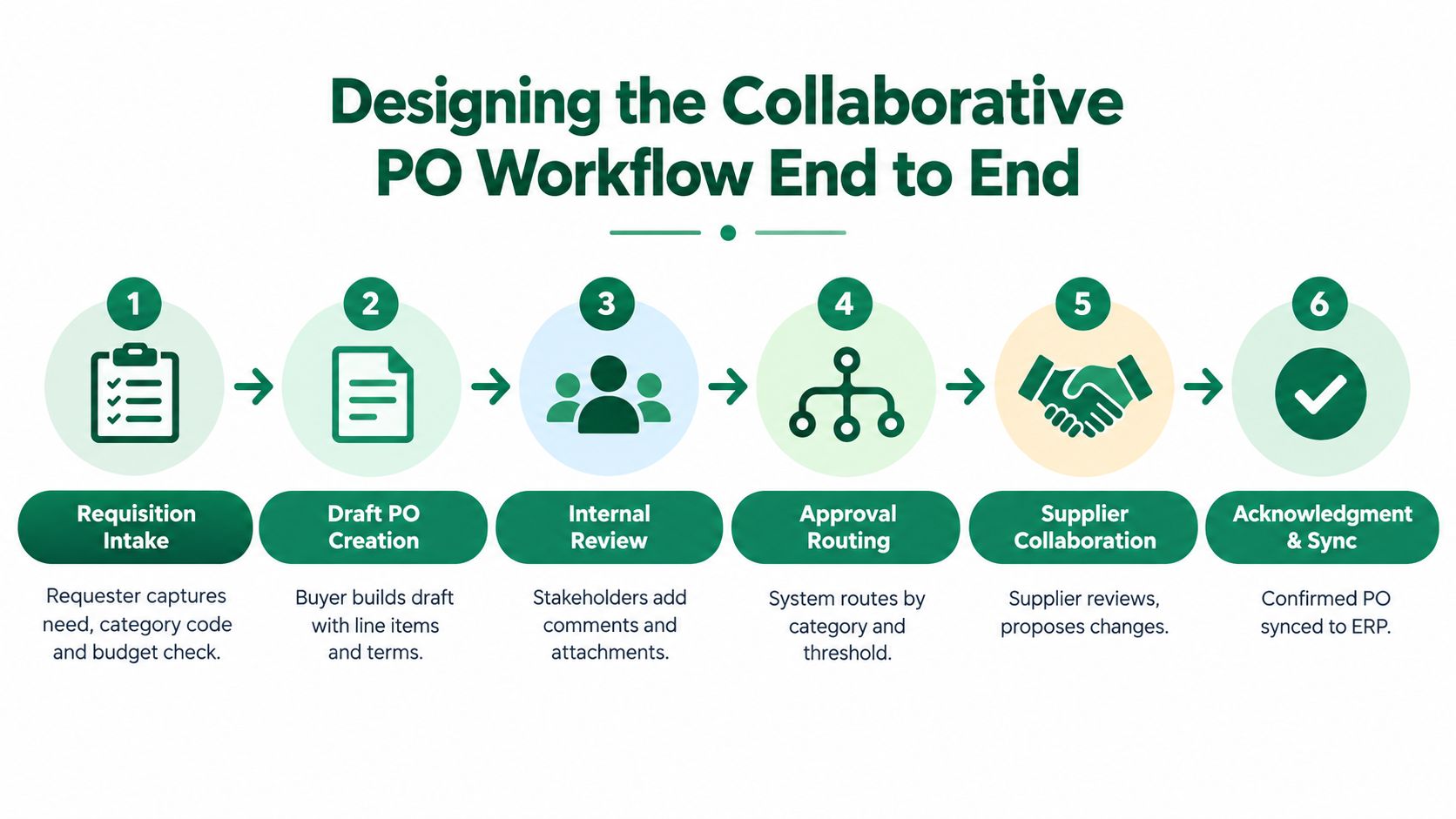
A workflow fails when handoffs are loose. The clean version starts with requisition intake, where the requester captures need, category code, and the attached specs. That draft then moves to the buyer, who consolidates similar lines from multiple requesters and builds a PO against the contracted supplier.
Each handoff needs a record, not a memory
The internal review stage should capture comments and attachments in the system, not in side emails. Then approval routing sends the PO to the right people by category and threshold, with the transition recorded by timestamp and user. Once approved, supplier collaboration opens the order in a structured portal where the supplier confirms price, lead time, or substitutions instead of replying in free text.
The acknowledgment step is one that many teams underestimate. If the supplier confirms by email, the confirmation often disappears into an inbox and the ERP never gets the update. That's how three-way matching gets messy, because the buyer thinks the order was accepted one way, while finance sees it another way.
What the system has to capture
Every transition should preserve the who, when, what changed, and what document was attached. Version IDs matter because they let you tell a draft from the final record. Human-triggered transitions matter because they separate automated routing from an actual decision.
A clean closeout sends the confirmed PO back to ERP, locks the record, and makes receipt and invoice processing depend on that frozen version. That's not admin overhead. It's what keeps procurement from re-litigating the same order three times in three different systems.
The broader market is moving this way too. Oracle's procurement documentation describes a traceable purchase order history with original actions and change orders, and independent 2025 analysis projected the broader procurement applications market at a 9.2% CAGR through 2028 Oracle procurement documentation. The trend is clear, traceable workflows are becoming the baseline, not the upgrade.
Routing Approvals Without Bottlenecks
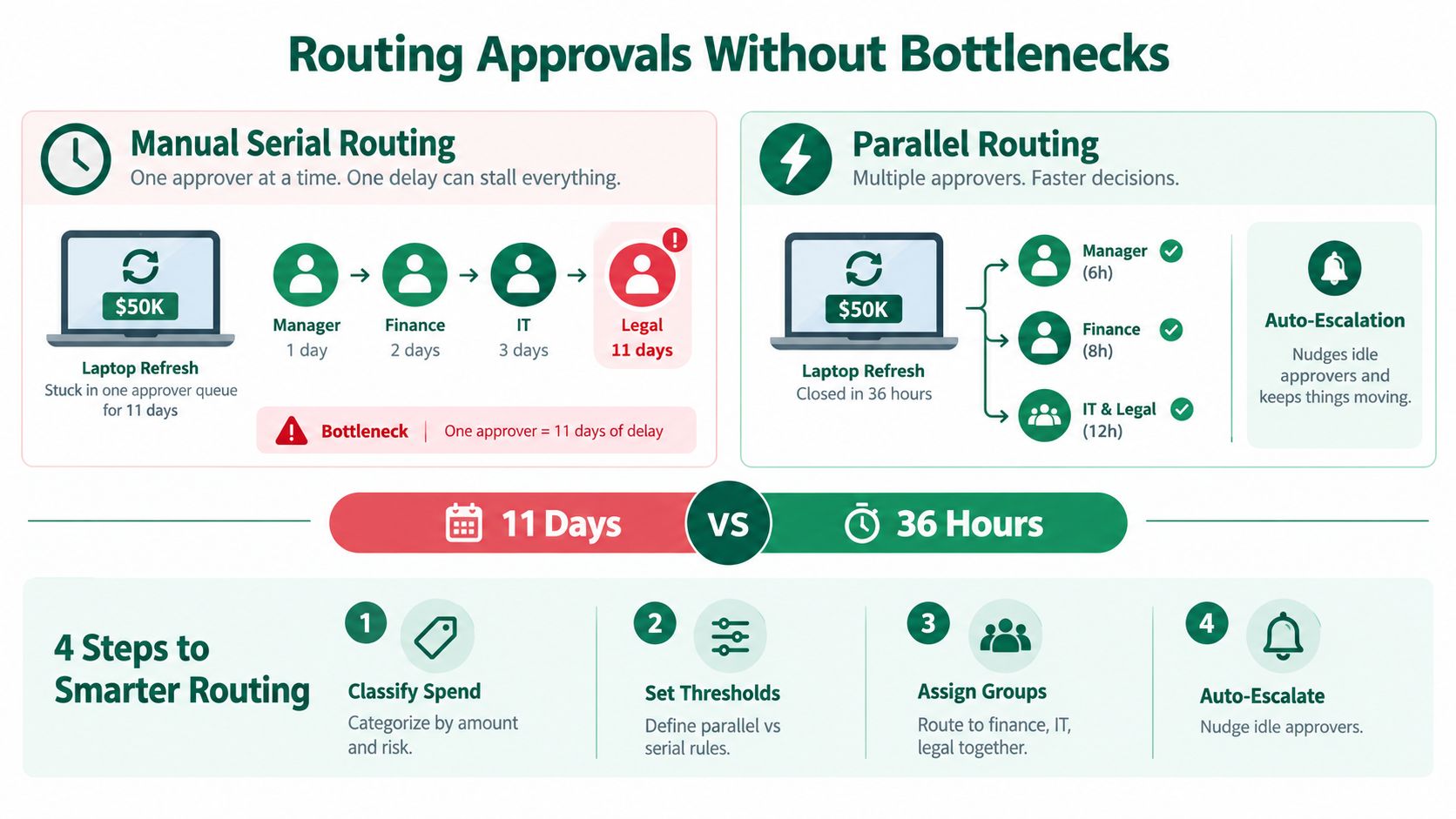
Manual routing is where procurement teams lose weeks without noticing the pattern. In guidance on automated approvals, manual routing is described as often taking 3 to 7 days, while automation can bring that down to 4 to 24 hours, and automated parallel approvals are associated with 30 to 50% faster procurement cycle times on average automated purchase order approvals guidance. Those are the kinds of gaps that make serial approval chains hard to justify.
Route by risk, not by habit
A $50K laptop refresh doesn't need the same path as a standard facilities reorder. Classify by dollar threshold, category risk, and contract type, then route accordingly. If the PO introduces a new vendor, legal or security may need to see it. If payment terms diverge from standard, finance should review the change before it leaves the queue.
The trick is to preserve independence without forcing every approver to wait for the slowest one. Parallel routing works when the approvals are conditional, not just stacked on top of one another because that's how the old process was built.
Escalation has to be explicit
If a primary approver is traveling, delegated authority should kick in cleanly. If no one acts, SLA timers at 24 and 72 hours are far better than passive reminders that get ignored. If an approver rejects the PO, the system should send it back with a reason and a new version state, not leave the requester guessing which line triggered the block.
For a practical overview of routing patterns, Vision's approval workflow guide is a useful external reference. The internal angle matters too, so the AI-based approval bottleneck guide is worth reviewing if you're trying to keep auditability while cutting queue time.
What works in practice: use routing logic that can be read by finance and audit without a system admin translating it first.
Handling Supplier Exceptions as a Two-Way Process
A facilities team ordering 200 HVAC units doesn't care that the PO looked perfect when it left the buyer's desk. What matters is that 40 of those units might ship two weeks late, and the supplier may want to offer a partial delivery with no penalty and a revised schedule. That's the point where collaboration either becomes controlled or gets messy.
Capture the exception as a structured event
The supplier should submit the exception request in a form tied to the PO, not as a loose email thread. That gives the buyer a timestamped, attributed record of the deviation, which matters when the commercial terms shift. It also stops the familiar back-and-forth where operations, finance, and the category manager all have different versions of what was agreed.
In the HVAC case, operations can accept the split shipment, finance can confirm that no PO reissue is needed, and the category manager can sign off on the revised timing. Each of those decisions should live in the same workflow as the exception itself. If the decision lives in email and the exception lives in the portal, the record is already split.
Send the counter-acknowledgment back through the portal
The supplier then needs to accept the counterproposal in the same structured channel. That closes the loop without forcing procurement to reconstruct the deal from forwarded messages and calendar notes. A two-way resolution should preserve four things, the original PO, the exception request, the internal decision, and the supplier's acceptance.
Practical rule: once the supplier changes a delivery date or term, treat it as a controlled amendment, not a side conversation.
A lot of teams fail here. They negotiate in email because it feels faster, then spend days rebuilding the record later. That's not collaboration, it's deferred cleanup.
Public procurement content is finally catching up to this issue. Recent materials still talk about shared PO status and transparent workflows, but they also admit that poor communication and disjointed systems remain bottlenecks, while organizations are prioritizing supplier collaboration and risk monitoring Alibaba product insights on purchase order process. The gap is governance, not just visibility.
Building an Audit-Ready Change Trail
An audit-ready PO trail doesn't mean storing more documents. It means connecting the ERP-of-record, the collaboration platform, supplier portal activity, and any email that still matters into one searchable timeline. If those sources disagree, procurement needs a process that flags the mismatch before month-end, not after a reviewer asks for proof.
Use the same fields everywhere
Each system should capture actor, timestamp, action, prior value, new value, and attachment hash. That lets you see exactly what changed, who changed it, and whether the document version matches the action taken. It also makes it much harder for a supplier confirmation to sit in one system while the ERP still shows the old date.
A daily reconciliation job is the practical fix. It can flag cases where the supplier portal shows a confirmed delivery date the ERP never received, or where an attachment in email doesn't match the locked PO record. Once those exceptions surface early, procurement can correct them before they contaminate receipt and invoice processing.
Run a simple quarterly discipline
Hash-stamped attachments: Use immutable file references so revised specs and acceptance forms can't be swapped.
Segregation of duties: Keep the requester out of final approval authority on the same PO.
Retention aligned to close: Keep records long enough to support the financial close cycle your team runs.
Quarterly sampling: Pull a small set of PO changes and trace them end to end without analyst support.
The best audit trail is boring. It's consistent, queryable, and hard to argue with.
Troubleshooting Common PO Collaboration Failures
Most rollout problems show up in three places. Queue buildup, inconsistent routing, and late spec drift detection. If you're trying to stabilize the next 90 days, those are the first workflow failures to inspect.
Start with the queue
If approvers are falling behind, ask whether the same people are carrying too many categories or too much spending authority. The fix is usually workload balancing and delegated rules, not another reminder email. Manual serial review tends to hide its own delay until the month closes and everyone starts asking why the PO sat untouched.
Check for routing drift
If a category crosses a spending threshold mid-cycle, the workflow can send the PO to the wrong people unless the routing table is locked at submission. That's a governance problem, not a software quirk. Lock the rules, then allow only controlled rerouting when a material change is posted.
Watch for supplier silence
If the supplier hasn't responded, don't let the PO age in an inbox. Use automated reminders and portal nudges, then require a structured change-request form before any amendment posts back to the supplier. That keeps the exception visible and stops teams from editing the order informally after the fact.
One practical way to reduce rollout friction is to test the workflow against live documents before you widen access. Procright is one platform that supports collaborative sourcing work with structured, evidence-backed records, so it can sit upstream of the PO process when teams need a clearer specification and approval trail. The point isn't the brand, it's the discipline of making the record defensible before the order ever leaves the buyer's hand.
If your PO process still depends on inbox archaeology, Procright can help teams build a more defensible sourcing trail before the order is issued, with collaborative drafting, evidence-linked decisions, and audit-ready records. Visit Procright if you want to tighten the handoff from specification to approval and reduce the cleanup that usually follows a messy PO change.
Try it on a real buy
Bring one category. Watch where the flags land.
We use a little analytics to see which pages actually help. Nothing else, no ad trackers.