SaaS Contract Negotiation Playbook for Enterprise Teams
A SaaS contract that looks inexpensive at signature can become expensive through renewal mechanics, packaging changes, usage fees, and weak evidence.
In this article
A SaaS contract that looks inexpensive at signature can become expensive through renewal mechanics, packaging changes, usage fees, and weak evidence. 89% of SaaS contracts include auto-renewal clauses, and independent procurement benchmarks report that companies overpay by an average of 26% when software buying is unmanaged, according to Vertice's procurement benchmark. The commercial risk rarely sits in the headline subscription price alone.
Enterprise SaaS contract negotiation now requires control over the full structure of the deal. Buyers need a locked specification, verified supplier claims, clear rules for AI consumption, protection against price and packaging changes, and an audit trail that shows why the final decision was defensible.
The New Reality of Enterprise SaaS Procurement
Software procurement has become a continuous operating discipline rather than an occasional legal exercise. The average software stack has reached 132 applications and is growing at an annual rate of 11%, while each SaaS negotiation can take an average of 21 days, according to the same Vertice procurement benchmark. A large organization may therefore manage a steady stream of renewals, expansions, replacements, security reviews, and commercial escalations.
The pressure increases because renewal events don't wait for procurement capacity. An auto-renewal clause can convert an overlooked date into another commitment, even when the business has reduced usage, changed strategy, or found a better-fit alternative. That makes renewal ownership, notice tracking, and contract review part of normal operating control.

Longer commitments change the leverage equation
A 2026 software procurement report found that agreements with terms of 12 months or less fell from 59.2% to 55.3% of new agreements year over year. Much of the movement shifted into 13 to 24-month terms, while the average primarily SaaS procurement cycle moved from 14.6 months to 15.7 months, as reported in Tropic's State of Software Procurement 2026.
Longer commitments can create room for concessions, but they also increase the importance of renewal timing, price escalators, exit rights, and change control. A buyer that trades commitment length for a discount without controlling those clauses may only defer the commercial problem.
The negotiation should therefore begin with four questions:
What is being purchased? Define functionality, service levels, data handling, integrations, and support responsibilities.
What can the vendor charge later? Identify renewal increases, consumption fees, AI surcharges, overages, and packaging changes.
How can the buyer exit? Set notice windows, termination rights, data return obligations, and transition assistance.
What happens when the vendor fails? Align liability, indemnity, security commitments, and remedies with the actual risk.
Teams operating across jurisdictions should also involve counsel who understands the relevant local framework. For buyers dealing with Israeli entities, data, or governing law, navigating Israeli SaaS contract law can provide useful legal context alongside the commercial review.
A central procurement workflow can connect renewal dates, specification records, supplier evidence, and approval history. Guidance on managing software buying without shadow IT is especially relevant when business units can adopt tools faster than procurement can register them.
Practical rule: Treat every renewal as a sourcing event unless the business has deliberately documented why the existing arrangement remains commercially and operationally sound.
Locking the Specification and Baseline Requirements
Price discussions should start only after the buyer has fixed what the service must do. If the specification remains open, vendors can redefine the problem around their strongest product package, add features the business doesn't need, or position a missing capability as a paid module.
The specification is an internal contract between the business, IT, security, finance, legal, and procurement. Each group must agree on the required outcome before suppliers are invited. Otherwise, the vendor becomes the party deciding which requirements matter.
Build a requirement set that can survive scrutiny
Start with the business outcome, then translate it into testable requirements. Avoid vague language such as “strong reporting” or “enterprise-grade security.” State what the system must produce, which users need it, what evidence the supplier must provide, and how the buyer will verify compliance.
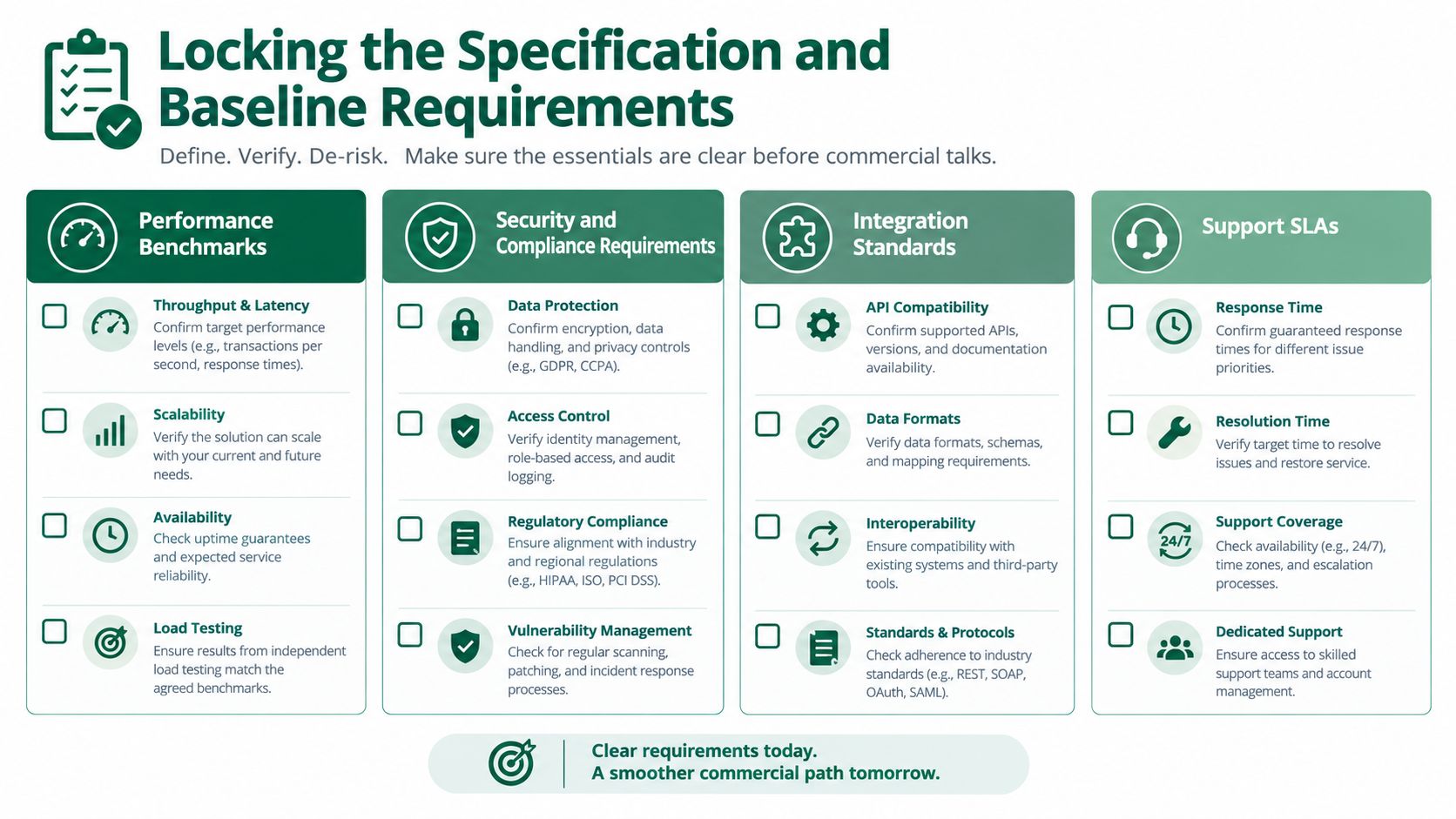
A practical baseline should address:
Performance: Define response expectations, availability commitments, maintenance notice, recovery responsibilities, and service credits or other remedies for failure.
Security and compliance: Specify data locations, access controls, encryption expectations, breach notification, audit cooperation, retention, deletion, and use of customer data for model training.
Integration: List required APIs, identity standards, data export formats, supported systems, integration ownership, and restrictions on custom work.
Support: Set support channels, severity definitions, response expectations, escalation routes, and named responsibilities on both sides.
Acceptance: Describe what must be demonstrated before production use, who signs acceptance, and what happens when the supplier misses a criterion.
A requirement should have a clear status: mandatory, preferred, or informational. Mandatory requirements need a defined failure consequence. If a vendor can't meet an essential security control, a favorable price shouldn't move that supplier into the shortlist.
Run gap analysis before the market scan
Review each requirement for ambiguity, hidden assumptions, and accidental supplier bias. A requirement that names one vendor's proprietary feature may create a single-bidder outcome without adding meaningful business value. Replace product language with outcome language where possible, then record any requirement that necessarily depends on a particular technical approach.
Ask the technical owner to identify what would make the service unusable. Ask security to identify what would make it unacceptable. Ask finance to identify what would make the cost unpredictable. Ask operations to identify what would make the service difficult to adopt or support.
The final baseline should include source documents, version control, approval owners, and a change process. If a stakeholder adds a requirement after supplier responses arrive, record the reason and assess whether every supplier must receive the same clarification.
A specification document template for moving from a blank page to a verified requirement set can help teams structure this work before commercial pressure enters the process.
The specification must also be tested against the contract. A requirement that appears in a procurement worksheet but not in the order form, service description, SLA, or incorporated policy may not be enforceable. Link each critical requirement to the document and clause that will control it after signature.
The demonstration should be treated as evidence, not entertainment. Require suppliers to show the workflow using the buyer's acceptance criteria, then preserve the response, assumptions, and limitations in the sourcing record.
Evaluating Supplier Claims and Compliance Evidence
A sales presentation is not proof of compliance. It may show the product at its best, omit dependencies, and describe a roadmap as though it were available functionality. Procurement teams should score the evidence behind each answer, not the confidence of the person giving it.
Use a requirement matrix with three primary outcomes: yes, no, or partial. Add a fourth field for evidence status, because a supplier can claim “yes” without providing a manual, policy, test result, or contract commitment that supports the answer.

Make every answer traceable
For each requirement, capture the supplier's answer, the exact evidence, the reviewer, the date, and any qualification. A response such as “supported through configuration” needs follow-up questions. Who performs the configuration? Is it included? Does it require professional services? Does the configuration affect upgradeability or support?
Evidence can come from product manuals, security documentation, service descriptions, data processing terms, independent technical material, demonstrations, or written clarifications. Preserve the page, section, timestamp, or document reference so a reviewer can find the supporting material without repeating the investigation.
A useful evidence hierarchy separates:
Contractual commitment: The supplier has agreed to provide the capability or control in an enforceable document.
Documented functionality: The supplier describes the capability in official technical material, but the contract doesn't yet incorporate it.
Demonstrated behavior: The supplier showed the capability during evaluation, with the test conditions recorded.
Unsupported assertion: The supplier made a statement without evidence that can be independently reviewed.
The first category carries the most weight for material requirements. The last category should never be treated as equivalent to a contractual promise.
Record why suppliers leave the shortlist
Elimination reasons should be specific enough that another reviewer can understand them later. “Not suitable” is weak. “Unable to meet the required data deletion control, and the supplier's proposed alternative wasn't accepted by security” is defensible.
Keep commercial and technical decisions connected without allowing price to conceal a compliance gap. A lower offer can't compensate for a mandatory requirement failure unless the business formally changes the requirement and obtains the required approvals.
Use weighted scoring for preferences, not as a way to average away critical failures. A supplier can score well on usability and still be disqualified for an unacceptable data-use term. The matrix should make that distinction visible.
A structured vendor due diligence checklist covering what to verify before a contract exists gives reviewers a common basis for challenging unsupported claims.
Evidence beats enthusiasm. If a supplier can't show where a promise is documented, the buyer should treat it as an open negotiation point, not as a delivered capability.
Negotiating Commercial Terms and Hidden AI Costs
The strongest SaaS contract negotiation changes the structure of the deal, not just the subscription price. Buyers should compare the benefit of a lower rate against the consequences of a longer commitment, automatic renewal, uncapped increases, variable consumption, and forced packaging changes.
Multi-year commitments can produce 10% to 25% additional discount depending on length, according to a benchmark in Vertice's SaaS contract negotiation analysis. That trade can be attractive when the service is stable and business demand is predictable. It becomes weaker when the vendor can change the metric, reclassify features, impose AI charges, or increase the price at renewal.
Another dataset cited in the same analysis found that 12-month contracts averaged 16% savings, compared with 14% for 24-month contracts and 13% for 36-month contracts. The lesson isn't that short terms always win. It is that term length alone doesn't determine value. Escalation caps, price locks, renewal notice, termination rights, and usage protections can matter more than the nominal discount.
Price is only one line in the deal
Use the commercial discussion to negotiate a complete economic model. Ask the vendor to define every billable unit, the source of usage data, the measurement period, the treatment of unused credits, and the process for disputing an invoice.
AI features require particular care. Independent research reports that 79% of IT leaders saw a renewal price increase in the past 12 months, 78% encountered unexpected consumption or AI-related charges, and 77% discovered costs only after signing, according to Zylo's research on SaaS pricing. These findings reinforce a practical point: a seat discount doesn't protect a buyer from an undefined token, credit, workflow, or model-processing charge.
Define the AI scope in the agreement. Specify which features are included, whether customer data is used for training, whether usage is retained, which model or service category applies, and whether the vendor can move an included capability into a paid tier. Require advance notice and buyer approval before new usage charges apply.
Contract Element | Standard Vendor Term | Optimized Buyer Term | Risk Mitigated |
|---|---|---|---|
Renewal | Automatic renewal under the existing framework | Non-renewal or a clearly defined notice window, with a renewal reminder owned by the vendor and buyer | Accidental commitment |
Annual increases | Vendor may raise fees under broad renewal language | Explicit cap applying to substantially similar services and successor packages | Budget shock and repackaging |
AI functionality | Features may be added or reclassified under online terms | Named AI features, included usage, data-use rules, and written approval for new charges | Hidden consumption costs |
Overage usage | Vendor invoices usage after the fact under an unclear metric | Defined measurement, audit access, agreed rate table, and controlled reconciliation | Unpredictable invoices |
Unused volume | Seats or credits expire automatically | Rollover, credit, or right-sizing treatment tied to the renewal structure | Paid-for capacity loss |
Term commitment | Discount exchanged for a long lock-in | Discount paired with exit rights, price protection, and service remedies | Weak leverage after signature |
Liability | One general cap for every event | Layered treatment for ordinary claims, security events, confidentiality, and intentional misconduct | Misaligned risk allocation |
The negotiation should also address annual increases and renewal mechanics directly. A 2026 benchmark reports that automatic fee increase clauses fell from 23% of cloud service agreements in 2024 to 13% in 2026, while cyber-insurance requirements rose from 9% to 12% over the same period, as described in Common Paper's SaaS contract benchmark report. The movement shows why buyers need to examine the actual clause instead of relying on assumptions about market practice.
Start early enough to create alternatives. One independent benchmark reports average savings of 49% when negotiations begin more than 90 days ahead, compared with 19% when they begin 30 to 90 days out, while another benchmark says a six-month lead time can improve savings by up to 39%, as summarized in Tropic's SaaS procurement predictions. Timing gives procurement room to benchmark, run legal and commercial review in parallel, and escalate before the vendor's bargaining power peaks.
Securing the Audit Trail and Preventing Spec Drift
A signed agreement doesn't guarantee that the buyer receives what the sourcing team evaluated. The final quote may contain a different support tier, the order form may omit an integration, or an online policy may introduce a data-use right that wasn't visible in the proposal.
Spec drift occurs when the negotiated service changes between the locked requirement, supplier response, final quote, contract, and implementation. The buyer needs a controlled comparison across all of those documents before signature, not a general confidence that the documents “look consistent.”

Capture the baseline before redlines begin
Create a baseline package containing the approved specification, supplier response, pricing schedule, service description, security materials, SLA, data processing terms, and incorporated online policies. Give each file a version, owner, approval status, and date.
Then map the material commitments. For a requirement such as data export, record the promised format, timing, included assistance, and controlling clause. For an AI feature, record the included functionality, consumption metric, data retention position, and change notice requirement. For support, record severity definitions, response obligations, escalation, and remedies.
A comparison should flag more than missing words. It should identify changed meaning, reduced scope, new dependencies, altered pricing units, weaker remedies, and references to documents that weren't part of the evaluation.
Use a variance register
Every difference should enter a variance register with five fields:
Original baseline: What the buyer approved.
New wording: What the supplier now proposes.
Commercial effect: Whether the change adds cost, limits usage, or shifts an obligation.
Risk owner: The person responsible for accepting or rejecting the variance.
Disposition: Accepted, rejected, revised, or escalated.
This record prevents a late-stage compromise from disappearing into email. It also stops implementation teams from assuming that a supplier's demonstration or sales promise has contractual force when the final agreement says something narrower.
Audit-ready doesn't mean storing more files. It means preserving the decision path from requirement to evidence, approval, contract, and post-signature verification.
Post-signature checks should compare invoices, release notes, service reports, and renewal proposals against the baseline. If the vendor changes a feature, metric, or package, the contract owner can identify whether the change is permitted, requires consent, or triggers a right to terminate or renegotiate.
Centralized document ingestion makes this practical. Stakeholders can review the same source, cite the same clause, and see which variance remains unresolved. That protects the buyer when an employee changes roles, a vendor account team changes, or a renewal arrives long after the original negotiation.
Building a Repeatable SaaS Negotiation Playbook
A repeatable playbook doesn't turn every SaaS purchase into bureaucracy. It gives teams a common sequence so important decisions don't depend on who happens to own the renewal or which vendor is most persistent.
The operating model should begin with an intake that identifies the business outcome, data involved, users, integrations, expected usage, renewal date, and incumbent obligations. Procurement then coordinates specification refinement, gap analysis, supplier discovery, evidence review, commercial negotiation, approval, and post-signature monitoring.
Standardize the work that creates leverage
Use a small set of controlled artifacts:
Requirement baseline: Approved mandatory and preferred requirements, acceptance criteria, security controls, and service expectations.
Supplier evidence matrix: Yes, no, or partial answers with citations and reviewer notes.
Commercial model: Subscription, usage, AI consumption, overage, renewal, discount, and growth assumptions in one view.
Clause position sheet: Buyer position, vendor response, fallback, owner, and escalation threshold.
Variance register: Every departure from the baseline, including the decision and commercial consequence.
Renewal calendar: Notice dates, negotiation start, benchmarking, legal review, business confirmation, and executive approval.
AI-assisted procurement analysis can support this workflow by finding relevant evidence across manuals, PDFs, videos, forums, reviews, and supplier websites. It can also compare proposal packages, score requirements, identify gaps, and flag differences between the locked specification and the final commercial documents. Human reviewers still need to approve material interpretations, risk acceptance, and contract language.
The platform should produce a decision record that a finance leader, auditor, security reviewer, or successor procurement manager can understand without reconstructing months of correspondence. It should show not just who won, but why alternatives were eliminated, which requirements were verified, which concessions were exchanged, and what remained unresolved.
SaaS contract negotiation becomes more defensible when procurement measures the full outcome rather than the opening discount. The right review asks whether the buyer controlled renewal timing, limited price and usage exposure, secured the required service, documented supplier evidence, and preserved a practical exit.
Procright supports sourcing workflows from specification drafting through supplier comparison, evidence-backed scoring, negotiation preparation, and spec drift detection, with decision records designed for audit and internal review. Visit Procright to evaluate how a centralized procurement workflow could strengthen your next SaaS negotiation.
Try it on a real buy
Bring one category. Watch where the flags land.
We use a little analytics to see which pages actually help. Nothing else, no ad trackers.