3 Es of Sustainability Explained for Procurement
The 3 Es give procurement teams a practical way to assess environmental impact, economic viability, and equity together, not as a compliance checkbox.
In this article
You're comparing supplier bids for the same product. One vendor offers the lowest price, another uses less energy, and a third provides stronger evidence of fair labor practices. The spreadsheet looks simple until you ask what happens after the purchase: Will the cheaper option cost more to operate? Can the supplier maintain quality during disruption? Are workers treated fairly throughout the supply chain?
That's where the 3 Es of sustainability become useful. They give procurement teams a practical way to assess environmental impact, economic viability, and equity together, rather than treating sustainability as a final compliance checkbox.
The important shift is to stop viewing the three Es as three independent scores. They behave more like connected levers. Weak social controls can undermine environmental commitments. Short-term price savings can create long-term operational risk. A strong procurement decision makes these connections visible, documents the trade-offs, and uses evidence rather than supplier promises alone.
Table of Contents
Introduction to the 3 Es of Sustainability in Procurement
A procurement manager sourcing cleaning services might receive a low-cost proposal that relies on disposable materials, offers limited worker protections, and provides little information about chemical handling. A more expensive proposal might include concentrated products, safer handling procedures, fairer employment terms, and clearer reporting. If the buyer compares only the quoted price, the second supplier appears less competitive.
That comparison misses the wider decision. The first supplier could create more waste, expose the organization to reputational problems, and make service continuity harder to verify. The second supplier might support better resource efficiency and more reliable contract management, even if its initial price is higher.
This doesn't mean the most expensive sustainable option should always win. Procurement still has to protect affordability, performance, competition, and value. The 3 Es framework helps the buyer ask better questions before selecting a winner.
The procurement problem behind the framework
Many organizations already collect environmental or social information, but they often collect it in separate workstreams. Sustainability teams ask about emissions. Legal teams review labor and human rights risks. Finance teams focus on price and supplier stability. Procurement then has to combine incomplete answers inside a sourcing event.
The three Es create a shared language:
Environment: What resources does the purchase consume, and what harm may it create?
Economy: Can the supplier deliver reliable value across the full lifecycle?
Equity: Does the purchase support fair treatment, access, and social well-being?
The framework is useful for corporate buyers, public-sector procurement teams, category managers, specification writers, and anyone responsible for defending an award decision.
Practical rule: Don't ask whether a supplier is “sustainable” in general. Ask which environmental, economic, and equity requirements apply to this purchase, what evidence supports them, and how the contract will enforce them.
By the end of this guide, you'll be able to translate the three Es into specifications, supplier checks, scoring criteria, and contract controls. You'll also have a clearer way to handle situations where environmental, economic, and equity priorities pull in different directions.
What the 3 Es of Sustainability Really Mean
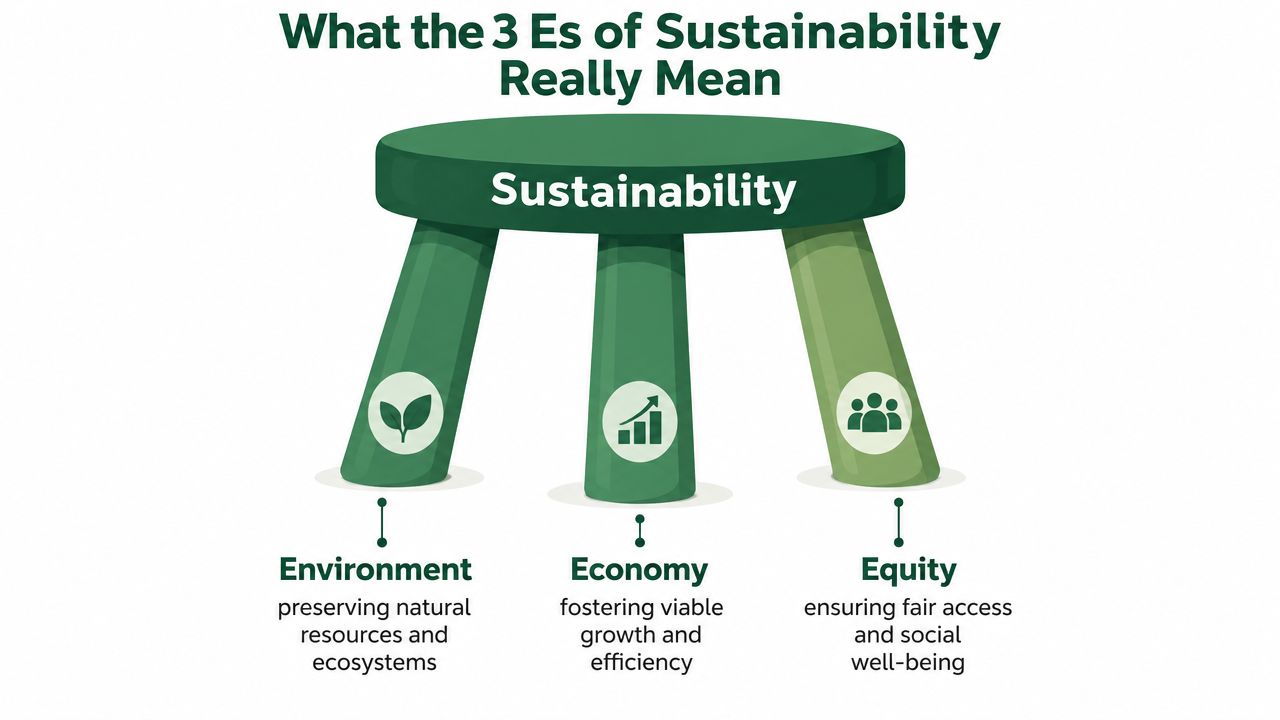
Think of sustainability as a three-legged stool. The seat represents a viable procurement outcome. One leg protects the environment, another supports economic durability, and the third protects equity. If one leg is weak, the decision may look stable in a presentation but fail under pressure.
Environment means managing impact
The environmental E covers the effect a purchase has on natural systems and resources. In procurement language, that can include energy consumption, emissions, waste, water use, packaging, material choices, pollution, and biodiversity impacts.
A buyer might translate this into requirements for energy-efficient equipment, repairable products, recycled content, lower packaging volume, or supplier reporting on resource use. The right criteria depend on the category. Environmental questions for cloud services won't look the same as those for construction materials or transport.
The key is to move beyond broad language such as “the supplier must be green.” A specification should describe the required performance, evidence, measurement method, or reporting process.
Economy means value that lasts
The economic E is broader than the purchase price. It asks whether the supplier, product, or service can remain viable and useful over time.
That includes total cost, operating expenses, maintenance, durability, availability of replacement parts, service quality, supplier resilience, and the health of the market supporting the purchase. A low initial price may not represent good economic sustainability if the product fails quickly or requires expensive support.
For buyers, this means comparing lifecycle value rather than relying only on the first invoice. It also means considering whether contract terms, payment structures, and performance controls encourage dependable delivery.
Equity means fair outcomes
The equity E, sometimes described as the social dimension, focuses on fairness, inclusion, rights, working conditions, and community well-being. Procurement teams may examine labor practices, health and safety, human rights, access for small or diverse suppliers, and the distribution of benefits and risks.
Equity isn't limited to a supplier's internal workforce. It can affect subcontractors, communities near production sites, service users, and people who may be excluded by an inaccessible product or service.
The three Es therefore provide a starting point, not a decorative label. They help buyers connect the purchase specification to real-world consequences and long-term organizational needs.
How the 3 Es Framework Evolved Over Time
The 3 Es framework grew through several milestones rather than one founding event. Each milestone widened the question buyers must ask: can today's sourcing decision protect future capacity while supporting people, the environment, and economic continuity?
In 1987, the United Nations report Our Common Future, commonly called the Brundtland Report, defined sustainable development as meeting present needs without compromising future generations' ability to meet their own needs. The report followed about 900 days of global meetings, according to Penn State's sustainability overview.
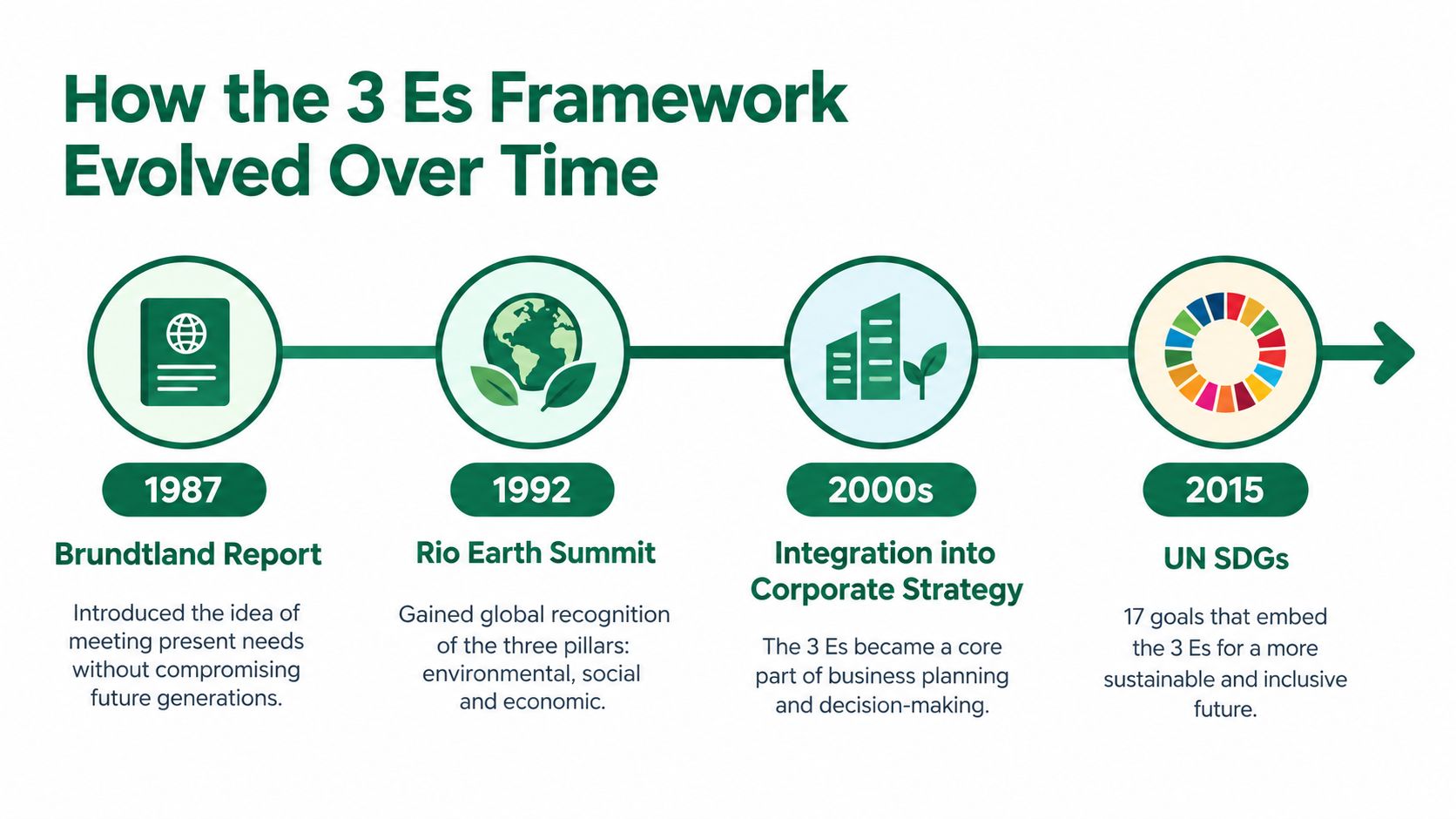
That definition changed the decision frame. Sustainability became a question of whether current choices preserve options for people who come later. For procurement, a supplier decision resembles drawing from a shared reserve. The immediate purchase may meet the specification, yet the sourcing model can still weaken future labor capacity, environmental quality, or market stability.
From sustainable development to business language
In 1994, John Elkington coined “triple bottom line” to describe business performance through people, planet, and profit. The concept connected sustainability with ordinary business planning and performance review, giving companies language for considering social and environmental effects alongside financial results.
That translation helped procurement teams broaden familiar evaluation criteria. Cost and delivery remained relevant, while supplier practices and environmental effects became part of business performance rather than separate charitable concerns.
The 3 Es are closely related, but they sharpen the procurement lens. Environment covers ecological effects, economy concerns durability and value, and equity makes fairness and social outcomes explicit. These are not three independent boxes. They work more like connected control levers: pulling one without checking the others can create hidden sourcing risk. For example, reducing price by accepting poor labor conditions may damage continuity, quality, and environmental controls later.
Why the framework remains useful
The model remains practical because its simple headings can organize requirements, assign ownership, and support an award recommendation across finance, operations, legal, sustainability, and executive teams.
Its simplicity also demands care. Treating the Es as an evenly weighted triangle can make a serious weakness look acceptable because stronger scores elsewhere conceal it. A procurement team should instead ask which lever affects the others and where a minimum standard is required. The historical lesson is clear: sustainability preserves future choices, rather than dividing attention evenly among three labels.
Breaking Down Each E and What It Covers
Each E answers a different procurement question, but the boundaries overlap. A product's energy use affects environmental performance and operating cost. Labor conditions affect equity and may influence continuity, quality, and supplier reliability. The table below gives buyers a quick reference point.
The 3 Es at a glance for buyers
Pillar | Core focus | Procurement example |
|---|---|---|
Environment | Resource use, emissions, waste, pollution, energy, and ecosystem impact | Require energy-performance information, reduced packaging, repairability, or documented waste controls |
Economy | Lifecycle value, financial durability, efficiency, resilience, and market viability | Compare purchase price, operating cost, maintenance, support, warranty, and supplier continuity |
Equity | Fair treatment, labor conditions, human rights, inclusion, access, and community effects | Include labor standards, subcontractor disclosure, audit rights, accessibility requirements, and remedy procedures |
Environment in a specification
Environmental criteria work best when they describe an observable outcome. Instead of asking suppliers to confirm that a product is sustainable, specify the relevant material, efficiency, durability, reporting, or end-of-life requirement.
For example, an equipment specification might ask for energy-use documentation, serviceable components, and a plan for responsible disposal. A logistics specification might address vehicle efficiency, route reporting, packaging, and emissions data. A facilities contract might include chemical-handling controls and waste segregation procedures.
The buyer should also decide how the supplier will prove compliance. Acceptable evidence could include technical documentation, testing records, certifications, or recurring reports, depending on the category and risk.
Economy is not the same as cheap
Economic sustainability asks whether the purchase continues to deliver value after award. Consider maintenance access, training, implementation effort, downtime exposure, replacement cycles, and the supplier's ability to support the contract.
A supplier with a lower bid may still be a weak economic choice if its proposal excludes essential services or depends on assumptions that aren't reflected in the quoted price. Comparing total cost and delivery risk creates a more defensible basis for selection.
Equity requires supply-chain visibility
Equity criteria should extend beyond a supplier's policy documents. Ask who performs the work, whether subcontractors are involved, how concerns are reported, and what happens when a breach occurs.
Buyers can use this vendor due diligence checklist to structure questions before contract award. The purpose isn't to create paperwork for its own sake. It's to identify evidence gaps while the buyer still has the ability to clarify requirements or exclude unacceptable risk.
Why the 3 Es Work Together and Not in Isolation
The three Es aren't independent boxes. Research published in Accounting & Finance found that a one-standard-deviation increase in country-level sustainability performance was associated with a 0.11% increase in GDP growth, with the economic effect driven mainly by environmental protection and governance-related improvements, as reported in the cross-country sustainability study.
That finding matters for procurement because supplier selection can influence several outcomes at once. Energy efficiency may reduce resource exposure and operating costs. Reliable labor practices may support continuity and reduce the chance of disruption. Strong controls may improve both environmental reporting and contract performance.
A separate empirical study found that the economic dimension positively influences social and environmental dimensions, while the social dimension also positively influences the environmental dimension, according to research in the Corporate Social Responsibility and Environmental Management journal. In practical terms, social performance can act as a pathway through which environmental performance improves.
Why social controls affect environmental delivery
Consider a supplier that promises lower waste but has weak worker training, poor subcontractor oversight, and no reliable escalation process. Workers may not receive the instructions or resources needed to separate materials, prevent spills, maintain equipment, or record environmental data.
The environmental promise fails because the social and operational system underneath it is weak. A buyer who checks emissions claims but ignores labor practices may approve a supplier that cannot consistently deliver the environmental outcome described in its proposal.
The hidden risk of silo scoring
A sourcing team might score environment, economy, and equity on separate pages, then select the highest total. That approach can conceal a critical dependency. A supplier could receive a strong environmental score while failing a minimum labor requirement that makes the environmental plan unreliable.
Use integrated controls instead:
Set minimum gates: Treat serious labor, safety, legal, or environmental failures as disqualifying rather than allowing them to disappear inside an average score.
Connect evidence: Ask how workforce training, subcontractor controls, and management systems support environmental commitments.
Test delivery: Score not only what the supplier promises, but how it will measure, report, correct, and sustain performance.
Review interactions: Discuss trade-offs with finance, operations, legal, and sustainability stakeholders before award.
The strongest sustainability score is not always the highest total. It's the score supported by a credible delivery system.
Putting the 3 Es Into Practice in Sourcing and Procurement
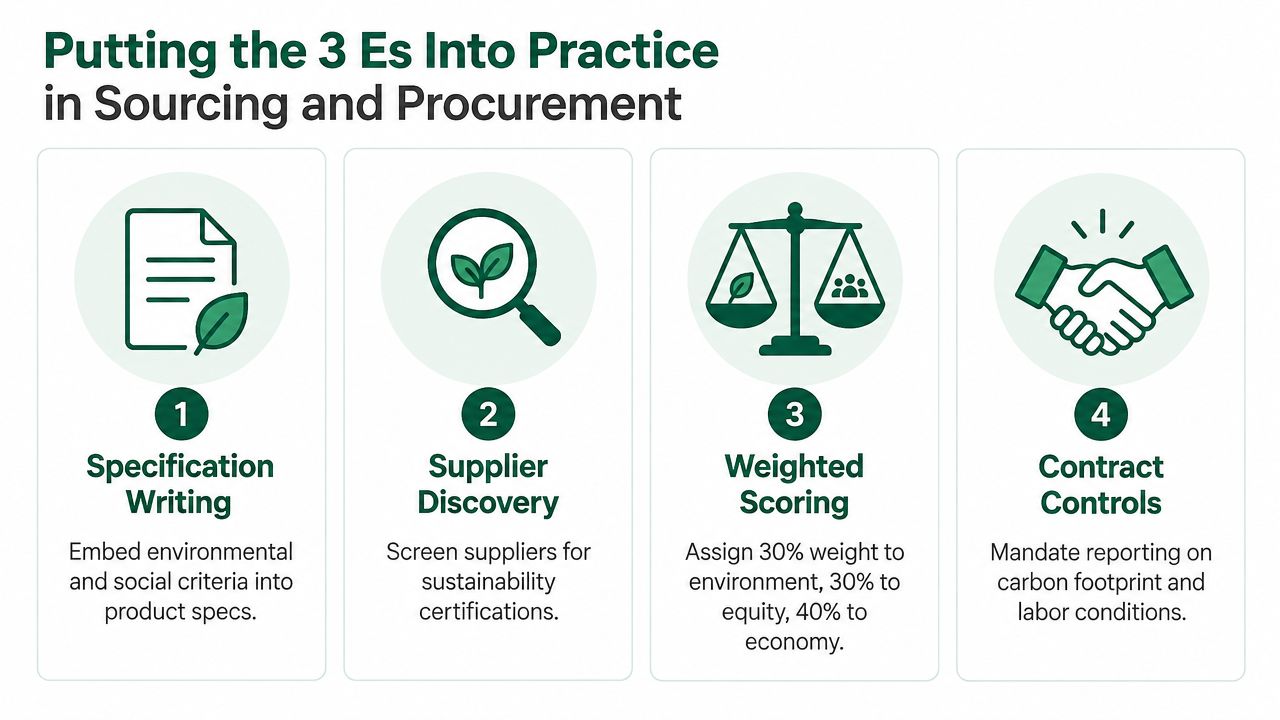
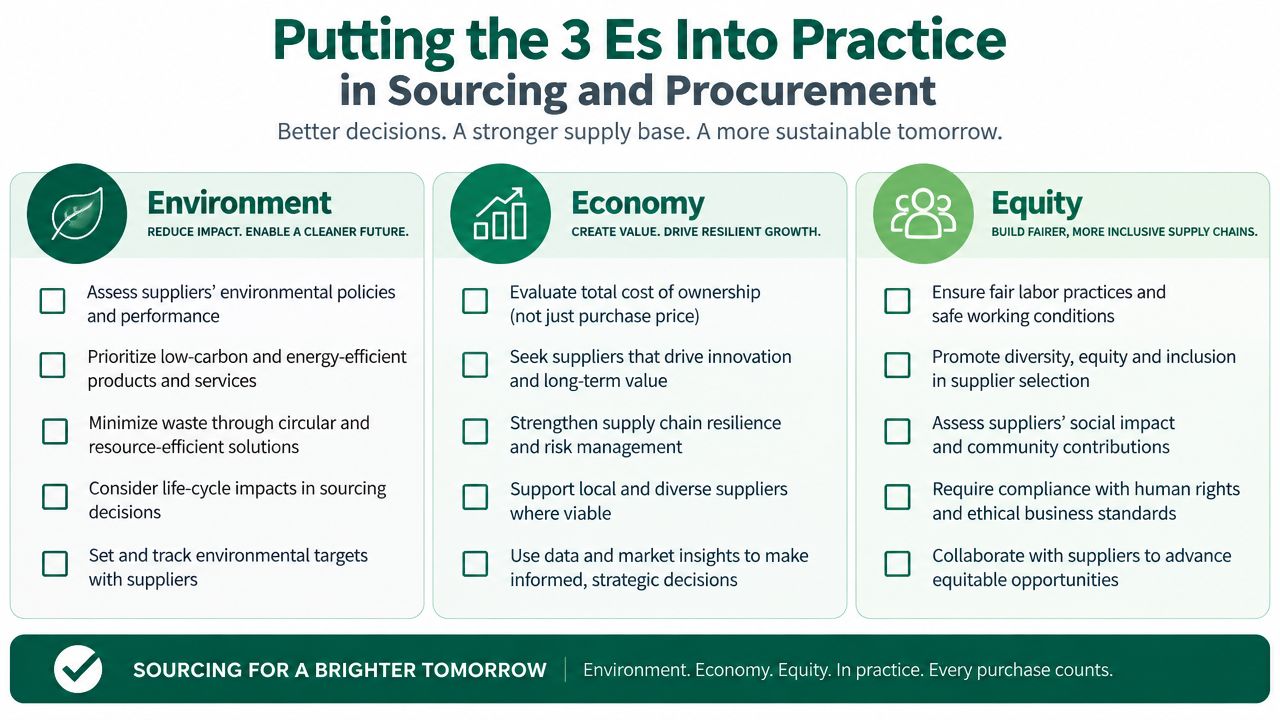
Procurement teams can apply the framework from the first draft of the specification through contract closeout. The work becomes easier when each E has a clear place in the sourcing process.
Start with the specification
Write requirements that suppliers can answer with evidence. For environment, that might mean energy-use documentation, repairability, material disclosure, or waste procedures. For economy, it could include lifecycle cost assumptions, maintenance coverage, service continuity, and transparent pricing. For equity, include labor standards, subcontractor visibility, accessibility, grievance channels, and audit rights where relevant.
Avoid adding criteria that no bidder can interpret consistently. Each requirement should have an evidence type, a response format, and a consequence for non-compliance.
Discover and screen suppliers
Supplier discovery should test whether the market can meet the locked specification. Look for technical documentation, relevant certifications, public policies, customer references, and clear answers about subcontracting and reporting.
The objective isn't to accept every sustainability claim. It's to distinguish a documented capability from a general marketing statement. If a requirement produces only one plausible bidder, revisit the wording before the event closes. The specification may be unnecessarily narrow, or the market may be constrained.
Score connected outcomes
Use a weighted model that reflects the category's risk and the organization's priorities. Don't copy a universal weighting from another purchase. A data-center service, a catering contract, and a fleet purchase create different environmental, economic, and equity exposures.
For a clearer view of value, procurement teams can review how procurement integrates sustainability and value. The scoring model should show why a supplier received its result, which evidence supports each answer, and whether any minimum requirement overrides the total.
Put commitments into the contract
A sustainability promise has limited value if the contract doesn't define delivery. Use measurable reporting duties, audit rights, corrective-action procedures, service-level provisions, and remedies that match the risk.
Public-sector buyers can also study practical guidance on winning UK government contracts, particularly where specifications, evidence, and compliance responses determine whether a bid remains competitive. The same discipline applies in private procurement. A clear requirement is easier to evaluate and easier to enforce.
A practical working checklist looks like this:
Specification: Identify the material environmental, economic, and equity outcomes.
Evidence: Define acceptable documents, data, declarations, and references.
Scoring: Separate weighted value from minimum requirements.
Contract: Add reporting, audit, correction, and remedy provisions.
Monitoring: Review performance against the original requirement, not a rewritten version after award.
The investment case is also becoming harder to ignore. By 2023, global renewable energy capacity had reached 3.8 terawatts, more than triple its 2010 level. Energy-transition investment exceeded 1.7 trillion U.S. dollars in 2023, up 17% year over year, while global green bond issuance surpassed 600 billion U.S. dollars, roughly 13 times the level of a decade earlier, according to Statista's sustainability data overview. These figures show that sustainability has become part of large-scale deployment and capital allocation, not merely an abstract policy discussion.
Making Balanced Decisions When the 3 Es Conflict
Trade-offs are unavoidable. A lower-cost supplier may have stronger local availability. A lower-impact product may require a higher upfront investment. A supplier with excellent labor controls may not yet offer the shortest delivery schedule.
The answer isn't to split the score evenly. Start by identifying harms and risks that are unacceptable under any circumstances. Serious rights violations, unsafe conditions, misleading evidence, or unacceptable environmental impacts shouldn't be hidden by a strong price score.
Next, compare the remaining options using lifecycle value and evidence quality. Document why a requirement received its weight, what alternatives were considered, and what risk the organization accepts. For complex purchases, use total cost of ownership guidance to prevent the initial price from dominating the decision.
Climate urgency also changes how buyers interpret “balance.” 2024 was the hottest year on record, and the World Meteorological Organization reported it at 1.55°C above the 1850–1900 baseline, as summarized by the American Library Association's sustainability resource. Environment can no longer be treated as a purely narrative factor with no operational threshold.
Use this decision rule:
Gate unacceptable risk.
Weight material outcomes for the category.
Compare full lifecycle value.
Test whether social and governance controls support environmental delivery.
Record the evidence, trade-off, approval, and contract remedy.
Procright helps procurement teams draft specifications, discover and compare suppliers, verify compliance evidence, and preserve an audit-ready decision record across sourcing events. Visit Procright to see how evidence-based workflows can turn the 3 Es of sustainability into practical procurement controls.
Try it on a real buy
Bring one category. Watch where the flags land.
We use a little analytics to see which pages actually help. Nothing else, no ad trackers.