AI Compliance Transparency for Regulated Industries
How regulated teams can create tamper-evident AI audit trails: data lineage, model versioning, decision logs, and named human review.
In this article
If your team can’t trace an AI decision, you may not be able to stand behind it. In U.S. healthcare, finance, and procurement, that usually comes down to four things: data records, model records, decision logs, and named human review (often tracked in a compliance matrix).
I’d sum up the article like this:
Transparency means proof, not claims.
Every AI output should be traceable to the data used, the model version, the prompt or policy applied, and the person who reviewed it.
Regulated teams need tamper-evident logs with long retention periods, such as 6 years for HIPAA-related audit logs and 7 years for SOX-related audit work papers.
Shared accounts are a problem. User actions need to tie back to a specific person.
High-stakes use cases like credit decisions, clinical support, AML alerts, and vendor approvals need reason codes, review steps, and logged overrides.
Procurement is often the weak spot because evidence lives in inboxes, PDFs, and spreadsheets instead of one searchable record.
The main test is simple:Can I rebuild this decision from the record later?
A few points stand out. In healthcare, teams may need to show PHI handling, de-identification steps, source attributes, and change records. In finance, teams may need model validation, drift checks, and adverse-action reasons that a person can read. In procurement, teams need a line from requirement → vendor claim → source file → cited passage → reviewer.
Here’s the short version:
Area | What teams need to show |
|---|---|
Data | Where inputs came from, how they were handled, and whether PHI/PII controls were applied |
Model | Which model version ran, when it changed, and whether it was tested |
Decision | Why the system gave that output, with source links or reason codes |
Governance | Who approved it, who overrode it, and what record proves it |
For me, the article’s main point is clear: AI in regulated work is not just about automation. It is about records that hold up under review. If your system logs prompts, inputs, outputs, human actions, and overrides in an immutable store, you’re in a much better spot when audit, legal, or regulators ask questions.
That is the lens I’d use for the rest of the piece.
Audit Trails and AI Transparency - Regulatory Compliance under the EU AI Act
What AI Compliance Transparency Means in Healthcare and Finance

4 Dimensions of AI Compliance Transparency: Data, Model, Decision & Governance
In healthcare and finance, transparency isn't just a nice idea. It means audit-ready proof that an AI system used the right data, followed the right rules, and produced a decision that can be traced from start to finish.
4 Dimensions of Compliance Transparency: Data, Model, Decision, and Governance
The main issue is simple: what proof does each layer need to produce?
Dimension | What It Means | Practical Evidence Required |
|---|---|---|
Data | Where did the inputs come from, and were they handled correctly? | Lineage, source attribution, PHI de-identification logs, input hashes |
Model | Which version ran, and has it been validated? | Version checksums, model cards, drift monitoring logs, validation reports |
Decision | Can a human read and explain the output? | Human-readable reason codes, source citations, trace IDs |
Governance | Who approved it, and who is accountable? | Named human approver identity, risk tiering rationale, override logs |
In healthcare, data transparency means showing that PHI was de-identified before prompts were sent to external APIs. Model transparency means version pinning with immutable checksums, so you can prove the exact model that ran on a given date. Without that, silent upgrades from third-party providers can reopen control failures without anyone noticing.
Decision transparency is just as concrete. Teams need output-level explanations that a person can read and make sense of, not vague probability summaries. Governance transparency ties it together by documenting named model owners, risk tiering, and human-in-the-loop checkpoints.
How Opaque AI Creates Risk in Clinical, Financial, and Procurement Workflows
Opaque AI creates risk in ways that are easy to miss until something goes wrong. In healthcare, a widely used health algorithm showed racial bias because it used cost as a proxy for need. In lending, the CFPB has been direct:
"Creditors cannot use complex or opaque technology as a defense for violating equal credit opportunity requirements." - CFPB Circular 2023-03
Procurement runs into the same problem. If an AI system recommends a vendor or marks a product as compliant using template-based comparisons, but no one can trace that recommendation back to clear inputs and written criteria, it likely won't hold up in an internal audit, let alone a regulatory exam. That's the heart of the problem: the decision can't be rebuilt from the record.
What Transparent AI Looks Like in Day-to-Day Operations
Transparent AI in daily work looks like a system where every decision leaves behind a clean record that compliance, legal, audit, and business teams can review and use.
In practice, that means immutable inference logs stored in protected systems with methods such as cryptographic hash-chaining or WORM (Write Once, Read Many) storage. Retention also has to line up with regulatory rules. HIPAA audit logs require 6 years, and SOX-relevant systems require 7 years of audit work papers. If a company deletes logs after 90 days, it's opening itself up to enforcement risk.
A defensible audit trail should record:
Decision ID
Inputs
Model version
Policy applied
Human review
Tamper-evident log integrity
Those records become the basis for the logging, policy, and review controls that follow.
U.S. Regulatory Expectations for AI Transparency
U.S. regulators want proof, not perfection. In healthcare and finance, the ask is pretty simple: show what data the system used, show which model ran, show who reviewed the output, and show that the decision can be rebuilt later by comparing products for compliance efficiently.
The exact rules change from one industry to another. But the basic standard stays the same. And it lines up with four control areas: data, model, decision, and governance.
Healthcare: HIPAA Logging, PHI Controls, and FDA Documentation Requirements
In healthcare, transparency starts with user-level logging, PHI controls, and documented changes.
HIPAA's Security Rule requires each ePHI access event to be tied to a specific authenticated user. Not a shared account. Not a generic API key.
The ONC's HTI-1 rule adds another layer for AI-driven clinical tools. Developers of Certified Health IT must disclose "source attributes" for Predictive Decision Support Interventions, including training data demographics, inclusion and exclusion criteria, and external validation processes.
For AI/ML medical devices, the FDA's Predetermined Change Control Plan (PCCP) framework allows model updates without a full regulatory resubmission. But there's a catch: the change process has to be documented ahead of time.
Finance: Model Risk, Fair Lending, AML, and Consumer Protection Traceability
In finance, that same standard shows up as model risk management, traceability, and documented human review.
SR 11-7 treats large language models as models. So the same documentation rules used for credit scoring also apply to AI-powered underwriting, fraud detection, and AML systems. That includes:
conceptual soundness documentation
independent validation by a separate team
monitoring for drift over time
Recent SEC and FINRA actions make the point even clearer. Unauthorized model changes and weak identity verification can lead to major penalties.
For fair lending and other adverse action decisions, regulators require specific principal reasons. A probability score on its own doesn't cut it.
Cross-Industry Governance Expectations for Explainability and Oversight
Across sectors, the rule stays the same: every AI-assisted decision must be traceable to its inputs, review steps, and an accountable owner.
In both healthcare and finance, U.S. governance expectations line up around explainability, traceability, monitoring, and human oversight. The COSO 2026 guidance published in February 2026 explicitly requires that effective monitoring of AI-driven processes include prompts, inputs, outputs, and evidence of human review.
High-risk decisions also need human oversight, documented review, and logged overrides. A defensible audit trail must capture prompts, inputs, outputs, review actions, and overrides.
Key Building Blocks of a Transparent AI Compliance System
The controls below turn the audit and oversight requirements above into system design.
Data Lineage, Provenance, and Classification Controls
Before an AI model touches a record, your team needs to know exactly what that record is, where it came from, and which records the model used to produce an output.
That starts with classification. For regulated data like PHI or PII, classification needs to happen before the data reaches the model. In healthcare, NLP-based detection tools can de-identify or pseudonymize PHI during prompt assembly, which helps enforce HIPAA’s “minimum necessary” access standard.
This becomes most important when something goes sideways. If a regulator or internal auditor asks why the system flagged a given transaction or suggested a certain clinical action, data lineage lets you trace the answer back step by step. It shows how a compliance score or recommendation was produced. Without lineage, the decision log is just a record on paper. It can’t be checked.
Explainability, Decision Logging, and Tamper-Evident Audit Trails
Use built-in model explanations when they’re available. If they aren’t, store a reason code with the decision at inference time. For high-stakes calls like credit denials or clinical recommendations, regulators tend to prefer built-in model explanations because the explanation is the logic itself, not a rough stand-in for it. That explanation needs to stay attached to the decision record.
A defensible audit trail should capture:
Timestamp
Requester identity
Model version
Inputs with source attribution
The policy or prompt invoked
Output
Human review or approval
Override and reason
A tamper-evident proof
It’s also not enough to log only the AI system. You need to log the human requester too. A shared service account does not meet this bar.
Tamper-evident audit trails often use SHA256 hash chaining, where each record includes a cryptographic hash of the record before it. If someone changes a past entry, the chain breaks, and the change becomes easy to spot. Pair that with WORM storage, such as AWS S3 Object Lock or Azure Immutable Blob Storage, and even admins can’t alter or delete records after the fact.
Policy Engines, Guardrails, and Human Review Checkpoints
Logging what happened matters. Stopping a noncompliant action before it happens is even better.
Good guardrails work in layers. A redaction layer removes PHI or PII before the model sees the input. Pre-model filtering catches restricted queries and routes them either to a human or to a safe response. Post-model review checks each output against a domain-specific rubric before it reaches the user. When a guardrail fires, it should write a decision record that shows what it detected and why the request was refused or flagged. That record then becomes part of the audit trail.
Human review adds one more control point for high-stakes decisions. Many systems use confidence thresholds, sending any low-confidence output to a human expert. If that reviewer overrides an AI recommendation, the override and the reason behind it must be logged.
Risk-based tiering decides how much friction each decision type needs. Low-risk tasks can auto-execute. Material disclosures or credit decisions need explicit human approval with documented reason codes. In plain English: guardrails help stop noncompliant outputs before they turn into procurement, clinical, or lending decisions.
These controls are what make automated compliance scoring and product comparison defensible.
How to Build Compliance Data Transparency into AI-Powered Procurement
Where Manual Procurement Loses Transparency
In procurement, transparency comes down to one thing: a clear record that connects requirements, vendor proof, and approvals.
Teams in regulated settings - whether they work at a hospital system, a regional bank, or a large insurer - run into the same mess. Compliance often sits in binders, inboxes, and spreadsheets instead of in a system you can search, review, or audit. So when a regulator asks why a vendor got picked, the answer often has to be pieced together after the fact instead of pulled from a structured record.
Here’s where that breaks down, step by step, and how AI changes the picture:
Process Step | Traditional Approach | AI-Powered Approach | Key Transparency Enabler |
|---|---|---|---|
Requirements Intake | Emails and spreadsheets | Structured requirement mapping | NLP-driven requirement extraction |
Vendor Documentation | Manual PDF review | Automated document extraction | OCR and RAG-based data extraction |
Compliance Verification | Manual review | Automated verification of certificate expiry and standard versions | Automated currency and existence checks |
Product Comparison | Manual spreadsheet comparisons with unclear scoring | Structured comparison with defensible compliance scores | Semantic matching and normalized data schemas |
Evidence Retention | Scattered files and inconsistent audit trails | Centralized audit logs | Cryptographic hashing and immutable audit stores |
Manual procurement loses transparency for a simple reason: the proof is spread across files, inboxes, and spreadsheets.
AI-Driven Specification Mapping and Automated Compliance Verification
The first place AI brings order is requirements intake. Instead of asking a procurement analyst to turn a clinical or technical brief into a vendor RFP by hand, AI can pull requirements from unstructured inputs - emails, PDFs, and prior contracts - and turn them into machine-readable specifications. This step, often called structured comparison, helps surface scope gaps and hidden assumptions before they turn into disputes.
Then AI can map each requirement to the matching regulatory duty or internal control. If a hospital is buying a diagnostic AI tool, that means tying a claim to the exact certificate, document version, page, and section that back it up. The evidence chain should look like this: requirement → claim → source document → cited excerpt → reviewer. Without that chain, a compliance check may be recorded, but it’s hard to defend.
Automated verification closes the loop. Certificate expiration dates and standard version currency can be checked programmatically, which cuts out the oversight gaps that make manual procurement shaky during audits.
Using Procright for Transparent Product Comparison and Compliance Scoring
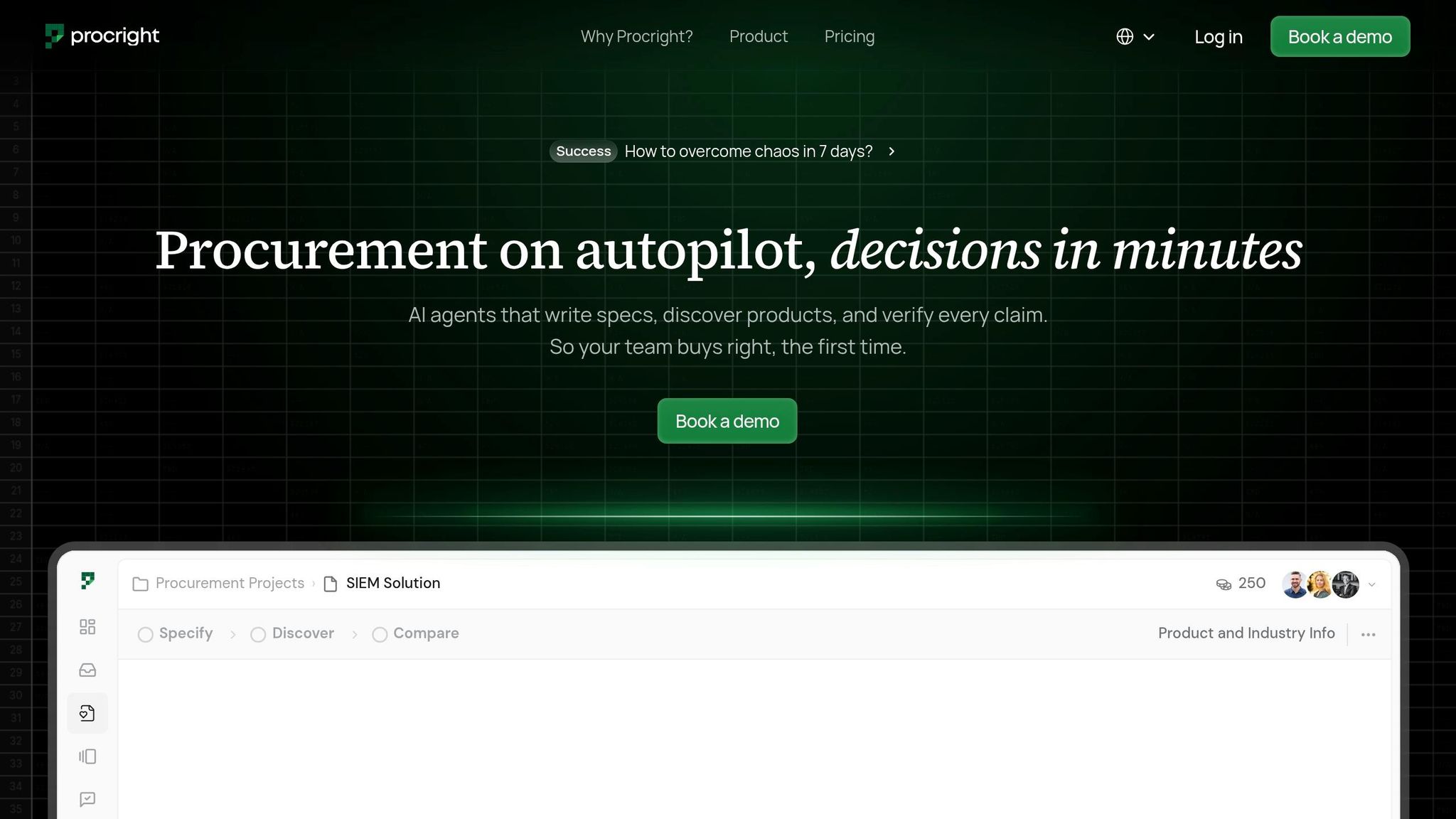
A transparent procurement workflow needs a single place to store specifications, evidence, and scoring.
Procright automates specification creation, product discovery, and compliance verification in one workflow. It compares products against requirements and produces transparent compliance scores backed by source evidence.
That gives teams an audit-ready record.
Governance, Risk, and Audit Practices That Keep Transparency in Place
Governance Roles, Model Risk Management, and Monitoring
Controls don't do much if ownership, validation, and evidence handling fade after launch.
Transparent AI compliance starts with named owners. A cross-functional committee that includes the Chief Medical Officer, CIO, Data Privacy Officer, and domain experts should own deployment approvals and failure investigations. Titles alone aren't enough. Each role needs a clear scope.
In procurement, that means naming the person who can:
approve vendor scores
override automated findings
archive the supporting evidence
Put simply, every vendor approval, override, and compliance score should tie back to a specific owner.
In finance, teams working under SR 11-7 must document why a model's design is reliable - its conceptual soundness. That calls for an independent validation team, separate from the development team, so failure modes and edge cases get reviewed on their own terms. In healthcare, operational model cards and related FDA documentation should stay current with training data descriptions, performance metrics, and known failure modes.
Monitoring also needs to match risk. Use real-time monitoring for high-risk systems and periodic checks for lower-risk tools. If groundedness drops below a threshold like 0.80, or if a request is tagged as high-stakes, the system should route the case to a human reviewer. Teams should also run continuous drift, fairness, and data-quality checks.
And here's the part people often skip: monitoring only counts when every alert turns into preserved evidence.
Audit-Ready Documentation and Evidence Management
Protective records should be generated automatically for every governed action that affects a vendor score, approval, or compliance finding.
A defensible audit trail needs the full chain: timestamp, decision ID, authenticated user, AI system and model version, inputs with source attribution, policy or prompt invoked, plain-language rationale, output, resulting action, human reviewer approval, and a tamper-evident integrity proof. Plain LLM logs aren't enough. Regulated industries also need output lineage - a traceable link from a specific output back to the exact retrieval context, model version, and prompt used.
Evidence should be stored in one place and kept under the retention rules tied to each regulatory framework. That central record should include:
model cards
validation reports
prompt design versions
RAG knowledge base descriptions
material change records
committee minutes
deployment sign-offs
monitoring logs
"A control that cannot demonstrate this linkage [between prompts, inputs, and outputs] may not survive PCAOB AS 2201 scrutiny." - Kognitos
Conclusion: What Transparent AI Compliance Requires
Transparency in AI compliance is an operating discipline. It relies on traceable data, explainable decisions, tamper-evident logging, embedded policy controls, and governance that keeps running, not just when an auditor shows up.
For regulated procurement, AI can turn scattered compliance work into structured, reviewable evidence. Regulators and internal reviewers need to see what data was used, what rule was applied, who reviewed it, and when.
Organizations that treat governance as infrastructure are better prepared for audits, examinations, and internal reviews by design. The target is simple: every compliance decision should be visible, reviewable, and defensible, not just automated.
FAQs
What records make AI decisions audit-ready?
AI decisions are audit-ready when there's a complete, immutable, traceable record of the full decision process.
In regulated industries, that means documenting:
Inputs and outputs
Model version
User attribution
Source citations
Human review status
Tamper-evident integrity proofs
Procright supports this by creating a documented, cited basis for procurement decisions. That gives teams a clear way to explain and defend those decisions during internal or external audits.
How can we prove an AI output later?
You can prove an AI output later only if your system records a clear, tamper-evident audit trail while it runs. You can't bolt transparency on after the fact by piecing together old logs.
That record needs to show the full decision chain: model version, exact input data and sources, prompt templates, retrieval logs, and immutable, append-only event records. In regulated settings, Procright supports this with transparent data presentation and clear compliance indicators.
When does AI need human review?
Human review matters most in high-risk AI systems and workflows where a mistake could lead to major financial loss, physical harm, or compliance issues.
In regulated industries, that review usually kicks in when:
AI confidence or groundedness drops below a set threshold
A compliance agent can't reach a resolution
The output involves a critical decision, such as credit scoring
There should also be a documented audit trail that shows whether a human reviewed and approved the output.
Related Blog Posts
Try it on a real buy
Bring one category. Watch where the flags land.
We use a little analytics to see which pages actually help. Nothing else, no ad trackers.