AI in Procurement: Benchmarking Products Across Sectors
How AI standardizes specs, compares costs and compliance across industries to speed procurement and cut TCO.
In this article
AI is transforming procurement by enabling faster processes, smarter decisions, and better cost savings. With 75% of companies exploring AI in procurement, early adopters report 58% faster cycle times and 2.03x greater cost savings. One standout benefit is cross-sector benchmarking, where AI compares products, pricing, and performance across industries - unlocking insights that were previously inaccessible. Tools automate tasks like normalizing data, flagging compliance gaps, and analyzing vendor proposals, cutting hours of manual work into minutes.
Key Takeaways:
Cross-Sector Insights: AI enables comparisons across industries, helping teams find better solutions outside their own sector.
Cost Savings: Real-time benchmarking reduces procurement costs by 20–30% and TCO by 20–40%.
Efficiency Gains: Tasks like vendor comparison matrices now take minutes instead of hours.
Compliance: AI ensures decisions align with regulations by flagging mismatches and providing transparent compliance scores.
Challenges: Data quality, AI hallucination, and bias require oversight to ensure accuracy.
AI isn’t just about automation - it’s about empowering procurement teams with data-driven insights to make faster, more informed decisions.
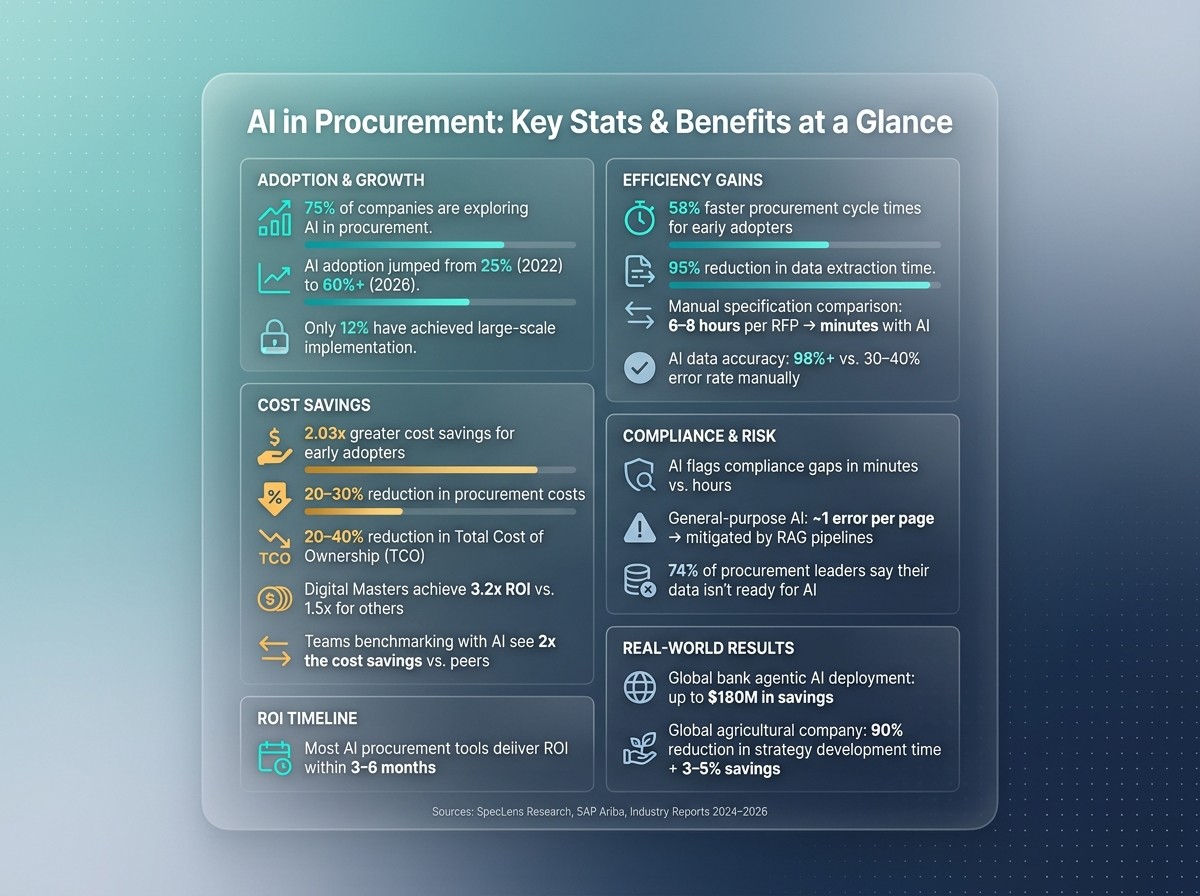
AI in Procurement: Key Stats & Benefits at a Glance
AI Techniques for Cross-Sector Benchmarking
Data Sources for Effective Benchmarking
Getting cross-sector benchmarking right starts with gathering the right data. AI platforms pull from a wide range of sources, such as internal spend data from ERP systems, purchase orders, supplier financial filings, regulatory records, news feeds, and real-time market pricing feeds. Some advanced platforms even combine signals from over 100 government and private databases at once.
However, the real challenge lies in standardizing the data. For instance, suppliers often report in different units - like kilowatts versus horsepower - which can make comparisons tricky. Normalization algorithms step in to align these discrepancies automatically, ensuring that values are equivalent. These algorithms also handle inconsistent terminology, mapping various terms to a common standard so your team can make accurate comparisons.
AI Models and Algorithms Used in Benchmarking
Once the data is standardized, advanced AI models come into play to organize and interpret the information for accurate benchmarking. Large Language Models (LLMs), such as those behind tools like GPT or Claude, go beyond simple keyword searches. They can actually interpret concepts within unstructured files like PDFs, Word documents, and spreadsheets. This allows AI to understand the essence of a vendor proposal, rather than just identifying specific terms.
To ensure accuracy, many procurement platforms rely on a Retrieval-Augmented Generation (RAG) architecture. This is particularly important in procurement, where even a small error in numbers can lead to costly mistakes.
"If the AI cannot point to the specific line in the proposal, it shouldn't make the claim." - Priya Sharma, Procurement Technology Lead, SpecLens
Beyond data extraction, vector embeddings help the AI understand semantic relationships. For example, it can recognize that an "IP67" rating means water resistance, even if the term "waterproof" isn’t explicitly mentioned. Confidence scoring further enhances reliability by rating the accuracy of extracted values and flagging uncertainties for human review before decisions are made.
Here’s a snapshot of some key AI techniques and their uses:
AI Technique | Purpose in Benchmarking |
|---|---|
Zero-Shot Extraction | Instantly extracts data from new documents. |
Unit Normalization | Converts units like kW to HP or BTU to watts for easy comparison. |
Gap Analysis | Identifies mandatory specifications vendors may have missed. |
Vector Embeddings | Understands implied meanings, not just literal text. |
Confidence Scoring | Flags potential errors for review before decisions are made. |
Limitations and Challenges of AI-Based Benchmarking
Despite these advancements, AI-based benchmarking isn’t without its challenges. Data quality remains the biggest hurdle. If internal spend data is inconsistent or locked in silos, even the best AI models can’t fully compensate. By 2026, 43% of procurement organizations are expected to explore AI deployment, but only 12% have achieved large-scale implementation so far - primarily due to fragmented data.
Another major issue is hallucination. General-purpose AI models can make errors, especially when working with complex procurement documents. On average, these models produce about one error per page. That’s why procurement-specific platforms prioritize RAG pipelines and strict citation practices to minimize risks.
"The procurement function is built on auditability; an unauditable answer is operationally useless even when it happens to be correct." - Rhea Kapoor, Head of Procurement Research, SpecLens
Algorithmic bias is also a concern. AI models trained on historical procurement data might unintentionally favor certain suppliers or regions, distorting benchmarks from the start. To counter this, governance is key. Teams need clear guidelines for reviewing AI outputs, deciding when to override them, and documenting decisions - especially for financially significant matters governed by regulations like the Sarbanes-Oxley Act.
Platforms like Procright tackle these risks by offering transparent compliance scores and traceable source analyses. This ensures procurement teams have the audit trails they need to justify their decisions to stakeholders.
CIPS Webinar: AI & Digital Maturity in Procurement: Benchmarking Your Digital Future
Key Use Cases for Cross-Sector Product Benchmarking
Procurement teams are tapping into advanced AI tools to enhance efficiency and transparency in their processes. These use cases highlight how AI's ability to standardize data and analyze it effectively translates into strategic benefits for procurement.
Standardizing Product Specifications Across Sectors
AI excels at turning inconsistent vendor documents into a unified dataset. Vendors often describe the same product differently - one IT supplier might write "500GB SSD", while another lists "Solid State Drive, 500 Gigabytes, SATA." Traditionally, manual reconciliation of these differences results in error rates of 30–40%. In contrast, AI achieves over 98% accuracy while slashing data extraction time by as much as 95%.
The complexity grows when comparing products across industries. AI simplifies this by converting units, mapping equivalent terms, and flagging discrepancies in performance data, such as storage IOPS tested under varying block sizes. It also identifies missing details in vendor specifications, alerting procurement teams to potential issues before contracts are finalized.
Comparing Cost and Performance Across Industries
AI helps normalize vendor bids, cutting through differences in formats, line items, and assumptions. For instance, it can detect when one vendor includes freight and installation costs while another omits them. This ensures procurement teams can make accurate, apples-to-apples cost comparisons. Beyond initial pricing, AI evaluates Total Cost of Ownership (TCO) by factoring in elements like maintenance schedules, consumable costs, product lifespan, and energy efficiency. As a result, organizations have reported 15–30% savings in procurement costs and a 20–40% reduction in TCO.
On the performance side, AI ensures that data is truly comparable. For example, if one vendor reports power consumption at "full load" while another uses "typical load", AI flags these mismatches to prevent inaccurate comparisons. It applies the same rigor to compliance checks, reducing risks and ensuring accuracy.
Compliance and Risk Assessment for Cross-Sector Products
AI significantly speeds up and simplifies compliance verification. In industries like healthcare, energy, and construction, procurement teams must compare products for compliance and confirm that vendors meet specific certifications - such as FDA, ISO, CE, or Joint Commission - before considering their products. AI maps RFP compliance requirements to vendor responses in minutes, highlighting gaps like a proposal offering only business-hours support when 24/7 coverage is required.
In highly regulated sectors, AI integrates qualification gates into workflows, ensuring that only vendors meeting regulatory and safety standards proceed to the evaluation phase. Tools like Procright take this further by offering transparent compliance scores and detailed source analyses. This level of traceability is essential for audits and stakeholder reviews.
"Manual specification comparison is the single biggest time sink in modern procurement. Teams that spend 6–8 hours per RFP cycle building vendor spreadsheets have no bandwidth left for strategic sourcing." - Senior Director of Strategic Sourcing, Fortune 500 Manufacturing Company
How to Implement AI-Based Benchmarking in Procurement
Assessing Readiness and Setting Clear Objectives
To make AI work effectively for cross-sector benchmarking, start by conducting a one-day audit of your procurement data. This involves checking the classification of your spend data, ensuring supplier names are consistent across systems, and identifying duplicate vendor records. Why is this so important? A staggering 74% of procurement leaders report that their data isn’t ready for AI, which is a major reason many AI projects fail. If you skip this step, you risk layering AI over flawed processes, which can backfire - AI tends to amplify existing weaknesses rather than resolve them.
Once your data is reviewed, define your goals before diving into vendor documents. What does success look like? Are you aiming to cut procurement cycle times in half? Reduce specification errors? Improve compliance rates? Setting these KPIs upfront ensures the implementation stays focused and gives you a way to measure ROI. The good news? Most AI procurement tools deliver returns within 3 to 6 months.
Building a Benchmarking Framework
With clear objectives in place, the next step is to create a solid benchmarking framework. Start by defining essential specifications and assigning weights to them before feeding any data into the system. This avoids vague evaluation standards that could slow down the process.
From there, follow a structured workflow:
Ingest vendor documents in multiple formats (PDF, Word, Excel, URLs) into a unified comparison set.
Tag your RFP as the baseline so the AI can align vendor responses with specific requirements.
Use automation to standardize and evaluate vendor responses.
Platforms like Procright simplify this entire process, from extracting specifications automatically to providing clear compliance scores. This allows teams to focus on making decisions rather than cleaning up data.
To ensure the AI outputs are ready for decision-making, evaluate them using a Decision-Readiness rubric. Can the output be directly exported for stakeholder use? Other factors to assess include Coverage, Normalization, Citation, and Confidence. A score of 16 out of 20 or higher on this rubric indicates that your benchmarking data is actionable.
"Treat the AI matrix as the input to the procurement decision, not the decision itself - the committee still owns the call, AI just gives them a faster, more auditable artifact." - Rhea Kapoor, Head of Procurement Research, SpecLens
Change Management and Team Training
Once your benchmarking framework is finalized, focus on preparing your organization and building an AI-native procurement team. The biggest roadblocks often aren’t technical - they’re organizational. Procurement teams need to transition from manually collecting and entering data to validating AI-generated insights and managing exceptions.
Begin with a pilot project using a past procurement cycle. Test the AI on real, complex vendor proposals to evaluate its performance. This approach builds trust and credibility faster than presentations or theoretical discussions. After automating data standardization, the next step is training your team to validate AI insights. This includes understanding confidence scores, overriding AI recommendations when necessary, and tracing values back to their source documents.
As Baber Farooq, Senior VP and Head of Market Strategy at SAP Ariba, explains:
"AI won't replace procurement professionals - it will redefine their role. Teams spend less time executing repetitive tasks and more time validating insights."
Organizations that achieve the best results - Digital Masters see a 3.2x ROI on AI investments compared to 1.5x for others - are those that treat AI adoption as a transformation of their processes, not just a software upgrade.
Conclusion: What Comes Next for AI in Procurement Benchmarking
AI-driven benchmarking isn’t just a concept for the future - it’s already transforming how procurement teams operate. In fact, over 60% of procurement organizations had piloted or implemented AI solutions by 2026, a significant jump from just 25% in 2022. The divide between early adopters and those lagging behind is growing fast. Teams that benchmark consistently with AI are seeing twice the cost savings compared to their peers.
Looking ahead, procurement is set to undergo even more changes. Next-generation agentic AI doesn’t just crunch numbers; it makes decisions and takes action. For instance, in April 2026, a global bank deployed an agentic AI system expected to save up to $180 million. Similarly, a global agricultural company used AI to slash strategy development time by 90% and achieved 3%–5% savings. These aren’t hypothetical scenarios - they’re real-world implementations delivering tangible results.
As AI takes on repetitive tasks, procurement roles are shifting toward overseeing AI outputs and handling strategic exceptions. This shift is driven by the ability to automate product specification creation, freeing up time for higher-level analysis. This evolution emphasizes that intelligent, autonomous procurement enhances human decision-making rather than replacing it.
FAQs
What is cross-sector benchmarking in procurement?
Cross-sector benchmarking in procurement is about stepping outside your industry bubble. It involves comparing processes, performance, and results with leading organizations or practices from entirely different industries. Instead of limiting comparisons to direct competitors, this approach uncovers efficiencies and strategies that might not be apparent within your own sector.
Procright simplifies this process by automating key tasks like product discovery and specification analysis. It standardizes requirements, making it easier to compare options objectively. Plus, with clear compliance scores, teams can make well-informed, impartial decisions that draw from the best practices across industries.
How can AI compare vendor bids accurately across different formats and units?
AI leverages semantic matching and normalization to effectively compare vendor bids, even when they come in different formats or use varying units. It achieves this by aligning terms and naming conventions across proposals into a unified structure and standardizing the data through steps like:
Currency conversion: Using real-time exchange rates to ensure consistency across bids.
Unit normalization: Adjusting measurements, such as calculating unit prices when vendors use different quoting methods (e.g., per box vs. per item).
How do procurement teams prevent AI errors or bias in benchmarking results?
To reduce errors and bias in AI systems, it’s important to rely on platforms designed specifically to provide auditability and maintain structured workflows. Here are some effective strategies:
Define criteria clearly upfront: This avoids any ambiguity in requirements and ensures alignment from the start.
Use platforms with traceable citations: These tools allow every data point to be tracked back to its source, increasing transparency.
Automate normalization processes: Standardizing units and terminology automatically can eliminate inconsistencies.
Conduct gap analyses: This helps pinpoint areas where critical data might be missing.
Apply Comparable-Spec Index scores: These scores ensure proposals are evaluated on a level playing field before making decisions.
By following these steps, teams can create a more reliable and fair AI framework.
Related Blog Posts
Try it on a real buy
Bring one category. Watch where the flags land.
We use a little analytics to see which pages actually help. Nothing else, no ad trackers.