What Is Procurement Automation and How Does It Work
Digitize purchase-to-pay: cut invoice costs and approval time, use AI for risk and forecasting, and support U.S. compliance checks.
In this article
Procurement automation simplifies and digitizes the entire purchasing process using software, AI, and workflows. It replaces outdated tools like spreadsheets and emails with structured, rule-based systems to save time, reduce costs, and improve accuracy. Key benefits include cutting invoice processing costs from $12.88 to $2.78 and reducing approval times from 17 days to 3 days. By automating repetitive tasks such as purchase order creation, invoice matching, and supplier onboarding, businesses can focus on strategic activities like negotiation and risk management.
Key Takeaways:
Cost Savings: Manual invoice processing costs $12.88 vs. $2.78 with automation.
Time Efficiency: Invoice processing drops from 17 days to 3 days.
Core Features: Automates purchase requisitions, invoice processing, and supplier onboarding.
AI Enhancements: Detects anomalies, forecasts demand, and monitors supplier risks.
Compliance: Ensures adherence to U.S. regulations like FAR, SOX, and TAA.
Procurement automation ensures processes are consistent, reliable, and compliant, transforming procurement from a manual bottleneck into a streamlined operation.
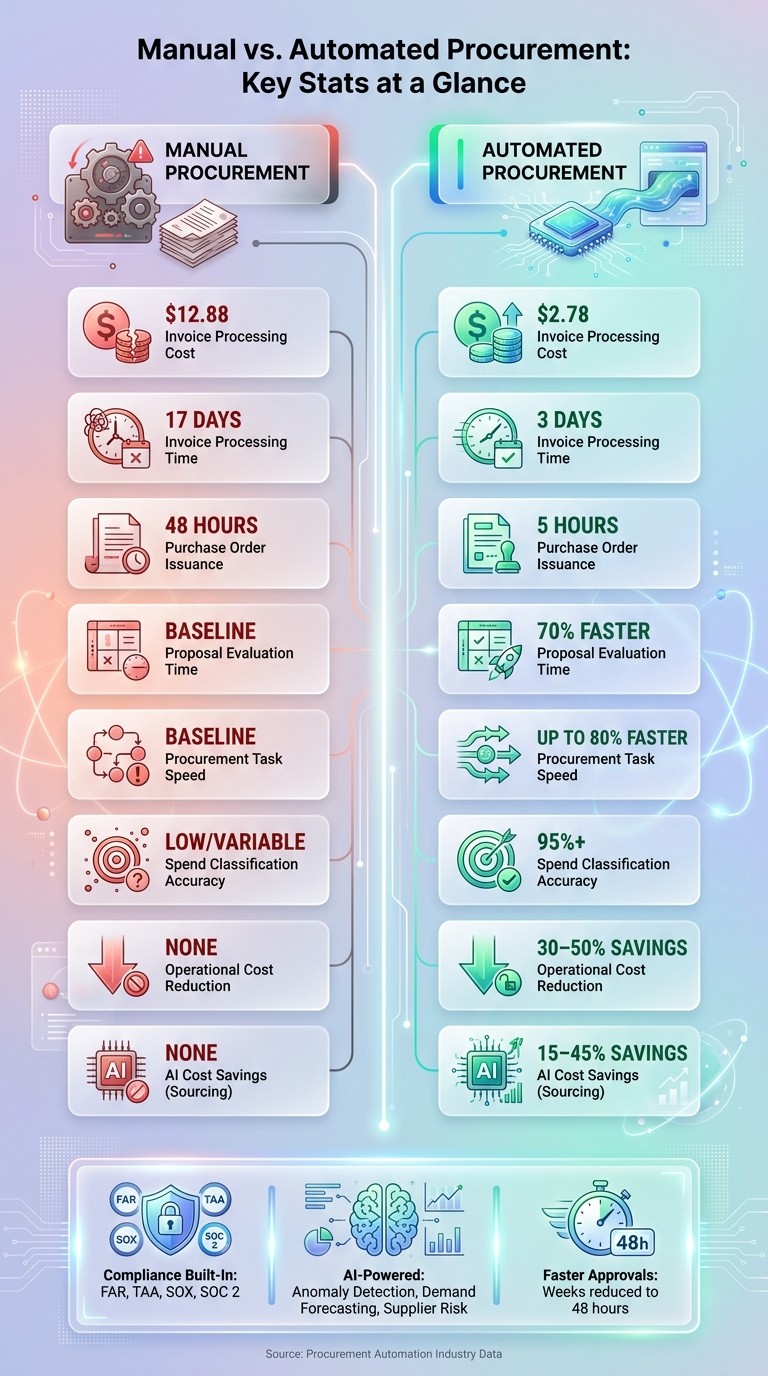
Manual vs. Automated Procurement: Key Stats at a Glance
Key Components of Procurement Automation
Core Procurement Processes That Can Be Automated
Procurement automation spans the entire procure-to-pay (P2P) cycle - the series of steps that starts when someone in a company identifies a purchasing need and ends with the supplier receiving payment. The repetitive and rule-driven nature of these processes makes them ideal for automation.
Some of the most frequently automated tasks include purchase requisitions, purchase order (PO) creation, invoice processing, supplier onboarding, contract management, and spend analysis. Traditionally, these tasks relied heavily on emails, spreadsheets, or phone calls, creating inefficiencies. Automation replaces these outdated methods with digital workflows that capture data, streamline approvals, and flag exceptions.
One standout area is invoice processing with three-way matching. Here, the system automatically compares an invoice to the original PO and the goods receipt document. If there’s a mismatch, an alert is triggered, preventing errors from slipping through. Additionally, AI-driven spend classification achieves accuracy rates of 95% or higher, offering finance teams a clear view of where funds are allocated.
These improvements are powered by a combination of advanced technologies, which are detailed below.
Technologies That Power Procurement Automation
Procurement automation relies on multiple technologies working together, each addressing specific needs. Integration between these tools is key to ensuring a seamless process.
At the core are workflow orchestration engines, which route tasks based on predefined rules. For example, they can direct approvals based on dollar amounts, department codes, or supplier risk levels, ensuring compliance with company policies. Complementing these engines, robotic process automation (RPA) handles repetitive tasks like generating documents, inputting data into ERP systems, and scheduling payments - eliminating the need for human intervention.
AI and machine learning add a layer of intelligence to these workflows. Beyond simply automating tasks, AI can detect irregular spending patterns, recommend preferred suppliers, and categorize invoices. Optical character recognition (OCR) - especially when enhanced with AI - extracts detailed data from paper or PDF invoices and maps it to the appropriate system fields. More advanced systems incorporate autonomous AI that operates within set boundaries, such as automatically reordering inventory when stock levels drop too low.
"Procurement automation is not primarily about speed. It is about consistency, control, and reliability at scale." - Lyzr Team
Although these technologies are widely applicable, U.S. businesses must also account for specific regulatory requirements, which are outlined next.
U.S.-Specific Factors to Keep in Mind
Operating in the United States introduces unique regulatory and financial considerations that directly impact how procurement automation systems should be configured.
For organizations working with federal agencies, workflows must comply with Federal Acquisition Regulation (FAR) and Trade Agreements Act (TAA) rules. These regulations limit sourcing to U.S. or TAA-approved countries, and automation systems should flag non-compliant suppliers before contracts are finalized. Companies pursuing federal contracts must also monitor spending against Small Business Administration (SBA) set-aside programs, including those for 8(a), HUBZone, and veteran- or women-owned small businesses.
On the financial side, publicly traded companies must ensure their systems provide audit trails that meet SOX internal control requirements. All financial data should default to USD, with formatting consistent across POs, invoices, and reports (e.g., $1,250.00). For cloud-based tools handling sensitive procurement data, compliance with SOC 2 or FedRAMP standards is essential, especially when federal data is involved. Integration with SAM.gov to verify contractor registration is another practical step for businesses engaging with government suppliers.
U.S. Requirement | What It Covers | Automation Impact |
|---|---|---|
FAR | Federal procurement rules | Supports checks against federal procurement rules |
TAA | Country-of-origin restrictions | Automatically flags non-compliant suppliers |
SOX | Internal financial controls | Requires detailed, timestamped audit trails |
SOC 2 / FedRAMP | Cloud data security | Sets security standards for procurement platforms |
SAM.gov | Contractor registration | Confirms supplier eligibility for federal contracts |
SBA Set-Asides | Small business programs | Tracks spending to meet diversity goals |
How Procurement Automation Works
From Purchase Request to Approval
Procurement automation kicks off the moment an employee needs to make a purchase. The process begins with a digital form, where employees provide details like the vendor, category, amount, and business justification. This structured approach minimizes delays caused by incomplete or unclear submissions that might otherwise require multiple follow-ups.
Once the form is submitted, the system automatically directs the request to the appropriate approver. For example, a $500 request for office supplies might be approved instantly, while a $50,000 software contract could require escalation to a VP. If the designated approver is unavailable, the system reroutes the request to a backup, ensuring the process doesn’t stall. This automation can reduce procurement cycle times by 50–70%, and high-performing teams can issue a purchase order in just five hours, compared to the 48 hours often required by manual processes.
"Instead of submitting purchase orders, they were submitting Slack requests. Coming from an audit background, knowing that everything was done in Slack and Google Sheets gave me some anxiety." - Kaela Patrinely, VP of Finance, Skin Pharm
In November 2025, Skin Pharm transitioned from manual procurement to automation, cutting approval times from weeks to just 48 hours.
Once approved, the system moves seamlessly into supplier selection and sourcing.
Automated Supplier Selection and Sourcing
After approval, the automation system steps in to help identify the best supplier. AI tools match purchase requirements with potential vendors, highlight preferred suppliers, verify compliance, and flag risks before human involvement is needed.
This step can save significant time and resources. AI-driven procurement tools can cut proposal evaluation time by 70%, and companies using AI for sourcing report cost savings ranging from 15% to 45%. Tools like Procright streamline the process by analyzing specifications, ranking products, and extracting sourcing data from various formats like web pages and PDFs. This allows procurement teams to focus on strategic decision-making instead of tedious data collection.
For critical or high-value purchases, human oversight is still essential. As Amazon Business aptly notes, "Autonomy without governance is just faster chaos".
Once the supplier is selected, the focus shifts to contract management.
Contract Management and Compliance Checks
With a supplier chosen, the next step is drafting and managing contracts. Automated systems create draft agreements using pre-approved templates, identify missing clauses, and ensure terms align with internal policies and U.S. regulatory standards. Alerts for deadlines and renewals help teams stay on top of compliance milestones.
By centralizing contracts in one searchable system with version control and a full audit trail, these tools eliminate the need for procurement and legal teams to track documents manually. This streamlined system also ensures accurate purchase order creation and tracking, removing a common bottleneck in the procurement process.
Purchase Order Creation and Tracking
Once the contract is finalized, the system automatically converts the approved request into a standardized purchase order (PO) and sends it directly to the supplier. This eliminates the need for manual data entry and reformatting, reducing errors and speeding up the process.
Both buyers and suppliers gain real-time visibility into the order status. Procurement teams can easily track what’s been ordered, what’s been delivered, and what’s still pending - without the need for manual follow-ups.
Invoice Matching and Payment Processing
When the invoice arrives, automation takes over again. AI and OCR extract line-item data from PDFs or scanned invoices and compare it against the purchase order and goods receipt. If everything matches within acceptable tolerances, the system processes the payment automatically. If discrepancies arise - such as pricing issues, quantity mismatches, or duplicate charges - the invoice is flagged for review.
This automated approach significantly reduces processing times compared to manual methods. Payments are scheduled per contract terms, often through methods like Electronic Funds Transfer (EFT), and updates are synced directly with the company’s accounting system.
AI in Procurement Automation
How AI Is Used Across Procurement
AI doesn't just make procurement faster - it reshapes how decisions are made. Unlike traditional rule-based systems, AI learns from data, identifies patterns, and provides smarter, more accurate recommendations over time.
"The biggest value isn't in automating how work flows - it's in automating what decisions get made." - Jeff Gerber, CEO, Suplari
Here’s where AI is making a difference in procurement:
Spend classification: Machine learning achieves over 95% accuracy in categorizing spend data, uncovering savings opportunities that manual methods often miss.
Demand forecasting: By analyzing historical trends, AI uses predictive analytics to forecast future purchasing needs, helping to avoid over-ordering or stockouts.
Supplier risk monitoring: AI scans for real-time signals of financial distress, news sentiment, or geopolitical risks, keeping potential issues on the radar.
Contract intelligence: Natural language processing (NLP) extracts critical details like obligations, deadlines, or risk clauses from contracts, drastically cutting down the time spent on manual reviews.
Invoice anomaly detection: Algorithms flag duplicate invoices, pricing discrepancies, and unauthorized spending before payments are processed.
Organizations using AI in procurement have reported cost savings of up to 45%. Procright builds on these capabilities to refine and optimize procurement workflows.
How Procright Supports AI-Driven Procurement
Procright takes AI's potential and integrates it into every stage of the procurement process. From defining requirements to evaluating suppliers, Procright uses AI to simplify and enhance workflows.
Its generative AI specification tool turns informal purchase requests into clear, structured documents through a conversational interface, reducing ambiguity early in the process. After specifications are set, Procright uses machine learning to compare products, normalize bid data, and rank options against defined criteria. This eliminates the need for manual bid reviews by providing clear, actionable summaries.
On the compliance front, Procright employs NLP to verify product compliance with specifications, flagging potential risks or mismatches before decisions are finalized. It also automates data extraction from sources like web pages, PDFs, and videos, ensuring procurement teams have up-to-date product information. These insights seamlessly feed into downstream processes, such as supplier selection, contract creation, and purchase orders, keeping everything consistent and trackable. Procright’s AI-driven approach not only saves time but also highlights both the opportunities and challenges AI brings to procurement.
Benefits and Challenges of AI in Procurement
AI’s role in procurement goes beyond time savings - it delivers measurable improvements in efficiency and decision-making. For example:
Procurement tasks can be completed up to 80% faster.
Team workloads can be reduced by 30%.
80% of organizations report improved data quality, and 64% of procurement leaders say AI enhances decision-making.
However, adopting AI isn’t without its hurdles. The table below compares AI-driven procurement with traditional manual approaches to illustrate the trade-offs:
Dimension | AI-Driven Procurement | Traditional Manual/Rule-Based |
|---|---|---|
Data handling | Processes unstructured data (e.g., contracts, emails) using NLP | Limited to structured fields |
Decision-making | Predictive; flags risks and suggests actions based on trends | Reactive; follows rigid, predefined rules |
Scalability | Instantly scales to handle large data volumes | Limited by team size |
Accuracy over time | Improves with machine learning and pattern recognition | Static; prone to human error |
Data requirements | Relies on clean, well-organized data | Limited analytical depth |
Governance | Needs clear guidelines for autonomous actions | Easier to audit but slower |
One of the biggest challenges in deploying AI for procurement is ensuring data quality. AI systems depend on clean, well-structured data, and fragmented or inconsistent records can lead to unreliable results. Before diving into AI adoption, organizations should audit their existing procurement data to identify and resolve gaps. Starting with targeted pilots - like automated spend classification or contract analysis - can help validate AI’s effectiveness before rolling it out on a larger scale.
Getting Started with Procurement Automation
Assess Your Current Procurement Processes
Begin by mapping out your entire procurement process - from the initial request to final payment. Pay close attention to who is responsible for each task and identify areas where data is manually re-entered or lost along the way.
Here’s a telling statistic: manually processing an invoice costs an average of $12.88 and takes 17 days to complete. In contrast, automated systems bring these numbers down to $2.78 per invoice and just 3 days. Similarly, top-performing teams can generate a purchase order in about five hours, while others may take up to 48 hours.
To uncover bottlenecks, consult the people directly involved - requesters, approvers, procurement staff, and accounts payable teams. Also, evaluate your data quality. Issues like common supplier scoring challenges like duplicate records, inconsistent naming, or missing fields can create significant challenges later.
Identify High-Impact Use Cases and Define Requirements
Once you’ve established a clear understanding of your current processes, rank them based on how much manual effort they require and the potential benefits of automating them. Tasks that are high-volume and low in complexity - like three-way invoice matching or catalog-based ordering - are often the best candidates for automation.
Be on the lookout for "maverick spend", where purchases bypass formal channels. These instances often signal compliance risks and inefficiencies in your budget. When defining your automation requirements, be as specific as possible. For example, decide how to handle exceptions like non-standard PDF invoices or purchases exceeding $10,000. Tools like Procright’s AI-driven specification platform can help translate informal requirements into actionable documents.
Once your requirements are clear, design a pilot program with a plan for scaling up gradually.
Design, Pilot, and Scale Your Automation
Start small with a pilot program - perhaps focusing on one business unit or a specific spend category. This allows you to test your assumptions without affecting the entire organization. Use a sandbox environment to simulate edge cases, such as multi-entity setups, foreign currencies, or unusual approval chains, before fully launching.
A phased rollout can help teams adapt more easily. For example, you could follow a 30‑60‑90 day adoption plan, introducing more advanced features over time.
Phase | Timeline | Focus |
|---|---|---|
Quick Wins | 0–3 months | Implement invoice capture (OCR) and automate approval routing for low-value purchase orders |
Medium-Term | 3–9 months | Introduce three-way matching, catalog management, and guided buying |
Long-Term | 9–18 months | Move to touchless invoice processing and predictive supplier risk analytics |
Set Up Governance and Train Your Team
Successful automation hinges on clear ownership, well-defined guidelines, and proper training.
"Be as strategic about governing AI as you are about adopting it." - Philip Ideson, Art of Procurement
Establish a cross-functional governance committee that includes members from procurement, IT, legal, finance, and compliance. This team should create policies for auto-approving low-risk, catalog-based items while ensuring human oversight for high-value contracts. Additionally, every AI recommendation should come with an audit trail explaining decisions, such as why a supplier was flagged or a payment was delayed.
When it comes to training, avoid a one-size-fits-all approach. Tailor the content to different roles - requesters, approvers, and procurement specialists. A train-the-trainer model can be especially effective: train department leads first so they can support their teams. Schedule quarterly reviews to evaluate AI performance and refine policies as workflows evolve. This continuous feedback loop is key to maintaining momentum and ensuring long-term success.
AI in Procurement: Smarter Sourcing, Contracts, & Supplier Management
Conclusion
Procurement automation has shifted from being a luxury to a necessity - marking the difference between teams bogged down by endless emails and spreadsheets and those making swift, data-driven decisions with confidence.
The numbers paint a clear picture: automation can slash operational procurement costs by 30–50%, cut invoice processing costs from $12.88 to $2.78 while reducing the timeline from 17 days to just 3, and save up to 80% of the time spent on routine tasks. These aren't just incremental improvements; they're game-changing shifts that create lasting advantages.
"Automation is no longer about saving time on routine tasks, it is about making procurement predictable, controllable, and auditable at scale." - Lyzr Team
What sets modern procurement automation apart is its ability to combine speed with intelligence. Automated workflows seamlessly handle repetitive tasks - like routing approvals, matching invoices, and flagging anomalies - while AI adds predictive insights for areas like supplier risk, demand forecasting, and compliance monitoring. Tools such as Procright enhance this process by turning informal requirements into structured, verifiable specifications early on, preventing issues before they arise.
Adopting automation doesn’t mean overhauling everything at once. Start small with high-volume, low-complexity tasks, prioritize clean data, and implement pilots to test workflows. Maintain human oversight for critical decisions to ensure balance. When done right, procurement transforms from a bottleneck into a powerhouse of efficiency, precision, and adaptability.
FAQs
Which procurement tasks should we automate first?
Start by automating tasks that are repetitive, time-consuming, and prone to errors - things like processing purchase orders, selecting suppliers, and managing contracts. Automation simplifies workflows, cuts down manual mistakes, and boosts overall efficiency. For instance, AI can identify suppliers that might be at risk, recommend suitable alternatives, and handle contract renewals or compliance tracking. By letting automation handle these processes, procurement teams free up time to concentrate on strategic priorities, such as sourcing opportunities and negotiations, which can bring more value to the organization.
What data do we need before adding AI to procurement?
To make AI work effectively in procurement, you need reliable data about suppliers, transactions, and purchasing trends. The key information includes supplier profiles, performance metrics, compliance records, purchase orders, invoices, and approval workflows. This data allows AI to automate repetitive tasks, identify potential risks, and support better decision-making. For AI to provide dependable insights and improve procurement processes, the data must be complete, accurate, and consistent.
Related Blog Posts
Try it on a real buy
Bring one category. Watch where the flags land.
We use a little analytics to see which pages actually help. Nothing else, no ad trackers.