AI Vendor Evaluation in Higher Education
AI streamlines vendor reviews in higher education by normalizing inputs, scoring with evidence, and preserving human sign-off.
In this article
AI can help colleges compare vendors faster, document each score, and keep review records ready for audits. But the output is only as good as the inputs, rules, and human review behind it.
Here’s the short version:
I see AI helping at 4 main points: requirements, bid comparison, scoring, and approval support
Schools still need people in procurement, IT, legal, security, and campus leadership to make the final call
The main inputs are RFPs, proposals, pricing sheets, contracts, campus requirements, HECVATs, and VPATs
Good tools turn messy files into a line-by-line compliance matrix
Scoring usually looks at fit, cost, risk, accessibility, and data/privacy terms
Strong review records tie every score to a quote, clause, or source page
Common triggers include FERPA, security review, accessibility review, and campus system integration checks
Some schools set hard review gates. For example, Colorado State University flags purchases above $15,000 or those tied to Level 3 or 4 data
AI should support the process, not run it alone
If I had to reduce the article to one idea, it would be this: the goal is not just to score vendors, but to make a buying decision that still makes sense months or years later.
Quick comparison
Area | What AI does | What people still do |
|---|---|---|
Requirements | Find gaps and organize specs | Set needs and approve criteria |
Bid review | Match vendor claims to source files | Check context and disputed items |
Scoring | Apply weights the same way | Set weights, cutoffs, and final judgment |
Compliance | Flag missing, weak, or conflicting terms | Confirm legal, privacy, and security risk |
Approval docs | Build summaries and packets | Approve, reject, or ask for more review |
Bottom line: if you want AI vendor evaluation to work in higher ed, start with clean data, fixed scoring rules, source-backed scorecards, and human sign-off at every campus gate.
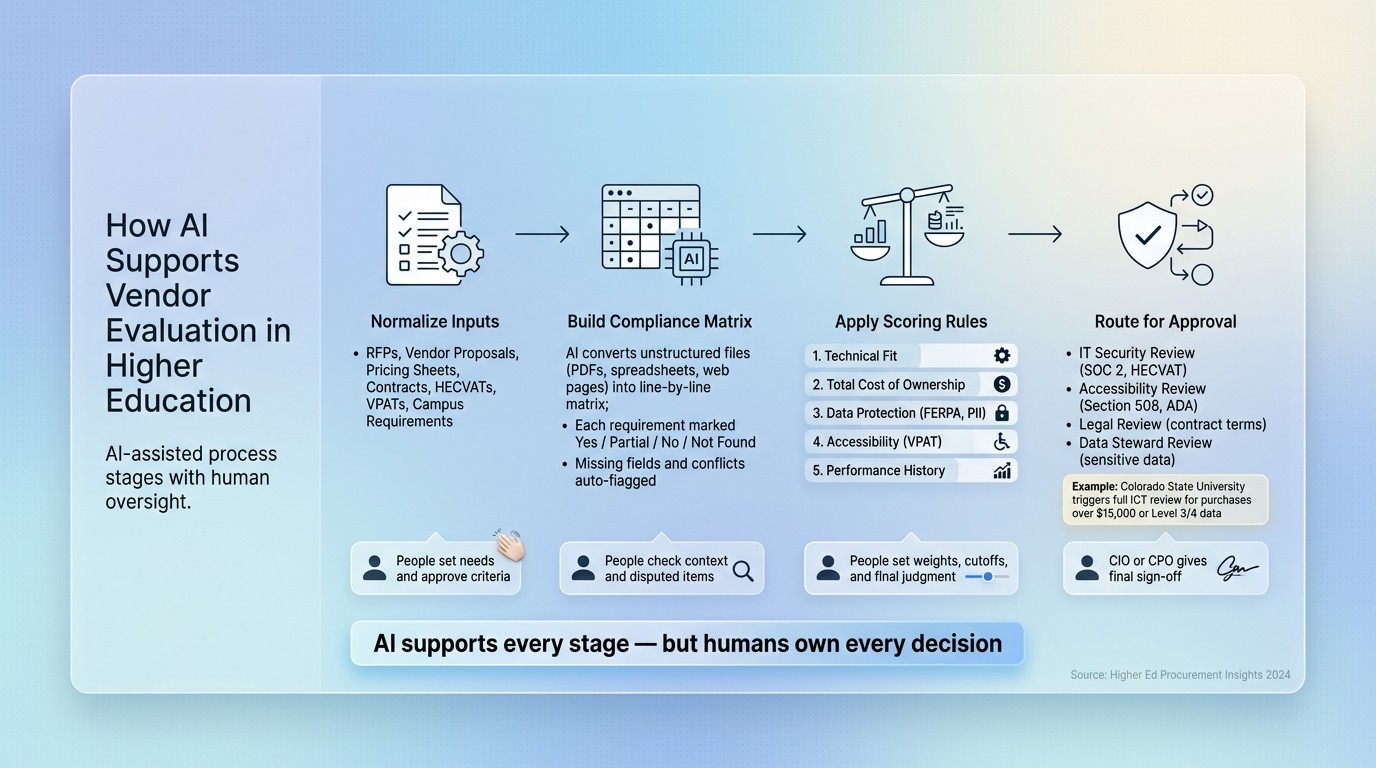
AI-Assisted Vendor Evaluation Process in Higher Education
Data Inputs and Normalization for AI-Driven Reviews
AI scoring starts with normalized inputs: bid documents, pricing, contracts, and campus requirements. In higher education, that means getting all of those materials together before review starts.
Key Inputs: Bid Documents, Pricing Sheets, Contracts, and Campus Requirements
The main inputs usually include RFPs, vendor proposals, quotations, Statements of Work, unsigned contracts, and detailed pricing tables. For higher ed, requirements often cover single sign-on, directory services, and integration with systems like Banner. The Office of Information Security also often needs a submitted HECVAT before approval can move forward.
"The software vendor must complete a Higher Education Community Vendor Assessment Toolkit (HECVAT) and provide it to the Office of Information Security prior to approval being provided." - University of South Alabama Policy
Pricing data needs to show the true annual cost, not just the sticker price. That includes setup fees, transition fees, per-incident charges, overage charges, and price escalation clauses. Campus requirements may also come from IT, legal, finance, and academic departments. Pulling those expectations together early helps keep the review on track by following a procurement compliance checklist.
Once those inputs are set, the next step is to standardize them so teams can compare vendors on the same basis.
How AI Converts Unstructured Files into a Compliance Matrix
Vendor submissions rarely come in one neat format. Some arrive as PDFs, others as spreadsheets, web pages, manuals, or even videos. AI can ingest and normalize those files, then cross-check vendor claims against the documents they submitted.
The output is a side-by-side compliance matrix that marks each requirement as Yes, Partial, No, or Not Found. Missing fields are flagged automatically, and conflicts between vendor claims and source documents are surfaced.
That gives procurement teams a clean shift from raw files to line-by-line review.
How Procright Supports Specification Creation and Data Structuring
One tough part of procurement is that the specification may still have gaps before bids are released. Procright helps spot missing requirements in draft specs and suggests technical details that line up with industry standards. It also pulls requirements into one place, flags gaps, and links each compliance claim back to source evidence.
That normalized record then becomes the basis for weighted scoring and committee review.
Scoring Rules, Compliance Checks, and Vendor Scorecards
Once the compliance matrix is in place, AI runs the same scoring rules across every submission. That matters because vendor reviews can get messy fast. A shared scoring model gives procurement teams a way to judge each response by the same standard.
Weighted Scoring Models for Fit, Cost, Risk, and Performance
Colleges and universities don't treat every criterion the same way. If a purchase touches FERPA-protected data, security and privacy will usually matter more than lower-risk items. Procurement teams set those weights at the start, and AI applies them the same way across all vendor responses.
Common scoring categories include technical fit (how well the product works with campus systems and architecture), total cost of ownership (license type, setup fees, and support over time), data protection (FERPA, PII, and retention rules), accessibility (often checked through a Voluntary Product Accessibility Template, or VPAT), and performance history (market data, peer interest, and support quality). Each category gets its own score, and those scores roll up into one composite result. If a vendor misses a required item, that response can be stopped before weighted scoring even starts.
Automated Compliance Checks Against Institutional Specifications
Before scoring happens, AI can flag responses that are missing information, conflict with other parts of the proposal, or fail to meet campus requirements. In higher education, that usually means close review of FERPA data handling, data retention terms, accessibility rules, and integration with campus systems - across procurement, IT, legal, and security teams.
The HECVAT (Higher Education Community Vendor Assessment Toolkit) is widely used for security risk checks. As Florida International University describes it:
"HECVAT is a questionnaire framework specifically designed for higher education institutions... to measure vendor risk as it relates to information, data, and cybersecurity policies."
AI can flag non-compliant items before the scorecard is locked in. It can also spot contradictions between proposal language and contract terms before an award is made. That's a big deal. A vendor might sound fine in the proposal, then slip in contract language that doesn't match what the committee thought it was buying.
Evidence-Based Scorecards for Committee Review
After scoring, committees need a clear record of why each vendor got a given score. A score by itself doesn't help much. It needs proof. Good AI-generated scorecards attach source quotes, contract clauses, and pricing data to each score so committee members can check the logic instead of taking it on faith.
Procright, for example, links each compliance finding back to the exact document, clause, or data point behind it. As Procright puts it: "The hard part isn't running a process: it's making a decision that is right, and that can be defended later."
The table below shows how scoring dimensions connect to data sources, AI review methods, and campus stakeholders:
Scoring Dimension | Data Sources | AI Evaluation Method | Key Campus Stakeholders |
|---|---|---|---|
Security & Risk | HECVAT, Security Addendums | Automated gap detection in security protocols | Information Security Office (ISO) |
Accessibility | VPAT, Accessibility Reviews | Flagging non-compliant interface features | Disability Services, IT |
Technical Fit | Architecture Diagrams, API Docs | Mapping vendor specs to campus IT standards | Enterprise Architects, IT |
Cost & Licensing | Pricing Sheets, Quotes | Normalizing per-user vs. enterprise costs | Procurement, Purchasing |
Compliance | Contracts, Privacy Policies | Detecting non-FERPA compliant language | Legal, Registrar |
Human reviewers still set the weights, define the thresholds, and make the final call. AI helps keep rule application consistent while preserving the evidence trail.
Approval Workflows and Decision Support on Campus
A vendor scorecard isn’t the final buying call. On most campuses, it’s the starting point for a multi-step review, and that process can slow down fast if the output doesn’t match how approvals actually move.
Governance Gates Across Procurement, IT, Legal, and Academic Leadership
Most institutions send tech purchases through several separate review stages, and each one is handled by a different team. A central IT reviewer usually takes the first pass. That person checks for duplicate tools and decides which review groups need to join based on what the product does and what kind of data it touches. Each gate looks at a different kind of risk, but they all work from the same scorecard.
From there, the request moves into more specialized reviews. IT security teams review SOC 2 reports and HECVAT submissions to produce a cyber risk assessment. Accessibility reviewers compare VPAT documentation against Section 508 and ADA requirements. Legal counsel flags non-standard contract terms. Data stewards step in when a system handles sensitive or confidential information.
Price also changes the path. At Colorado State University, purchases or renewals over $15,000, or those involving Level 3 or 4 data, trigger a full ICT Compliance and Security Review. Final sign-off stays with university leaders who have delegated authority, such as the CIO or Chief Procurement Officer. AI can help at every stage, but it does not make the decision at any of them.
AI-Generated Summaries, Routing, and Approval Documentation
AI helps package the findings for each approval gate. It turns the scorecard into a routing packet for procurement, IT, legal, and leadership. It can also produce evaluator-ready summaries that pull out the points that matter, flag conflicts, and show side-by-side cost comparisons. That documentation then moves with the requisition through each governance gate.
In practice, that usually means attaching the AI summary, SOC 2 report, and HECVAT to the requisition for each review step. Colorado State University's process, for example, requires that a PDF copy of the formal ICT approval accompany the requisition for procurement records. The University of Kentucky requires a ServiceNow-based pre-purchase vetting for all software purchases, no matter the dollar amount, including free tools and click-through agreements, and the GRC team's vendor assessment routes automatically to Procurement Services.
Post-Award Monitoring and Vendor Performance Tracking
After the award, that same evidence trail still matters. Teams can use the same framework to track service levels, vendor performance, and renewal risk. Renewals can also trigger another ICT review if data use changes or the vendor’s security posture shifts.
Limits, Risks, and Best Practices for Responsible Use
Common Limits in Data Quality, Explainability, and Bias
AI evaluation is only as strong as the data behind it. If bid documents are missing details, or if specs are vague, the system ends up judging vendors against shaky criteria. You may get a neat-looking scorecard, but it can still rest on weak inputs.
Bias is another risk, and it's often harder to spot. When a scoring model leans on past purchasing patterns, it can carry old preferences forward and tilt decisions toward certain vendors. Explainability matters too. If a reviewer can't show why one vendor scored higher than another, that result becomes hard to support during a review or audit. Schools and universities need decisions they can trace back to clear source evidence.
Some parts of evaluation are also tough for AI to judge in a steady way. Qualitative factors, in particular, still need human review. That's why every risk needs a clear control, not just good intentions.
Controls That Keep AI Evaluation Defensible and Compliant
The table below pairs each common limit with a practical control institutions can use:
Limitation | Mitigation Practice |
|---|---|
Incomplete bid data | Flag missing fields and suggest template-based requirements |
Bias in outputs | Require bias documentation and fairness checks |
Weak explainability | Link each score to source pages or clauses |
Overreliance on automation | Require mandatory human sign-off at final approval |
Data privacy exposure | Require HECVAT, SOC 2, and FERPA-aligned terms |
Accessibility gaps | Require VPATs and accessibility review |
After controls are set, the next job is disciplined review. Three practices matter most:
Start with a pilot
Keep the audit trail
Maintain human sign-off
A limited pilot helps teams spot issues before they affect campus-wide procurement. Every AI output should stay in the requisition record. Boston University requires IT review before contracting to confirm security and system standards. And even when AI tools do much of the analysis, the contract owner is still responsible for understanding the terms and sharing risk with authorized signatories. AI can do the heavy lifting, but people still own the decision.
Conclusion: Key Takeaways for Higher Education Procurement Teams
The point of AI evaluation isn't just faster scoring. It's making purchasing decisions that hold up later. AI works best when the inputs are solid, the scoring rules are clear, and people stay involved.
The strongest institutions tend to do four things well: define requirements clearly before the process begins, build scoring rules reviewers can explain in plain English, treat post-award monitoring as part of the same evaluation cycle, and keep each decision traceable from intake through renewal. Procright supports this workflow by combining specification creation, compliance scoring, and evidence mapping in one record.
"The hard part isn't running a process: it's making a decision that is right, and that can be defended later." - Procright
FAQs
How does AI score vendors fairly?
AI helps teams evaluate vendors with a more even hand by standardizing comparisons and cutting down on human bias. Procright maps requirements against vendor documentation - such as web content, PDFs, and videos - to produce objective, item-by-item compliance scores.
Teams can also weight specific specification lines, so AI ranks vendors by how well they match institutional needs, not marketing claims. Each score includes citations, which gives teams clear, traceable evidence they can check for themselves and use during audits.
What documents should schools collect first?
Start with the core security, access, and compliance documents:
HECVAT
current SOC 2 Type II report
VPAT
data handling details, including storage location, access controls, and data residency policies
contract materials, including quotes, SLAs, and terms and conditions
These documents help confirm whether a vendor lines up with FERPA, HIPAA, GDPR, PCI, and your institution’s own requirements.
Where should human reviewers step in?
Human reviewers should step in for complex negotiations, high-priority categories, and final decisions when AI analysis hits a wall. They also need to weigh the subtle qualitative factors that software can miss.
Cross-functional stakeholders, including IT, legal, and admissions, should help confirm institutional priorities, verify security and integration needs, and keep an auditable separation of duties in place.
Related Blog Posts
Try it on a real buy
Bring one category. Watch where the flags land.
We use a little analytics to see which pages actually help. Nothing else, no ad trackers.