The Collaborative Procurement Model Explained
The collaborative procurement model turns scattered demand into a single buying position, so organizations stop paying different prices for the same thing.
In this article
You know the pattern. Three teams buy the same software, each one swears they got a “good deal,” and finance still can't explain why the invoices don't match. Procurement ends up cleaning up the mess after the contract is signed, the renewal date is missed, and nobody can agree on which terms apply.
That's the primary problem the collaborative procurement model tries to fix. It's not just about chasing a bigger discount. It's about turning scattered demand into a single buying position, so organizations stop paying different prices for the same thing and stop wasting time on duplicate sourcing work.
The Hidden Costs of Buying Alone
A procurement team often sees the damage only after the fact. One business unit buys a SaaS tool directly, another routes the same need through a different manager, and a third negotiates its own terms because nobody had a shared view of the demand. The result is usually not just price variation, but also inconsistent renewal clauses, different service levels, and extra work reconciling records later.
That fragmentation creates a second layer of waste that gets missed in budget discussions. Buyers spend more time running separate RFQs, suppliers spend more time answering nearly identical requests, and legal gets pulled into repeated reviews of near-identical contracts. The hidden cost is the internal effort, not just the line item on the invoice.
Practical rule: if three teams are buying the same category in different ways, the issue is usually governance and visibility, not supplier performance.
This is why small purchases matter more than they look on paper. Tail spend looks harmless in isolation, but repeated low-value buys often bypass standard process and make demand impossible to aggregate. A useful companion read on that problem is Procright's guide to tail spend management, which shows how quickly small exceptions can add up operationally.
The buyer who acts alone has less bargaining power, less data, and more admin overhead. Collaborative models exist because those three weaknesses tend to show up together.
Understanding Collaborative Procurement
Think of a neighborhood that buys heating oil together before winter. Each household needs the same product, but no single family wants to negotiate by itself. By pooling demand, the group can ask for better pricing, simpler delivery terms, and a clearer service commitment than any one buyer could secure alone.
That's the basic logic behind a collaborative procurement model. Organizations combine demand, align specifications, and buy through a shared structure so they can improve purchasing conditions and reduce duplicated effort. The mechanism is simple, but the consequences are structural, because scale changes the bargaining position of every participant.

A formalized modern version of this practice took shape in the early 1990s, even though governments had been joining forces on contracts for well over a century to save time and money. In the United States, cooperative purchasing groups such as US Communities and WSCA emerged in that period, and a 2018 survey of procurement officials found cooperative procurement had grown to account for approximately 20% of state, local, and education government agency spend Harvard cooperative procurement research. That scale matters, because it shows collaborative procurement isn't a fringe technique, it's a major channel for demand aggregation.
What the model actually does
The model operates in two ways. First, it aggregates demand, so buyers can approach suppliers with a larger, more predictable volume. Second, it standardizes specifications, so the comparison is cleaner and the negotiation is about real differences rather than internal variation.
Collaborative buying works best when participants agree on what “good enough” looks like before the sourcing event starts.
That's why the model feels familiar to teams that already use cross-functional working groups. It's not new in principle, only more formal and more scalable. In public-sector markets especially, shared contracts can reduce duplication, improve purchasing conditions, and pool expertise across organizations.
The structure also has a digital side. Procurement work that depends on many reviewers, versions, and supplier inputs benefits when the draft, comments, and evidence live in one place.
A short video overview can help align non-procurement stakeholders on the basic idea.
Once that definition is clear, the key question becomes whether the organization can govern the model well enough for the savings to survive the coordination effort.
Two Primary Collaborative Models
The two most common structures are consortium buying and shared services. They both aim to concentrate demand, but they distribute control very differently. That difference matters, because a model that looks efficient on paper can become slow or political if the participants don't understand how decisions are made.
Consortium buying versus shared services
A consortium, often called a group purchasing organization, is usually an independent entity that members join to access pre-negotiated contracts. A shared services model is more hands-on, because the participating organizations actively pool resources and run procurement activity together. One is more about access, the other is more about joint operating capacity.
Characteristic | Consortium Buying (GPO) | Shared Services Model |
|---|---|---|
Control | Lower day-to-day control for members | Higher shared control across participants |
Resource investment | Smaller internal effort after joining | More internal effort to run the joint function |
Flexibility | Often easier to adopt quickly | Usually requires deeper alignment |
Scalability | Strong for broad category access | Strong when the group wants tighter process coordination |
A consortium fits organizations that want speed and access to market power without building a full joint team. It works when the contract is the main value driver and members can live with standardized terms. That makes it attractive for common categories where the buying logic is already clear.
A shared services model fits organizations that need more influence over the process itself. If the group wants to shape specifications, manage exceptions, and keep tighter control over how sourcing happens, the shared services route gives more operational ownership. It also demands more trust, more process discipline, and a stronger willingness to compromise.
The UK National Audit Office notes that lower prices come from economies of scale and from using pricing information to challenge suppliers, while fewer tendering exercises cut administrative overhead NAO collaborative procurement review. That's the logic behind both models, but the implementation burden is different. A consortium shifts work outward, while shared services shifts it inward and across the participant group.
For mid-market organizations trying to match bigger buying programs, the practical issue is often bargaining power, not policy. A useful reference point is Procright's guide on how procurement teams at mid-size companies can compete with enterprise buying power in 2026, because the winning move is often better coordination, not just more spend.
The choice comes down to how much control the members are willing to share, and how much operating discipline they can sustain.
The Business Case Benefits and Risks
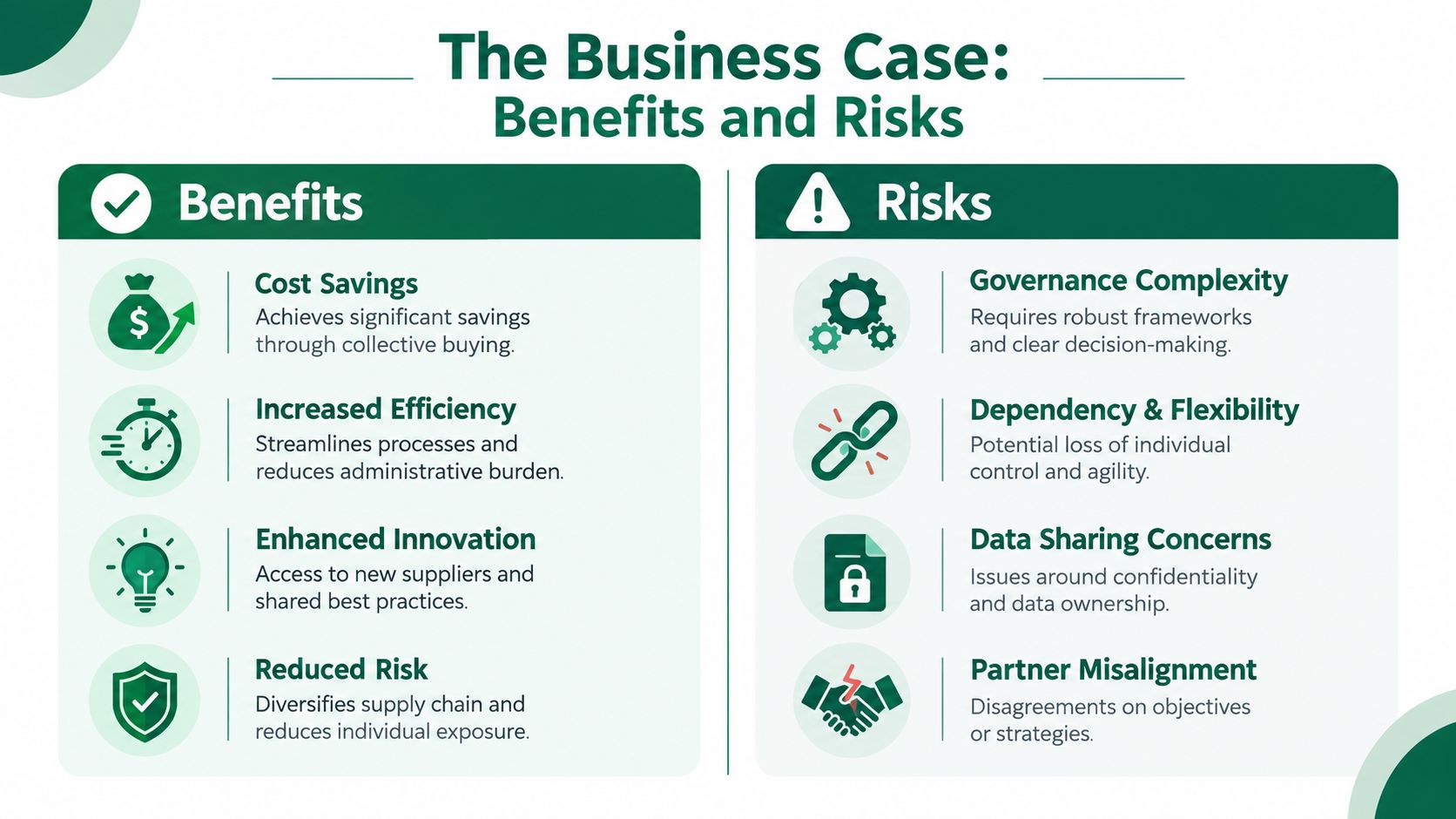
A collaborative procurement model makes sense first on cost, but the strongest cases do not stop at headline savings. Research reviews show that centralized procurement and framework agreements produce the largest documented savings, often over 50%, while many other procurement interventions still achieve around 5% to 10% price savings public procurement review. The same review also reports that procurement rationalization can save between 7% and 35% of spend, depending on the country public procurement review.
Why the upside is real
Those gains come from more than larger buying volumes. Collaborative procurement improves bargaining power, cuts transaction costs, and gives buyers a stronger basis for challenging supplier pricing. The National Audit Office points to economies of scale and the use of pricing information as the two core reasons lower prices emerge NAO collaborative procurement review.
The operational wins are just as practical. One public-sector collaborative procurement guide reports 12% savings on a £75.9m programme spend and 29% first-year savings in a police procurement example collaborative procurement guide. The same guide also cites a single tender replacing eight separate tenders, plus transactional savings of up to £40k per authority when e-procurement was introduced collaborative procurement guide. The pattern is consistent, less duplication and tighter process design create measurable value.
That logic also fits teams focused on sustainable logistics practices. Consolidation, visibility, and fewer redundant movements all support the same discipline collaborative procurement needs.
Where collaboration breaks down
The failure point is usually coordination, not sourcing. A public-sector review found fragmented governance, nearly 50 professional buying organizations, duplicated procurement activity, and wide price variation for the same commodities even within existing collaborative arrangements NAO review of collaborative procurement. Those are warning signs, and they are easy to miss when the focus stays on expected savings.
Earlier empirical work also highlights set-up costs, management complexity, and the hitchhiker's dilemma, where some participants benefit without contributing proportionally. In practice, a model can look efficient until one member starts free-riding, or until governance becomes so heavy that the group loses speed. That is why a business case needs to include the cost of coordination, decision control, and auditability, not only unit price.
Modern tooling helps here. Shared dashboards, approval trails, and clear category data make it easier to see who is doing what, where value is being created, and where exceptions are piling up. That kind of transparency is what keeps the collaborative model credible once the first savings are captured.
For teams trying to match bigger buying programs, the central question is often how to coordinate better, not how to spend more. A useful reference point is Procright's guide on how procurement teams at mid-size companies can compete with enterprise buying power in 2026.
Building a Governance Framework That Works
A collaborative model breaks down quickly when “shared” is treated as “informal.” In practice, the strongest arrangements spell out who decides, who pays, how benefits are measured, and what happens when members disagree. Without that clarity, internal politics fills the gap.
The operating rules that need to be written down
Start with a steering committee that owns strategy and escalates decisions. Below that, working groups can handle category detail, supplier evaluation, and implementation issues. That split keeps executive decisions separate from the operational work, where collaborative programmes often lose time.
Then define roles and responsibilities in plain language. Who approves specifications? Who signs off the award? Who manages supplier communication? If those answers are unclear, collaboration turns into a chain of assumptions, and assumptions are where audit issues usually start.
Practical rule: if two people can reasonably believe they own the same decision, the governance model is too vague.
Cost-sharing needs the same discipline. Members should know what they contribute, what they receive, and how benefits are distributed when usage is uneven. If those terms stay fuzzy, resentment builds fast, especially when one participant feels it is subsidising the others.
A strong governance pack should also cover onboarding and offboarding. New members need a standard entry path, and exiting members need a clean process for unwinding obligations without disturbing live contracts. That keeps the group steady when budgets shift or leadership changes.
The friction points that kill trust
Fragmented governance, duplicated activity, and price variation can still appear inside collaborative arrangements, even when the structure looks sound. The problem is enforcement. Rules only matter if participants apply them consistently, especially when they want exceptions for their own category or region.
Dispute resolution is often treated as an afterthought, and that creates avoidable delays. If a member objects to a specification, delivery model, or award recommendation, there needs to be a clear route to settle it. Otherwise, the process stalls and stakeholders begin treating the collaboration as optional.
A useful governance framework makes transparency routine. Everyone can see the rule set, the approval path, and the reason behind decisions. That is what turns the model from political to operational. Modern tooling helps by keeping the evidence trail visible, which gives governance teams the auditability they need when questions arise.
Implementation and Modern Tooling
The practical rollout usually starts with partner selection, scope definition, a master agreement, and the first joint sourcing event. That sequence sounds straightforward, but the failure point is rarely the contract language. It's the data behind the decision and the evidence trail that proves the decision was fair.
What to get right before the first event
The group needs a shared scope that is narrow enough to govern and broad enough to generate value. Once the scope is set, the master agreement should define pricing logic, service expectations, and the rules for future additions. After that, the first sourcing event should be treated as a test of both process and trust.
The practical importance of data quality becomes evident. Research on collaborative public procurement notes persistent dependence on supplier-provided data, lack of standardized product coding, and poor market consideration, all of which make it hard to compare suppliers or defend eliminations Liverpool collaborative procurement research. If the team cannot compare options cleanly, the collaboration becomes harder to justify internally.
A modern workspace helps because it creates one version of the specification, one evidence record, and one review trail. Procright is one example of that kind of tooling, it supports shared specification work, evidence-based comparison, and source-backed decisions inside a single workspace. For teams trying to tighten the workflow between reviewers, the resource on how real-time collaboration changes procurement specification teams is a useful reference point.
Where tooling changes the outcome
The goal isn't automation for its own sake. It's auditability. If the platform can show why a supplier was eliminated, what evidence supported the shortlist, and who approved the locked specification, the collaboration is much easier to defend later.
That matters because collaborative procurement often involves multiple reviewers with different priorities. Finance wants cost clarity, operations wants usability, legal wants defensibility, and category managers want a clean award process. A shared digital record keeps those conversations tied to the same facts instead of four separate email threads.
Good tooling also reduces the everyday friction of collaboration. Comments, redlines, supplier responses, and approvals stop living in disconnected files, which makes it easier to maintain version control and easier to prove compliance after award. In a model built on shared trust, transparency is the operating system.
If you're building or repairing a collaborative procurement program, Procright can help you keep the spec, supplier evidence, and decision record in one place. Visit Procright to see how an audit-ready procurement workspace can support shared sourcing, cleaner eliminations, and more defensible awards.
Try it on a real buy
Bring one category. Watch where the flags land.
We use a little analytics to see which pages actually help. Nothing else, no ad trackers.