Compliance with Contract from Spec to Audit
In this article
The usual advice on compliance with contract obligations starts too late: sign the agreement, load the dates into a tracker, and monitor the supplier. That won't settle an invoice dispute if nobody defined what acceptable performance looks like. A defensible compliance file starts with the specification, before bidders answer and before anyone approves the award.
Table of Contents
Why Compliance Breaks Before Anyone Monitors It
Say a facilities contract is signed, the procurement team records the dates, and finance later challenges an invoice. Operations says the work was completed. The supplier points to a service report. Nobody can connect that report to an acceptance test in the contract.
That's a design failure, not a filing failure. A better document repository would help people find the report, but it wouldn't establish whether the report proves that the supplier earned payment.
The Institute for Supply Management's 2025 strategic-sourcing findings report that 84% of organizations perform contract negotiation and management, while only 21% rate compliance as excellent. Those findings don't establish that poor specifications cause weak compliance, but they challenge the assumption that having a contract-management process is enough.

Where the argument begins
In a facilities award, a requirement for adequate cleaning leaves the reviewer guessing. Does completion mean attendance, completion of listed tasks, or a passed inspection? If the supplier and site manager use different definitions, the invoice dispute was already possible before award.
A cloud licence can fail the same way. A promise of support doesn't establish which incidents qualify, when the response clock starts, which subscription tier includes the service, or what record proves performance.
The specification writer needs to resolve those questions while suppliers can still price the obligation.
Vague requirements: Replace subjective language with an observable result and an acceptance method.
Unsupported answers: Require a document reference and relevant passage, not just a bidder's confirmation.
Single-bidder lines: Check whether a restrictive feature meets a genuine business need or merely copies an incumbent's description.
Unclear consequences: State who decides whether a gap requires correction, an approved exception, or rejection.
Use one evidence model
A sourcing team shouldn't score a supplier against one definition and ask operations to accept delivery against another. Keep the requirement identifier, test, evidence standard, owner, and exception rule together throughout the purchase.
A tracker can remind someone to review an obligation. It can't make an ambiguous promise testable.
The useful output is one evidence model that supports the award decision and remains usable at review, acceptance, payment, and renewal. Build it while the specification is still open to correction.
Write a Testable Specification Before Award
Write requirements so a reviewer can reach a decision without asking what the author intended. That doesn't mean making every purchase rigid. It means separating mandatory outcomes from preferences, and documenting the discretion you're willing to allow.
Use a structured requirements matrix rather than leaving the acceptance logic scattered across meeting notes. A procurement specification completeness checklist provides a useful prompt for checking whether technical requirements, commercial terms, and acceptance conditions form a complete package.
Make each line scoreable
Describe an observable result. Replace a general promise of support with the incident category, response requirement, operating hours, and measurement source. For example, require the supplier to demonstrate that its ticketing export records receipt and first response. Set the actual response threshold to the business need, not a copied template.
Attach the acceptance test. Name what the reviewer will inspect: a demonstration, signed acceptance record, valid certificate, system extract, or delivered item. Specify the scope the evidence must cover. A certificate for a different service or legal entity doesn't answer the requirement.
Define partial compliance before scoring. A supplier might meet the functional requirement but exclude a required location. Record that as partial and identify the exclusion. Don't let evaluators round it up because they prefer the supplier overall.
Resolve restrictive or incomplete lines. Challenge requirements that only a named product can meet. Where the restriction is necessary, preserve the business justification. Add missing acceptance and remedy clauses before issue, rather than expecting negotiation to repair them later.
Require a cited answer. Ask bidders to identify the document, version, and passage supporting each response. If the answer relies on a future capability, distinguish a contractual delivery commitment from an existing feature.
Connect failure to an action. Identify the testing owner, correction process, applicable service credit, and change-control trigger. Ensure proposed remedies are incorporated into the agreement rather than left in the evaluation workbook.
Preserve the connection to payment
A line item should remain identifiable when it becomes an order, deliverable, and invoice entry. For public-sector teams, FederalPipeline's guide to understanding CLINs in government contracts is useful context when designing that connection between contract line items and performance records.
Don't confuse a purchasing identifier with an acceptance test, though. A correctly coded invoice can still charge for an unaccepted deliverable.
Keep the scored matrix as a controlled record. Freeze the award version, retain approved clarifications, and make subsequent changes visible. Otherwise, a well-designed evaluation can become an unreliable baseline once people start editing the working spreadsheet.
Rank Every Obligation by What a Breach Costs
What to test first on a live contract
Class | Stake | Primary evidence | Review cadence | Escalate when |
|---|---|---|---|---|
Deliverable or milestone | Missed acceptance can prevent use and affect payment entitlement | SOW item, acceptance record, delivery note | Each milestone | Evidence is missing at acceptance |
Service level | Service credits and operational disruption | Joint metric definition and source-system extract | Monthly or per the SLA | Result passes the contractual credit threshold |
Price and volume terms | Overcharges and missed discounts | Rate card, invoice, discount schedule | Each invoice cycle | Invoice doesn't match the signed rate |
Regulatory and data duties | Regulatory exposure, notification duties, or termination risk | Certificate, policy version, audit-right file | Quarterly or on a relevant law change | Certificate has expired or its scope doesn't match |
Renewal and termination | Unwanted extension or lost exit rights | Notice calendar and clause version in force | Before each notice date, checked at least quarterly | Remaining time reaches the internal approval and service buffer |
Insurance and subcontracting | Uninsured exposure or unauthorized delivery arrangements | Policy schedule and subcontract approval | At award and each renewal | An unapproved subcontractor is performing the work |
These are starting review cadences, not legal requirements. Tighten them where the contract, operating risk, or applicable rules demand faster checks.
Don't give an administrative reporting clause the same review effort as a disputed price formula. Rank each obligation by financial exposure, regulatory consequence, operational criticality, likelihood of failure, and detectability. A serious failure that's difficult to detect deserves attention even when the supplier hasn't missed a deadline.
WorldCC reports average contract-value erosion of approximately 8.6%, with best performers near 3% and the weakest organizations at 15% or more. That's a benchmark for prioritizing commercial controls, not a forecast of what your contract will lose.
Turn priority into a control record
For each selected obligation, create a record containing the requirement, evidence type, named owner, due date, measurement formula, escalation threshold, and remedy. Include the clause reference and the person authorized to approve an exception. The reviewer needs both a test and a route to a decision.
Walk through the exposure behind each row. A milestone without acceptance evidence requires a decision under the payment provisions, not an automatic assumption that delivery equals acceptance. A service-level failure requires the agreed calculation, including exclusions and credit-claim deadlines.
An invoice needs reconciliation to the rate card, discount schedule, and applicable index. A certificate needs a scope check, not merely a valid-looking expiry date. Procurement should send an expiring regulatory document to the responsible compliance owner to determine whether work must stop.
Renewal controls need enough lead time for internal approval and valid service of notice. Insurance and subcontracting reviews must establish whether the actual work and performing entity fall within the approved arrangements.
Prioritization rule: Spend review effort where a wrong decision changes payment, operational continuity, legal exposure, or the ability to exit.
High-priority rows warrant milestone or monthly testing where appropriate. Lower-risk administrative duties can receive a lighter quarterly sample, provided missed items still have an owner.
Don't manufacture a single financial estimate for every legal obligation. Where exposure can't be credibly quantified, document the consequence and decision authority instead. A transparent risk judgement is more useful than a precise-looking number nobody can defend.
How to Run the Review from Clause to Record
Name a person who owns the review and a controlled location for its evidence. Shared responsibility without decision authority leaves procurement chasing documents while operations, finance, and the supplier each assume someone else accepted the exception.
The file should contain the work an auditor would need to inspect. U.S. Department of the Interior contract-audit guidance addresses reporting compliance with contract provisions and documenting the audit plan, which makes a contemporaneous test record more useful than a narrative assembled after the audit starts.

Run a repeatable review cycle
Extract the operative obligations. Read the signed agreement, incorporated specification, schedules, and amendments using the contractual order of precedence. Record the controlling clause and version. Don't assume the most recent file overrides the signed agreement.
Classify each duty. Mark it as deliverable, service-level, commercial, legal, or reporting. This routes the test to the right reviewer: technical acceptance shouldn't be decided solely by the invoice-processing team.
Agree on measurement in writing. Confirm the metric, source, review frequency, exclusions, and exception treatment with the supplier. Preserve that agreement without informally changing the contract. A measurement clarification that changes entitlement needs authorized change control.
Specify the objective test. State what passes, what fails, and what counts as partial. A demonstration might prove functionality without proving the required production configuration; record that distinction before testing.
Collect source evidence. Obtain the delivery note, system extract, inspection result, or certificate that supports the claim. A supplier attestation can form part of the file, but don't substitute it for available corroborating records.
Record the result accurately. Use yes, no, or partial for evaluated performance. Use indeterminate as a separate working label when evidence is missing or contradictory. Record the reason so a blank field cannot become an accidental pass.
Investigate and assign corrective action. Calculate the supported commercial impact, identify the responsible person, and set a due date. Route waivers and disputed interpretations to someone with delegated authority, not merely someone copied on the email.
Verify closure independently. Have someone other than the corrective-action owner check the replacement evidence or retest the result. Completion of a task isn't proof that the underlying obligation is now satisfied.
Preserve the original decision trail. Retain the initial evidence, finding, correspondence, approval, and revised result. Use version history or append-only records so nobody can replace an adverse finding with a clean answer.
Make the file usable beyond procurement
For regulated or public contracts, map relevant rows to applicable laws, cost principles, and audit criteria. Keep that mapping separate from the commercial test where necessary, because satisfying a negotiated clause doesn't automatically resolve a regulatory duty.
Kons Law's contract management tips for 2026 can support a broader governance review. For the evidence file itself, the practical reason traceability matters in procurement is straightforward: another reviewer must be able to reproduce the decision without relying on the original buyer's memory.
Any mismatch between the controlling clause and a later document belongs in the drift log. Don't resolve it by rewriting the result to yes.
Catch Drift and Keep the Green Score Honest
A green dashboard can conceal a changed deal. The supplier meets the metric in its service report, but the report excludes incidents the signed agreement includes. Someone has measured performance accurately against the wrong obligation.
Baseline each test with the requirement version in force, the relevant performance period, supporting evidence, and the commercial consequence of a deviation. Then compare the documents people use to order, deliver, bill, and approve the work.
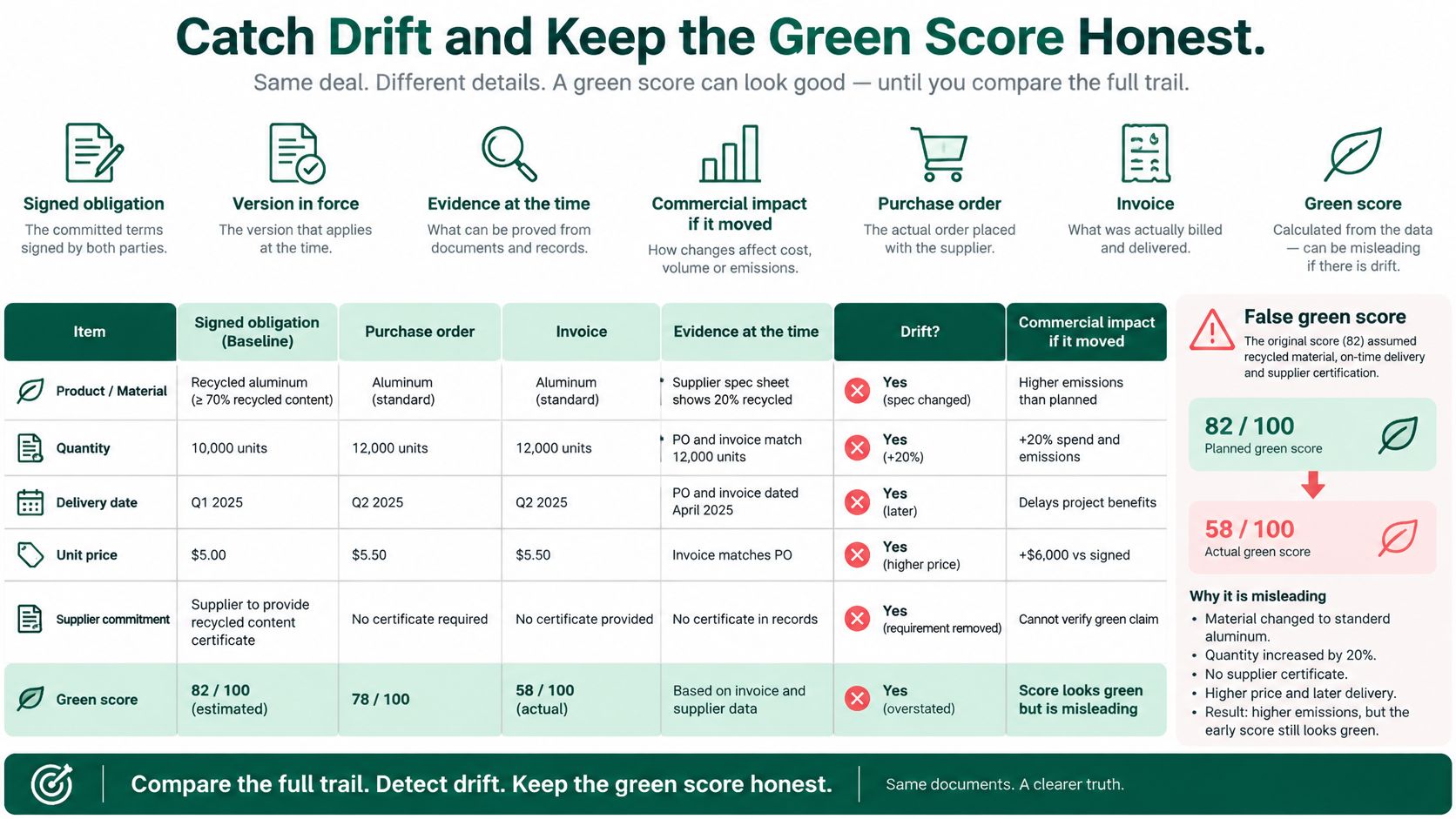
Where the signed deal drifts in later documents
Document | Compare against | Typical drift | Status if it does not match |
|---|---|---|---|
Signed contract or spec | Approved baseline and authorized amendments | Uncontrolled edits presented as the current baseline | Indeterminate until the controlling version is established |
Purchase order | Price, quantity, delivery, Incoterm | Unit price or risk transfer changed | Noncompliant, or indeterminate if the PO is missing |
Statement of work | Scope and acceptance test | Extra tasks or softer acceptance | Partial where part is satisfied; noncompliant where a mandatory test fails |
Invoice | Rate card, discount, index, credits | Discount dropped or index applied incorrectly | Noncompliant; route the disputed line through the contractual payment process |
Manual, quote, or certificate | Technical or regulatory conformity | Feature or certificate scope omitted | Partial if the missing item is separable; otherwise noncompliant |
Amendment or email | Change-control clause | Informal change without an authorized approver | Indeterminate until authority and contractual effect are established |
The baseline document isn't proof of performance. It states the test. A later mismatch also isn't automatically a breach: an authorized amendment may legitimately change the obligation, so check authority and effective date before deciding.
Open the purchase order to check whether an administrator changed a rate or delivery term. Open the statement of work to see whether a project manager softened acceptance. For the invoice, recalculate the affected line rather than accepting the supplier's summary.
A manual or certificate can reveal a narrower capability than the bid promised. An email can reveal an attempted scope change that never reached the authorized approver. Preserve those documents even when the parties later agree on a correction.
Keep uncertainty visible
Use compliant, noncompliant, partial, and indeterminate consistently. For partial results, name the unmet component; for indeterminate results, identify the missing evidence and its owner. Neither belongs in the compliant count.
Don't treat missing evidence as automatic permission to withhold all payment or refuse renewal. Suspend the affected internal approval where permitted, then apply the agreement's acceptance, dispute, notice, and payment provisions. A control shouldn't create a separate breach by ignoring those provisions.
A clean dashboard isn't worth a weak file. Keep the exception visible until someone with authority has resolved it.
Watch overdue obligations, unresolved exceptions, missing evidence, unapproved changes, and repeat breaches. Use a supplier performance scorecard that lets reviewers open the underlying evidence and exceptions, not just view a supplier's overall colour.
Severity matters more than counting failures. Aon's analysis of EMEA warranty-and-indemnity claims identifies tax as the most frequently notified breach category, while material-contract, compliance-with-laws, and litigation breaches can produce losses disproportionate to their share of claims. That insurance finding isn't a supplier-performance benchmark, but it illustrates why frequency alone is an inadequate risk measure.
Deloitte's 2025 Global CPO Survey reports that supplier performance was a plan metric met or exceeded by 84% of leading organizations versus 59% of followers. That difference doesn't establish whether a particular compliance score reflects lower risk or better measurement.
Show the reporting denominator, open exceptions, and exposure alongside the percentage. A compliance percentage without its unresolved exceptions is a story, not a control.
Baseline One Live Contract This Month
Choose a live contract with a pending acceptance payment, an approaching renewal decision, or an important recurring service. Pick something whose commercial owner will participate. Don't begin with the largest archive or a portfolio-wide dashboard redesign.
Set a practical finish line: another reviewer can open the file, identify the controlling obligations, and understand which decisions remain unresolved. That's more useful than migrating every historical document without testing any of them.
Produce a decision-ready file
Select the consequential obligations. Include the terms that affect the next acceptance, invoice, service-credit claim, or notice decision.
Collect the operating documents. Put the signed text beside the current purchase order, statement of work, invoice, relevant manual, and approved changes.
Assign the unresolved work. Give each partial or indeterminate item an owner, a supported impact assessment, and a decision deadline tied to the next contractual event.
Bring the right approvers together. Ask operations to confirm performance, finance to confirm the disputed amount, and the authorized contract owner to decide exceptions.
Don't spend the review meeting debating colours. Ask which evidence is absent, which interpretation is contested, and who can authorize the next action. Record a disagreement explicitly when the parties haven't resolved it.
Repair the next specification too
If the same argument keeps returning, correct the requirement before the next sourcing event locks. An acceptance dispute about an undefined test won't disappear because the next contract uses a different supplier.
Procright supports that pre-award work by gap-checking specifications and producing source-backed yes/no/partial answers for compliance items without waiting for supplier responses. That helps establish the decision record, but it doesn't replace the accountable owner, operating review cadence, or invoice reconciliation on a contract already being performed.
Keep the scope of the first exercise narrow enough to finish. Approve legitimate changes, pursue supported remedies, and leave unresolved items visible rather than closing them for reporting convenience.
Make this month's test one contract, one controlled evidence file, and no green mark without a source. Before the next payment or notice decision, require the owner to identify exactly what the file proves and what still needs approval.
Procright helps procurement teams build testable specifications, identify gaps before award, and compare supplier answers against cited evidence. Visit Procright to explore a specification gap analysis and establish a source-backed baseline your team can carry into contract performance.
Try it on a real buy
Bring one category. Watch where the flags land.
We use a little analytics to see which pages actually help. Nothing else, no ad trackers.