7 Gap Analysis Examples: Templates for Procurement Teams
A contract can look complete and still leave the buyer exposed. A good gap analysis example makes that problem visible before the specification is locked.
In this article
A contract can look complete and still leave the buyer exposed. The team may discover during delivery that the warranty period was never defined, an urgent response time was assumed rather than written, or the supplier has no obligation to return data at exit. By then, clarification becomes negotiation, and negotiation becomes cost, delay, or dispute.
A good gap analysis example makes that problem visible before the specification is locked. The examples below show how procurement teams can compare the current requirement with the required state, identify the specific gap, add a clause or acceptance test, assign a risk level, and preserve an audit-ready decision record. The point isn't to create another checklist. It's to make every important procurement judgment explainable later.
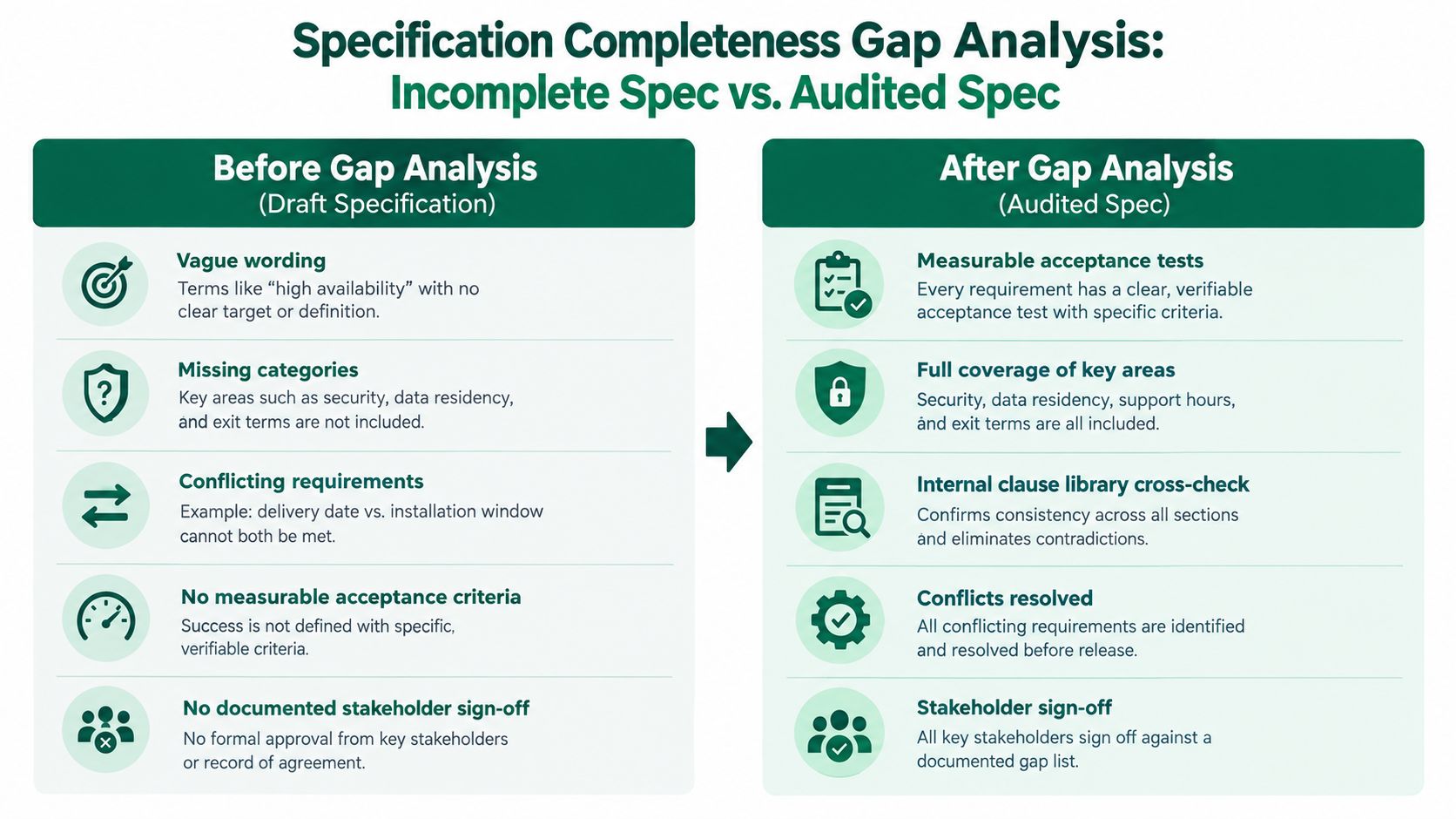
1. Specification Completeness Gap Analysis
A facilities team writes a cleaning-services specification with room schedules, staffing assumptions, and inspection duties. It looks detailed until someone asks what happens when a flood, spill, or security incident requires urgent attendance. The specification defines routine frequency but says nothing measurable about emergency response.
That is a requirement gap, not a minor drafting issue. The review should compare every stated need with a measurable acceptance test, a defined scope boundary, and an accountable owner. For example, the missing requirement could become an urgent-incident response time, coverage hours, escalation path, restoration standard, and evidence required after the incident.
The same problem appears in technology purchases. “High availability” isn't an acceptance criterion. The buyer needs a target, a measurement period, a failover-time limit, and a test method. A practical review can follow the principles in this procurement specification completeness checklist for IT teams.
What the review should record
Gap found: Urgent incidents have no response commitment, and “high availability” has no target or test.
Clause or acceptance criterion: Add response-time, escalation, availability, failover, reporting, and test requirements.
Risk level: High, because bidders may price different service levels and the buyer may have no enforceable remedy.
Decision record: Store the original wording, reviewer, evidence, approved replacement clause, owner, decision date, and document version.
Run this review before the specification reaches the market. Record why each gap was closed, rejected, or converted into a supplier question. That history matters because a later reviewer should be able to distinguish a deliberate omission from an overlooked one.
2. Single-Bidder and Supply Market Depth Analysis
A hardware tender names a particular chassis type because the technical team has used it before. The requirement may be familiar, but familiarity isn't the same as necessity. A market review finds other manufacturers that meet the actual cooling, expansion, rack, security, and support needs.
The gap here sits between the buyer's preferred design and the market's viable alternatives. A restrictive reference can reduce competition, increase dependency, and make a single-bidder result look like a market fact when it was partly created by the specification.
Start by documenting the search method, the qualified suppliers found, and the reason each supplier was included or excluded. Then separate a genuine technical constraint from a preference. “Must use Vendor ABC's chassis” should normally become functional requirements unless that exact design is essential and the justification is documented.
Practical rule: Treat every proprietary reference as a question that needs evidence, not as a requirement that needs obedience.
A software purchase may need a different response. If only one platform supports a core capability, split the requirement into a core platform lot and a separate integration lot where possible. That can preserve the necessary capability while allowing more suppliers to compete for surrounding work.
Gap found: The draft specification may describe a preferred brand or architecture rather than an objectively necessary capability.
Clause or acceptance criterion: Use open functional requirements, interoperability tests, and a documented exception for any proprietary dependency.
Risk level: High where supplier choice is narrow or switching is difficult.
Decision record: Preserve supplier-search terms, market findings, restriction rationale, lotting decision, and approver.
The trade-off is clear. An open specification may require more evaluation work, while a narrow one may simplify review but weaken competition and increase dependency. The decision record should show why the buyer accepted that trade-off.
3. Supplier Capability Compliance Gap Analysis
Three suppliers answer “yes” to an uptime requirement. On closer review, only one offers a contractual service-level agreement with service credits. The other two describe historical performance or marketing commitments, but neither gives the buyer an enforceable remedy.
A supplier comparison should therefore use yes, partial, and no ratings with defined meanings. A “yes” means the evidence directly meets the requirement. “Partial” means the supplier may meet it but has an unresolved condition, limitation, or missing proof. “No” means the evidence conflicts with the requirement or shows that the capability isn't available.
The same discipline applies to data residency. A supplier may answer “yes” while citing a document that covers backup storage only. The correct action is to revise the rating to partial and ask where production data is hosted, which locations apply, and what contractual commitment governs the answer.
Evidence must travel with the rating
For each requirement, retain the supplier answer, document name, version, page or section, reviewer interpretation, clarification request, and final rating. Don't let a polished response sheet become the only record. A reviewer should be able to reproduce the conclusion from the cited evidence.
Gap found: The supplier's claim is broader than the supporting document, or a commercial remedy is missing.
Clause or acceptance criterion: Require a contractual SLA, service credits, defined residency scope, and verification evidence.
Risk level: High for unsupported compliance claims tied to operational or legal exposure.
Decision record: Save the original answer, revised rating, clarification exchange, evidence citation, reviewer, and approval.
The trade-off is speed versus defensibility. Accepting an untested “yes” keeps evaluation moving, but a clarification round takes less effort than discovering after award that the supplier meant something else.
4. Contract Clause Coverage Gap Analysis
A supplier misses a response target, and the buyer discovers that the contract offers no service credit, cure period, or escalation route. The service description promised performance, but the signed terms did not turn that promise into an enforceable remedy.
Exit terms create a separate exposure. A software licence may permit access during the contract term while omitting data-return format, deletion evidence, transition support, and exit assistance. The buyer then faces a practical choice: pay the incumbent's transition costs or accept delays while it controls the timing and format of the handover. A guide on contracts for Amazon sellers shows how exit and data-return clauses can be drafted in high-liability agreements.
Review the specification against the agreement line by line. Record the related clause, schedule, acceptance test, reporting duty, and remedy. A requirement that appears only in the specification is difficult to enforce after signature. The SaaS contract checklist provides a useful review frame for service levels, security, data processing, audit rights, renewal, termination, data return, deletion, and transition assistance.
Gap found: A service promise lacks a defined remedy, or termination leaves data return and supplier cooperation unclear.
Clause or acceptance criterion: Add tiered service credits, cure rights, acceptance conditions, a specified data format, deletion evidence, and transition duties with owners and deadlines.
Risk level: High when operations depend on uninterrupted service or the supplier holds sensitive data. Medium when a workable alternative supplier and tested export already exist.
Decision record: Link each requirement to the clause, legal comment, negotiated change, approver, final contract version, and accepted residual risk.
The trade-off is commercial resistance. Stronger remedies may increase pricing or reduce supplier choice, while weaker terms leave recovery costs with the buyer. Record which protections were required, which were negotiated, and why any remaining gap was accepted.
5. Regulatory and Security Compliance Gap Analysis
A cloud supplier presents an ISO/IEC 27001 certificate, so the evaluation team marks the security requirement compliant. A scope review then shows that the certificate doesn't cover the product being purchased. The certificate exists, but the relevant service remains unverified.
This example shows why compliance review must test scope, validity, applicability, and evidence, not just the presence of a logo or certificate. The buyer should request the certificate scope, statement of applicability where relevant, expiry information, service boundary, and any compensating controls.
A SaaS vendor may also provide a data processing agreement that doesn't explain how sub-processors are notified. If the buyer's requirements include obligations under GDPR Article 28, the missing mechanism belongs in the contract review, not in an informal email thread.

Classify the exposure precisely
Gap found: The certificate scope excludes the purchased service, or a required processor obligation isn't reflected in the agreement.
Clause or acceptance criterion: Require applicable certification scope, current evidence, control references, sub-processor notification, incident duties, and compensating controls where needed.
Risk level: Critical or high when the gap affects legal obligations, regulated data, or an essential security control.
Decision record: Record the framework version, certificate scope, expiry information, cited control or article, security review, exception owner, and approval.
The trade-off is between supplier access and control strength. A smaller supplier may offer useful capability without every preferred certification, while a larger supplier may provide stronger evidence at a higher cost. Don't turn an unknown into an automatic failure. Rate the evidence accurately, involve security and privacy owners, and document any accepted residual risk.
6. Software License Entitlement vs. Usage Gap Analysis
An enterprise discovers that many named users in a productivity suite aren't active. The right conclusion isn't automatically “buy fewer licences.” The team needs to distinguish dormant accounts, seasonal users, shared workflows, contractors, and users who need occasional access but remain contractually entitled.
This analysis compares entitlements with actual deployment and use, then checks whether the vendor's metric matches the business model. A database licence priced per core creates another risk. A virtualization change can alter the licensed core count even if the application's user population stays stable.
Start with major renewals and expensive metrics. Pull usage from deployment and identity tools rather than relying on departmental estimates. Then read the terms for transfer, reassignment, virtualization, downgrade, audit, and minimum-commitment rights before proposing a reduction.
Gap found: The organization owns more access than it needs, uses more capacity than it has licensed, or misunderstands the licensing metric.
Clause or acceptance criterion: Define entitlement, approved deployment scope, reassignment rights, virtualization treatment, true-up method, and renewal adjustment.
Risk level: Medium for excess entitlement, high for under-licensing or a vendor audit exposure.
Decision record: Preserve entitlement files, usage reports, metric interpretation, assumptions, renewal model, owner, and approval.
The cheapest renewal isn't always the smallest renewal. A reduction that ignores growth, transfer rights, or audit terms can create a larger correction later.
A recurring review is more useful than a one-off cleanup. The trade-off is internal effort versus financial and compliance control. Put the review on the renewal calendar and record why the selected quantity and metric fit the actual deployment.
7. Post-Award Spec Drift and Commercial Deviation Gap Analysis
The buyer approves a specification requiring a 12-month warranty. The supplier's quote later lists a 90-day warranty. The difference may sit in a footnote, order form, manual, or standard terms rather than in the main response, which makes manual review unreliable.
Spec drift analysis compares the locked requirement with every document that can affect delivery or price. It should cover technical capability, warranty, delivery window, payment terms, exclusions, support, renewal, and supplier terms of service.
A payment change illustrates why commercial review belongs here. If the agreed terms are net-30 but the order form says net-60, the buyer should flag the deviation, identify the working-capital effect, and obtain approval before signature. A longer payment period may help the buyer, but an unapproved change still creates inconsistent records and possible supplier disagreement.
Gap found: A quote, order form, manual, or standard term conflicts with the locked specification or commercial agreement.
Clause or acceptance criterion: Require written deviation schedules, warranty alignment, delivery commitments, payment confirmation, and acceptance of the controlled terms.
Risk level: High where the deviation affects service, price, delivery, warranty, or acceptance.
Decision record: Cite the exact document and page, state the required correction, name the approver, and record the approval date.
The trade-off is timing. Rejecting a deviation before signature can delay award, while accepting it informally may create a harder dispute during delivery. Require suppliers to identify deviations explicitly and keep the approved baseline in one controlled record.
7-Point Gap Analysis Comparison
Analysis Type | Implementation Complexity 🔄 | Resource Requirements & Efficiency ⚡ | Expected Outcomes ⭐ / Impact 📊 | Ideal Use Cases 💡 | Key Advantages |
|---|---|---|---|---|---|
Specification Completeness Gap Analysis | 🔄 Moderate, structured review against templates; repeatable | ⚡ Low–Moderate: requirements reviewers, clause library; quick to rerun | ⭐ High clarity; 📊 fewer change requests & disputes | Draft specs before market release; category-spec creation | Prevents omissions; measurable acceptance criteria; documented sign‑off |
Single-Bidder & Supply Market Depth Analysis | 🔄 Moderate, market research and supplier screening | ⚡ Moderate: market data & outreach; may need intelligence tools | ⭐ Medium, improved competition; 📊 reduced single‑bid risk | When supplier count uncertain; proprietary or niche categories | Identifies restrictive spec language; widens participation; supports sole‑source justification |
Supplier Capability Compliance Gap Analysis | 🔄 High, requirement‑by‑requirement mapping per supplier | ⚡ High: evaluator time, evidence collection; benefits from tooling | ⭐ High, objective, defensible comparisons; 📊 clear elimination rationale | Multi‑supplier technical evaluations; high‑risk procurements | Surfaces overstated claims; evidence trail; enables targeted clarifications |
Contract Clause Coverage Gap Analysis | 🔄 Moderate, checklist vs contract draft; legal input needed | ⚡ Moderate: legal review and clause library; template reuse speeds work | ⭐ High, reduced legal/commercial exposure; 📊 aligned remedies & SLAs | Before signature on high‑liability or long‑term contracts | Closes legal gaps; proposes insertable clauses; aligns contract to spec |
Regulatory & Security Compliance Gap Analysis | 🔄 High, framework/control mapping and certificate validation | ⚡ High: security/compliance specialists, certificate checks | ⭐ High, audit‑ready evidence; 📊 lower regulatory risk | Data‑sensitive purchases; regulated sectors (GDPR, SOC2, ISO) | Distinguishes certified vs self‑declared; tracks remediation & scope |
Software License Entitlement vs Usage Gap Analysis | 🔄 Moderate, reconciliation of entitlements and usage metrics | ⚡ Moderate–High: usage data, SAM tools, IT involvement | ⭐ High, cost optimization; 📊 reduced audit exposure & better budgeting | Large renewals, per‑seat/core/resource‑priced licenses | Identifies over/under‑licensing; models renewal scenarios; improves negotiation |
Post‑Award Spec Drift & Commercial Deviation Gap Analysis | 🔄 High, cross‑document comparison (quotes, forms, manuals) | ⚡ Moderate: document processing tools and reviewers | ⭐ High, protects negotiated terms; 📊 quantifies commercial impact | Pre‑signature checks and ongoing delivery monitoring | Catches silent changes; quantifies deviations; records approvals and decisions |
Turning Each Gap Into a Decision Your Auditors Can Trace
A gap analysis becomes useful when it changes a decision, not when it merely produces a list of weaknesses. Start with the specification. Compare each requirement with the operational need, define its acceptance test, identify ambiguous language, and separate a missing requirement from a missing piece of knowledge.
That distinction matters. If the buyer doesn't know the normal support model for a category, the answer may be an RFI or supplier-discovery exercise rather than an arbitrary mandatory clause. “Local support required” should become measurable coverage hours, response time, escalation, parts availability, and remote-support conditions. Otherwise, an uninformed preference can narrow competition without proving that it protects the business.
Then test the market. Record the search method, supplier pool, proprietary dependencies, and reasons for exclusions. Compare supplier claims with source documents and rate them as yes, partial, or no according to rules agreed before evaluation. Finally, map the accepted requirements into the contract and check every later document for drift.
A single decision record should connect:
The requirement: The exact wording, owner, version, and acceptance method.
The gap: The missing, ambiguous, contradictory, unsupported, or changed element.
The evidence: The source document, page or section, date, and confidence.
The action: The clause, clarification, supplier question, control, or exception.
The decision: The final rating, approver, date, and accepted residual risk.
AI can speed up document comparison, but an AI explanation alone isn't an audit trail. The record should preserve the source passage, interpretation, scoring rule, human override, weighting change, and final approval. This is especially important because procurement teams need to reconstruct why a supplier was accepted, rejected, or marked partial after documents change.
The historical case for early gap closure is strong. A Carnegie Mellon Software Engineering Institute review reports that 42% to 64% of defects originate in requirements engineering or requirements-and-design activities, and that correcting requirements defects after field deployment can cost 50 to 200 times more than correcting them earlier. That review supports a practical procurement rule: resolve uncertainty before award whenever the requirement affects acceptance, cost, compliance, or dependency.
On your next tender, choose one active requirement and trace it from draft wording to supplier evidence, contract clause, acceptance test, and final approval. If any link is missing, you've found your first actionable gap. Tools such as audit-ready compliance reporting workflows can help centralize that chain, while a procurement platform such as Procright can support specification gap analysis, evidence-backed supplier comparisons, and spec-drift review.
Procright supports procurement teams with specification gap analysis, supplier compliance scoring, source citations, and deviation checks across quotes, manuals, and terms. Use Procright to turn your next tender review into a decision record that shows what changed, why it changed, and who approved it.
Try it on a real buy
Bring one category. Watch where the flags land.
We use a little analytics to see which pages actually help. Nothing else, no ad trackers.