SaaS Contract Checklist: 10 Procurement Checks
A practical SaaS contract checklist connects contract language with operational requirements, vendor evidence, and an audit-ready decision record.
In this article
Before you sign a SaaS agreement, test it against the day the service fails, usage rises unexpectedly, a supplier suffers a security incident, or your business needs to move to another platform. A contract that looks acceptable during procurement can become expensive when the uptime promise excludes the affected service, overage rules count usage you can't audit, or data export turns out to exclude permissions and audit history.
A practical SaaS contract checklist connects contract language with operational requirements, vendor evidence, negotiation power, and an audit-ready decision record. Use it against the full contract package, not only the master agreement. That means reviewing the order form, service-level agreement, data processing addendum, security exhibits, support policy, product schedules, and every referenced online term.
The ten checks below follow the enterprise procurement workflow. First, lock measurable requirements. Then verify the vendor's evidence, compare commercial exposure, and preserve remedies that remain usable after signature. Finally, detect drift between the agreed specification and the documents your team is about to execute.
Table of Contents
4. Payment Terms, Pricing Model, and True-Up or Overage Clauses
9. Business Continuity, Disaster Recovery, and Incident Response
10. Onboarding, Training, Documentation, and Change Management
1. Service Level Agreements and Performance Metrics
An uptime percentage is only useful when the contract explains how the vendor will measure it. A 99.0% annual uptime commitment permits approximately 87.6 hours of downtime, while 99.5% permits about 43.8 hours, 99.9% permits about 8.76 hours, and 99.99% permits roughly 52.6 minutes, according to VendorBenchmark's SaaS SLA analysis. Those differences can be acceptable for a low-criticality collaboration tool and unacceptable for payments, identity, manufacturing, or public services.
Write the SLA as a control system. Record the measurement period, covered service components, outage definition, monitoring source, planned-maintenance exclusions, incident-response targets, claim deadline, service-credit formula, and escalation route. Don't accept a headline uptime figure if exclusions could remove the failures your business cares about.
Tie the remedy to business impact
Service credits should be easy to claim and meaningful enough to discourage repeated failures. Automatic credits are preferable. If the vendor won't make them automatic, require a simple claim process with a clear calculation and a deadline that doesn't depend on the customer discovering the outage immediately.
Practical rule: An SLA is incomplete until it explains what happens after the vendor misses it repeatedly.
Include support-response commitments, performance thresholds where relevant, and a right to escalate or terminate after material or repeated failures. Request historical availability reports and incident records during due diligence, then attach the accepted performance requirements to the contract or SLA exhibit. This SaaS contract negotiation guidance can help procurement teams identify gaps before they become redline disputes.
2. Data Security, Privacy, and Compliance
Security evidence should answer a procurement question, not merely decorate a vendor portal. Ask for the vendor's current audit reports, certifications, security policies, incident-response procedures, data-flow information, and list of material subprocessors. Then compare those documents with the data your organization will process and the controls your internal policy requires.
A SOC 2 report or ISO 27001 certificate can support diligence, but it doesn't replace contract language. The agreement should define encryption obligations, access controls, tenant isolation, audit logging, vulnerability management, incident cooperation, breach-notification deadlines, and responsibility for preserving evidence. For personal data, include an appropriate data processing addendum and address cross-border transfer requirements. For regulated workloads, add the required sector-specific schedule rather than assuming a general security statement is enough.
Review the vendor ecosystem, not just the contracting entity
Third-party exposure often sits outside the vendor's primary security presentation. SecurityScorecard's analysis of 1,000 breaches found that 35.5% involved a third-party nexus, up from 29% the prior year, as reported in its 2025 third-party breach report. Your checklist should therefore require disclosure of material subprocessors and fourth parties, notice of changes, flow-down security obligations, and rights to suspend risky integrations or terminate unresolved high-risk findings.
Check the evidence date, scope, exclusions, and expiration. A certificate that covers a different service or an old reporting period may not support the risk decision. Procright can be used to review vendor security risks in procurement platforms and connect published evidence to the requirements in the specification.
3. Data Ownership, Portability, and Exit Rights
A data-ownership clause should be direct: the customer owns customer data, and the vendor may use it only to provide, secure, and support the contracted service. Define whether customer data includes uploaded files, account records, prompts, embeddings, workflow history, audit logs, attachments, permissions, metadata, and generated outputs. AI-enabled services make this distinction especially important because a vendor's platform may process several different asset types under one broad definition.
Data export must be testable. Specify the export schema, machine-readable formats, included metadata, response time, export frequency, read-only transition access, and assistance available during migration. Ask the vendor to demonstrate a test export using representative data before signature. If the export omits permissions, links, audit history, or embedded content, procurement needs to record that limitation as a switching risk.
Make deletion and transition operational
The contract should state when production data, backups, logs, and retained copies will be deleted or made inaccessible. Require a deletion certificate and define how long backup copies may remain. Also address what happens if the vendor is acquired, changes its pricing model, suffers a prolonged outage, or stops supporting a product tier.
Free or technically available export isn't the same as practical portability. A vendor may provide an API but leave your team to reconstruct relationships, permissions, and workflows without assistance. Include transition support, a defined service window, migration cooperation, and a prohibition on unreasonable extraction fees. Keep recurring export options available during the term so exit doesn't become the first time your team tests recoverability.
4. Payment Terms, Pricing Model, and True-Up or Overage Clauses
Commercial risk often hides in definitions. Before approving the order form, define the billable unit, included capacity, committed usage, renewal baseline, consumption metric, minimum purchase, overage trigger, and true-up process. “Active user,” “transaction,” “storage,” and “API call” can each produce different invoices unless the contract gives them precise meanings.
Separate fixed subscription fees from variable consumption charges. Require detailed invoices with usage records your team can reconcile, and give the customer a defined period to dispute an inaccurate true-up. The vendor should explain how it handles deleted or inactive users, unused licenses, rolled-over capacity, seat reductions, and additional purchases during the term.
Model the whole lifecycle
Renewal language deserves the same attention as the initial price. A 2025 SaaS-buying survey reported that 60% of agreements were long-term, according to the data summarized in SaaS renewal and contract guidance. Long terms can provide budget predictability, but they also increase exposure to automatic renewal, price increases, unused capacity, and changing product packaging.
Your checklist should capture the initial term, renewal length, exact notice method, notice deadline, price-adjustment mechanism, currency, taxes, minimum commitments, and any requirement to buy additional seats. Assign an internal owner and calendar the deadline. Also negotiate advance notice of metric or packaging changes, a cap on automatic increases, and a right to reduce unused capacity at renewal. Use weighted cost comparison to evaluate committed-seat and consumption-based proposals on the same assumptions, including overages and exit costs.
5. Integration, APIs, and Technical Interoperability
An integration requirement isn't satisfied by a vendor's statement that “an API is available.” Procurement should obtain an endpoint and capability matrix showing which records can be read, written, deleted, synchronized, and exported. Confirm whether the platform supports webhooks, bulk operations, sandbox testing, authentication methods, versioning, and the data relationships your architecture requires.
Test the critical workflow before signature. A trial should prove that the system can create, update, reconcile, and recover the records your teams depend on. Check rate limits, synchronization frequency, error handling, retry behavior, pagination, and API availability. If the integration is business-critical, the API should have a service commitment that aligns with the main service and a support path for integration failures.
Protect the integration from product change
Require advance notice before the vendor deprecates endpoints, changes schemas, removes connectors, or alters authentication. The notice period should give your technical team time to assess the change, test a replacement, and deploy it without interrupting operations. Documentation should be maintained and versioned, not left as an informal help-center promise.
Integration risk is a contract issue when a product change can force your team into manual work, reimplementation, or an unplanned migration.
Specify who pays for custom integration work and who owns the resulting code and configuration. Clarify whether support covers the vendor's API, pre-built connectors, and customer-developed integrations. Procright can compare locked integration requirements with documented vendor capabilities and flag gaps before award.
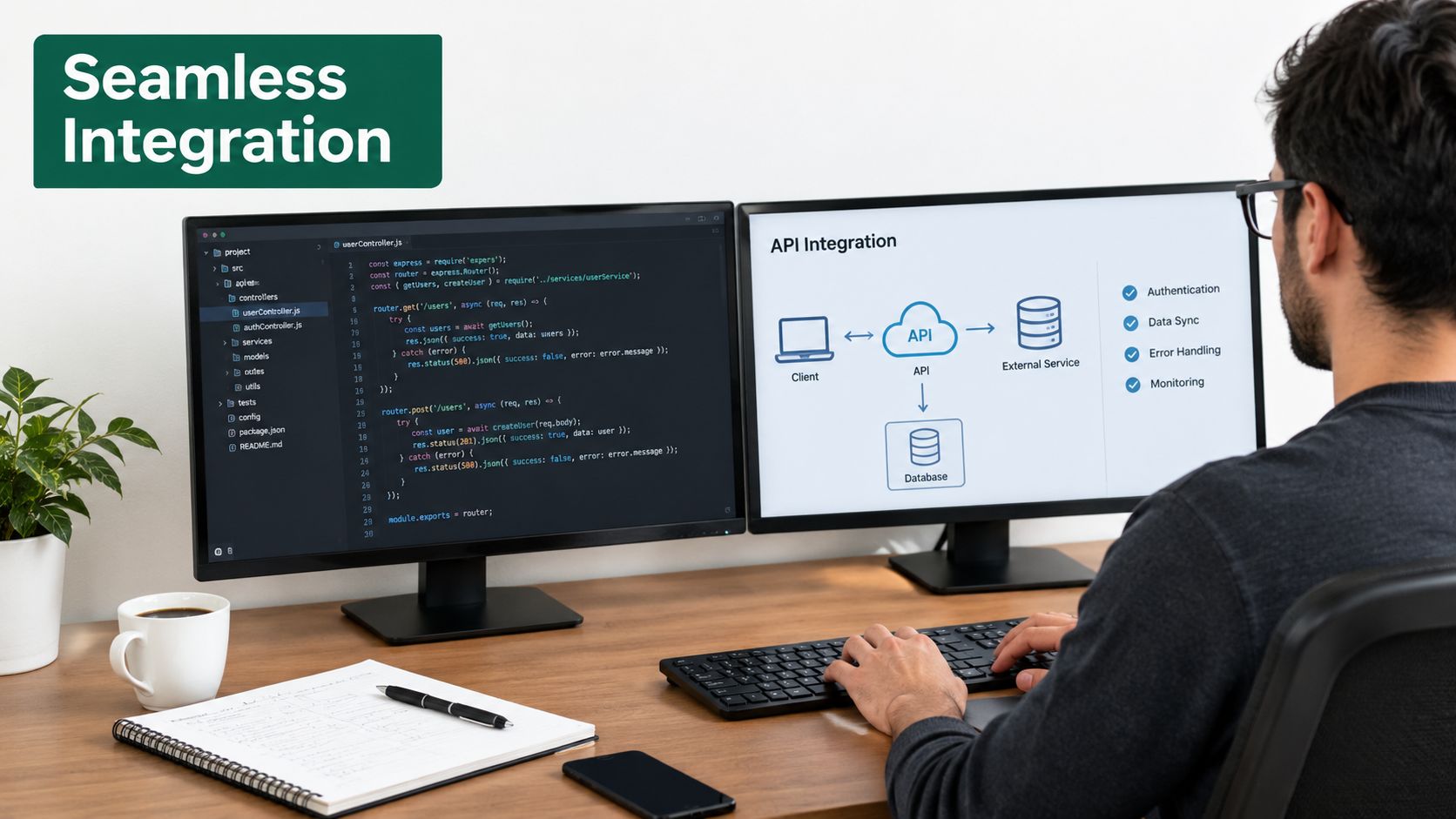
A sandbox result is stronger evidence than a sales presentation. After the technical test, retain the relevant API documentation, test notes, limitations, and vendor responses with the procurement record.
6. Intellectual Property Ownership and License Scope
Separate four things in the contract: vendor platform IP, customer data, customer-created content, and implementation work. The customer should receive the rights needed to use the service, reports, configurations, workflows, and outputs created for its business. The vendor should retain ownership of its pre-existing software and general know-how, but that ownership shouldn't extend to customer-specific materials or data.
Review vendor rights to use feedback, telemetry, usage patterns, prompts, generated outputs, and anonymized information. “Anonymized” should have a usable definition and should not allow the vendor to identify the customer or reconstruct sensitive content. For AI features, state whether customer data, prompts, outputs, embeddings, or fine-tuning artifacts may be used to train models or improve services. Require consent for uses outside service delivery and address provider telemetry separately.
Protect the implementation and third-party rights
If the vendor or a professional-services partner creates custom code, reports, configurations, or integrations, specify ownership and the license each party receives. Don't assume the order form resolves this. The implementation statement of work and the SaaS agreement need to use compatible definitions.
Ask for disclosure of open-source components and applicable obligations. IP indemnity should address third-party infringement claims, with procedures for notice, defense, settlement, and customer cooperation. Make sure the remedy includes a practical path if an infringement claim prevents continued use, such as replacement, modification, or a refund for the affected service.
Also review restrictions on security research, testing, reverse engineering, and interoperability. A blanket prohibition can obstruct legitimate assessment or migration work. Procright can help compare IP language, open-source disclosures, and published terms against the procurement team's approved positions.
7. Support, Maintenance, and Service Commitments
Support terms should describe the service your operations team will receive, not just the channel where it can open a ticket. Define severity levels using business consequences. A production outage, material data-loss risk, security incident, major feature failure, and cosmetic defect shouldn't all receive the same response.
For each severity, record support hours, response target, update frequency, escalation route, engineering involvement, and resolution or workaround expectations. If your team operates across regions or outside business hours, confirm that support coverage matches the production environment. Premium support shouldn't be accepted as a vague label. The contract should identify the included tier, named contacts, escalation process, and any additional fees.
Treat maintenance as a scheduled operational event
Maintenance exclusions can weaken both support and uptime commitments. Require notice, defined maintenance windows, coordination with critical business periods, and an emergency-maintenance process. Ask how the vendor communicates incidents, status changes, workarounds, and restoration progress.
Test support during the evaluation phase. Submit a realistic technical question and record the response quality, time, ownership, and escalation behavior. That evidence won't replace a contract commitment, but it can reveal whether the support model matches the promises.
For critical systems, include a technical account contact or equivalent escalation path. Also clarify whether the vendor supports integrations, custom configurations, and customer-specific workflows. If those elements are excluded, document the boundary and price the required professional services before approval. Post-award, monitor ticket response and escalation records against the agreed schedule so a support downgrade doesn't remain invisible until the next renewal.
8. Warranties, Disclaimers, and Limitation of Liability
Read the warranty and disclaimer clauses together. A vendor may promise that the service will conform to its documentation, then disclaim fitness, uninterrupted operation, accuracy, and suitability for your stated use. The practical question is what the customer can recover or require when the service fails to meet the specification.
Tie warranties to measurable acceptance criteria, security obligations, documentation, and agreed service commitments. If the vendor won't provide a broad performance warranty, preserve specific commitments for the functions that justified the purchase. Include a cure process, remediation obligation, and termination right for an uncured material breach.
Separate ordinary service risk from severe harm
A general liability cap based only on subscription fees may not reflect the exposure created by a data breach, confidentiality failure, IP infringement, gross negligence, or willful misconduct. Negotiate appropriate carve-outs or separate caps for these risks, and check whether the cap applies per claim or in the aggregate. The final position should reflect the data sensitivity, operational dependency, and realistic cost of response.
Ask for evidence of relevant insurance and confirm that coverage remains in force during the term. Insurance doesn't replace indemnity or liability language, but it can support recovery when a serious incident occurs. Also check the exclusive-remedy clause. Service credits may be appropriate for ordinary availability misses, but they shouldn't automatically eliminate remedies for confidentiality breaches, security failures, or a failure to return customer data.
Record the accepted fallback position in the negotiation file. A lower cap may be tolerable for a low-risk tool, but the decision should be explicit, approved, and tied to the business impact rather than accepted because it appeared in the vendor's template.
9. Business Continuity, Disaster Recovery, and Incident Response
Business continuity language must describe how the vendor will keep the service available, restore it, and help the customer operate during a disruption. Require documented recovery-time objectives and recovery-point objectives for critical services. Then check whether those objectives support your own continuity plan, not merely whether the vendor has a disaster-recovery document.
The SLA and the disaster-recovery schedule should address backup frequency, geographic redundancy, restoration procedures, failover responsibilities, permitted regions, and dependency on subprocessors. Ask for evidence from restoration tests, not just a policy statement. The evidence should show what was tested, what failed, what the vendor changed, and when the next test will occur.
Contract the response after the incident
Require prompt incident notification, regular updates, preservation of logs and evidence, customer cooperation, and a post-incident root-cause analysis. The vendor should provide remediation actions with accountable owners and target dates. For security incidents, define cooperation with forensics, regulatory inquiries, affected customers, and communications teams.
MITRE's cloud SLA considerations recommends addressing service quality, security, performance, failure remedies, and a complete exit plan. Its guidance also highlights provider assistance, fees, data retrieval, business continuity, and deletion or inaccessibility of retained copies. Use those points to turn a generic continuity promise into auditable obligations.
The contract should also identify customer responsibilities. If the customer must configure backups, maintain an alternate connection, approve failover, or provide emergency contacts, assign each duty to an owner. A recovery commitment is only credible when both parties know what they must do during the event.
10. Onboarding, Training, Documentation, and Change Management
A SaaS purchase can fail without a contract breach if users never adopt the product or a release breaks a critical workflow. Put the onboarding plan in the commercial record. Define milestones, deliverables, dependencies, customer inputs, training sessions, administrator enablement, data migration tasks, and acceptance criteria.
Training should match the people who will operate the service. Ask for administrator and end-user materials, recorded sessions where appropriate, documentation for new hires, and a clear route for unanswered implementation questions. If onboarding relies on a vendor consultant, identify the included work and the rate for additional services.
Make product change predictable
Require a maintained change log, release communication, deprecation policy, and notice for breaking changes. The vendor should explain whether a sandbox or staging environment is available and whether customers can test major changes before production release. Documentation should be updated when the product changes, especially for APIs, security controls, permissions, and export procedures.
A product promise is easier to manage when the vendor's roadmap, release notice, and documentation obligations are written into the operating model.
Define what happens if a material change removes a contracted capability, undermines an integration, or creates a compliance problem. Possible remedies include a replacement function, a transition period, additional support, a price adjustment, or termination for cause. Keep the onboarding plan, release commitments, and training assumptions with the final agreement. Guidance on onboarding a procurement tool without disrupting active RFP cycles is useful when implementation overlaps with live sourcing work.
SaaS Contract Checklist, 10 Key Clauses Compared
Item | 🔄 Implementation Complexity | ⚡ Resource Requirements | 📊 Expected Outcomes | 💡 Ideal Use Cases | ⭐ Key Advantages |
|---|---|---|---|---|---|
Service Level Agreements (SLAs) and Performance Metrics | 🔄 Medium, negotiation + monitoring and legal review | ⚡ Monitoring tools, SRE/ops, legal time, SLA dashboards | 📊 Predictable uptime, financial remedies, reduced operational risk | 💡 Mission-critical production systems needing uptime guarantees | ⭐ Vendor accountability; measurable remedies; dispute reduction |
Data Security, Privacy, and Compliance (GDPR, HIPAA, SOC 2) | 🔄 High, audits, DPAs/BAAs, continuous compliance work | ⚡ Security engineers, third‑party audits, encryption/key management | 📊 Lower regulatory and breach risk; audit-readiness | 💡 Regulated industries (healthcare, finance), PII processing | ⭐ Independent verification (SOC 2/ISO), legal compliance |
Data Ownership, Portability, and Exit Rights | 🔄 Medium, contract clauses + technical export capability | ⚡ Export tools/APIs, migration support, legal negotiation | 📊 Reduced vendor lock‑in; controlled data exits; continuity | 💡 Large datasets, frequent vendor changes, strategic data assets | ⭐ Preserves proprietary data; enables migrations |
Payment Terms, Pricing Model, and True‑Up/Overage Clauses | 🔄 Medium, pricing models, true‑up policies, dispute terms | ⚡ Finance/procurement, usage analytics, audit rights | 📊 Better budget predictability; fewer surprise charges | 💡 Usage‑based services, large seat counts, variable consumption | ⭐ Cost control; clearer dispute resolution; TCO visibility |
Integration, APIs, and Technical Interoperability | 🔄 Medium–High, API maturity and custom integrations | ⚡ Developers, middleware, sandbox/test environments | 📊 Automated workflows, reduced manual work, data consistency | 💡 Multi‑system environments; real‑time sync needs; automation | ⭐ Extensibility; faster integration and operational efficiency |
Intellectual Property Ownership and License Scope | 🔄 High, detailed legal negotiation and IP audits | ⚡ Legal/IP counsel, contract reviews, OSS license checks | 📊 Clear IP rights, portability of custom work, reduced disputes | 💡 Custom implementations, R&D, proprietary analytics | ⭐ Protects customer IP; prevents unexpected vendor claims |
Support, Maintenance, and Service Level Commitments | 🔄 Low–Medium, define SLAs, escalation, maintenance windows | ⚡ Support team/TAM, ticketing, monitoring, escalation paths | 📊 Faster issue resolution; planned maintenance; improved uptime | 💡 Production services needing rapid incident response | ⭐ Operational continuity; clear response and escalation paths |
Warranties, Disclaimers, and Limitation of Liability | 🔄 High, negotiate caps, carve‑outs, insurance terms | ⚡ Legal review, insurance validation, indemnity clauses | 📊 Defined remedies, capped exposure, clearer risk allocation | 💡 High financial exposure or sensitive-data engagements | ⭐ Certainty on liability; carve‑outs for breaches and IP claims |
Business Continuity, Disaster Recovery, and Incident Response | 🔄 High, RTO/RPO definitions, testing, vendor proof | ⚡ DR testing, backups, geographic redundancy, runbooks | 📊 Faster recovery, resilience, regulatory evidence of readiness | 💡 Mission‑critical systems, regulated industries, high‑availability apps | ⭐ Validated recovery plans; reduced downtime impact |
Onboarding, Training, Documentation, and Change Management | 🔄 Low–Medium, onboarding plans and release policies | ⚡ Customer success, trainers, documentation, sandbox access | 📊 Faster adoption, fewer support tickets, smoother upgrades | 💡 New deployments, large user bases, frequent employee turnover | ⭐ Reduced time‑to‑value; predictable change management and enablement |
Turn the Checklist Into a Negotiation Record
A checklist becomes valuable when it creates a controlled decision, not when it produces a long list of questions. Start by mapping every requirement to a clause, exhibit, order-form field, or documented vendor commitment. If a requirement appears only in a sales presentation, help-center page, or unsigned security response, mark it as unsupported until the contract incorporates it or the procurement team accepts the risk.
Use a simple response structure for each requirement: yes, no, or partial. Add the vendor's exact answer, the source document, the relevant page or section, the evidence date, the internal owner, and a risk rating. For each “partial” response, record what is missing and whether the requested fallback is acceptable. This gives legal, security, finance, IT, and operations a shared view of the decision instead of separate interpretations in email threads.
Lock the specification before comparing vendors
The strongest negotiating position comes from a clear baseline. Define the business-critical service components, required integrations, data classes, recovery needs, renewal protections, exit assets, and acceptable commercial model before vendors submit final proposals. Check for single-bidder requirements that unnecessarily narrow the market, then revise the specification or document why the restriction is justified.
Compare more than the subscription fee. Model committed usage, variable charges, overages, renewal exposure, support tiers, implementation work, extraction fees, transition assistance, and the cost of any missing control. A lower first-year price can create greater exposure if the vendor has broad exclusions, weak portability, or an expensive true-up mechanism.
Detect drift before signature and after award
Before signing, compare the final redline, order form, SLA, DPA, security materials, support policy, and linked terms against the locked specification. Look for changes introduced outside the redline, including a different renewal notice method, a narrower definition of customer data, a new subprocessor process, a reduced support tier, or an online policy that overrides the negotiated schedule.
After award, keep monitoring the obligations. Track renewal dates, notice periods, price-adjustment mechanisms, SLA reports, incident records, security evidence, subprocessor changes, export tests, deletion certificates, and support performance. A contract can drift operationally even when nobody edits the signed document. Vendor policy changes, product packaging, acquisitions, and new AI features can create a new risk that wasn't present at award.
PwC's 2024 Digital Procurement Survey reports that 50% of companies planned to invest in upgrading or implementing contract-lifecycle-management technology within three years, while 92% of procurement departments used source-to-contract solutions and 96% used procure-to-pay solutions. Those findings support a practical design choice: store SaaS contract obligations as structured, machine-readable fields instead of leaving them buried in PDFs.
Procright can support this workflow by centralizing supplier responses, citing evidence for compliance decisions, comparing weighted requirements, identifying specification gaps and single-bidder risks, and checking final documents for drift against the locked specification. Use it to preserve the requested position, accepted fallback, source evidence, approval owner, and post-award monitoring responsibility in one audit-ready record.
The strongest SaaS contract isn't the longest one. It's the contract with measurable obligations, evidence you can verify, remedies your team can use, and an exit plan that works in practice.
Use Procright to turn your SaaS contract checklist into a documented procurement workflow, with evidence-backed supplier comparisons, gap analysis, and pre-signature drift detection. Start reviewing your next SaaS agreement with Procright and preserve the decision record from first requirement to final award.
Try it on a real buy
Bring one category. Watch where the flags land.
We use a little analytics to see which pages actually help. Nothing else, no ad trackers.