Gap Analysis Process Before You Source
A gap analysis process turns gaps into controlled requirements before invitation, then follows them through supplier responses and delivery evidence.
In this article
Your backup-appliance specification looks ready to send. It names the brand, capacity, warranty period, and payment schedule. Then operations asks how quickly it must restore a failed workload, and procurement discovers that only one reseller carries the named model.
Neither issue is a missing detail you can safely settle during negotiation. One threatens the business case; the other threatens competition. A useful gap analysis process turns both into controlled requirements before invitation, then follows them through supplier responses, contract wording, and delivery evidence.
Table of Contents
Gap Scores That Block a Spec Lock
A finished-looking specification isn't necessarily a testable one. Capacity tells you how much the appliance stores, but not whether operations can recover the workload before downtime becomes unacceptable. A warranty heading doesn't tell finance whether payment falls due before anyone proves the equipment works.
Start with a register in Excel or a shared spreadsheet. Give each gap its own row, linked to the requirement it affects. Don't combine recovery performance, warranty coverage, and supplier eligibility into a single technical-risk entry. Different people control those exposures, and each needs different evidence.
Score the exposure, not the wording
For a practical internal scoring model, use likelihood from 1 to 5 multiplied by commercial impact from 1 to 5. These are proposed working rules, not universal procurement thresholds:
15 or higher: Treat the row as a lock blocker.
8 to 14: Require a written control and a named approver before release.
Below 8: Release with a documented disposition, unless a mandatory obligation requires escalation.
Assess likelihood against the draft as written, not against the supplier you hope will win. Assess impact through unpaid service credits, premature payment, downtime, replacement costs, or loss of competitive tension.
In the hypothetical appliance buy, no restore target earns a worked score of 5 × 4 = 20. Without a recovery commitment, the buyer could purchase equipment that meets its capacity requirement but fails the business need. A brand-only line earns 4 × 5 = 20 when it leaves the event unable to support competition.
Procurement gap register with lock rules
Copy these illustrative rows, then replace the scores with your team's assessment.
Gap type | Worked score | Clause that closes it | Owner | Later evidence |
|---|---|---|---|---|
Missing acceptance criteria | 4 × 4 = 16, lock blocker | Payment released only after a signed test | Spec writer | Test plan and signed result |
No restore or response target | 5 × 4 = 20, lock blocker | SLA with penalty and a measurement window | Operations | Service schedule and monthly report |
Single-bidder or brand lock | 4 × 5 = 20, lock blocker | Or-equal performance line, brand removed | Category manager | Market-scan note |
Warranty and payment conflict | 3 × 4 = 12, clause required | One precedence clause for conflicting terms | Legal | Redline accepted by both sides |
Compliance requested, no evidence | 3 × 3 = 9, clause required | Cite the certificate or mark the line declined | Compliance | Certificate, page, or URL |
Must-have with no owner | 2 × 3 = 6, file note required | Named RACI line inside the spec | Project lead | Sign-off log |
The owner column names the person responsible for inserting or approving the control. It isn't a distribution list. Add requirement ID, approver, closure condition, and actual closure date alongside the table.
For bidder-stage checks, distinguish this risk score from a procurement compliance score. Risk scoring sets the order of work; compliance scoring assesses the evidence against the resulting requirement.
Practical rule: A response saying the issue is noted doesn't close a gap. An approved change to the controlled specification does.
A low score also doesn't waive a legal or mandatory compliance requirement. Escalate those through the appropriate control owner, regardless of the arithmetic.
How to Run the Gap Analysis Process
A draft appliance specification can look complete while leaving reviewers unsure which version they are approving. Start with a controlled baseline, then carry each finding through the bidder response and into post-award evidence.

Establish the baseline
Freeze the draft. Save a version-controlled copy and assign an ID to every must-have, preference, and commercial term. Include attachments and service schedules. Reviewers need to work from the same baseline so an approved change can be traced to the right line.
Gather the inputs that affect the decision. Assemble the current contract or incumbent quote, relevant incident and missed-delivery history, stakeholder must-haves in their own words, the budget ceiling, and any brand or reseller restrictions. Choose an incident period that captures normal operations and relevant failures. Keep unrelated presentations out of the review folder.
If stakeholder notes are scattered, use a requirements-gathering template that feeds procurement specifications. Keep the original need beside the proposed wording so the technical owner can confirm that the requirement addresses the right problem.
Classify each line. Mark it met, partial, missing, or single-source. A requirement is partial when wording exists but bidders cannot be tested against it. “Rapid recovery,” for example, needs a workload, timing, and successful completion condition. Flag single-source lines separately: complete wording can still restrict competition.
Turn findings into release decisions
Score open rows. Apply the agreed likelihood-and-impact model and record a short reason for each score. State the exposure in concrete terms, such as inability to recover payroll, payment before commissioning, or exclusion of otherwise capable suppliers. Score before the detailed market scan so the team can resolve requirements before assessing vendors.
Specify the control and approver. Classify each gap as operational, commercial, legal, or timing-related, then draft the remediation in terms a supplier can answer. A general compliance statement will not resolve a conflict between invoice timing and acceptance.
For a service desk, specify which ticket events, timestamps, and reports will establish contractual performance. A measurement guide for SysAid workflow performance may help frame the workflow measures, but the contract still needs to define the evidence the buyer will accept.
Challenge the revised line with the technical owner. Could unrelated suppliers answer yes, no, or partial and cite a document page? If an acceptable answer requires the incumbent's proprietary feature name, determine whether that feature is truly required or just familiar. Check the control against the underlying need, not only the edited sentence.
Lock the controlled package. Check that the specification, attachments, gap register, and approval log agree. Record closure only when the required evidence exists. If a blocker remains under discussion, send the package back rather than releasing it with a promise to resolve the issue during bidding.
The chain continues after release: retain the bidder's answer against the requirement ID, record any accepted deviation and approval, then identify the post-award evidence that will show whether the commitment was met. This keeps the original need, contractual response, and performance proof connected.
The review can fit into focused working sessions when the draft and decision-makers are ready. The main scheduling risk is an approver who cannot decide the commercial trade-off. Assign approval authority before inviting comments, so a complete technical review does not stall while the team waits for a decision.
Clauses That Close Commercial Exposure
Take a facilities-services renewal and a server purchase. Both can contain detailed scope descriptions while leaving the buyer exposed at the point where money changes hands.
The facilities contract may define tasks without defining an acceptable completed service. The server quote may promise delivery without making successful commissioning a condition of final payment. Use clauses that address those failures directly.
Make payment follow acceptance
For a hypothetical server purchase, a buyer could insert:
A defined portion of the purchase price becomes payable only after the buyer signs the acceptance-test result. A failed test requires correction and retesting within the agreed acceptance window. Silence, delivery, and installation alone do not constitute acceptance.
Put the retained amount and test window in the commercial schedule after finance and operations approve them. The test should name the workload, configuration, success criteria, and person authorized to sign.
For facilities services, use a service-completion record rather than a hardware commissioning test. Identify who inspects the work and how the supplier corrects a rejected task. Don't withhold payment against an undefined standard that the supplier can't price or demonstrate.
Define the service clock and remedy
For the appliance's recovery service, draft the obligation around measurable events:
The supplier shall restore the named workload within the recovery period stated in the service schedule, measured from the recorded incident timestamp to successful completion of the agreed recovery checks.
Then specify the service-credit trigger, calculation, cap, and claim process. Separate acknowledgment, attendance, and restoration. A fast callback isn't recovery.
The trade-off is real: demanding recovery performance may increase the fee or require changes to network access, backup frequency, and buyer staffing. Allocate those dependencies explicitly, and have legal review whether the proposed remedy fits the contract.
Remove conflicts without removing protection
Use targeted inserts for the remaining exposures:
Competitive equivalence: Replace the model number with required throughput, usable capacity, rack space, interoperability, and parts-support obligations. Require equivalent offers to demonstrate each attribute rather than merely claiming equivalence.
Document precedence: State that the signed contract terms prevail over conflicting supplier documents, with approved deviations incorporated at their relevant line IDs. Legal should define the complete hierarchy and prevent unapproved boilerplate from overriding it.
Evidence-backed compliance: State that an affirmative answer without the required certificate, manual page, or public filing is assessed as partial pending evidence. Explain which requirements remain mandatory.
Competition exception: If the market scan still identifies only a capable sole supplier, document the reason and obtain the required competition approval before release.
A precedence clause doesn't repair a supplier's inability to deliver. Resolve operational contradictions before relying on document hierarchy.
Choose the highest-scoring open row and paste in the relevant draft control. Then ask its owner to complete the schedule, confirm the evidence, and approve the commercial effect. A usable clause is better than another general risk comment.
From Locked Line to Performance Proof
A noted gap has an explanation in the file. A resolved gap has a control that survives supplier documents and produces evidence during delivery. Tender release establishes the proposed control, not proof that the supplier performed it.
The monitoring weakness is material: the 2025 NIGP benchmark, covering 751 public-procurement respondents, found that only 29% used technology for supplier-performance management, while 41% had not undergone a contract-performance audit in the previous three years. Private buyers can leave the same practical hole when their procurement record ends at signature.
Follow the recovery requirement through the chain
For the hypothetical appliance, carry the restore obligation through these linked records:
Evidence-chain link | What the buyer retains |
|---|---|
Baseline requirement | Named workload and required recovery outcome |
Proposed control | Recovery clock, test method, and contractual remedy |
Bidder response | Answer with cited service schedule and manual pages |
Accepted deviation | Approved exception, or an explicit record that none was accepted |
Contract obligation | Executed wording incorporating the agreed requirement |
Performance evidence | Ticket timestamps, recovery results, and service reports |
Post-award review | Owner's assessment, remedy decision, and corrective action |
A requirements traceability matrix can hold the connections without forcing reviewers to search separate folders.
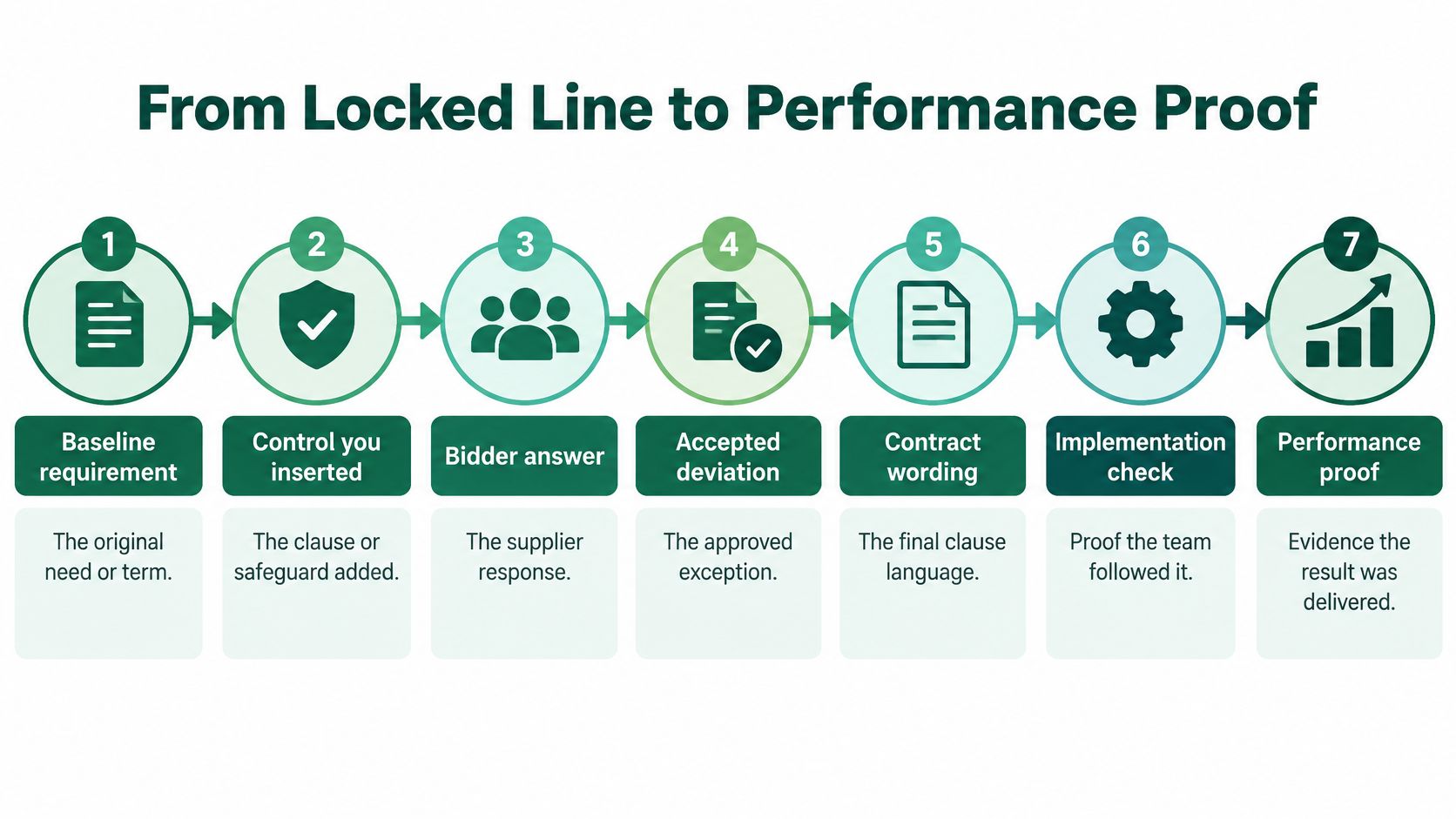
Say the specification requires restoration within a defined period, but the bidder's manual promises best effort and its quote offers next-business-day support. Those statements don't establish the same obligation. Procurement must obtain a binding commitment or route the exception for approval before award.
The commercial exposure includes more than delayed recovery. Finance may have priced the purchase on an enforceable remedy that the final supplier documents no longer support. Warranty exclusions can create the same mismatch by excluding the workload or operating conditions that mattered to the buyer.
Recognize drift before accepting it
A clarification becomes specification drift when it changes a tested value, remedy, delivery window, or allocation of risk. The label on the email doesn't determine its effect.
The authorized requirement or commercial owner, not the salesperson, approves that change. Record the originating page, revised obligation, business impact, and approval in the deviation log. Where procurement rules require broader notification or a renewed process, follow that route before proceeding.
Contract signature confirms agreement. The service report and the buyer's review establish whether the control worked.
Add accepted deviation and initial performance evidence to the register. Name the reviewer who will inspect that evidence during the opening operating quarter, including missed tickets and excluded incidents. Keep specification closure separate from performance verification so an approved draft doesn't appear to prove a delivered outcome.
Tips That Keep the Pass Short
The gap review should help the buyer decide, not become another project competing for attention. In 2024, 91% of global business purchases surveyed stalled at some point in the buying process, according to Forrester.
Workload makes that discipline important: in 2024, 53% of procurement and supply-chain managers and directors identified workload issues and inefficiencies as their organizations' top risks, according to research reported by Supply Chain Management Review. Those are different findings: workload risk isn't a measure of stalled buying activity.
Keep the review inside the buying event
Limit the first pass to requirements that affect money, uptime, mandatory compliance, or competition. Park preferences such as report layout unless they change how the team will operate or audit the service.
Bring the technical owner into the scoring session. Circulating an unscored document invites isolated comments, repeated explanations, and incompatible edits. A live decision on the disputed line is more useful than a long email thread.
Use these operating rules:
Separate omissions from disagreements: An omitted requirement needs wording. A disputed requirement needs an authorized decision-maker and a decision date.
Keep supplier preference visible: Record the incumbent relationship on the competition row. Don't let familiarity substitute for an eligibility test.
Reject brochure-led requirements: A brochure can evidence capability, but it can't decide what the business needs. Write the test before matching supplier language to it.
Preserve the baseline: Read bids against locked IDs. Treat a late stakeholder request as a change requiring assessment, not an invisible edit to the evaluation criteria.
Avoid false shortcuts
Don't lower impact because the failure would be awkward to explain. Translate it into an operational or financial consequence. Equally, don't inflate every inconvenience into a blocker, or the team loses the ability to prioritize.
Avoid closing a row because someone acknowledged an email. Record the changed clause and its approval. Supplier input can help explain feasibility, but giving a prospective bidder control of the final wording creates an avoidable competition risk.
Desk check: If the team can't describe the test, it isn't ready to score a supplier's answer.
Choose a live event and start with its potential blockers. Book the review before the next steering meeting, and bring unresolved decisions rather than a presentation about the template. The useful output is a clear release decision and a short list of accountable actions.
Lock the Spec or Send It Back
The release decision should fit on the steering group's decision record. Don't ask reviewers to infer readiness from a spreadsheet full of green cells.
Use this gate for the controlled package:
Lock: Every row scoring 15 or higher has an inserted control, a named owner, a test an independent capable supplier could pass, and an actual closure date; other required approvals are complete.
Return: Any blocker remains a comment, an unjustified brand restriction, an unsupported promise, or an unapproved exception.
Release: Invite suppliers only after the authorized buyer records that the package passed.
Hand over a decision record
Start with the highest-scoring open line. Resolve it or return it to its owner, then submit the register, gate result, and deviation log together. The steering group needs to see what was approved, what remains exposed, and who has authority to act.
During bidding, assign reviewers to the relevant quote, manual, and service-term pages. Preserve their evidence against the locked IDs so the award recommendation shows the offer accepted, not the offer everyone remembers discussing.
The contract manager should receive the same requirement references and the planned opening-quarter checks. That handover makes the procurement decision usable by operations and finance after the sourcing team moves to another event.
Use an outside check after scoring
For a second review before commitment, we offer Procright gap analysis on a submitted specification. It flags gaps, single-bidder lines, and missing clauses, including acceptance tied to payment and SLA penalty provisions, and suggests wording to add before the specification locks.
Run your own scoring first. Compare the flagged rows with your register, then let the authorized owners decide which changes to accept. An analysis can identify a missing safeguard; your team still owns the business trade-off and release approval.
The action this week is to lock or return the highest-scoring open line. Don't start another template while that decision remains unresolved.
Procright can check your draft specification for missing requirements, single-bidder restrictions, and commercial clauses before you release it. Bring your scored register and draft to Procright to compare the findings and identify the wording your team needs to approve.
Try it on a real buy
Bring one category. Watch where the flags land.
We use a little analytics to see which pages actually help. Nothing else, no ad trackers.