How Real-Time Updates Improve Procurement Accuracy
How live spec sync, AI-driven extraction, and governance cut PO errors, compliance misses, and inventory waste.
In this article
If your specs update late, your PO accuracy drops fast. I’d sum it up like this: one live record helps stop wrong items, wrong prices, late compliance checks, and supplier mix-ups before they turn into rework, delays, or extra cost.
Here’s the short version:
I see procurement accuracy as getting the right item, quantity, pack size, supplier, price, and lead time
The main problem is version drift across ERP records, spreadsheets, PDFs, and email
That drift leads to reduce costly procurement errors like invoice mismatches, stock issues, and compliance misses
Real-time updates help by giving teams one current record, with change logs, approval history, and synced data
AI tools help by pulling data from supplier files, standardizing units, and flagging mismatches before approval
This only works when there is clear ownership, audit trails, and system integration
A few numbers make the risk hard to ignore:
22% of construction rework is tied to poor project information
Design and documentation errors can add 1% to 9% to project cost
Poor data quality costs companies about $12.9 million per year
In one case, missing parts at production start dropped from 31% to 8%
In other cases, on-time delivery reached 99%, with inventory cuts of 32% and safety stock cuts of 66%
The core idea is simple: static specs create lag, and lag creates errors. I’d treat real-time updates as a control point that keeps engineering, procurement, suppliers, and inventory working from the same current data.
Webinar On-Demand: Turning Data Accuracy in Direct Procurement into a Competitive Advantage (Infor)
The Main Problems Caused by Outdated Specifications
Outdated specifications usually break down in three places: conflicting records, missed handoffs, and poor compliance calls. The issue isn't change. Change happens. The issue is slow sync.
Conflicting data across ERP records, spreadsheets, and supplier documents
This starts with a simple problem: different teams work in different AI procurement tools. Procurement uses supplier data in one platform, engineering owns the spec in PLM, and operations may still be using an older spreadsheet export. So even when people are doing their jobs, they're often doing them from different versions of the same spec.
Things get worse when supplier data shows up as unstructured PDFs or email attachments. Someone has to re-enter that data by hand, and that's where transcription mistakes and unit-conversion mix-ups creep in. A measurement might be stored in inches in one system and millimeters in another. Small error, big mess.
That can lead to:
PO matching failures
Freight cost overruns
Inventory reporting gaps that are tough to track down
Poor data quality costs organizations an average of $12.9 million annually. That's how version drift turns into wrong orders.
Miscommunication between engineering, operations, and procurement
Even when everyone means well, version drift creates gaps that no one can see until it's too late. A designer updates a spec in a local file. That update doesn't flow to procurement, which is still using an older export. Both sides think they have the current version. Neither spots the mismatch. The wrong product gets ordered.
This hits hardest with fast-changing parts and materials. Say engineering approves a substitute component, but procurement doesn't hear about it in time. The team may still source the original part, only to learn that it no longer fits the updated spec. By the time procurement sees the revision, the original part may already be obsolete.
Compliance failures and financial fallout
When specs fall out of sync, compliance checks stop being dependable. A purchase order can go out against a spec that no longer matches current safety or regulatory rules. Once that mismatch shows up, the order has already been placed, and the room to fix it shrinks fast.
JBT AeroTech dealt with this kind of execution gap by putting a structured process in place for managing supplier commitments. That cut missing parts at the start of production from 31% to 8% and improved supplier on-time parts arrival from 68% to 89%.
The point is simple: they closed the gap between what the system showed and what suppliers were actually delivering. When that gap stays open, companies end up with missed inventory, production delays, budget overruns, and compliance risk. These problems don't come from one-off mistakes. They come from delayed updates.
How Real-Time Specification Updates Fix the Problem
Real-time updates close the gap by pushing each approved change into the same live record. That matters because product and packaging data stays in one system of record, and ERP and inventory updates reach every team at the same time.
One source of truth with live data sync
Real-time purchase order workflows turn static documents into live records. Those records capture supplier confirmations, price changes, and substitutions as they happen. Instead of chasing updates across inboxes, every team works from the same current version.
That also changes how suppliers work with your team. They can update the live record directly instead of sending changes by email. One manufacturer used real-time PO collaboration to improve on-time delivery and cut inventory.
AI-driven data extraction, normalization, and change tracking
This is where automated procurement platforms help most. They turn live spec data into faster decisions with fewer mistakes.
AI tools pull data from PDFs, spec sheets, web pages, and video. Then they standardize units and attributes into one structure, so buyers can compare like with like before approval. If one supplier lists weight in pounds and another uses kilograms, the system lines them up in the same format. That saves time and cuts the back-and-forth.
Automated version control also tracks each change with a revision number and timestamp. That creates an audit trail, so every export uses the latest approved version.
Where Procright supports real-time accuracy
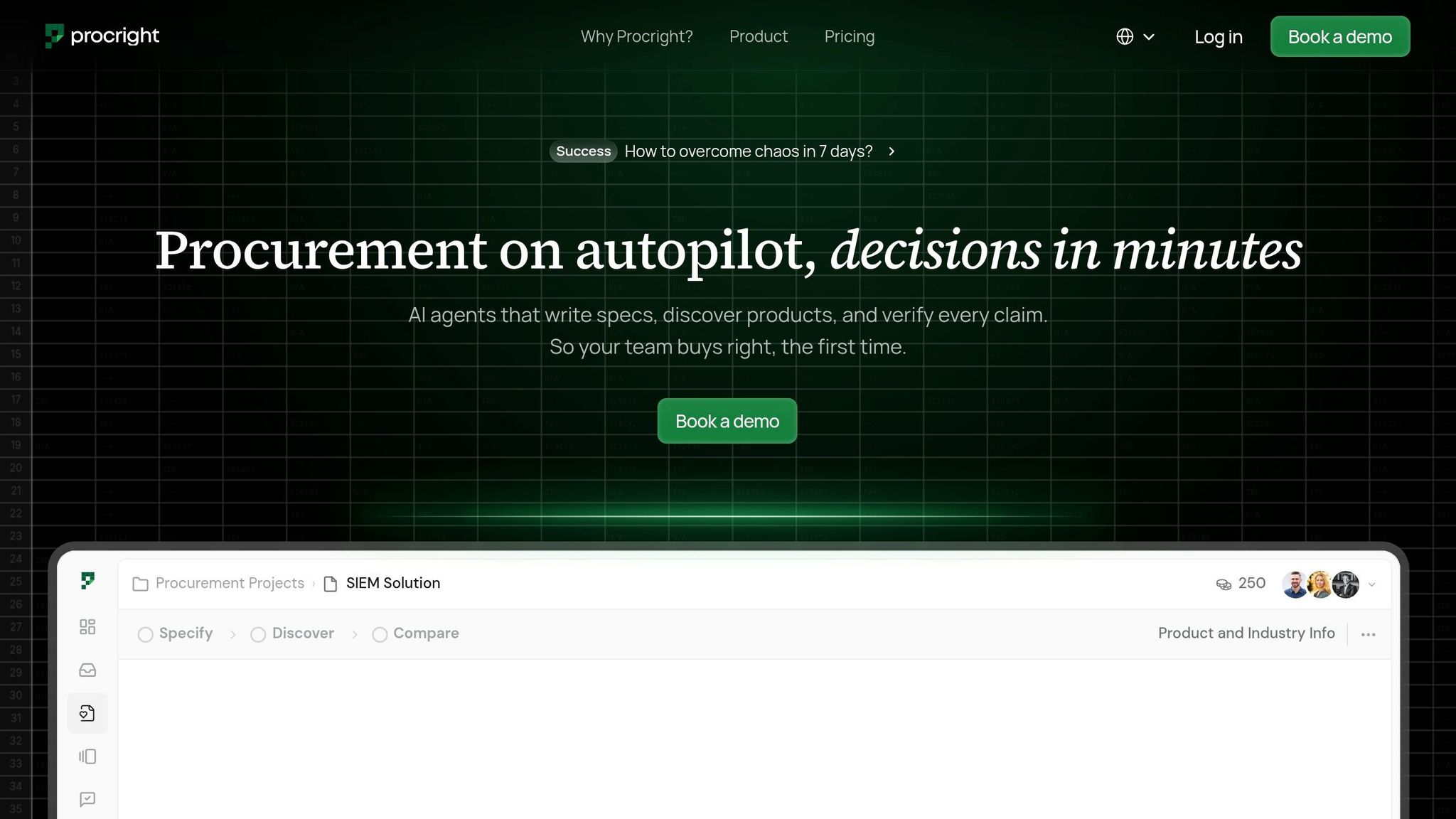
Procright supports this workflow by automating product specification creation, product discovery, and compliance verification. It compares products against requirements, pulls source data from PDFs, web pages, and video, and shows clear compliance scores like Yes, Partially, or No, tied to each source.
How Real-Time Updates Improve Accuracy in Practice
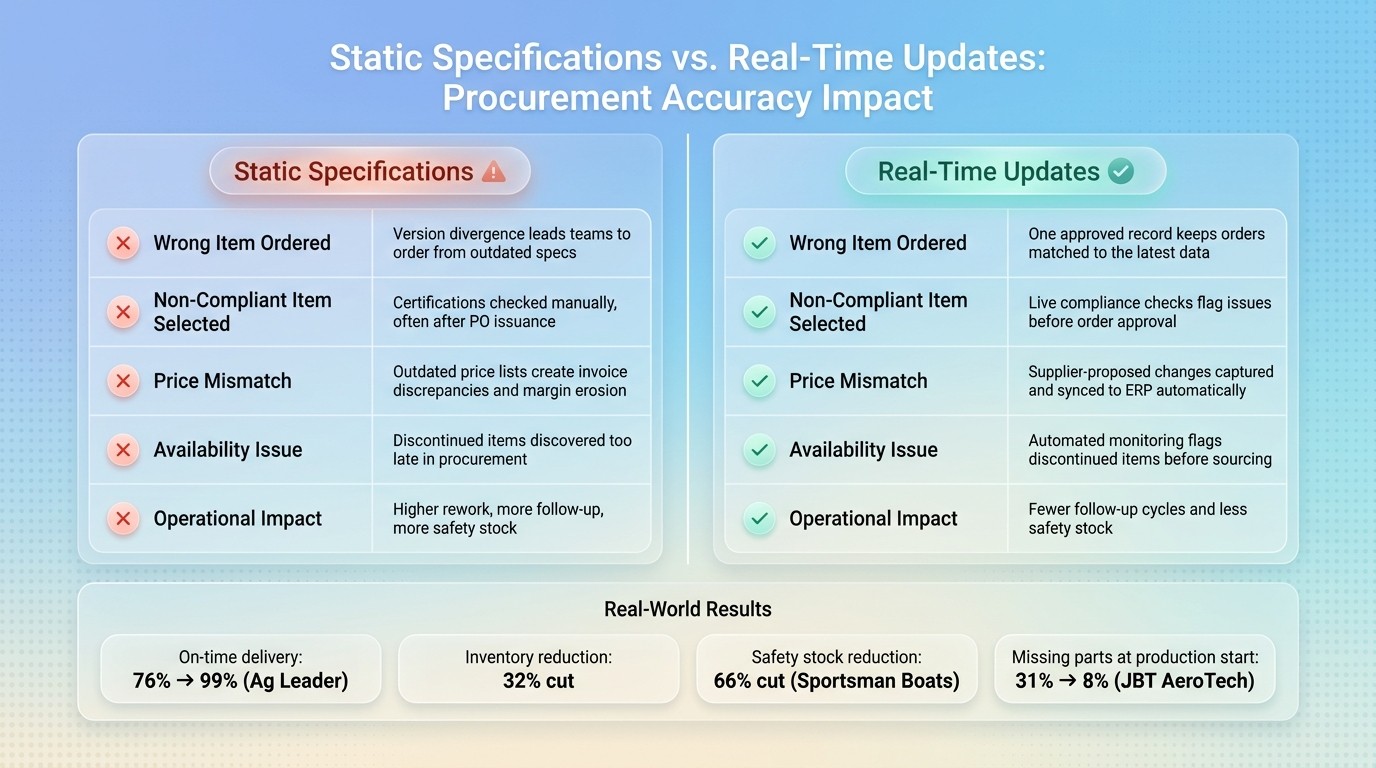
Static Specifications vs. Real-Time Updates: Procurement Accuracy Impact
Fewer errors in items, quantities, and pricing
The first place these controls show up is in PO accuracy. When changes sync to the live record, teams make fewer ordering mistakes. Shared live specs cut errors in item selection, pack size, and pricing because the price comes from one approved record instead of an old spreadsheet.
This hits hardest when a supplier changes price or quantity in the middle of a cycle. Real-time approvals keep the ERP in sync and help stop invoice mismatches before they happen. Exception alerts also catch price spikes, odd quantities, or discontinued SKUs before the PO goes out.
The payoff can be dramatic. Ag Leader improved on-time delivery from 76% to 99% and cut inventory by 32%. Sportsman Boats reached 99% PO-date accuracy and reduced safety stock by 66%.
Better compliance checks and supplier decisions
Accuracy also depends on one simple thing: is the spec current at the moment of approval?
When teams work from current specs, they can compare products for compliance before approval instead of fixing problems later. Procright gives both teams one compliance reference. That means less back-and-forth during approval and faster supplier decisions.
Comparison table: Static specifications vs. real-time updates
The gap shows up pretty clearly in the failure modes below.
Error Type | Static Specifications | Real-Time Updates |
|---|---|---|
Wrong item ordered | Version divergence leads teams to order from outdated specs | One approved record keeps orders matched to the latest data |
Non-compliant item selected | Certifications and standards are checked manually, often after PO issuance | Live compliance checks flag issues before the order is approved |
Price mismatch | Outdated price lists create invoice discrepancies and margin erosion | Supplier-proposed changes are captured and synced to the ERP automatically |
Availability issue | Discontinued items are often discovered too late in the procurement process | Automated monitoring flags discontinued items before sourcing starts |
Operational impact | Higher rework, more follow-up, and more safety stock | Fewer follow-up cycles and less safety stock |
What Organizations Need to Make Real-Time Updates Work
Data governance, ownership, and integration basics
Fixing these errors takes process discipline, not just better software. If a company wants real-time updates to work, it needs data-driven procurement decisions based on governed, structured data. That means treating specifications as structured records with dimensions, performance requirements, and approved vendors, not as editable PDFs or spreadsheets floating around with no change log. Version drift slows down when specs are clearly owned, structured, and synced.
Ownership matters just as much as structure. Engineers should own technical decisions. Procurement teams should own commercial approvals. When those lines get fuzzy, even a live system can spit out conflicting outputs. Each change needs a named approver and an automatic version bump so ERP, WMS, and EDI stay synced automatically.
Change management, auditability, and performance metrics
Once the data model is in place, adoption and traceability are what make it work day to day. And yes, adoption is usually the hard part. A smart place to start is with open purchase orders: capture supplier acknowledgments and route exceptions to buyers.
Audit trails aren't optional. They're required for internal controls and audits. Every change should include a timestamp, requester, and reason before approvals fall behind spec changes. AI outputs need that same paper trail, so compliance flags and product matches can be traced back to the source.
After the system is live, track the metrics that show where accuracy is breaking down:
Purchase order error rate
Return rate
Compliance incidents
Change orders
Cycle time
Expedited freight costs
These numbers show whether errors are falling or just popping up somewhere else.
Conclusion: Real-time updates turn specifications into a control point
With governance in place, the impact gets easier to measure. Ag Leader improved on-time delivery from 76% to 99% and cut total inventory by 32%. Those gains came from pairing live data with clear ownership and measurable accuracy targets.
Platforms like Procright help by automating specification creation, running compliance checks against current data, and giving teams clear compliance scores that stop outdated data from getting into approvals. Live data becomes a control point only when ownership and audit trails are in place.
FAQs
What counts as a real-time update in procurement?
In procurement, real-time updates are changes that show up in the system almost as soon as they happen. Instead of relying on static reports, teams can work from current information, not old data.
That can include automatic updates to pricing, inventory availability, and supplier compliance. It also covers purchase order acknowledgments, delivery tracking, and instant alerts when bottlenecks may be starting to form.
How do real-time updates reduce PO errors?
Real-time updates cut purchase order errors because they stop version mix-ups that happen when teams work from separate files or long email chains.
What do teams need before adopting real-time updates?
Teams first need high-quality, structured data. AI-driven systems work best when the information going in is consistent, accurate, and complete.
They also need to move away from manual, spreadsheet-based work and use centralized, role-based platforms that give people clear visibility and structured supplier workflows. Procright helps make that shift by automating specification creation and compliance verification.
Related Blog Posts
Try it on a real buy
Bring one category. Watch where the flags land.
We use a little analytics to see which pages actually help. Nothing else, no ad trackers.