Real-Time Data Integration for Compliance Verification
How live data integration enables instant compliance checks, continuous audit readiness, faster error detection, and lower compliance costs.
In this article
Outdated compliance methods are risky and slow. Real-time data integration solves this by offering instant updates, faster error detection, and continuous audit readiness. Here's what you need to know:
Real-Time Benefits: Live data updates ensure compliance issues are caught immediately, reducing risks and delays.
Audit Readiness: Always-on systems maintain a live evidence repository, avoiding last-minute audit chaos.
Cost Savings: Automation cuts manual work and compliance costs by up to 40%.
Traditional Methods Fall Short: Periodic reviews leave gaps where issues go unnoticed for months.
For fast-moving sectors like procurement, real-time systems are a game-changer. They provide accurate, up-to-date insights, helping organizations avoid penalties and operate more efficiently. While setup costs can be high, the long-term savings and risk reduction make it a smart choice for businesses dealing with frequent regulatory changes.
AI First Automation for Seamless Compliance & Data Integration
1. Real-Time Data Integration
Real-time data integration pulls live information from systems like ERPs, cloud accounts, HR platforms, and financial tools through APIs and streaming pipelines. This setup updates compliance data within seconds or minutes, ensuring data stays current and errors can be caught quickly.
Data Freshness
Traditional compliance tools often rely on snapshot models, where data is collected at specific intervals and reviewed later. Real-time systems change the game by using Policy-as-Code to validate configurations against frameworks like NIST or GDPR as changes happen. This means compliance checks are ongoing, eliminating the gaps found in periodic audits.
Error Detection Speed
With real-time integration, anomalies such as unauthorized transactions, configuration drift, or supplier risk monitoring flags expired certifications as soon as they occur, significantly reducing the time these issues go unnoticed.
"Traditional compliance is often retrospective. It looks at what happened over the last six months to prove adherence. Real-time compliance, however, is prospective and active." - Devi Narayanan, V-Comply
In addition to catching issues quickly, continuous data capture ensures organizations are always ready for audits.
Audit Readiness
Real-time integration transforms audit readiness into an ongoing process rather than a last-minute scramble. Audit logs are updated continuously, creating a live repository of evidence. Framework cross-mapping also simplifies compliance by allowing one piece of evidence to satisfy multiple standards - like SOC 2, HIPAA, and GDPR - at the same time. This eliminates redundant manual checks and streamlines the entire process.
"Audit readiness fades the moment the audit ends. Real-time compliance closes that gap, giving organizations continuous visibility and control between audit cycles." - Aman Pare, Cyber Security Analyst, Network Intelligence
Operational Effort
Automated workflows significantly reduce the workload associated with compliance. Companies using automated GRC tools have reported cutting compliance costs by up to 40%, thanks to the elimination of repetitive, manual tasks. AI-driven tools can categorize evidence automatically, freeing up teams to focus on strategic decisions. For example, platforms like Procright simplify procurement compliance by analyzing supplier data and providing clear compliance scores.
2. Older Compliance Verification Methods
Traditional compliance verification methods were built for a slower pace, where changes unfolded over weeks or months instead of minutes. These methods rely heavily on periodic reviews, manual data collection, and scheduled batch processing. The result? A compliance status that’s always slightly outdated.
Data Freshness
Older systems capture a single moment in time rather than providing a continuous, live feed of updates. Think of it as taking a snapshot of an access log or saving a static spreadsheet - this only reflects what was accurate at that specific moment. Josef Kamara, CPA, CISSP, CISA, put it best:
"The annual compliance audit is not a quality assurance mechanism. The audit captures organizational compliance posture on a single day, presented as evidence of year-round control effectiveness."
This approach creates significant gaps. For example, quarterly reviews leave an 89-day window where issues can go undetected, while annual audits leave a 364-day gap. In today’s fast-moving environment, this static approach simply can’t compete with the immediacy of real-time updates.
Error Detection Speed
Periodic review cycles mean compliance failures can go unnoticed for months. Sanctions controls also require effective governance and reporting. GVA Capital faced a $215.9 million penalty in June 2025 for knowingly managing investments for a sanctioned individual and failing to comply with an OFAC subpoena. Similarly, Unicat Catalyst Technologies paid $3.88 million in fines after shipments to Iran and Venezuela slipped through undetected for years under outdated controls.
Even commercial compliance databases aren’t immune to delays, often lagging 4 hours to 14 days behind the latest regulatory updates. These delays not only hurt audit readiness but also disrupt operational efficiency.
Audit Readiness
The delayed detection of errors makes audits even more challenging. Teams are forced to spend over 200 hours per cycle tracking down disconnected screenshots, spreadsheets, and documentation. And once they’ve assembled this evidence, it quickly becomes outdated, offering little assurance for events that happen after the snapshot was taken.
Operational Effort
Older methods also demand significant resources. Large organizations allocate 30%–40% of their financial-crime compliance budgets to periodic file refreshes. manual tasks like comparing products for compliance or conducting bank call-backs are not only time-consuming but also prone to human error. As Devi Narayanan of V-Comply aptly described:
"Spreadsheets are where compliance data goes to die. They are disconnected, prone to human error, and offer zero visibility into live risks."
Adding to the inefficiency, traditional audits typically examine only around 5% of data files, leaving the vast majority of transactions unreviewed between cycles . These limitations highlight the pressing need for real-time, automated solutions to modernize compliance verification.
Pros and Cons
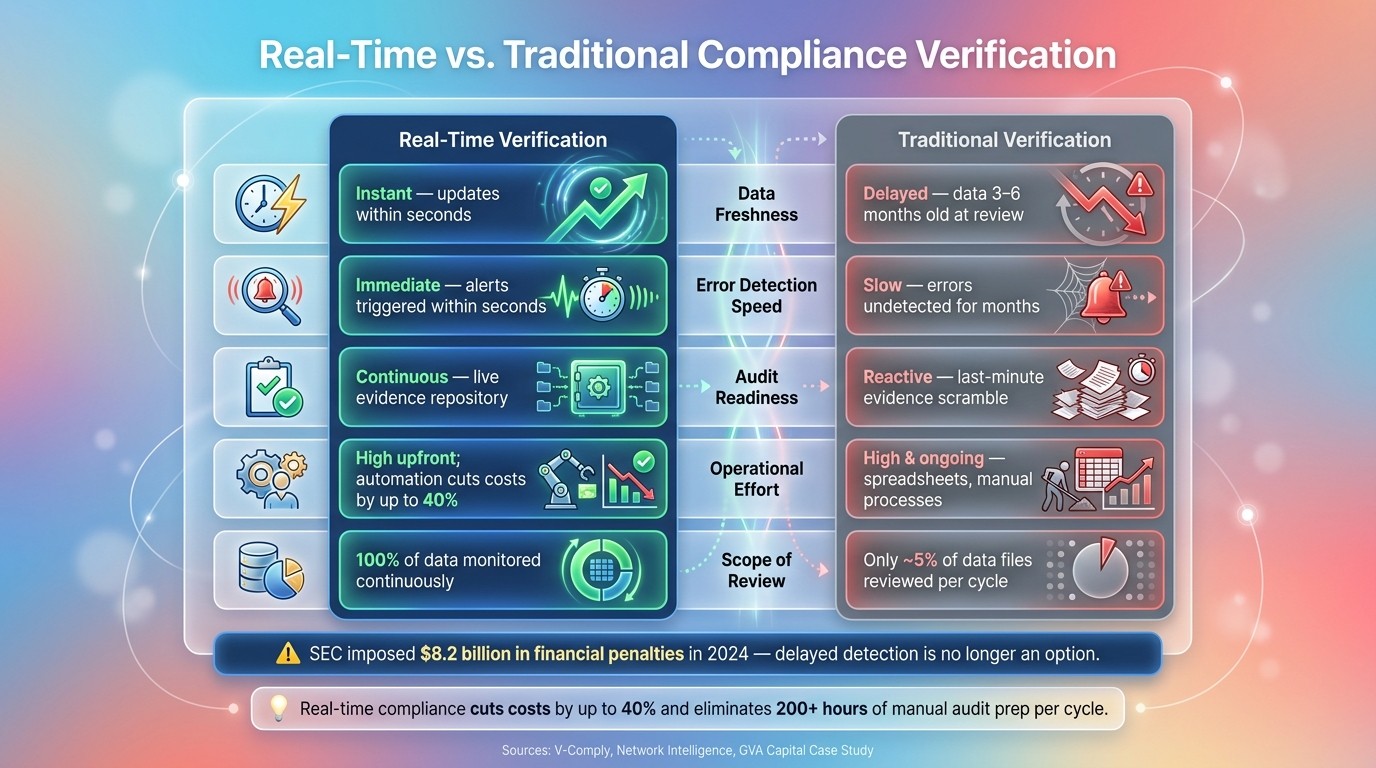
Real-Time vs. Traditional Compliance: Key Metrics Compared
The earlier sections broke down how different approaches manage areas like data freshness, error detection, audit readiness, and operational effort. Here's a side-by-side comparison to make things clearer:
Dimension | Real-Time Data Integration | Older Methods (Batch/Manual) |
|---|---|---|
Data Freshness | Instant; updates occur as changes happen | Delayed; data is often 3–6 months old by the time it’s reviewed |
Error Detection Speed | Immediate; alerts are triggered within seconds | Slow; errors can remain undetected for months until the next audit |
Audit Readiness | Continuous; maintains a live repository of verified evidence | Reactive; requires scrambling to gather evidence during audits |
Operational Effort | High at the start; automation reduces ongoing manual work | High and ongoing; relies heavily on spreadsheets and manual processes |
Scope of Review | Comprehensive; monitors 100% of data and transactions | Limited; only reviews a sample of past data |
This comparison highlights how real-time integration shifts compliance from a reactive, stressful process to a proactive, streamlined system.
The biggest challenge with real-time integration is the upfront cost. Setting up APIs, configuring workflows, and training teams can require a hefty investment. However, once in place, automation significantly reduces manual work and cuts compliance costs by as much as 40%.
In contrast, older methods come with minimal setup costs but demand constant manual effort, leading to higher recurring expenses. Real-time updates also remove the lag between a sanctions list update and operational response, a critical advantage in fast-moving regulatory environments.
For low-risk settings, traditional methods might still work. But in today’s regulatory landscape - where, for example, the SEC imposed $8.2 billion in financial penalties in 2024 - the risks of delayed error detection far outweigh the initial investment in real-time solutions.
This breakdown makes it clear why real-time integration has become a cornerstone for modern compliance verification.
Conclusion
Real-time data integration and traditional batch-based methods operate in entirely different spheres. The older methods focus on retrospective analysis, relying on limited data samples and last-minute efforts to gather evidence. In contrast, real-time integration takes a forward-looking approach, identifying issues as they arise and maintaining a continuous, verified record - eliminating the need for frantic, last-minute corrections.
As Yuna Park from Finance Fundamentals aptly stated:
"The traditional 'annual audit' is no longer a safety net - it is a post-mortem."
That said, the best approach depends on an organization’s risk profile. For fast-paced procurement, highly regulated industries, or cross-border trade, where even one missed update can lead to penalties or delays, real-time integration becomes indispensable. While it does require an initial investment, it can lower compliance costs by up to 40% and significantly reduce the time spent on audit preparation . In an increasingly demanding regulatory environment, these efficiencies are more than just helpful - they offer a real competitive edge. Real-time integration doesn’t just address risks as they emerge; it positions businesses to thrive in even the most stringent regulatory landscapes.
FAQs
What data sources should be integrated first for real-time compliance?
Integrate your core procurement SaaS, ERP systems, and supplier management tools first. These systems are essential because they house critical transactional, financial, and supplier master data. Additionally, link to regulatory databases and sanction lists, such as OFAC or FinCEN, to enable automated screening processes.
Related Blog Posts
Try it on a real buy
Bring one category. Watch where the flags land.
We use a little analytics to see which pages actually help. Nothing else, no ad trackers.