Procurement vs Sourcing: What Actually Changes
Sourcing and procurement are two stages of one evidence and risk-control system, not isolated departments. Sourcing shapes the decision. Procurement preserves it.
In this article
Most procurement explainers offer a neat answer: sourcing chooses suppliers, procurement buys from them. That answer is technically useful and operationally incomplete. It doesn't tell you who owns a specification change during contracting, who proves that the awarded supplier still meets the requirement, or where the evidence goes when an award is challenged months later.
That gap is where accountability disappears. Sourcing and procurement should be treated as two stages of one evidence and risk-control system, not as isolated departments connected by a signature. Sourcing shapes the decision. Procurement must preserve, execute, test, and learn from that decision.
A useful comparison is the purchase of technical infrastructure. A team evaluating fiber network engineering and construction needs more than a low quote. It needs a locked specification, comparable supplier evidence, clear acceptance criteria, and a record that remains usable when the project moves from award into delivery. The same discipline applies to software, facilities, equipment, professional services, and public contracts.
Why the Usual Framing Falls Short
The clean sequence fails because contract signature isn't the end of the decision. It's the point where a commercial judgment becomes an operating obligation.
Sourcing normally owns the upstream work: defining the requirement, finding suppliers, requesting proposals, normalizing responses, evaluating evidence, negotiating terms, and recommending an award. Procurement then turns that decision into purchase orders, deliveries, invoices, performance reviews, and renewals. The problem appears when everyone assumes the handover is automatic.
It isn't.
The handover creates the control risk
A supplier may win against one specification and sign against another. A negotiated delivery commitment may disappear from the final contract. A warranty may be softened during legal review. A stakeholder may approve a substitution without sending it back through evaluation. Procurement may receive the supplier name and price but not the evidence supporting the award.
Those are not administrative defects. They're failures in decision continuity.
Practical rule: The award isn't operationally complete until procurement has the locked specification, evaluated evidence, negotiated terms, approval record, exception log, and monitoring requirements.
The distinction matters at organizational scale. Public procurement represented 12.7% of GDP across OECD countries in 2023 and 29.9% of total government expenditure, according to the OECD analysis of public procurement size. At that scale, a weak handover doesn't create a small filing problem. It can affect value for money, competition, transparency, and auditability across major spending portfolios.
Track accountability, not just activity
The useful question in procurement vs sourcing isn't “which team does this task?” It's:
Who owns the decision before signature?
Which evidence supports the decision?
What must remain unchanged after award?
Which deviations require re-evaluation?
Who measures whether the promised outcome was delivered?
That is the operating boundary. Sourcing owns the defensible choice. Procurement owns controlled execution, while both functions share responsibility for keeping the decision record intact.
The Two Definitions and Their Boundaries
Procurement is the broader, end-to-end commercial control system. It can include need definition, specification development, market research, supplier selection, purchasing, contract administration, inventory control, receiving, stores management, supplier performance, and asset management. Its responsibility continues after a supplier has been selected.
Sourcing is the strategically concentrated, pre-award activity inside that wider lifecycle. It identifies and evaluates suppliers, compares responses, negotiates commercial and technical conditions, recommends an award, and supports contract authorization. The core output isn't merely a shortlist. It's a documented supplier decision that procurement can execute.
A practical guide to strategic sourcing for procurement teams helps clarify why the distinction matters. Sourcing shapes the competitive field before award. Procurement makes sure the organization buys, receives, pays for, and manages what it selected.
The boundary that survives real work
Use specification-to-award as the sourcing boundary and post-award execution as the procurement boundary.
Lifecycle point | Sourcing ownership | Procurement ownership |
|---|---|---|
Requirement | Identify gaps, challenge assumptions, refine specifications | Confirm operational need, budget, and approval path |
Market | Discover suppliers and test market coverage | Maintain approved supplier records and buying channels |
Evaluation | Normalize bids, verify evidence, apply weighted scoring | Confirm operational feasibility and implementation requirements |
Award | Recommend supplier and preserve award rationale | Convert terms into executable contract and ordering controls |
Execution | Support clarification of award assumptions | Order, receive, monitor, reconcile, and manage performance |
Review | Feed market and supplier lessons into the next event | Track delivery, quality, compliance, cost, and realized value |
The historical shift explains why people often use the terms loosely. Procurement evolved from transactional purchasing into a broader discipline concerned with total value, supplier relationships, governance, and lifecycle outcomes. Its foundational “five rights” are the right quality, quantity, place, time, and price. Sourcing influences whether those rights are achievable by shaping competition and supplier choice before award.
The cleanest test is simple. If the question is “who should we select, under what terms, and why?”, it belongs primarily to sourcing. If the question is “did we order, receive, pay for, and manage the agreed outcome correctly?”, it belongs to procurement.
Side by Side on Objectives and KPIs
Sourcing and procurement need different scorecards because they control different levers. A sourcing team shouldn't be judged mainly on invoice accuracy. A procurement team shouldn't claim success because a negotiation produced attractive terms that buyers never use.
Criterion | Sourcing | Procurement |
|---|---|---|
Core objective | Select the strongest supplier and commercial model | Execute purchases and protect contracted value |
Primary work | Market discovery, RFx design, bid evaluation, negotiation, award | Requisitioning, approvals, ordering, receiving, payment, performance |
Time horizon | Event-based and pre-award | Continuous and post-award |
Main evidence | Specification, supplier responses, scoring, award rationale | Contract, purchase orders, receipts, invoices, performance records |
Core KPIs | Specification-to-award duration, qualified-bidder count, competitive coverage, evaluated savings, award leakage, evidence coverage | Purchase-order compliance, contract utilization, delivery and quality, realized savings, lifecycle cost |
Tooling posture | Research, RFx, bid normalization, weighted evaluation, traceability | Workflow, contract execution, ordering, receiving, invoice control, supplier performance |
Main failure | A weak or unsupported supplier decision | A sound award that fails in execution |
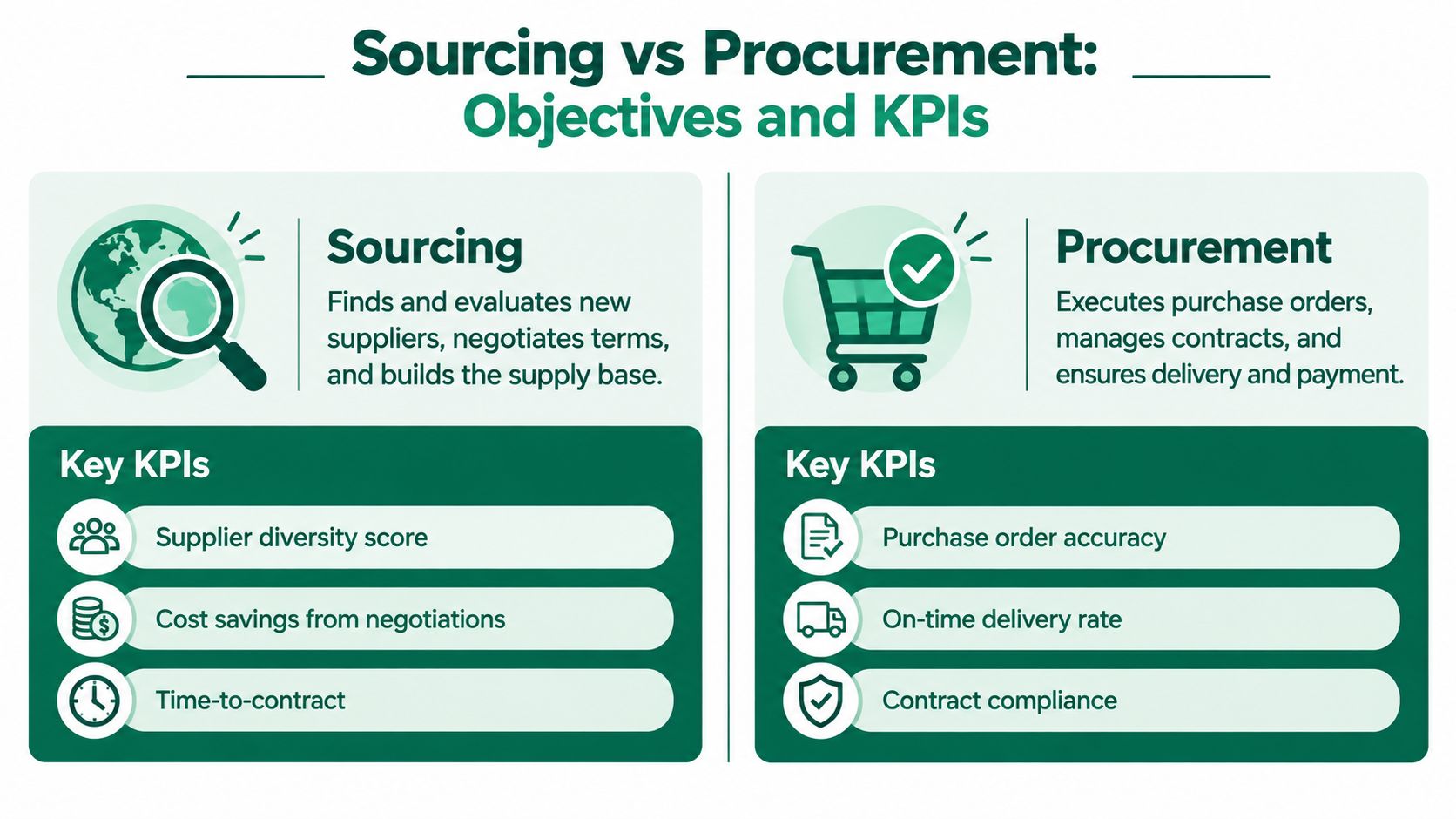
What belongs on the sourcing dashboard
Sourcing should track specification-to-award duration, because delay can indicate poor requirements, weak market coverage, or manual evaluation work. It should track the qualified-bidder count and competitive coverage, not just the number of invitations. Five invitations mean little if only one supplier can satisfy the locked requirement.
The award record should also show:
Evaluated savings, separated from untested supplier claims.
Award leakage, including requirements or terms lost between evaluation and contract.
Evidence coverage, showing how much of the decision rests on cited documentation.
Single-bidder exposure, especially where the specification may have excluded viable alternatives.
SAP's benchmark reports an average sourcing-event cycle time of 46.4 days, compared with 68 days for bottom-performing organizations. It also reports that top-quartile organizations achieved sourcing up to four times faster and more than 9% annual sourcing savings through more competitive events, as documented in the SAP Ariba benchmarking report. Those figures don't turn speed into the sole objective. They show why cycle time and competitive quality belong on the sourcing scorecard.
What belongs after signature
Procurement should measure whether the award survives contact with daily buying. That means purchase-order compliance, contract utilization, supplier delivery, quality, realized savings, invoice control, and lifecycle cost.
McKinsey reports that moving procurement capability from the middle to the top quartile can increase annual savings by more than 1% of addressable spend. At $10 billion of spend, that represents over $100 million annually, according to its 2021 benchmarking analysis. The commercial lesson is direct: a sourcing result isn't realized until procurement channels, supplier behavior, and invoices confirm it.
For a practical operating scorecard, procurement KPI guidance should be connected to the award record. Don't let sourcing report negotiated value while procurement reports transactions with no common baseline. Reconcile the quoted benefit with actual invoices, exceptions, scope changes, escalation clauses, and performance penalties.
A Real Purchase Walked End to End
Consider an enterprise buying a critical technical service. The business starts with an operational need, but the first draft is incomplete. It describes the outcome in broad terms and omits acceptance criteria, service levels, support obligations, and consequences for missed delivery.
Sourcing shouldn't rush to market. It should run gap detection, challenge any requirement that points to only one supplier, and lock the technical and commercial conditions before comparing offers. Procurement contributes operational knowledge, but the sourcing team owns the pre-award decision record.

From market discovery to award
Sourcing maps the market and identifies plausible suppliers. It asks each supplier to answer the same requirements, then normalizes different formats, assumptions, exclusions, delivery windows, warranties, and payment terms.
A simple price comparison is not enough. The evaluation should show whether each supplier meets each requirement as yes, no, or partial, with supporting evidence. Weighted scoring then makes trade-offs visible. Price may matter, but so do capacity, quality, risk, compliance, service, delivery, and support.
The award file should contain:
The locked specification, including acceptance criteria and required evidence.
The supplier universe, including invited, excluded, and non-responsive suppliers.
The normalized responses, with differences made explicit.
The weighted scoring model, including approved weights.
The negotiation record, including changed commitments.
The award rationale, stating why the selected offer was superior.
The handover breaks when the contract team edits a requirement without returning it to evaluation. It also breaks when sourcing sends procurement only a supplier name, negotiated price, and signed contract, leaving the underlying evidence in an email thread or analyst's spreadsheet.
From contract to renewal
Procurement creates the purchase order and embeds the agreed terms into the buying process. It confirms that the supplier record, approval route, contract reference, delivery requirements, and invoice checks reflect the award.
After delivery begins, procurement monitors the obligations that sourcing used to justify selection. If the supplier misses service levels, substitutes materials, changes a warranty, or invoices outside the agreed scope, procurement records the variance and escalates it according to the contract.
At renewal, the organization shouldn't start from memory. It should compare the original decision with actual delivery, quality, cost, exceptions, and stakeholder experience. That evidence informs the next sourcing event. The cycle is complete only when post-award performance improves the next pre-award decision.
How Supplier Risk Is Rewriting the Boundary
Price and competition remain important. They no longer provide an adequate supplier decision on their own.
A 2025 study reported that 73% of organizations experienced a disruption even though 98% of leaders believed supplier data was complete and current. The same study found that supplier-risk reviews took more than a day for 65% of organizations and more than a week for 30.5%, according to the Sphera supplier risk management report.
That combination exposes a serious control weakness. Leaders can feel confident about supplier data while the organization still misses disruption exposure. A supplier profile isn't the same as current, verified risk intelligence.
What sourcing must do differently
Before signature, sourcing must test supplier claims rather than copy them into a comparison sheet. It should compare resilience, compliance, financial strength, capacity, cybersecurity, geography, delivery dependencies, and relevant Tier-2 exposure alongside price.
It should also document why suppliers were eliminated. If a supplier fails a mandatory requirement, the record should show the requirement, the evidence, and the decision. If the supplier is accepted with a partial response, the record should show the mitigation and the owner.
A cheaper supplier may not be economically superior after the organization accounts for disruption exposure, approval effort, recovery difficulty, and contract drift. That isn't an argument for selecting the most expensive supplier. It's an argument for evaluating the cost of being wrong.
Teams building a broader operating model can also examine supply chain solutions in New Zealand for ideas on connecting supply visibility, supplier information, and operational execution.
What procurement must monitor after award
Procurement owns the continuing signal watch. It should monitor financial, regulatory, cybersecurity, delivery, quality, and service indicators, then route material changes back to the category or sourcing owner.
The handover should specify what triggers action:
A material specification deviation should trigger technical review.
A changed commercial term should trigger commercial review.
A new compliance concern should trigger risk review.
Repeated delivery or quality failure should trigger supplier-performance escalation.
A change in supplier dependency should trigger continuity planning.
A structured vendor risk scoring approach helps turn these signals into a repeatable review rather than an informal reaction. The important point is ownership. Sourcing validates risk before award. Procurement keeps watching after award. Neither function can safely discard the other's evidence.
Tooling, Auditability, and the Verifiable Decision Record
The sourcing platform and procurement system should connect, but they shouldn't be expected to solve the same problem.
A sourcing platform must support market discovery, RFx design, supplier invitations, document ingestion, bid normalization, weighted evaluation, negotiation, and award defensibility. A procurement operating model must support requisitions, approvals, contract execution, purchase orders, receiving, invoices, payment, supplier performance, and realized value.
The boundary is therefore a data-model question, not just an org-chart question. The system must carry the locked specification and the evidence behind the award into the operational layer.
Build the record around evidence
Every material answer should point to its source. Every elimination should have a reason. Every exception should have an owner. Every negotiated change should be visible against the prior evaluated response.
A defensible record should connect:
Requirement to evidence
Evidence to supplier response
Response to weighted score
Score to award rationale
Award rationale to contract term
Contract term to purchase order
Purchase order to receipt and invoice
Execution variance to the next sourcing decision
That chain protects the organization when a stakeholder challenges the award long after the event. It also prevents a common failure: treating supplier assertions as facts because nobody preserved the underlying manual, proposal, test result, or compliance document.
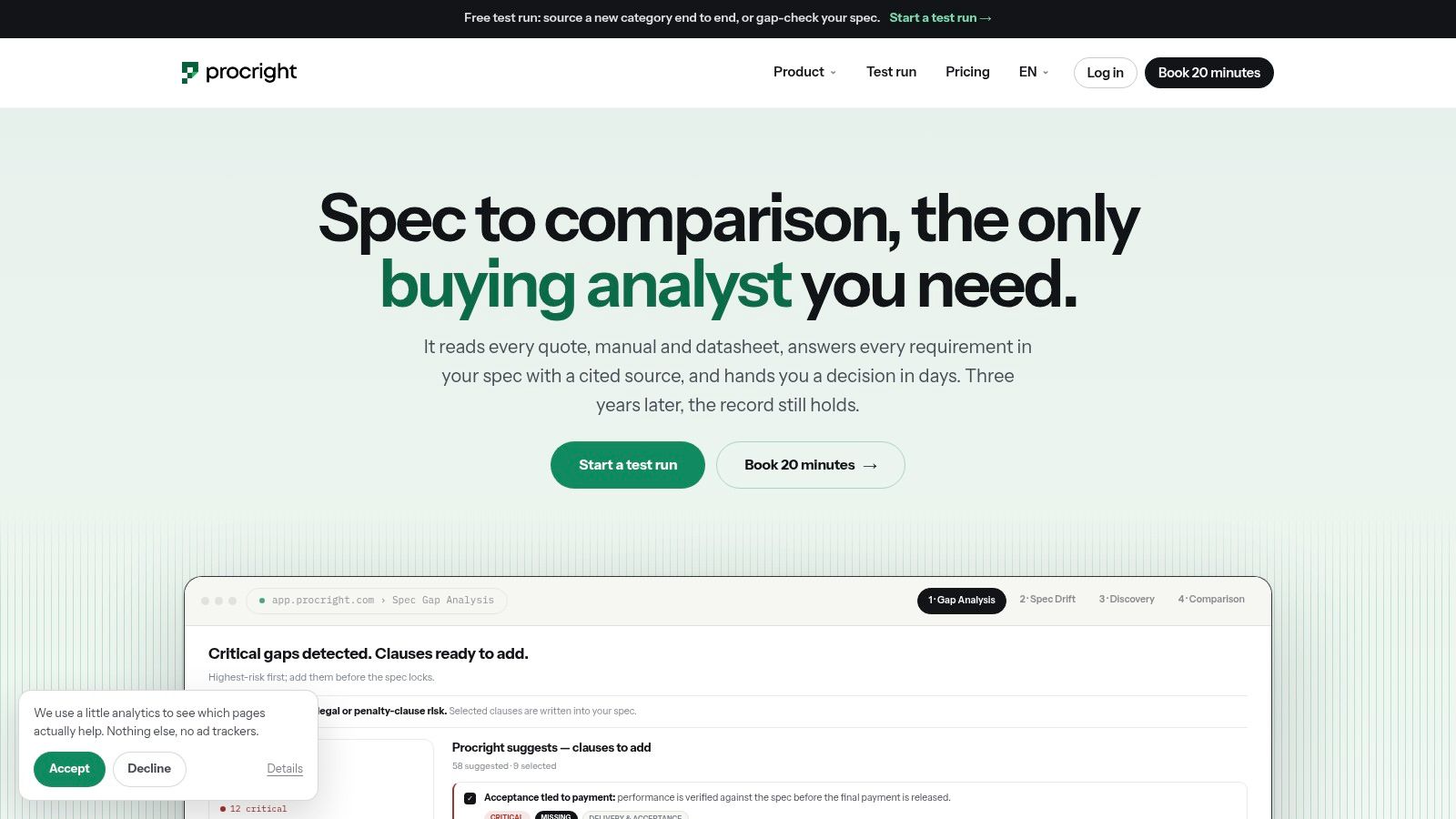
Detect drift before signature
Drift can enter through a revised quote, a contract schedule, a manual, a service description, or a legal redline. The control should compare those materials against the locked specification before signature, not wait for a delivery dispute.
Procright is one option for this sourcing layer. It supports specification refinement, supplier discovery, evidence-backed comparisons, weighted scoring, source-linked answers, and checks for drift between requirements, supplier documents, and commercial terms. The broader principle applies regardless of platform: preserve the record in a format that reviewers, finance, legal, operations, and auditors can understand without reconstructing the event from scattered files.
Which Function Should Lead Each Purchase
The answer depends on the decision risk, not the department chart.
For a single-bidder or highly specialized purchase, sourcing should lead the specification challenge, market test, evidence review, and exception approval. Procurement should support supplier onboarding and define the post-award monitoring plan. The handover deserves explicit sign-off because dependency risk is already high.
For regulated public-sector spend, sourcing should lead competition design, evaluation rules, documentation, and award defensibility. Procurement should lead contract administration, ordering controls, delivery evidence, and records retention. The two functions should agree in advance on what constitutes a material deviation.
For a high-value strategic category, sourcing should lead market strategy, supplier comparison, negotiation, and award. Procurement should lead operationalization, contract utilization, performance management, invoice control, and realized-value reconciliation. Finance and the business owner should validate the baseline and outcome.
Use this decision rule:
The team that controls the next irreversible decision should lead that stage, while the receiving team must approve the evidence needed to execute it.
That means sourcing cannot throw a signed contract over the wall. Procurement cannot alter the conditions that made the award defensible. Where the handover can change supplier choice, risk, scope, or value, treat it as a control point.
Applying This on the Next Sourcing Event
Use these actions before the next award:
Lock the specification: Record requirements, acceptance criteria, service levels, evidence standards, and approved assumptions.
Test the market: Document qualified suppliers, single-bidder exposure, exclusions, and reasons for elimination.
Normalize responses: Separate price, scope, delivery, warranty, compliance, capacity, and service commitments.
Score with evidence: Link each material answer to a source and record partial or failed requirements.
Freeze the award record: Preserve the approved weights, negotiation changes, exceptions, and rationale.
Define the handover: Transfer the specification, evidence, contract terms, supplier obligations, and monitoring plan to procurement.
Set re-evaluation triggers: Require review for specification drift, material term changes, failed mandatory requirements, or new risk signals.
Reconcile outcomes: Compare invoices, delivery, quality, penalties, and realized value with the award assumptions.
Feed the next event: Use performance variances and supplier risk changes to improve the next specification and evaluation model.
The practical test is whether a reviewer can understand the award without asking the original sourcing manager to explain it from memory. If they can't, the organization hasn't preserved the decision.
Procright helps procurement teams turn requirements into supplier comparisons, evidence-backed scoring, and an audit-ready decision record that carries from specification through award. Visit Procright to explore how its sourcing analysis tools can help your next purchase survive the handover into execution.
Try it on a real buy
Bring one category. Watch where the flags land.
We use a little analytics to see which pages actually help. Nothing else, no ad trackers.