Vendor Risk Scoring That Actually Guides Sourcing Decisions
Most vendor risk scoring produces a number, not a decision record. A useful score holds up when stakeholders ask why and what evidence supports it.
In this article
A lot of teams are in the same spot right now. Procurement has a shortlist. Security has a questionnaire. Legal is asking about subcontractors. The business owner wants a recommendation by Friday. Then a vendor comes back with a “low risk” profile that looks clean on paper, but nobody can explain whether that score should eliminate them, push them into remediation, or still allow award with controls.
That's where most vendor risk scoring breaks. It produces a number, not a decision record.
In practice, sourcing teams don't need a prettier scorecard. They need a scoring method that holds up when a stakeholder asks three hard questions at once: Why is this vendor rated this way, what evidence supports it, and how did that rating affect the award decision? If your current model can't answer those questions without opening five spreadsheets and rereading supplier emails, the score isn't doing its job.
Table of Contents
Why Vendor Risk Scoring Fails Before Sourcing Starts
The failure usually begins before anyone sends a questionnaire.
A business unit defines a need. Procurement starts market discovery. A few familiar suppliers make the first cut because they look safe, large, or already approved somewhere else in the company. Then risk review happens too late, after preferences have hardened and timelines have narrowed. At that point, “vendor risk scoring” becomes a pressure test on a near-final choice instead of a sourcing tool.
Low scores can still hide real exposure
I've seen vendors score well on security paperwork and still create serious sourcing risk. The issue wasn't that the controls were fake. The issue was that the score only reflected one slice of exposure.
A vendor can look acceptable in a cyber review and still create problems because they are:
Operationally concentrated in one location or one delivery team
Jurisdictionally exposed in ways the contract owner never considered
Dependent on subcontractors that were never surfaced in intake
Business critical far beyond what the questionnaire assumed
That's why treating vendor risk scoring as a cybersecurity checkbox gives false comfort. It compresses different kinds of exposure into a narrow review that rewards clean answers more than real resilience.
A score that ignores business dependency isn't low risk. It's incomplete risk.
Recent coverage also points to the same expansion in scope. Leading programs are broadening beyond classic ICT review to include non-ICT third parties, subcontractors, ESG, business-impact analysis, and dollar-quantified models, while Gartner says vendors are increasingly using machine learning and AI to automate assessment and analysis, according to CyberPeace's overview of third-party risk management trends for 2025.
Most programs still start with weak sourcing inputs
There's another problem. Many teams are trying to score vendors with thin, inconsistent intake data.
The old pattern is familiar. A questionnaire goes out. A policy packet comes back. Someone reads it quickly, gives a few category ratings, and assigns an overall score. That may satisfy process, but it won't survive challenge if the vendor later fails, drifts from spec, or triggers an audit finding.
If you're tightening your pre-contract checks, a practical vendor due diligence checklist before a contract exists helps separate baseline verification from deeper scoring work. That distinction matters. Due diligence confirms the supplier is real, viable, and relevant. Scoring decides whether the supplier belongs on the shortlist and under what conditions.
A defensible score has to drive sourcing choices
Good vendor risk scoring does three things that weak models don't.
First, it helps eliminate vendors early when exposure is outside tolerance.
Second, it helps differentiate among acceptable vendors when commercial offers are close.
Third, it creates a traceable record showing why a vendor moved forward, paused, or lost.
When teams get this right, the score stops being a side exercise owned by one control function. It becomes part of sourcing judgment. That's the shift that matters.
How Vendor Risk Scoring Works When Done Right
A defensible model starts with a simple base: likelihood × impact. The mistake is thinking that this formula alone is enough. It isn't. The work is deciding when a vendor has earned a lower likelihood score, and what evidence is strong enough to justify that reduction.
A practical expert framework described by VISO TRUST's vendor risk scoring methodology gets this right. It uses likelihood × impact as the core, then reduces likelihood only when the vendor can show control evidence. That reduction is governed by control influence, evidence presence, and assurance credibility.
Start with inherent risk, not claimed maturity
If a vendor processes sensitive data, supports a critical workflow, or sits in a failure path that would interrupt operations, start there. That is inherent exposure. Don't let the first answer in a questionnaire pull the score down before you've mapped the actual risk surface.
A clean way to structure it is:
List exposure points tied to the service, data flow, dependency, and access model.
Score likelihood and impact for each exposure point before any mitigation credit.
Apply reductions only for verified controls.
Roll sub-risks into a composite vendor score with traceability intact.
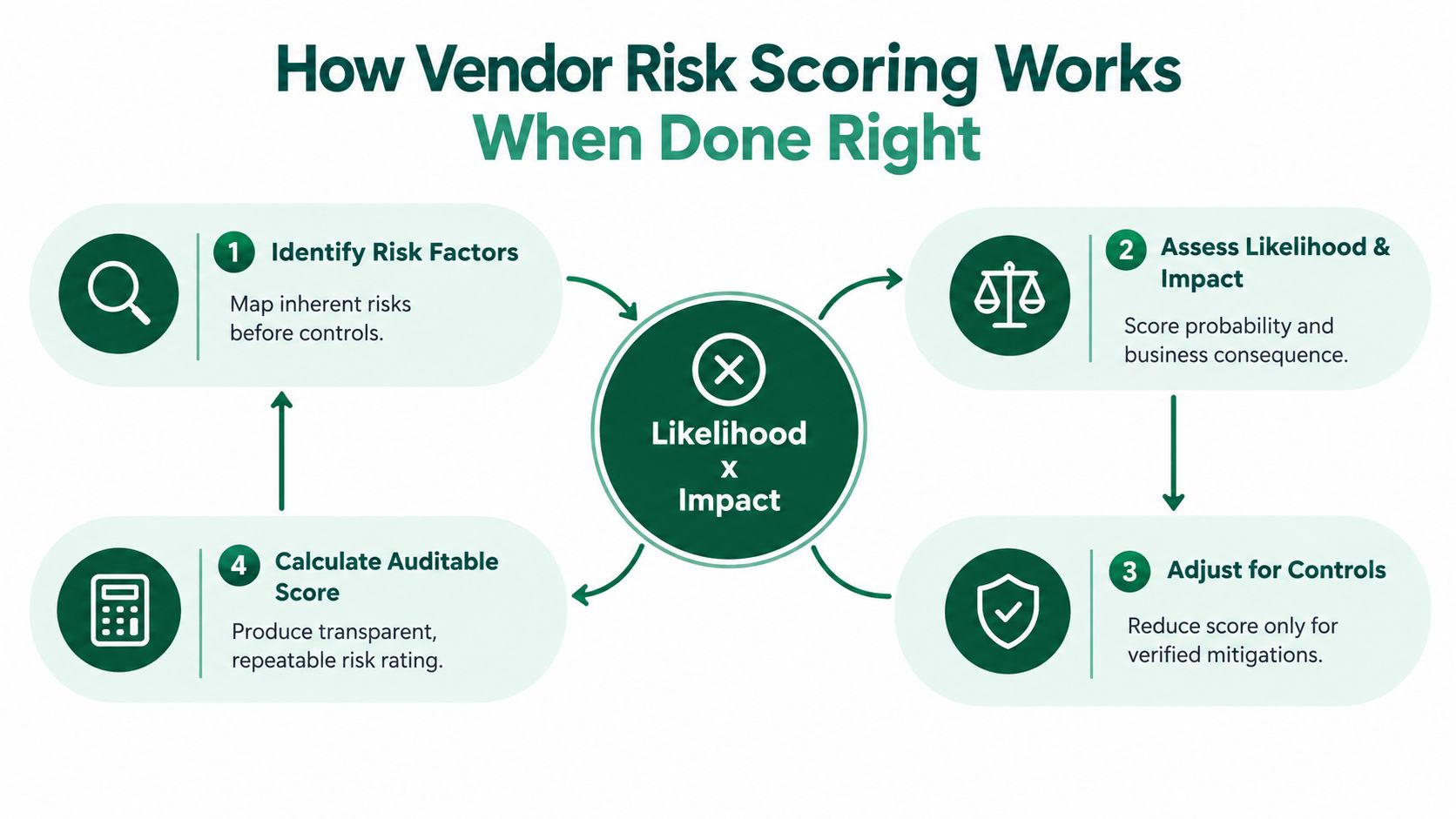
That structure matters in audits because it preserves the path from a final score back to the underlying issue. If a stakeholder asks why the vendor landed in a medium-risk band, you can point to specific sub-risks and the evidence attached to each one.
Reduce scores only when controls are proved
Many teams inflate vendor scores. They treat control statements as if they were verified controls.
A more reliable method tests three separate things:
Does the control exist The vendor says they perform a control or maintain a safeguard.
Is there evidence A document, report, artifact, configuration record, certification, or test output supports the claim.
How credible is that evidence An independently assured report carries more weight than self-attestation. A current artifact carries more weight than an undated policy.
Practical rule: Never lower likelihood because a vendor answered “yes.” Lower it because the vendor proved the “yes.”
This is why the variables matter:
Variable | What it asks | Why it matters |
|---|---|---|
Control influence | Would this control materially reduce the risk? | Some controls are relevant, others are decorative |
Evidence presence | Is there an artifact tied to the claim? | No artifact means no reliable reduction |
Assurance credibility | Who validated it, and how trustworthy is it? | Independent assurance is stronger than paper-only claims |
A vendor may have an incident response policy. That alone doesn't mean much. If they also provide current evidence of testing, named ownership, and an assured review, then a likelihood reduction is easier to defend.
Keep the model auditable at sub-risk level
The strongest scoring models don't jump straight to one overall number. They score at sub-risk level first.
For example, one vendor might have:
strong access control evidence,
weak subcontractor transparency,
moderate continuity planning,
high business criticality.
If you flatten that into one early average, you lose the logic of the decision. If you preserve each sub-risk and show how it rolled up, procurement, security, legal, and the business can all see where the score came from.
That's what makes vendor risk scoring useful in sourcing. It's not just mathematically tidy. It's reviewable.
Choosing Data Sources That Make Scores Trustworthy
A sourcing team gets three vendors to the final round. All three return polished questionnaires. All three attach a SOC 2 report. One supports a low-impact internal tool. One will process customer data in four regions. One sits behind a revenue-critical workflow with no easy replacement. If those inputs get scored the same way, the model fails before award review.
Trustworthy scoring starts with a simple rule. Use sources that tell you different things, then weight them by how much they can prove. The goal is not to produce a cyber scorecard. It is to produce an auditable sourcing decision that shows likelihood, impact, evidence strength, and business criticality in one trail a reviewer can follow.
The industry pattern explains why weak inputs create weak scores. A collaborative study by Mastercard, RiskRecon, and the Cyentia Institute found that many third-party risk programs still rely heavily on questionnaires and documentation reviews, while fewer use remote assessments, security ratings, or onsite reviews, as summarized in KPMG's third-party risk management survey page.
Questionnaires help with coverage. They do not prove much on their own.
Questionnaires are useful for scale. They capture scope, declared controls, subcontractor use, data handling, and gaps the vendor is willing to disclose. They also show whether the respondent understands the service being sold, which matters more than teams admit.
But self-attestation inflates scores fast.
Earlier benchmark data on vendor risk scoring noted that security questionnaires often produce high pass rates across the vendor base. In practice, that usually means the questions are easy to satisfy, the scoring gives too much credit for policy language, or reviewers are treating every “yes” as a control reduction. Any of those choices compress the score range and make very different vendors look equally acceptable in committee.
Use each source for a specific job
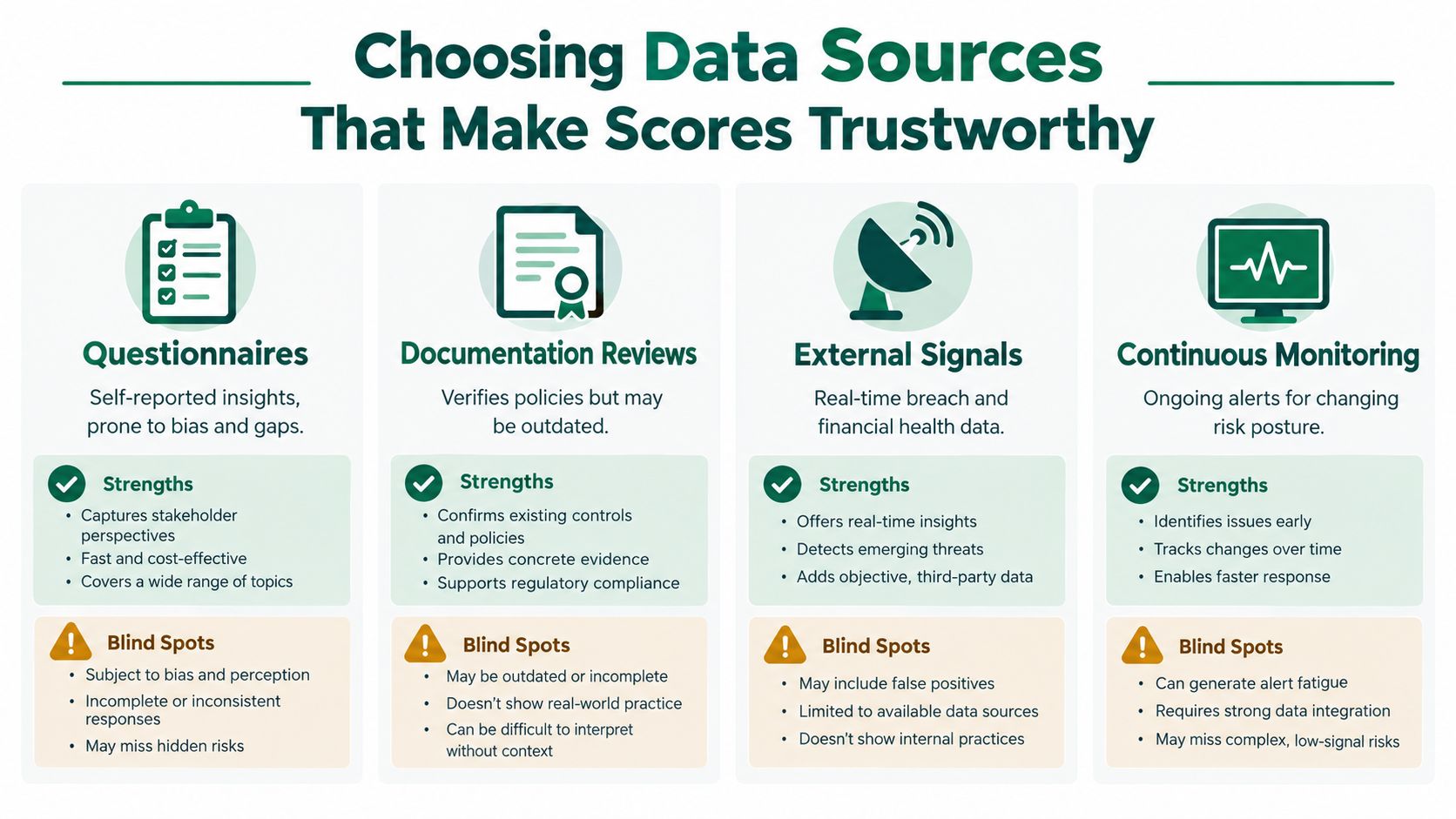
The practical test is whether the source changes likelihood, changes impact, or only adds context.
Data source | Best use in scoring | Typical weakness |
|---|---|---|
Questionnaire | Captures vendor-specific claims, scoping details, and declared control ownership | Self-reporting bias, broad interpretations, incomplete answers |
Documentation review | Confirms that policies, reports, diagrams, and test records exist and are in scope | Documents may be stale, generic, or unrelated to the actual service |
External signals | Adds independent observations and trend data, often useful for cyber hygiene and exposed infrastructure | Limited scope, uneven coverage, weak fit for operational and legal risk |
Onsite or remote assessment | Tests whether controls operate in the service context and whether staff can explain them | Higher effort, slower cycle times, hard to apply across the whole portfolio |
Good programs do not stack these sources just to get more volume. They use them to challenge each other. A questionnaire says the vendor encrypts backups. A document review checks whether the control is documented and tested. An assessment checks whether the team can show how restore access is controlled. If those three inputs conflict, the score should reflect the conflict instead of averaging it away.
Business context belongs in the same evidence set
Security teams usually own only part of what makes a vendor risky to award. Procurement needs the rest in the scoring record.
That includes:
Business criticality of the service
Dependency concentration across business units, platforms, or regions
Subcontractor reliance
Jurisdictional exposure
ESG or regulatory conditions that affect whether the vendor is acceptable at all
These inputs do not sit outside the score. They affect impact directly, and in some cases they change how much evidence is required before a control claim should reduce likelihood. A weak control environment at a low-impact supplier may be tolerable with remediation terms. The same weakness at a sole-source, customer-facing processor usually is not.
If a data source cannot show both what the vendor claims and how much the business depends on that vendor, it cannot support an award decision by itself.
Teams usually struggle here before they struggle with math. Supplier names do not match across systems. Evidence sits in email, shared drives, and ticketing tools. The same vendor appears three times with different subsidiaries and different owners. Cross-source data consolidation challenges in vendor records and evidence stores usually weaken trust in the score long before weighting models do.
One hard-earned rule helps. Score down when evidence is thin. Score up only when the source is current, in scope, and strong enough to defend in audit. That standard keeps the model useful when sourcing, legal, security, and the business all ask the same question: why did this vendor get approved?
Building Your Weighted Scoring Model and Automating It
A scoring model usually gets tested the first time two vendors look commercially similar and one business stakeholder asks a fair question: why is this supplier a 62 and that one an 81? If the answer is “the spreadsheet weighted it that way,” the model will not survive sourcing review or audit.
The score has to show three things clearly. How likely the risk is. What the business impact is if it happens. How strong the supporting evidence is. If those three elements are blended well, the score becomes more than a cyber screening output. It becomes a sourcing decision record.
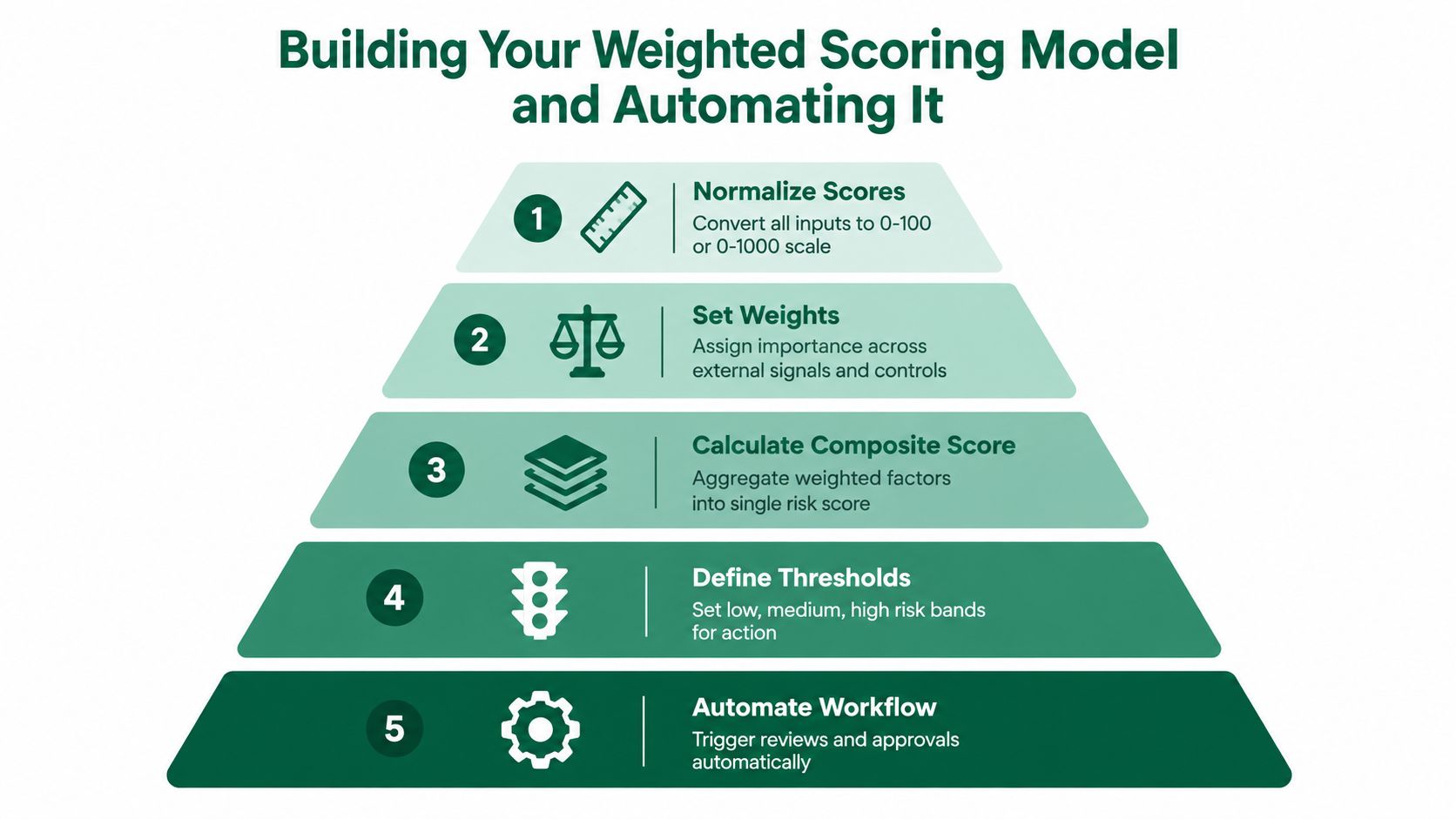
Normalize first, then weight
Start by putting every input on the same scale. A 0 to 100 scale is usually enough. It is easy to explain, easy to threshold, and easy to audit later when someone asks why a vendor moved bands.
Then weight by decision value, not by how easy the data is to collect. A practical starting model looks like this:
Input Group | Suggested Weight | Example Signals |
|---|---|---|
External signals | 40% | Security ratings, adverse events, public exposure indicators |
Assessment results | 35% | Questionnaire answers, control evidence, documentation review outcomes |
Business context | 25% | Criticality, replacement difficulty, transaction sensitivity, jurisdiction |
Those percentages are only a starting point. The underlying rule matters more. Inputs backed by stronger evidence should carry more weight. High business criticality should keep pressure on the score even when the vendor presents polished documentation.
I have seen teams make the same mistake repeatedly. They give questionnaire responses too much influence because they are structured and easy to score. That inflates weaker vendors and creates arguments later when legal, security, or internal audit asks what justified the reduction in risk. A better model treats self-attestation as provisional until supporting evidence is reviewed.
If your team is trying to align risk weights with broader award criteria, this supplier evaluation template for deciding what criteria to weight is a useful companion.
Build the score so it reflects audit reality
A defensible score separates inherent exposure from residual exposure. Without that split, a vendor handling sensitive data in a high-dependency role can look safer than it is because the questionnaire came back complete.
A workable formula often has four parts:
Inherent likelihood, based on the service profile, attack surface, and operating model
Business impact, based on what failure would interrupt, expose, delay, or prevent
Control effectiveness, based on validated evidence rather than vendor assertions alone
Evidence strength, which adjusts how much credit a control claim should receive
That last factor is the one many models skip. They should not. A SOC report in scope for the actual service should affect the score differently from a policy PDF, and both should carry more weight than an unchecked “yes” answer in a questionnaire.
Prevent middle-of-the-road scoring
Weak models push everyone into the same range. That creates false precision and weakens sourcing decisions because the score stops distinguishing between manageable risk and risk that needs approval, mitigation, or rejection.
A few design choices help:
Set evidence gates before a vendor can move into a lower residual risk band
Cap self-attestation credit until documentation or testing supports the claim
Use wider scoring bands so meaningful differences show up in the final rating
Apply category rules for services with materially different risk profiles, such as payment processing versus temporary staffing
A spreadsheet can calculate those rules. It usually fails at applying them consistently over time.
Automation keeps the score current and reviewable
EY's global third-party risk management survey found low confidence in the data supporting many programs, which tracks with what sourcing and procurement teams see in practice when scoring is maintained through email, shared files, and one-off updates in spreadsheets, as reported in EY's global third-party risk management survey PDF.
That is the practical case for automation. Scores decay quickly when evidence expires, findings are remediated without being reflected in the model, or a vendor's service scope changes after selection.
This short walkthrough is worth watching if you're translating weighted logic into a working process:
A stable operating model usually includes:
Automated score refreshes when evidence changes or new signals arrive
Remediation tracking tied to specific findings, not generic follow-up
Evidence capture stored at control level
Approval workflows that document overrides and exceptions
The goal is not to remove judgment. The goal is to make judgment visible. When a stakeholder overrides a score, the system should show who approved it, what evidence was missing, what mitigation was accepted, and when the decision should be revisited.
One option in this space is Procright, which supports weighted supplier comparisons, evidence-backed yes or no or partial compliance checks, spec drift detection, and an audit-ready decision record inside sourcing workflows. That matters when the score needs to support an award decision, not just fill a dashboard.
Applying Risk Scores to Sourcing and Award Decisions
A vendor risk score has value only when it changes a sourcing decision.
That doesn't mean the highest-scoring vendor always loses, or that the lowest-risk vendor always wins. It means the decision record shows how risk affected the shortlist, negotiations, mitigations, and final award.
Use risk scores at three decision points
The strongest teams use vendor risk scoring before onboarding, not after commercial preference has already settled.

Three points matter most:
Discovery and elimination
Vendors that fail baseline conditions, show unresolved critical evidence gaps, or create unacceptable dependency risk should leave the process early.Shortlisting and comparison
A score helps separate vendors that are commercially similar but operationally different.Award with mitigations
A vendor can still win with a higher risk profile if the exposure is understood, accepted at the right level, and reduced through contract terms, implementation controls, or monitoring obligations.
Partial compliance is where judgment matters
Most sourcing decisions aren't clean pass or fail calls. They involve partial compliance, uneven evidence, and a supplier that fits the need better than the cleaner alternative.
That's why the score should inform judgment, not replace it.
For example:
A vendor may have stronger delivery capability but weaker subcontractor transparency.
Another may have better documented controls but higher replacement difficulty if something goes wrong.
A third may meet the spec today but show signs of future drift in implementation detail or support coverage.
The award file should show what the vendor lacked, what mitigated it, and who accepted the residual exposure.
This becomes especially important in software and cloud sourcing, where provenance and build security can affect supplier acceptability. If you're evaluating development supply chain controls, a practical reference on how to implement SBOM and SLSA helps teams translate software supply chain requirements into concrete award criteria.
Keep the score tied to evidence and contract action
A sourcing decision becomes defensible when every major conclusion can be pointed back to evidence.
That means documenting:
Why a vendor was eliminated, not just that they were
Which findings were accepted temporarily
What contract controls were added
What reassessment or monitoring trigger applies after award
A low score without a sourcing consequence is just reporting. A higher-risk award without recorded mitigations is worse. It creates the appearance of discipline without the substance of governance.
Good procurement teams don't let vendor risk scoring operate as a side memo from security. They fold it into the actual award logic.
Practical Tips to Keep Your Scoring Framework Reliable
Most scoring models don't fail because the formula was wrong. They fail because the discipline around the model faded.
A reliable framework stays useful when teams add new categories, onboard unfamiliar suppliers, and deal with changing risk signals without rewriting the model every quarter.
Habits that keep vendor risk scoring credible
A few practices make a big difference over time:
Broaden scope beyond cyber. Include non-ICT suppliers, subcontractor exposure, dependency concentration, and jurisdictional factors when they affect continuity or compliance.
Refresh on signal change, not just calendar dates. Annual-only reviews miss too much drift.
Treat paper-only compliance carefully. Policies without current evidence should not produce generous score reductions.
Quantify business impact in operational terms. If a vendor failure would halt payroll, disrupt production, or lock a team out of a core platform, that needs visible weight.
Document overrides. If an executive accepts a higher-risk vendor for strategic reasons, record the rationale and the conditions.
Recent market coverage also says AI adoption is accelerating while mature enterprise-wide programs remain limited. One survey noted 63% of organizations are already using or piloting AI for vendor risk scoring, contract analysis, and continuous monitoring, yet less than a third have a mature TPRM program, according to TermScout's analysis of structured data in vendor risk scoring. That gap is worth taking seriously. Automation can speed up review, but it won't fix a weak scoring logic or poor evidence model.
What to watch before the framework drifts
The quiet risk is technical and process debt inside the scoring program itself. Rules pile up. Exceptions multiply. Old evidence remains in circulation. Different analysts start interpreting the same control differently.
That's why procurement leaders should think about framework maintenance the same way engineering teams think about architecture hygiene. The discussion in Faberwork LLC technical debt risk control is useful here because the same pattern applies. If you defer cleanup too long, your model becomes slower, less trusted, and harder to defend.
Start smaller than you think. Weight a few inputs well. Automate early where evidence capture is repetitive. Keep every scoring change traceable.
Procright supports sourcing teams that need vendor risk scoring to hold up in real award decisions, not just in review meetings. It helps teams compare suppliers against locked requirements, score them with cited evidence, detect spec drift before signature, and keep an audit-ready decision record from draft to final award. If that's the gap you're trying to close, visit Procright.
Try it on a real buy
Bring one category. Watch where the flags land.
We use a little analytics to see which pages actually help. Nothing else, no ad trackers.