RFP Evaluation Software: How to Choose
In this article
The global RFP software market was valued at USD 2.8 billion in 2025 and is projected to reach USD 7.6 billion by 2034, yet the most important buying criteria aren't faster scoring screens. Enterprise teams should prioritize complete audit trails, evidence-linked scoring, and early controls that detect specification gaps before automation accelerates a flawed decision.
Can your evaluation platform prove why a supplier was eliminated years after the award, or can it only show a final score? That question exposes the weakness in conventional comparisons. Most tools promise weighted scoring, collaboration, and AI assistance. Fewer show whether each answer was tied to reliable evidence, whether the specification was fair to begin with, or whether a reviewer changed the outcome without leaving a defensible record.
RFP evaluation software should function as a control system for the sourcing decision, not merely as a digital spreadsheet. It should help procurement teams define requirements, compare responses consistently, identify missing evidence, preserve reviewer activity, and explain the award in language an auditor, finance executive, or unsuccessful bidder can understand.
Table of Contents
The Growing Demand for RFP Evaluation Software
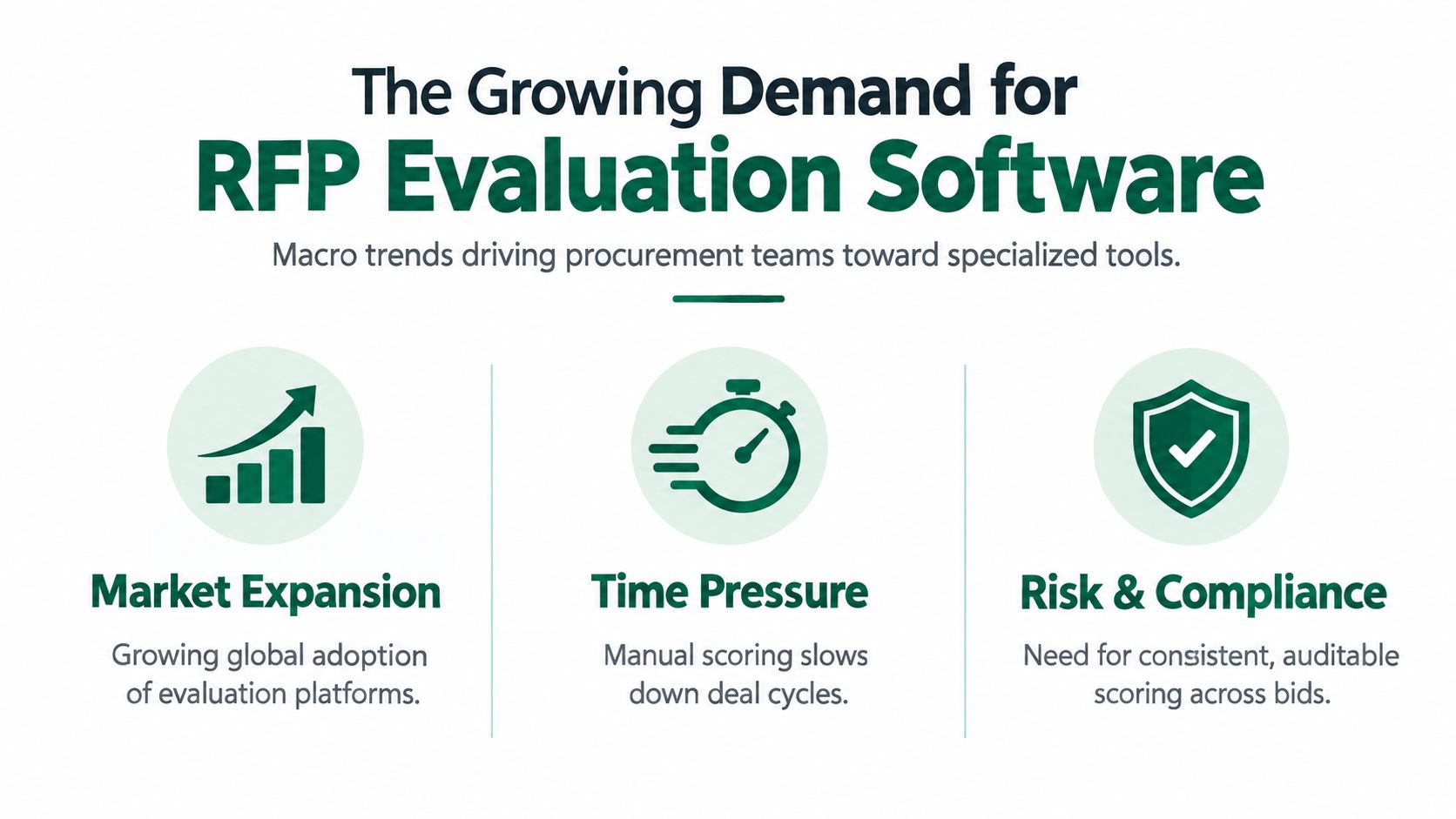
Procurement teams aren't adopting evaluation platforms because spreadsheets suddenly became inconvenient. They're adopting them because complex sourcing events now involve more documents, contributors, requirements, and scrutiny than a manually maintained workbook can reliably control.
The market signal is substantial. The global RFP software market was valued at USD 2.8 billion in 2025 and is projected to reach USD 7.6 billion by 2034, with a projected 11.7% CAGR from 2026 to 2034, according to DataIntelo's RFP software market analysis. The same source reports that software represented 63.4% of 2025 RFP software revenue, while North America held about 38.2% of revenue share. Those figures indicate an established enterprise category, not an experimental procurement add-on.
Digital procurement has become the operating environment
Procurement technology adoption reinforces that shift. A 2026 procurement statistics summary reports that 91% of organizations use e-procurement solutions, and 65% use cloud-based platforms. The same overview identifies e-procurement as the most adopted procurement technology at 90%, followed by spend analytics at 75% and supplier management at 70%.
RFP evaluation now sits inside that broader data-driven stack. A team may discover suppliers in one system, manage contracts in another, review spend in a third, and still evaluate proposals in a spreadsheet that has no dependable connection to the underlying requirements. That separation creates avoidable risk. A score can be mathematically correct while the source material, version, or interpretation behind it is wrong.
Speed creates value only when the decision remains defensible
Manual evaluation becomes especially fragile when several reviewers work across different files. One person scores a current response, another reviews an earlier version, and a third records comments in a meeting note that never reaches the final decision record. The organization may complete the event quickly, but it can't reconstruct the reasoning cleanly.
That distinction matters for enterprise buyers. The right platform reduces repetitive work while preserving the chain from specification to question, response, evidence, score, approval, and award. If you're building the underlying sourcing process before choosing technology, Refact's RFP guide for founders offers useful context on structuring an RFP so suppliers can respond to a clear brief rather than shape the requirements themselves.
Procurement rule: Faster evaluation is useful only when the organization can still explain how it reached the result.
Critical Features for Modern Procurement Teams
A credible RFP evaluation platform needs four connected capabilities. Weighted scoring matters, but it should sit inside a controlled evidence and workflow model. A polished interface can't compensate for missing source linkage or weak change history.
1. Evidence-linked evaluation
The platform should connect each requirement to the relevant supplier answer and then to the evidence supporting that answer. The strongest workflow distinguishes yes, no, and partial compliance rather than forcing a reviewer to convert uncertainty into a clean score.
Many tools stop too early. A supplier may claim that a product supports a required integration, but the evaluator needs to see the relevant manual section, contractual term, technical page, or other source. Without that link, the score represents an assertion, not a verified conclusion.
Independent review frameworks place unusual emphasis on this issue. One supplier-evaluation ranking assigns 40% of its score to traceability strength and questionnaire-to-evidence linkage, as reported by WorldMetrics' supplier-evaluation software framework. The weighting is a useful warning: traceability isn't a reporting feature added after scoring. It should shape the evaluation model from the start.
2. Governance and audit history
An audit-ready system records more than the final result. It should show:
Who reviewed each requirement: Assign responsibility to the right subject-matter expert instead of letting every stakeholder score everything.
What evidence supported the decision: Preserve source citations alongside the answer and score.
Which version was evaluated: Prevent old questionnaires, amended specifications, or superseded supplier files from contaminating the record.
When changes occurred: Maintain activity history for edits, approvals, clarifications, and overrides.
Why a supplier was eliminated: Record explicit reasons instead of relying on a low aggregate score.
Public-sector and regulated buyers need this level of control because a decision may face scrutiny long after the sourcing team has moved on. A scorecard without provenance makes the organization defend an outcome from memory.
3. Workflow control and integrations
The system should route questions, approvals, clarifications, and exceptions through defined roles. It should also connect with the procurement stack so teams don't manually re-enter supplier information, requirement data, or award results.
Integration depth matters because evaluation rarely ends at scoring. Finance may need commercial comparisons, IT may need security evidence, legal may need contractual exceptions, and leadership may need an approval package. A tool that produces an isolated scorecard leaves the organization with another data silo.
A market comparison framework from Nvelop's RFP software review weights AI capabilities at 30%, governance and audit at 30%, integrations at 20%, scoring and evaluation at 15%, and implementation speed at 5%. The structure reflects a practical buying principle: AI doesn't outrank governance, and implementation speed shouldn't dominate long-term operational fit.
4. Controlled automation
AI can extract answers, identify missing information, compare documents, and surface possible deviations. It shouldn't quietly invent certainty or replace the approved evaluation criteria.
Look for controls that show the underlying source, flag ambiguous answers, distinguish extraction from human judgment, and require approval for material overrides. Automation should reduce reading and reconciliation work. It shouldn't turn an unsupported supplier claim into an apparently objective score.
Comparing Scoring Models and Audit Capabilities
Traditional weighted scoring remains useful for straightforward evaluations. The problem arises when teams treat a weighted total as proof of decision quality. A model can rank suppliers neatly while hiding incomplete specifications, unsupported answers, or inconsistent interpretations.
The practical distinction is between score-centered evaluation and evidence-centered evaluation. The first asks, “What number did this proposal receive?” The second asks, “Which requirement did the proposal satisfy, what proves it, who approved the conclusion, and what changed before award?”
Feature | Traditional Scoring | Evidence-Based Compliance |
|---|---|---|
Primary output | Weighted supplier score | Requirement-level conclusion with supporting evidence |
Requirement handling | Criteria entered into a matrix | Locked specification mapped to questions and documents |
Supplier answers | Manually interpreted and scored | Classified as yes, no, or partial, with source linkage |
Audit trail | Often limited to scores and comments | Preserves sources, reviewers, timestamps, changes, and decisions |
Specification risk | Usually outside the evaluation workflow | Gap detection and single-bidder risk can occur before release |
Version control | Depends on file naming and user discipline | Centralized versions with controlled updates |
AI role | Drafting, extraction, or summarization | Assisted analysis with citations and human approval |
Best fit | Low-risk or relatively stable purchases | Complex, regulated, multi-stakeholder sourcing events |
Weighted scoring still has a place
Weighted scoring is valuable when the team has already defined clear requirements and knows how to distinguish mandatory conditions from preferences. It helps reviewers focus on the factors that matter most and makes supplier comparisons easier to explain.
The weakness is input quality. If the requirements are vague, duplicated, contradictory, or written around one supplier's solution, a precise weighting scheme only gives structure to a biased process. The software may produce an impressive dashboard while the sourcing event remains contestable.
Evidence-based compliance changes the order of work
An evidence-based model starts at requirement level. The evaluator identifies the exact obligation, reviews the supplier's response, checks the cited evidence, records the conclusion, and then applies the approved score. This sequence makes gaps visible before they become buried in an aggregate number.
It also supports better elimination reasoning. A supplier may fail because it missed a mandatory requirement, supplied no evidence, introduced an unacceptable commercial deviation, or couldn't meet a specified delivery condition. Those are materially different outcomes, and a single low score doesn't explain them.
Teams designing a comparison matrix should separate mandatory gates, scored criteria, evidence requirements, and approval points. The Procright comparison matrix guidance is useful for thinking through how a matrix can move beyond side-by-side scores and capture the reasoning behind each comparison.
AI should surface risk, not conceal uncertainty
AI-driven platforms can accelerate document review and identify possible specification drift. They become dangerous when they translate unclear language into confident compliance without showing the supporting passage.
Require a visible distinction between extracted text, machine interpretation, evaluator judgment, and final approval. If a supplier answer is incomplete, the system should preserve that uncertainty and prompt a clarification or exception decision. A fast “yes” without evidence is a governance failure, not an efficiency gain.
A final score is an output. The defensible decision is the connected record behind it.
Real-World Use Cases by Industry
The right evaluation controls depend on the purchase. A category manager sourcing a standard service needs a practical comparison workflow. An IT infrastructure leader needs technical evidence and deviation control. A public-sector compliance officer needs a record that can withstand formal review.

Category managers need to see what the score hides
A category manager may receive proposals from several suppliers, each using different language for service levels, implementation responsibilities, exclusions, and renewal terms. A basic matrix can rank the submissions, but it won't necessarily show that one supplier omitted a required service, another changed an assumption in a pricing attachment, and a third answered a key requirement with marketing language rather than evidence.
An effective platform lets the manager lock the requirements, assign sections to appropriate reviewers, compare answers at requirement level, and record why a response passed or failed. It should also expose unanswered questions before the committee treats an incomplete bid as a competitive offer.
The manager's practical priority isn't an elaborate dashboard. It's a clean line from the sourcing objective to the supplier response and the final recommendation.
IT leaders need technical proof and spec-drift control
IT and infrastructure sourcing produces documents that rarely agree automatically. A proposal may describe one capability, a product manual may qualify it, and commercial terms may limit availability to a particular package. The team needs to compare those materials against the approved specification instead of accepting the supplier's summary as the final truth.
A useful workflow flags deviations in compatibility, support, warranty, implementation responsibility, and licensing assumptions. It should identify the exact document location and let the technical reviewer decide whether the deviation is acceptable, negotiable, or disqualifying.
The following video provides additional context for teams reviewing how procurement technology fits into broader sourcing workflows.
Public-sector officers need defensibility over convenience
Public procurement adds formal transparency requirements, structured evaluation rules, multiple approvals, and heightened sensitivity to inconsistent treatment. A platform should preserve the published criteria, evaluator assignments, clarifications, evidence, scoring changes, and final approval record.
A low-cost tool that lacks audit logging or multi-approver controls can create a larger downstream exposure than its purchase price suggests. Recent government procurement guidance highlights the need for transparency mandates, structured evaluation, audit logging, and multi-approver workflows, while warning that weak controls can create legal and compliance risk, as described in SteerLab's public-sector RFP software guidance.
For these buyers, the decisive question isn't whether the system can calculate a score. It's whether an independent reviewer can reconstruct the decision without relying on personal inboxes, private spreadsheets, or recollection.
Avoiding Faster Mistakes with Better Specifications
RFP evaluation software can't rescue an incomplete specification. It can process ambiguity more quickly, distribute a flawed questionnaire efficiently, and produce a polished comparison that masks the original problem.
Manual workflows already suffer from version-control errors, missing files, and fragmented review. Industry guidance also describes traditional RFP processes as capable of stretching implementation timelines by up to 3x, while 44% of CIOs cited sourcing cost as a top pain point in 2024, according to CIO's analysis of the traditional software RFP process. Removing manual steps helps, but it doesn't improve an unclear requirement by itself.
Lock the requirement before you optimize the score
Start with a specification review that asks practical questions:
Is the requirement testable: Can a reviewer determine whether the supplier meets it from the response and evidence?
Is the requirement necessary: Does it support the business outcome, or did it survive from an old template?
Is the requirement neutral: Could multiple credible suppliers satisfy it without reverse-engineering one incumbent's design?
Is the requirement complete: Are acceptance criteria, support obligations, compliance conditions, and commercial assumptions explicit?
Is the requirement consistent: Do the questionnaire, attachments, contract terms, and evaluation matrix describe the same outcome?
A gap-analysis capability should flag missing clauses and expose lines that only one plausible supplier can satisfy. Single-bidder detection is especially important because a narrow specification can reduce competition before suppliers ever receive the event.
Treat supplier answers as evidence, not declarations
Teams should require source-backed responses for material claims. A supplier's statement about security, integration, capacity, warranty, or delivery shouldn't receive full credit until the evaluator can connect it to an authoritative document or an approved clarification.
The specification workflow should also continue after responses arrive. Compare quotes, manuals, terms, and proposal commitments against the locked requirements. If the supplier changed a delivery condition or excluded an assumed service, the evaluator needs to see that commercial impact before signature, not during implementation.
For practical guidance on building a supplier-neutral brief, use this guide to writing an RFP without letting vendors write it for you. The technology should support that discipline, not replace it.
Control the input first: A transparent scoring model can't make a biased specification fair.
Selection Criteria for Enterprise Buyers
Choose RFP evaluation software by testing the decision record, not by watching a polished product tour. Ask vendors to demonstrate a complete event from specification creation through final award.
Use this buying sequence
Test the specification controls. Ask the vendor to show gap detection, requirement versioning, single-bidder risk identification, and a method for locking the approved specification.
Trace one requirement end to end. Follow it from the questionnaire to each supplier answer, evidence source, reviewer, score, exception, and final recommendation. If the demonstration jumps straight to a dashboard, the product may not provide sufficient provenance.
Challenge the audit trail. Change an answer, replace a document, revise a score, and add an approval. Confirm that the system preserves who made each change, when it happened, and why.
Inspect integrations and exports. Procurement teams need usable outputs for finance, legal, technical reviewers, executives, and auditors. Check whether the platform exports the evidence and activity history, not just the final ranking.
Set rules for AI. Require citations, confidence handling, human approval, and visible separation between machine extraction and evaluator judgment. Don't accept “AI-powered” as a governance answer.
Match the plan to the risk. A small team may need structured scoring and document control. Enterprise and public-sector teams may require role-based access, external review links, extended audit history, and stronger reporting.
For a broader assessment of SaaS procurement decisions, use this guide to evaluating software vendors without losing three months. It reinforces the need to assess fit against the full procurement process rather than a narrow feature checklist.
One option is Procright, an AI-driven procurement analysis platform that supports specification refinement, supplier discovery, evidence-based compliance comparison, weighted scoring, spec-drift detection, collaboration, and audit-ready reporting. Treat it like any other shortlisted platform: test the source linkage, workflow controls, exports, and approval history against a real sourcing event.
Procright helps procurement teams connect specifications, supplier evidence, compliance decisions, weighted comparisons, and final award records in one sourcing workflow. Visit Procright to test whether its audit-ready evaluation approach fits your next complex procurement event.
Try it on a real buy
Bring one category. Watch where the flags land.
We use a little analytics to see which pages actually help. Nothing else, no ad trackers.