RFP RFI RFQ Explained How to Choose and Use Each
In this article
You're managing a sourcing event for a purchase that sits somewhere between “we need to understand the market” and “send us your lowest price.” A stakeholder may ask for an RFQ because the acronym sounds familiar, while suppliers are preparing detailed solution proposals that the request never asked for. By the time the mismatch becomes obvious, the team is answering clarification questions, revising requirements, and explaining why the bids can't be compared.
That confusion is exactly why RFI, RFP, and RFQ deserve separate treatment. Each document answers a different procurement question. Choose well, and the process moves from discovery to evaluation to commercial comparison with less ambiguity. Choose poorly, and you may narrow the supplier field, create inconsistent responses, or leave an incomplete decision record.
Table of Contents
Why Choosing the Wrong Request Wastes Weeks
A category manager is asked to source a new technology service. The business knows the outcome it wants, but it doesn't know which delivery models exist, what capabilities suppliers can provide, or which requirements are realistic. The manager issues an RFQ with a list of technical specifications copied from an old purchase.
The responses arrive quickly, but they aren't useful. One supplier prices a managed service, another quotes software licenses, and a third assumes the buyer will provide implementation resources. The team has not asked suppliers to design a solution, yet every supplier has interpreted the need differently. Procurement now has to clarify the scope after the event has started.
An RFP could also be the wrong choice. Suppose the business is buying a standard item with fixed specifications, known quantities, and no meaningful difference in delivery approach. Asking suppliers for lengthy methodologies, implementation plans, and solution narratives adds work without improving the decision. An RFQ would have created a cleaner like-for-like price comparison.
Practical rule: Choose the request based on the answer you need, not on the form your team used for the last purchase.
The distinction is formal, not cosmetic. An RFI gathers market intelligence early, an RFP asks suppliers to propose how they would solve a defined problem, and an RFQ seeks pricing when the specification is already clear. This progression is described in Ivalua's explanation of RFI, RFP, and RFQ differences, particularly for complex technology, infrastructure, and services sourcing.
The payoff goes beyond speed. A correctly chosen document gives suppliers a clear response task, helps evaluators compare equivalent evidence, and creates a more defensible explanation of why the process followed a particular route. This guide takes you from the basic meaning of each request to practical selection, specification checks, drafting controls, response scoring, and AI-assisted auditability.
Understanding What RFI RFP and RFQ Really Mean
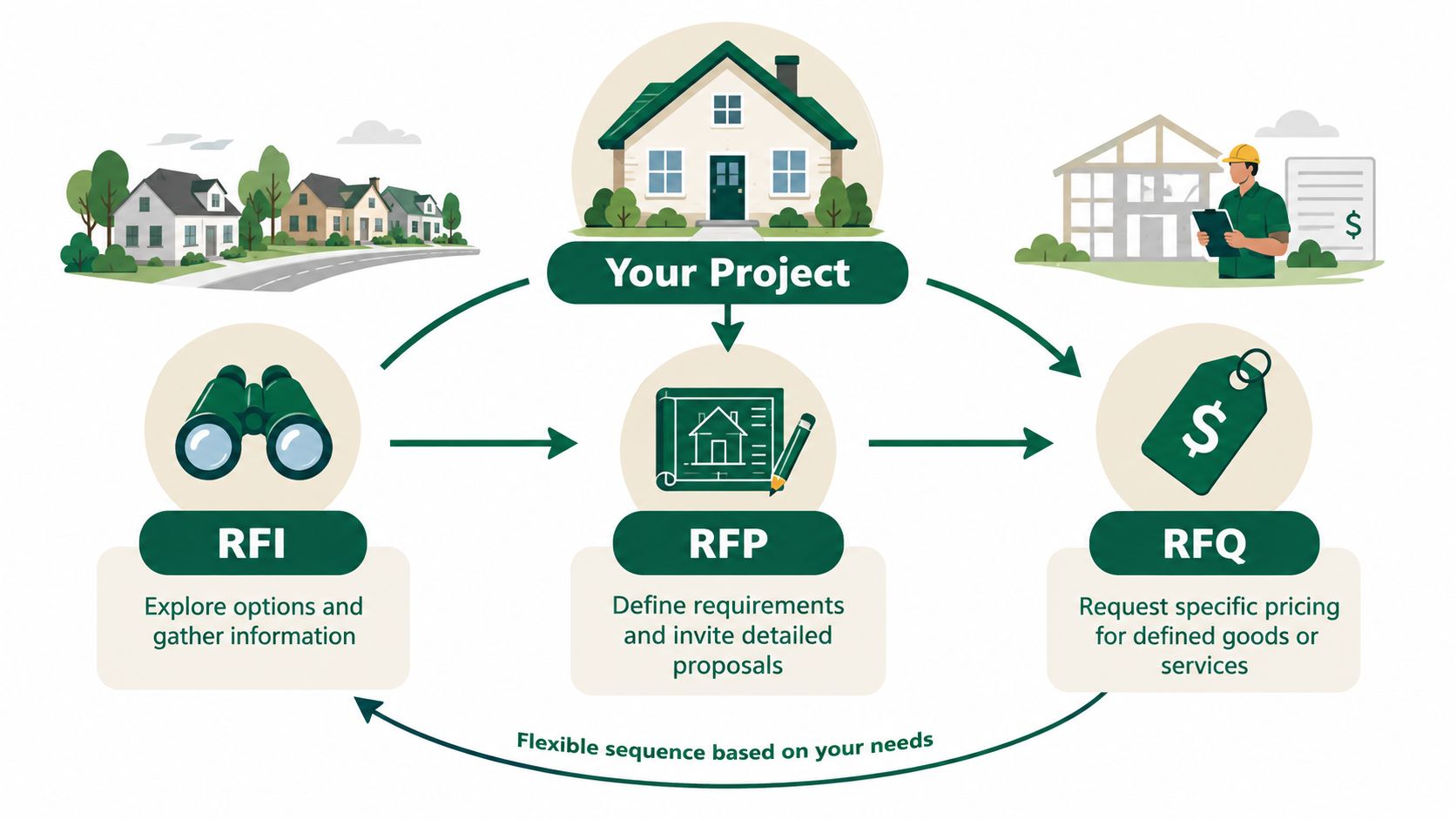
A construction team may know it needs a new facility but still lack answers about available methods, supplier capabilities, and the cost of different approaches. Choosing the request too early is like asking for a final house price before deciding the design. Procurement uses three document types to control different kinds of uncertainty.
RFI, or Request for Information: Use it to learn what the market can provide, which suppliers have relevant capabilities, and whether the initial requirements are realistic. An RFI gathers information rather than binding bids, so its value lies in improving the requirement before a formal solicitation.
RFP, or Request for Proposal: Use it when the business problem and desired outcome are clear, while the delivery method remains open. Suppliers may propose different approaches, implementation plans, risk controls, qualifications, service levels, and commercial terms.
RFQ, or Request for Quotation: Use it when suppliers can price the same defined requirement. The request should state the specification, quantity, delivery conditions, quality requirements, and service terms so quotations can be compared fairly.
Why the sequence is useful, but not automatic
A typical project may begin with an RFI to test the market, continue with an RFP to compare delivery choices, and finish with an RFQ once the specification is stable. The sequence is a decision aid, not a mandatory ritual. A mature team may skip the RFI when its requirement and supplier market are already well understood. It may also skip the RFP when the specification is fixed and only comparable pricing is needed.
Use each stage to test what is still uncertain. An RFI can reveal that a requirement is unrealistic or missing a performance measure. Before issuing an RFP or RFQ, ask suppliers to identify ambiguous terms, unavailable materials, dependencies, and assumptions. Revising the specification at this point is cheaper than changing it after bids arrive.
The U.S. General Services Administration's guidance on RFIs, RFQs, and RFPs separates the documents by their purpose: gathering information, requesting solution proposals, and seeking prices against defined requirements.
A practical choice
Ask: What would make a supplier response useful right now?
Choose an RFI when market knowledge is missing. Choose an RFP when supplier judgment is needed to shape the solution. Choose an RFQ when the requirement is controlled enough for like-for-like pricing. Keep the questions, assumptions, and specification changes on record, especially if AI later helps classify or score responses. An audit-ready evaluation must show which criteria were approved, how evidence was checked, and where human reviewers made the final decision.
How RFI RFP and RFQ Compare at a Glance
A useful comparison starts with one question: what remains uncertain, and what must the supplier return? An RFI reduces uncertainty about the market. An RFP compares possible ways to meet a defined need. An RFQ works like a price check against a requirement that is already controlled.
Criterion | RFI | RFP | RFQ |
|---|---|---|---|
Purpose | Learn about supplier capabilities and market options | Compare complete approaches to a defined business need | Compare prices and commercial terms |
When to use | The market, capability landscape, or requirement is still developing | The problem is defined, but the solution remains open | Specifications, quantities, and conditions are fixed |
Typical content | Capability questions, market feedback, service models, constraints, relevant experience | Scope, requirements, methodology, implementation, risks, service levels, pricing, contract terms | Detailed specification, quantities, delivery terms, quality requirements, pricing schedule |
Evaluation focus | Information quality, capability fit, market coverage | Technical approach, execution, risk, compliance, commercial value | Price, delivery, and compliance with the locked specification |
Expected output | Market intelligence and a possible shortlist | Qualified solution proposals and an award recommendation | Comparable quotations and a commercial baseline |
Supplier interpretation | “Tell us what you can do” | “Show us how you'd solve this” | “Price this defined requirement” |
The table describes different control points, not a compulsory sequence. A familiar category with a stable requirement may begin with an RFP or RFQ. An unfamiliar category may need an RFI first, because suppliers cannot provide useful proposals or prices until the buyer understands available options.
The document name also sets expectations. Calling every supplier request an RFP can produce the wrong response: a price-only answer when you need a solution design, or a lengthy proposal when you need comparable quotations. The title, instructions, response fields, and evaluation method should point to the same decision.
Use the response format as a quality check before issuing the request. An RFI should ask structured capability and market questions, with space for suppliers to identify constraints or alternatives. An RFP should separate the proposed approach, delivery plan, risks, evidence, and commercial response so evaluators can compare unlike solutions fairly. An RFQ should provide consistent units, quantities, assumptions, delivery conditions, acceptance requirements, and a pricing schedule.
If evaluators use AI to sort or summarize responses, retain the original submissions and the approved criteria alongside the outputs. Record how missing evidence, exceptions, and scoring recommendations were reviewed by people. That keeps the comparison useful without treating an automated classification as the procurement decision.
When to Use Each Document and When to Skip a Stage
Start with the maturity of the requirement, not with the procurement calendar.
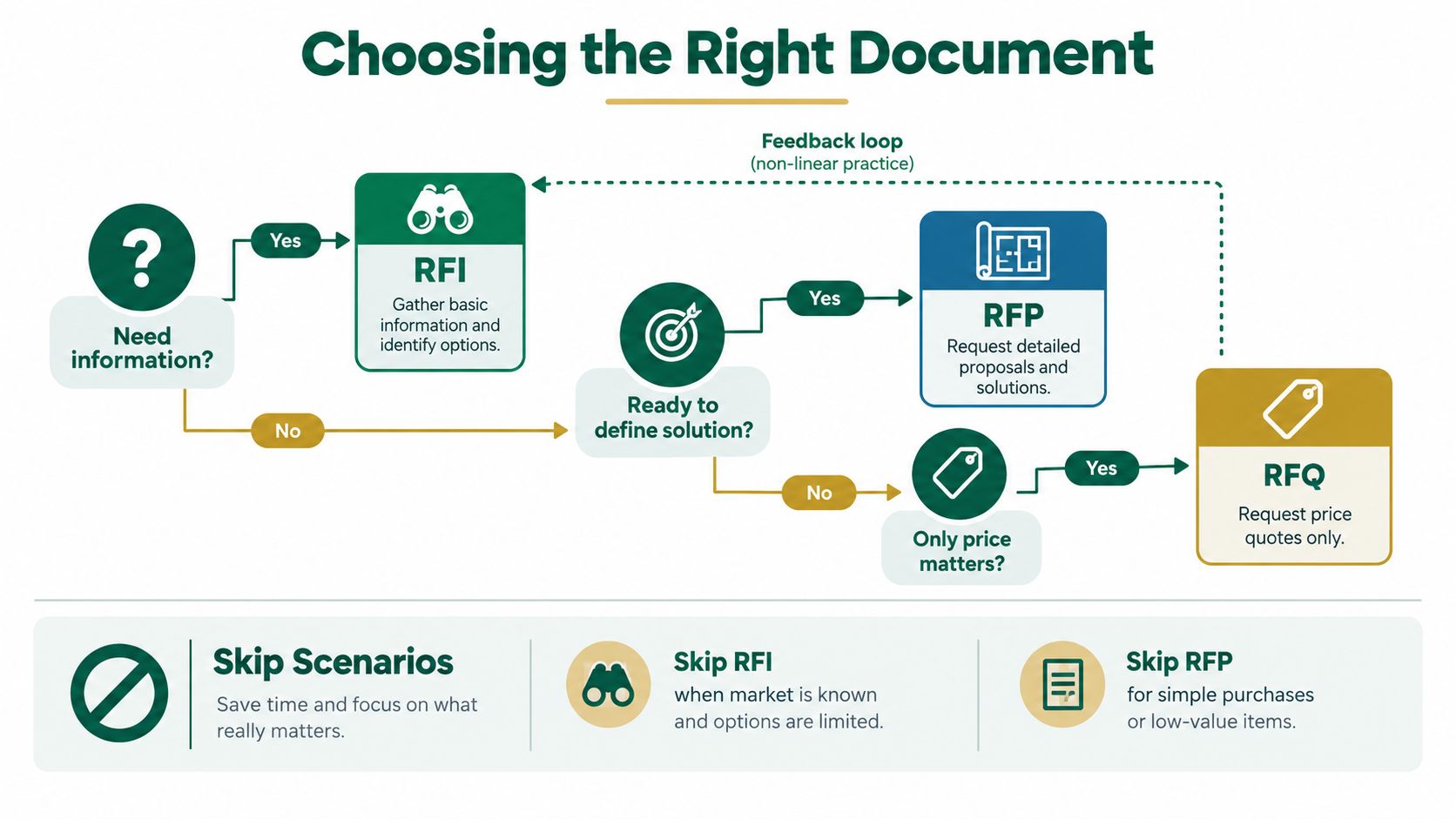
Use an RFI when the team can't answer basic market questions without supplier input. That includes uncertainty about available delivery models, supplier capabilities, technical alternatives, or whether an internal specification reflects the market. The RFI should inform the next decision, not become an unfocused request for marketing material.
Move to an RFP when the business outcome and key constraints are clear, but suppliers can reasonably propose different methods. A cloud transformation, managed service, facilities model, or complex implementation typically needs this kind of solution comparison. The buyer wants a response that explains how the supplier will deliver, not merely a number.
Choose an RFQ when the requirement is stable and suppliers can price it on the same basis. If suppliers need to make material assumptions about the design, scope, or operating model, the specification probably isn't ready for an RFQ.
When skipping is defensible
Skipping an RFI can make sense when the market is already well understood, the supplier pool is established, and the requirement has been validated through prior sourcing or operating experience. Skipping an RFP can make sense for a simple, standardized purchase where the specification is fixed and price comparison is the main decision.
The control is documentation. Record why the market is known, how the specification was validated, which suppliers were considered, and why the selected request matches the decision needed. If you're evaluating cloud services brokers, for example, an RFI may help distinguish available capabilities before an RFP defines the operating model. For a mature, repeatable requirement, that exploratory step may add little value.
Use this software procurement process for evaluating SaaS vendors when the category requires structured discovery, comparison, and stakeholder control.
Where AI changes the path
Procurement commentary increasingly describes a non-linear and AI-assisted RFx workflow. Buyers may use an RFI to map capabilities, move directly to an RFP or RFQ when they already know the market, and use generative AI to shortlist suppliers or synthesize questionnaire responses for human comparison. Recent commentary on AI-assisted RFI, RFP, and RFQ decision frameworks highlights that the workflow is changing faster than the terminology.
AI doesn't remove the need for controls. Keep the original supplier response, the prompt or evaluation instruction used, the cited evidence, the human reviewer's decision, and the reason for any override. That record lets a reviewer understand what the system did and what the buyer approved.
Templates and Clauses That Prevent Costly Gaps
A strong request document does more than describe a purchase. It tells suppliers what to answer, tells evaluators how to judge the answers, and closes the gaps that otherwise appear during negotiation or delivery.
Start with a shared structure, then adapt it to the category.
Build the request around the decision
An RFI should open with the business context, the information sought, the response format, and clear questions about capabilities, constraints, delivery models, and relevant evidence. Avoid questions that invite brochures. Ask suppliers to explain how a capability works, what assumptions it depends on, and what information the buyer should consider before finalizing the requirement.
An RFP needs greater specificity. Include:
Background and objectives: Define the business outcome without prescribing a supplier's method.
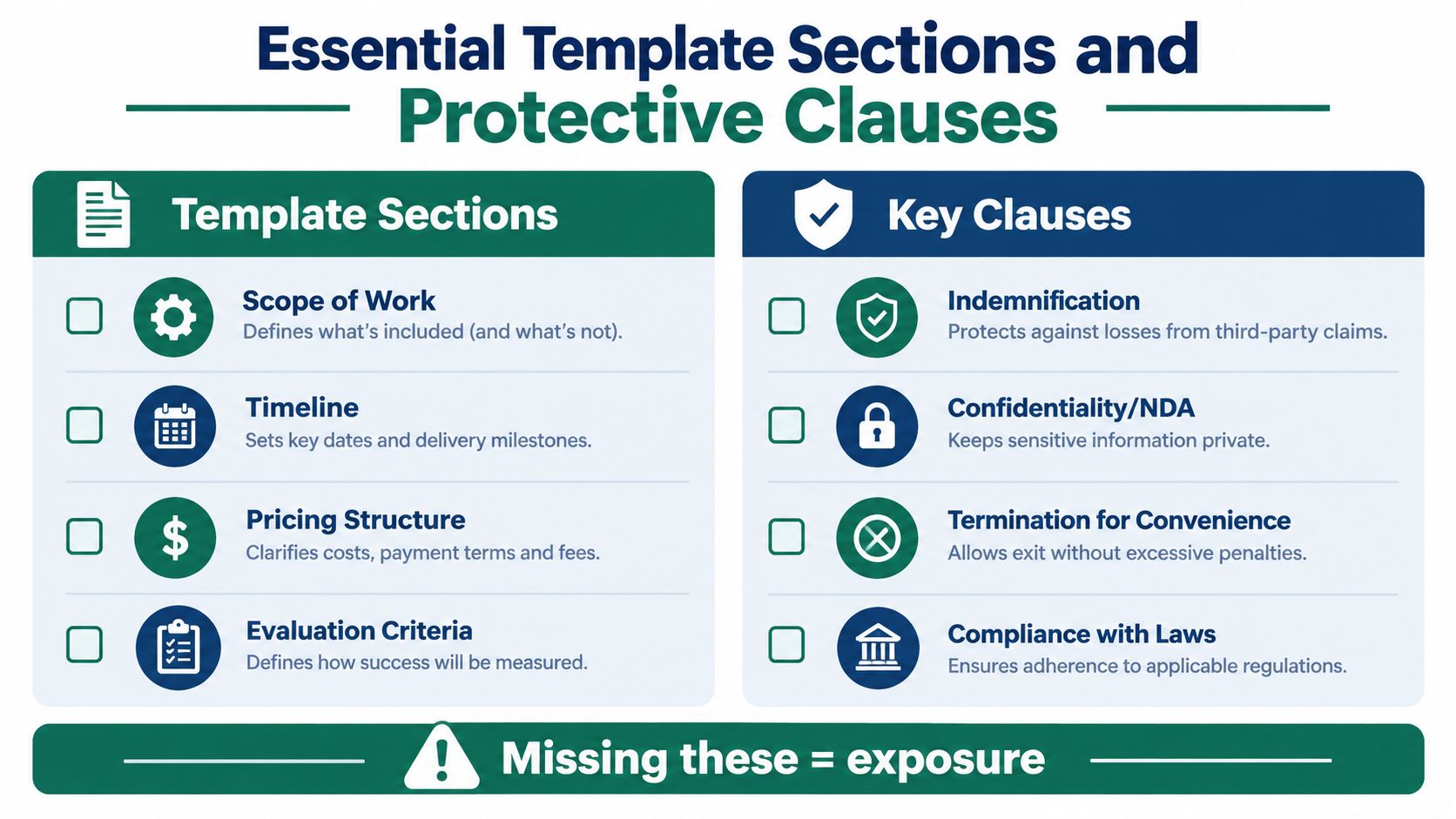
Scope of work: Separate mandatory deliverables from optional services and identify dependencies.
Acceptance criteria: State how the buyer will confirm that each deliverable meets the requirement.
Implementation and timeline: Ask suppliers to show activities, responsibilities, dependencies, and decision points.
Service levels: Define measurable operating expectations and the remedy for missed commitments.
Evaluation method: Explain the technical, commercial, organizational, and compliance factors that will influence the award.
Submission instructions: Control file formats, questions, deadlines, assumptions, and contact channels.
An RFQ should make the pricing table the center of the response. Include consistent line items, units, quantities, delivery conditions, warranty requirements, recurring and one-time charges, taxes or exclusions, payment terms, and quote validity. If suppliers price different interpretations, the table has failed its purpose.
Test the specification before release
A requirement can be technically precise and still be commercially harmful. Look for brand-specific language without an objective reason, unusual combinations of features, unnecessary certifications, restrictive geography, and requirements that only one known supplier appears able to satisfy.
The Fairmarkit review of procurement themes identifies an important gap in common guidance: teams are often told when to use an RFP or RFQ, but not how to determine whether a specification is too narrow, biased, or likely to produce a single-bidder outcome.
Run a short gap review with technical, operational, legal, and supplier-facing stakeholders. For each mandatory line, ask:
What business risk does this requirement control?
Is the requirement outcome-based or tied unnecessarily to one design?
Can a capable alternative meet the same need?
What evidence will prove compliance?
What happens if the supplier partially meets it?
Use explicit clause language for acceptance, service levels, data handling, regulatory compliance, change control, warranties, indemnification, confidentiality, termination, and remedies. A requirement without an acceptance test is difficult to enforce. A service level without a remedy may not influence supplier behavior.
For a practical drafting reference, consult this modern RFP template guide, then have the category owner confirm that each section serves the actual sourcing decision.
Evaluating Responses and Keeping an Audit Ready Record
A polished proposal can still fail a mandatory requirement. Evaluate each response against the published rules, then preserve the evidence behind every judgment. Start by separating compliance from quality. Mark every mandatory item yes, no, or partial, and record the exact response section, attachment, page, or other approved evidence. A confident claim without support is not a pass.
Use a scoring model that reflects the purchase
An RFP scoring matrix may cover technical, commercial, and organizational factors. One sourcing guide describes evaluations that frequently use 15–25 criteria, as explained in this guide to RFI, RFP, and RFQ evaluation. That range is a planning reference, not a rule. The matrix should represent the actual decision and remain practical for every evaluator to apply.
For each criterion, define:
The question: What exactly is being judged?
The evidence: Which supplier statement or document supports the answer?
The scale: What separates a strong, acceptable, weak, or non-compliant response?
The weight: How important is this criterion compared with the others?
The owner: Which subject matter expert is accountable for the assessment?
A supplier evaluation template covering weighted criteria can help organize these fields. Keep the raw answers beside the normalized scores. If a reviewer changes an initial score, record the reason, date, reviewer, and approved clarification. The final ranking should remain traceable to the source response.
Control drift and preserve the decision trail
Drift appears when a quote, proposal, manual, or contract term differs from the requirement used for comparison. Flag the difference instead of changing the score. The buyer can then reject the response, request clarification, revise the requirement under the event rules, or negotiate a defined alternative.
Operational benchmarks commonly place RFI completion at about 2–3 weeks, RFP activity at 4–8 weeks, and RFQ completion at 1–2 weeks when requirements are fully defined. The same benchmark describes typical narrowing patterns of 5–10 vendors after an RFI, 3–5 qualified proposals after an RFP, and 3–8 quotes for an RFQ. Use these figures for planning only. Category complexity and governance requirements can change the actual cycle.
AI can summarize responses or compare evidence, but its work must remain reviewable. Save the prompt, generated output, cited source, human check, correction, and final approval. This creates a record showing where automation assisted and where an evaluator made the decision.
Store invitations, clarifications, addenda, supplier responses, scoring sheets, approvals, elimination reasons, negotiation records, and the final recommendation in one controlled event record. A complete file should let an independent reviewer reconstruct the decision without relying on memory or an uncited summary.
Putting Your RFP RFI RFQ Process Into Practice
A sourcing event works best when the document follows the decision, not the other way around. Start by confirming what is unknown, what is already defined, and what evidence stakeholders need before approval.
Use this checklist:
Clarify the unknown: If supplier capability or market options remain unclear, issue an RFI.
Test the need: Review requirements for hidden bias, unnecessary detail, or dependence on one supplier. Ask suppliers to validate whether the specification is workable before locking it.
Select deliberately: Use an RFP when solution design and trade-offs matter. Use an RFQ when every supplier can price the same fixed specification.
Skip with evidence: Move directly to an RFP or RFQ when existing research and a tested requirement support that choice. Record why the skipped stage was unnecessary.
Lock the evaluation: Set compliance checks, scoring criteria, weights, and approval roles before responses arrive.
Protect the record: Keep original answers, citations, clarifications, score changes, eliminations, and approvals in one controlled file.
Keep AI reviewable: Save prompts, summaries, cited sources, human checks, corrections, and overrides.
AI can help discover suppliers, synthesize questionnaires, identify gaps, compare weighted responses, and flag specification drift. The buyer still owns the judgment. Every AI-assisted conclusion should point to source evidence and a human decision.
A successful event produces more than submissions. Suppliers understand the request, evaluators apply consistent rules, stakeholders can trace the recommendation, and awarded terms still match the approved specification.
Procright helps procurement teams draft specifications, compare suppliers, score responses with cited evidence, and flag drift before award. Visit Procright to test an end-to-end sourcing workflow or run a gap analysis on a live RFI, RFP, or RFQ.
Try it on a real buy
Bring one category. Watch where the flags land.
We use a little analytics to see which pages actually help. Nothing else, no ad trackers.