Procurement Risks and Compliance: A Practical Guide
Procurement risks and compliance need requirement-level evidence, traceable supplier checks, and risk-based reviews before an award can be defended.
In this article
The sourcing event finished on Friday. By Monday, the award recommendation had passed procurement, legal, and the business owner. Everyone had reviewed the scorecard, and the supplier looked compliant.
The audit question arrived months later: Where does the contract prove that the supplier met the mandatory acceptance criteria? The team found a thin specification, a clause nobody had tested, and a supplier term that changed between the approved draft and the signed agreement. The award wasn't necessarily wrong. The record was incomplete, and that made the decision difficult to defend.
That pattern is common in complex purchasing. Risks and compliance don't appear only at signature. They begin when someone describes the need, continue through market discovery and evaluation, and remain active during delivery, invoicing, renewal, and supplier change. A defensible process preserves the evidence at every stage.
The Sourcing Event That Looked Fine Until Audit
The problem usually starts innocently. A business team submits a request for a platform, service, or equipment package. Procurement turns the request into a specification, invites suppliers, compares responses, and moves toward award. Under time pressure, acceptance criteria remain broad because the team assumes the supplier's proposal will fill in the detail.
That assumption creates the first gap. “Meets operational requirements” doesn't tell a reviewer what was tested, who accepted the result, or what happens if the supplier fails. A service-level promise can look reassuring until nobody can identify the measurement window, remedy, reporting obligation, or consequence for repeated misses.
Practical rule: If a requirement can't be scored before award, it probably can't be enforced clearly after award.
The second failure is quieter. A supplier answers “yes” to a security or delivery requirement, then attaches a manual, proposal, or standard term that qualifies the answer. The qualification may be buried in a footnote or appear only in the final contract. Without page-level evidence, reviewers remember the conclusion but lose the basis for it.
The third failure occurs during negotiation. A quote changes, legal substitutes a supplier term, or a commercial concession is added to the signature version. Nobody compares the final text against the locked specification, so the deviation becomes part of the contract by default.
A useful vendor comparison approach with audit trails treats each answer, score, exclusion, and exception as part of one decision record. That record should show what the organization required, what each supplier demonstrated, what remained unresolved, and who approved the residual risk.
Public procurement illustrates why this discipline matters. In OECD countries, procurement represented approximately 12% of GDP and 29% of total government expenditure in 2013, equivalent to about EUR 4.2 trillion, and 63% of OECD government procurement occurred at the subnational level. The OECD integrity guidance on public procurement identifies exposure across needs assessment, specification, tendering, supplier selection, contract management, invoicing, and payment. Compliance is therefore a lifecycle property, not a checklist completed at the end.
The Four Risk Families Procurement Teams Actually Face
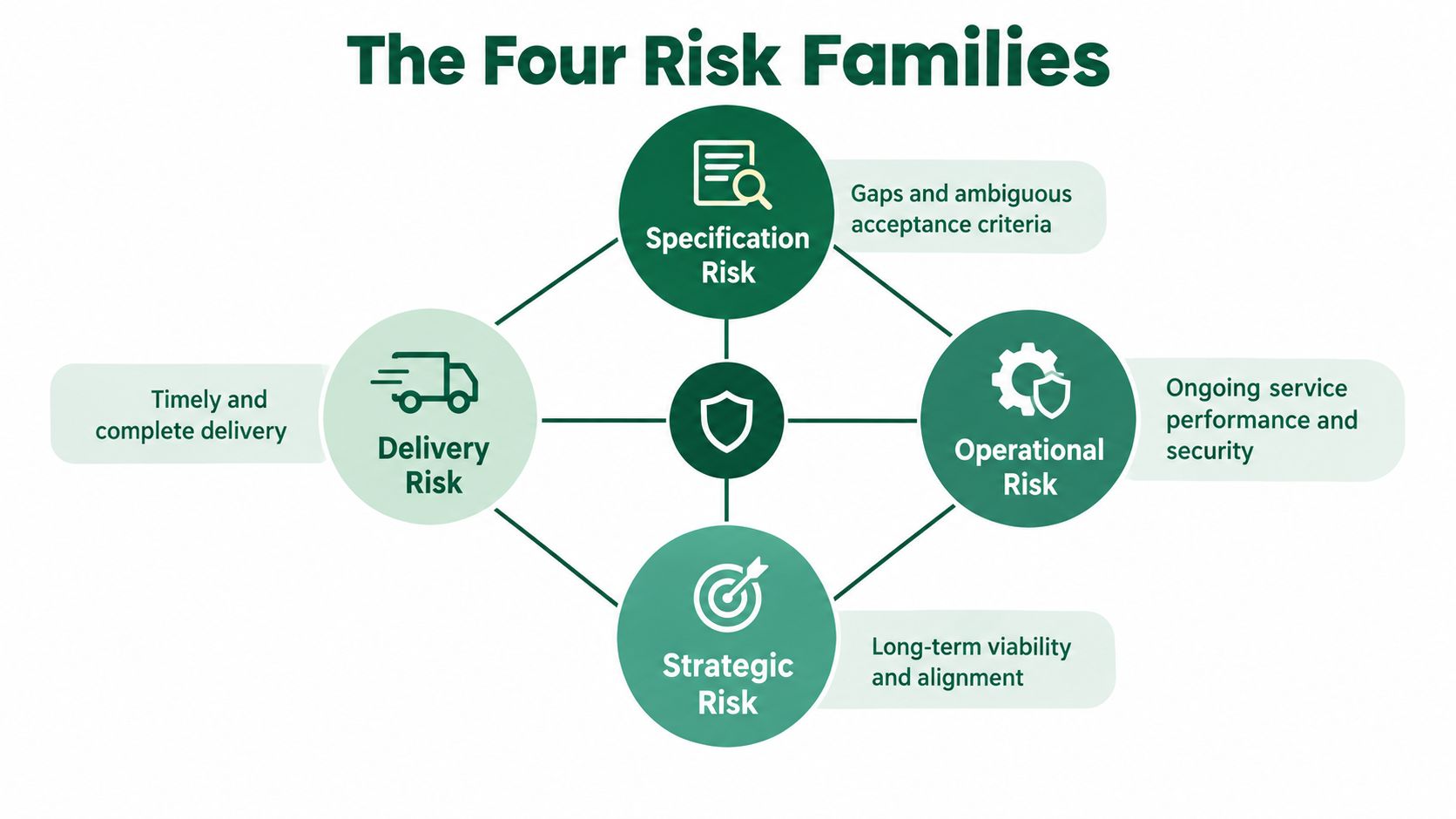
Procurement teams use different labels, but four recurring families explain most breakdowns. They overlap, yet each appears at a different point in the sourcing lifecycle and calls for a different control.
Specification risk starts before suppliers respond
A weak specification is like ordering a building without defining the foundation, load limits, or inspection standard. Suppliers can submit polished proposals that answer different questions, making the comparison appear objective while hiding incompatible assumptions.
Look for missing acceptance tests, undefined service levels, unclear data responsibilities, and requirements that use words such as “appropriate,” “secure,” or “timely” without a measurable interpretation. This risk belongs primarily in needs assessment and specification design. The right response is gap analysis before the document is locked, followed by explicit criteria and evidence expectations.
Delivery risk appears when promises meet operations
A supplier can satisfy the written requirement and still fail in practice if delivery windows, implementation dependencies, warranty obligations, or escalation routes remain vague. Delivery risk isn't limited to late hardware. It includes incomplete onboarding, missing documentation, failed integrations, and services that can't reach the agreed operating condition.
The control is a delivery model tied to acceptance evidence. Define what the supplier must provide, when the buyer will inspect it, and what happens when the result is incomplete. A purchase order shouldn't be the first place those details appear.
Operational risk continues after acceptance
Operational risk covers the period when the supplier is already embedded in the business. It includes service performance, incident notification, access management, security maintenance, support quality, and lifecycle changes. A supplier may meet the original requirement while later changing hosting arrangements, subprocessors, product functionality, or support coverage.
Contract management should therefore connect obligations to owners, review dates, incident routes, and evidence refreshes. This is where many teams discover that a signed clause has no operating owner.
Strategic risk concerns dependence and long-term fit
Strategic risk is the risk of choosing a supplier that creates unacceptable dependence, weak substitution options, or a poor fit with the organization's direction. A single bidder deserves scrutiny not because single-bid awards are automatically improper, but because limited competition can reduce challenge, weaken negotiation strength, and make assumptions harder to test.
Supplier risk scoring should combine business impact, substitutability, data sensitivity, and viability rather than relying on a single label. A practical vendor risk scoring framework can help teams explain why a supplier received deeper review and why another received proportionate treatment.
What Evidence-Backed Compliance Actually Means
A compliance answer is useful only when a reviewer can verify it. “Compliant” is a conclusion. Evidence is the clause, manual page, certification, test result, public filing, or other artifact that supports the conclusion.
For each requirement, use three states:
Yes: The available evidence directly supports conformity with the requirement.
No: The evidence contradicts the requirement, or the supplier explicitly fails it.
Partial: The supplier meets only part of the requirement, provides a qualification, or leaves an important condition unresolved.
The partial state deserves the most attention. Teams often treat it as a softer version of yes because the supplier appears close enough. In practice, partial answers contain the assumptions that later become disputes. A supplier may support the required service level but exclude a critical region, provide the security control but not the audit right, or accept the warranty obligation while limiting the remedy.
Citation turns a score into a decision record
Every answer should carry a source citation and an accountable reviewer. Record the document name, page or section, relevant wording, date reviewed, and any interpretation applied. Keep supplier assertions separate from independently corroborated evidence, especially for certifications, regulatory claims, security capabilities, and product behavior.
This method also improves internal discussion. Legal can challenge the clause, technical reviewers can test the implementation detail, and procurement can identify whether a commercial exception changes the evaluation. Nobody has to reconstruct the reasoning from email threads.
The procurement record needs its own requirement-level evidence, because general corporate compliance doesn't prove that a particular supplier met a particular specification.
Residual risk needs an owner
A partial answer isn't automatically disqualifying. The important question is whether the exception is visible, understood, and accepted by the right person. Capture the deviation, its consequence, compensating control, expiry or review date, and accountable owner.
NIST supply-chain-risk guidance calls for identifying weaknesses across suppliers, acquisition processes, delivery, integration, maintenance, and disposal, then documenting mitigating controls and residual-risk decisions. Its evidence examples include supplier inventories, procurement documents with security clauses, supplier agreements with incident-notification and audit provisions, risk registers, and residual-risk ratings. A supply-chain due diligence evidence guide can help teams organize those artifacts around requirements rather than storing them as disconnected attachments.
Three Compliance Postures and What Each One Costs You
The fastest way to assess a supplier review is to ask what would happen if an auditor challenged one mandatory requirement. The answer usually reveals the team's compliance posture.
Posture | Evidence Type | Audit Defensibility | Typical Risk Left |
|---|---|---|---|
Fully evidenced | Requirement-level citations, reviewer, status, and exception record | Strong. The organization can explain the decision and reproduce its basis | Residual risk is visible and assigned |
Partially evidenced | Some citations, broad references, and unresolved qualifications | Moderate. Reviewers can follow part of the logic but must reconstruct the rest | Hidden assumptions, inconsistent interpretations, and disputed deviations |
Asserted-only | Supplier questionnaire, summary claim, or uncited score | Weak. The conclusion exists without reliable proof | Misrepresentation, untested obligations, and no clear basis for acceptance |
A fully evidenced review can take more effort before award, but it reduces rework when stakeholders challenge the result. It also gives contract managers something actionable after signature. They know which document supports the obligation and what evidence to request during performance reviews.
Partially evidenced reviews often feel efficient because the team has completed most of the visible work. The cost appears later, when different reviewers interpret the same answer differently or when a supplier disputes what it promised. The organization then pays in delay, escalation, and duplicated analysis.
Asserted-only is the cheapest posture to produce in the moment and the most expensive to defend. A completed questionnaire may show that a supplier made a claim, but it doesn't establish that the claim was accurate, current, or incorporated into the contract.
The practical test is simple: can another reviewer reproduce the award decision without asking the original buyer what happened?
Before signature, look for three signals. Mandatory requirements lack direct citations, partial answers are folded into yes, and deviations are described in email rather than in the evaluation record. Those signals matter more than the visual polish of the scorecard.
Controls Across the Sourcing Lifecycle
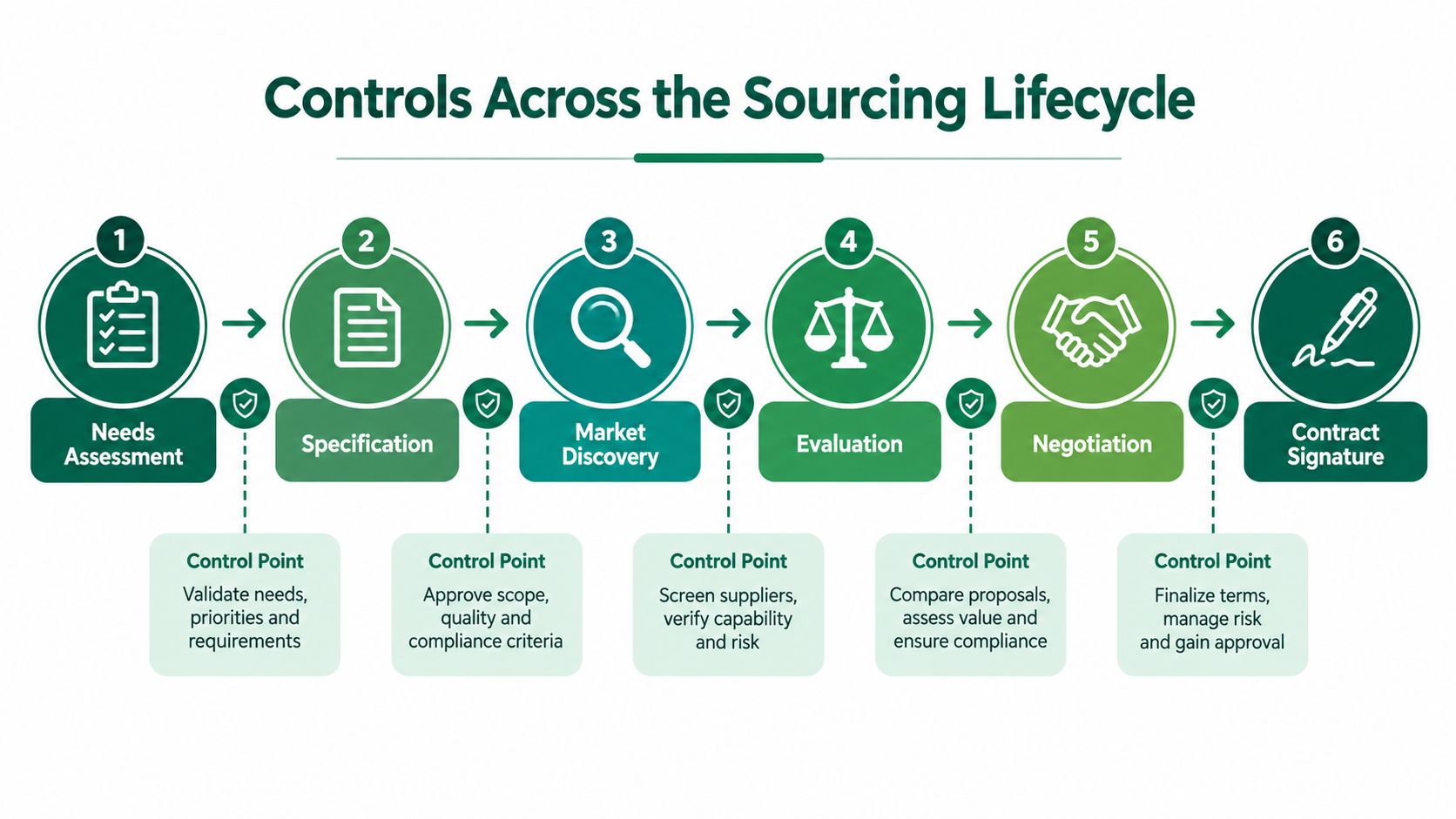
Controls work best when they produce an artifact at the moment a risk appears. Waiting until contract review forces one team to repair decisions that several teams made earlier.
Needs assessment and specification
Start by separating the business outcome from the proposed solution. Ask what must be true at acceptance, what failure would disrupt operations, which obligations are mandatory, and which requirements are preferences.
The artifact should be a requirements register with owners, priority, acceptance method, and evidence expectations. A gap review at this stage catches ambiguous terms, missing security obligations, absent support conditions, and requirements that unintentionally point to one supplier.
Market discovery and evaluation
During discovery, test whether the specification describes a real market or embeds an incumbent's design. Record suppliers considered, reasons for elimination, and any single-bidder signal. If only one supplier can satisfy the requirement, determine whether the requirement is genuinely necessary, overly narrow, or unsupported by market evidence.
Evaluation should then compare suppliers against the same locked requirements. Preserve the source behind each yes, no, or partial answer, and document why a supplier was excluded. This prevents the common failure where evaluators score from memory or from different versions of the proposal.
Negotiation and contract signature
Before signature, compare the quote, manuals, schedules, order form, and final terms with the approved specification. Flag changes to price, delivery, service levels, security commitments, incident reporting, audit rights, warranty, termination, and lifecycle support.
NIST's supply-chain controls support this approach by emphasizing documented plans, supplier inventories, security clauses, service-level commitments, audit rights, and residual-risk records. Contract teams that want a complementary financial-services perspective can review how banks assess third-party risk, especially the emphasis on governance, criticality, controls, and ongoing oversight.
The final artifact is more than a signed contract. It is a versioned record containing the locked requirement, supplier response, evidence citation, evaluation outcome, approved deviation, and sign-off.
Why One-Time Questionnaires Stop Working for AI and Cloud
A questionnaire records what a supplier said at a particular moment. That can be useful, but it doesn't prove that an AI or cloud supplier still operates within the same boundaries after award.
AI products change quickly. Models, training practices, data-processing arrangements, manuals, hosting locations, subprocessors, and terms can all move while the contract remains unchanged. In a 2025 EDUCAUSE poll, 45% of respondents identified the pace of AI-product change as a major procurement challenge, while 40% cited insufficient institutional AI governance. The same poll found that 86% considered security and regulatory compliance, and 77% considered whether institutional data would be used to train AI models, according to the EDUCAUSE QuickPoll.

The issue isn't that questionnaires have no value. They establish a baseline and force suppliers to address defined topics. The failure occurs when buyers treat the baseline as permanent evidence, especially for services that can change without a new sourcing event.
Build a recurring evidence model
For a critical AI or cloud supplier, link each requirement to an evidence source, owner, status, and refresh condition. Define what must be refreshed routinely and what event triggers immediate reassessment.
Useful triggers include:
Model or product changes: A new model version, material feature, or processing function may alter data use or control coverage.
Hosting changes: A new region, infrastructure provider, or data location can change legal, security, and operational exposure.
Subprocessor changes: A newly introduced party may require separate due diligence and contractual review.
Incident or control failure: A security event, service outage, or certification issue should reopen relevant requirements.
Term changes: Updated manuals, privacy terms, service levels, or audit provisions can create drift against the signed position.
A certificate or questionnaire may support a point-in-time conclusion. It doesn't answer whether later changes preserved conformity. The defensible approach is event-triggered reassessment, with the record showing what changed, what evidence was reviewed, and who accepted any residual risk.
A Risk-Based Way to Allocate Compliance Effort
Continuous monitoring sounds sensible until a team has hundreds of suppliers and limited reviewers. Applying the same depth to every vendor creates administrative volume without necessarily improving control. A better model directs evidence work toward the suppliers that could cause the greatest harm.
EY's third-party risk analysis found that 57% of organizations had centralized enterprise-wide programs, up from 54% in 2023. When monitoring third parties, 53% considered regulatory or compliance risk, while privacy and cybersecurity were each considered by 54% of respondents. Separately, Whistic’s 2025 TPRM Impact Report found that 56% of surveyed companies worked with more than 100 vendors, the average vendor count rose to 286 from 237 in 2024, and 77% of reported breaches over the preceding three years originated with a vendor or another third party.
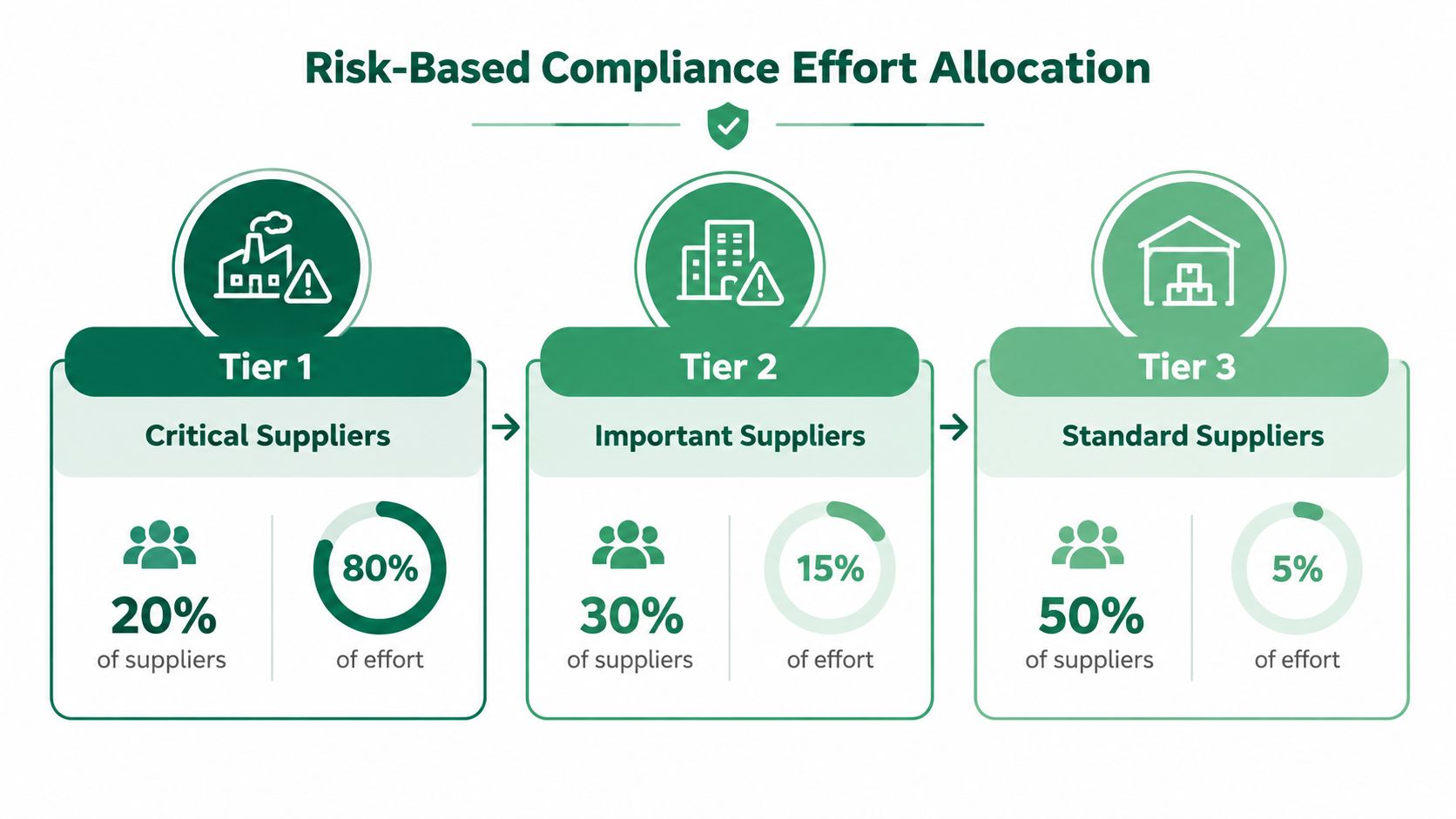
Illustrative allocation only, not a prescribed percentage split.
Tier suppliers by potential harm
Tiering should consider business impact, data sensitivity, substitutability, concentration, regulatory exposure, and dependency on a single provider. A supplier supporting a critical process or sensitive data deserves deeper evidence than a commodity provider with easy substitutes.
Critical suppliers: Require requirement-level evidence, stronger contractual protections, defined monitoring, independent corroboration where practical, and documented executive acceptance of residual risk.
Important suppliers: Use structured due diligence, targeted evidence refreshes, and event-triggered reassessment for material changes.
Standard suppliers: Apply proportionate checks, confirm core contractual obligations, and escalate when the supplier's scope expands.
The tier isn't permanent. A low-risk supplier can become important when it gains access to sensitive data or becomes a sole source. A critical supplier may also need reassessment after ownership changes, a new hosting arrangement, an incident, a new subprocessor, or a material contract amendment.
The measure of maturity isn't the number of questionnaires completed. It's whether evidence depth, review frequency, and escalation rules match the supplier's potential impact.
Putting It Into Practice With Procright
A workable process connects each control to the point where the risk emerges. Gap detection belongs before the specification locks. Single-bidder signals belong during market discovery. Evidence citations belong inside the evaluation record, not in a separate folder that nobody can reconcile later.
Procright can support this workflow by analyzing specifications, identifying gaps and single-bidder lines, comparing supplier responses, and attaching source citations to yes, no, or partial compliance answers. It can also compare quotes, manuals, and contract terms with the locked specification and flag deviations before signature. Those functions are useful only when the organization assigns reviewers, sets approval rules, and treats exceptions as decisions rather than formatting issues.
The audit history should preserve the full chain:
Every requirement answered: The record shows the status and source behind each mandatory criterion.
Every elimination explained: The team can state why a supplier left the shortlist.
Every deviation flagged: The final terms are compared with the approved position.
Every exception owned: A named decision-maker accepts or rejects residual risk.
Every change traceable: Later supplier or contract changes trigger the appropriate review.
This is what turns procurement compliance from a final audit exercise into an operating discipline. The system can organize evidence, but the procurement team still has to define what matters, challenge weak claims, and decide whether a partial answer is acceptable.
Procright helps procurement teams structure requirements, compare supplier evidence, detect specification and contract drift, and preserve an audit-ready decision record across the sourcing lifecycle. If your reviews still depend on spreadsheets, email trails, and supplier assertions, visit Procright to test a more traceable approach on your next sourcing event.
Try it on a real buy
Bring one category. Watch where the flags land.
We use a little analytics to see which pages actually help. Nothing else, no ad trackers.