Sourcing to Pay: The Complete Guide for Procurement Leaders
The traditional sourcing to pay process fails most often before the first bid, when an unclear specification creates disputes, drift, and weak audit defense.
In this article
A source-to-pay market study estimated the global category at USD 5.35 billion in 2024, rising to USD 6.30 billion in 2025 and potentially reaching USD 21.30 billion by 2032. Yet the traditional sourcing to pay process fails most often before the first bid, when an unclear specification creates downstream disputes, specification drift, and weak audit defense.
A technical team requests new infrastructure equipment. The buyer turns a hurried email into a specification, copies language from an old tender, and sends it to the market. One supplier asks for clarification. Another drops a requirement without notice. A third submits a polished response that appears compliant until someone compares the quote with the technical manual.
The award goes through. Then the problems start. The delivered configuration doesn't match the user's expectation, the contract doesn't define acceptance clearly, and the invoice includes charges that nobody can reconcile confidently. During an audit, the team can show that it collected bids, but not why the requirements were written as they were, why one supplier was eliminated, or when the final scope changed.
Sourcing to pay means managing the full cycle from identifying a need through supplier discovery, evaluation, contracting, purchasing, receiving, invoice verification, and payment. Modern tools should do more than move approvals between screens. They should catch specification errors early, preserve evidence, and connect the original decision to the transaction that follows.
Table of Contents
Why Sourcing to Pay Breaks Before the First Bid
Most procurement teams focus their controls on the competitive event. They check whether suppliers received the same request, whether bids arrived before the deadline, and whether evaluators completed their scorecards. Those controls matter, but they don't correct a flawed starting point.
A specification can be incomplete without looking obviously wrong. It may describe a product by brand-specific terminology, omit service-level requirements, leave acceptance criteria open to interpretation, or combine technical preferences with mandatory conditions. Each omission gives suppliers room to interpret the request differently. Procurement then compares responses that aren't answering the same question.

The first failure is usually a definition failure
Specification drift often begins before the sourcing event opens. A stakeholder adds a requirement in a meeting, an engineer accepts an alternative in an email, or a supplier's product description influences the wording. By award time, the requirement used for evaluation may no longer match the requirement the business actually needs.
That creates three connected exposures:
Commercial exposure: Suppliers price different scopes, so the apparent low bid may not be comparable.
Execution exposure: Delivery teams discover that the contract doesn't define what “complete” means.
Audit exposure: Reviewers see a final decision without a reliable chain from need to requirement to award.
Sourcing to pay is therefore a control framework, not just a linear workflow. The process should lock a baseline specification, preserve revisions, identify suppliers against that baseline, and carry the accepted terms into purchase orders and invoices.
Practical rule: If the team can't explain why a requirement exists before bids arrive, it won't be able to defend the award when a supplier challenges it later.
The strongest technology touchpoint sits at the beginning. Gap analysis, single-bidder detection, clause suggestions, and structured approvals can expose weaknesses while the team can still fix them. Once suppliers have priced the work and stakeholders have formed preferences, correcting the specification becomes slower, more political, and harder to defend.
The Sourcing to Pay Lifecycle Explained
A reliable lifecycle has clear ownership and a durable record at every handoff. The names of the stages vary by organization, but the control logic stays consistent.
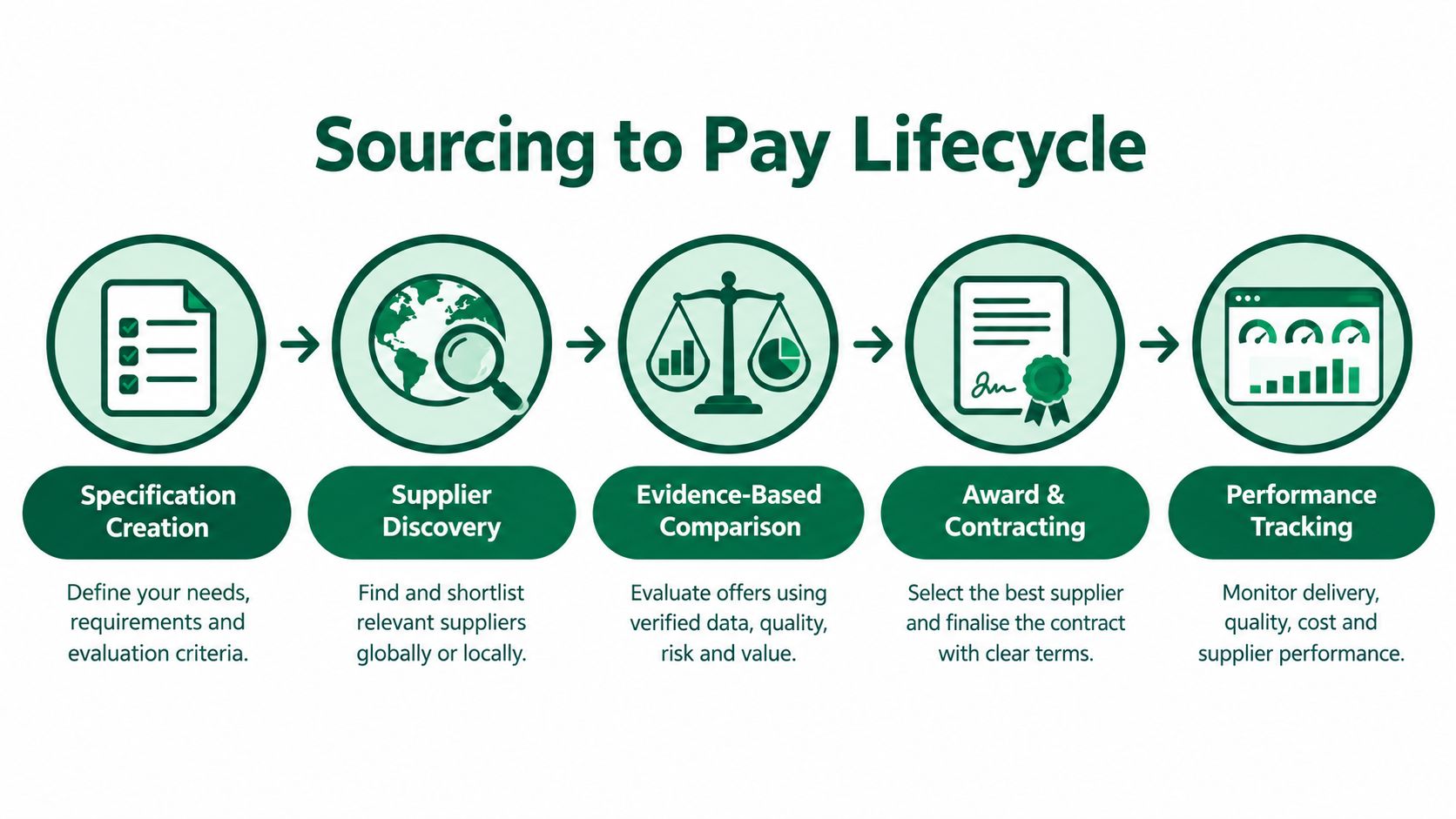
From need to an approved baseline
The business owner identifies the need and explains the outcome required. A technical specialist translates that outcome into measurable requirements, while procurement checks neutrality, completeness, and market viability. The approved artifact should include mandatory requirements, desirable features, acceptance criteria, delivery expectations, service obligations, and commercial assumptions.
Next comes supplier discovery. Procurement searches the market, records the suppliers considered, and explains exclusions. A shortlist isn't defensible merely because it contains familiar vendors. Each candidate should survive the same locked specification.
The evaluation stage then compares responses requirement by requirement. A useful record captures the supplier's answer as yes, no, or partial, together with a source citation and reviewer comment. That structure prevents a supplier assertion from becoming an undocumented fact.
From award to controlled execution
The award decision should preserve the scoring model, weights, clarification history, deviations, and approval record. Contracting then converts the selected offer into enforceable terms. Legal, finance, procurement, and the business owner need to agree on the commercial baseline before signature, not reconstruct it from emails later.
Purchase execution connects the contract to a requisition and purchase order. The order should carry the approved descriptions, quantities, prices, delivery terms, and milestones. Milestones can acknowledge completion of deliverables and support received quantity, amount, and percentage calculations on purchase orders, as shown in this vendor-neutral procurement workflow documentation.
Receiving confirms whether the supplier delivered what the organization ordered. Invoice processing then checks the invoice against the purchase order, receipt, and contract. Payment follows only after exceptions have an owner and a documented resolution.
For organizations connecting procurement with finance systems, a practical EDI guide from SubmitMySaas can help teams think through how structured transaction data moves between trading partners. The technology choice matters less than preserving the evidence behind each transaction.
A useful process reference is this guide to where the procure-to-pay process breaks down and how AI can address each stage. It reinforces the core discipline: every downstream control depends on the quality and traceability of the upstream decision.
Specification Drift and Single-Bidder Traps
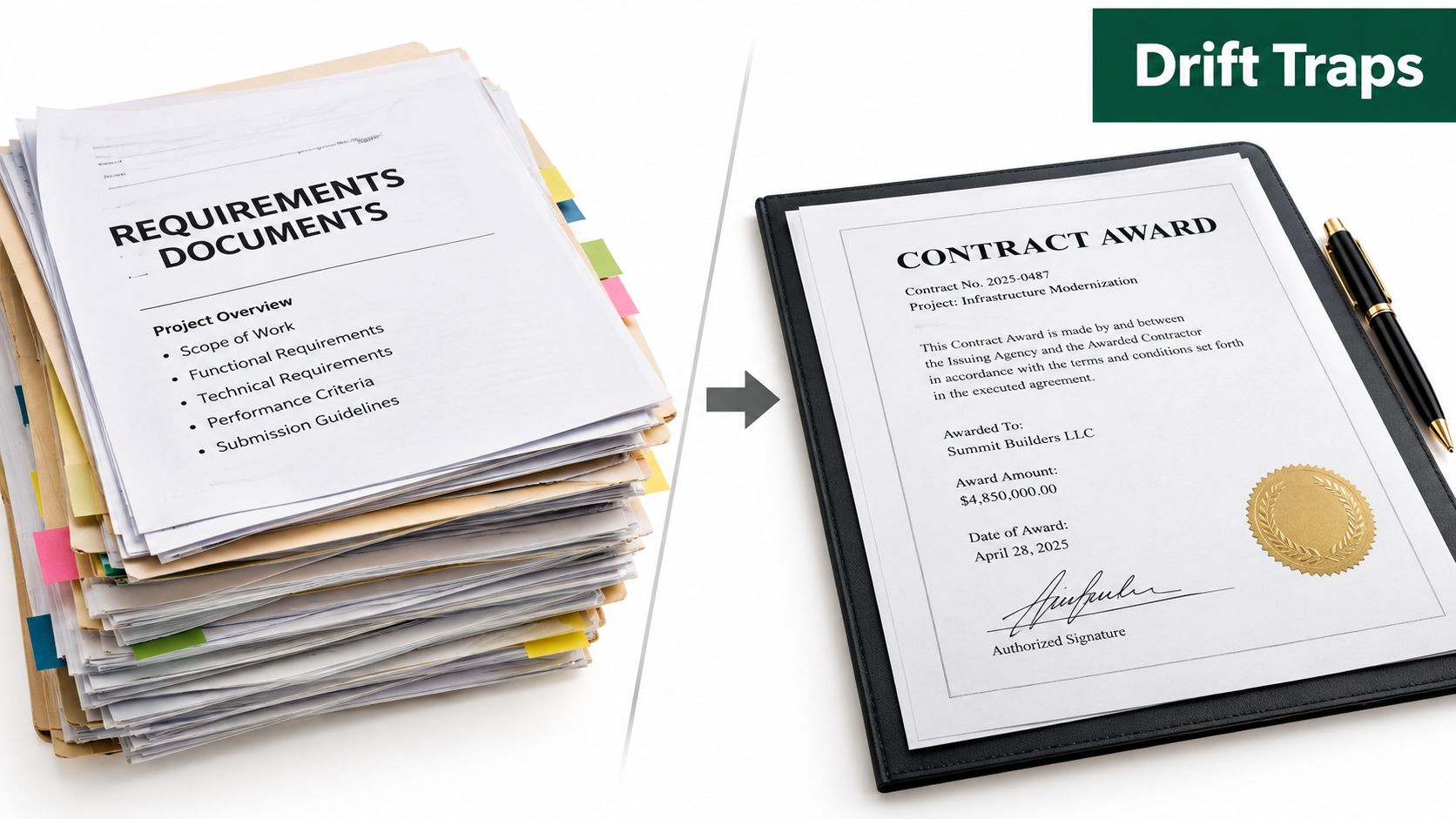
A narrow specification can look efficient because it reduces evaluation work. In reality, it may be hiding a market problem. If only one supplier can answer, the team may have discovered a genuine technical constraint, or it may have written a requirement around one supplier's product.
The difference should be demonstrated before the tender closes. Procurement needs to know whether the requirement is outcome-based, whether equivalent solutions exist, and whether every mandatory condition is necessary. A market scan that lists vendors without testing them against the specification doesn't answer that question.
How drift enters the event
Drift develops through small, reasonable changes:
Requirement edits: The technical owner adds a feature after supplier discussions begin.
Document conflict: A quote describes one warranty while a manual describes another.
Commercial substitution: A supplier meets the technical requirement but changes delivery, support, renewal, or payment terms.
Clarification leakage: One bidder receives information that other bidders don't receive.
Manual review often misses these changes because reviewers read documents sequentially. They remember the general meaning of the original request, but they don't compare every phrase, condition, and commercial consequence against a controlled baseline.
A strong specification process records the original requirement, its rationale, its owner, and every approved change. It also tests whether a requirement unnecessarily excludes viable suppliers. The procurement specification completeness checklist for IT teams provides a useful reference for examining those gaps before publication.
The cheapest fix happens before award
Platforms designed for risk control can flag incomplete requirements, detect language associated with a single-bidder outcome, and suggest missing clauses such as acceptance criteria or service penalties. They can also compare supplier documents with the locked specification while the event is still active.
That doesn't remove professional judgment. It gives the buyer better questions to ask while changes are still reversible. A flagged requirement may be justified, but the justification should appear in the decision record.
Supplier Evaluation Without the Guesswork
Supplier evaluation has a real trade-off. Manual scoring can move quickly when the event is small and the reviewers know the category. It becomes fragile when several suppliers submit long technical documents, when evaluators interpret criteria differently, or when the team must defend an elimination long after the event closes.
The answer isn't to replace judgment with an opaque score. It's to make judgment traceable. A weighted model should begin with a locked specification, assign weights that reflect business priorities, and record the evidence supporting each score.
Two evaluation models
Evaluation Aspect | Traditional Approach | Evidence-Based Platform Approach |
|---|---|---|
Requirement interpretation | Reviewers read documents and apply personal judgment | Requirements are structured against a controlled baseline |
Compliance answers | Yes or no answers may rely on notes or memory | Yes, no, or partial answers include source citations |
Supplier comparison | Scorecards can mix different interpretations | Side-by-side responses use the same requirement set |
Eliminations | Reasons may remain in email threads | Each exclusion has a recorded reason and supporting evidence |
Commercial review | Technical and commercial deviations are reviewed separately | Quote, manual, warranty, delivery, and terms differences are connected |
Audit response | The team reconstructs the decision after the fact | The decision record is created during evaluation |
The faster approach isn't always the better approach. A spreadsheet may be sufficient for a contained purchase with stable requirements. For complex events, the time saved by informal scoring can be consumed later by clarification rounds, stakeholder disputes, invoice exceptions, or audit requests.
Make the shortlist debate useful
A defensible shortlist distinguishes non-compliance from uncertainty. If a supplier hasn't provided evidence, the answer shouldn't automatically become “no.” Mark it as unverified, request clarification, and preserve the response. That prevents a confident but unsupported assumption from distorting the award.
Reviewers should also assess market adoption, vendor stability, relevant support coverage, and the supplier's ability to meet operational obligations. These inputs don't replace requirement compliance. They add context to the risk of choosing a technically acceptable supplier that can't support the relationship.
Procurement teams building a repeatable model can use this supplier evaluation template and weighting guide to structure criteria before reviewers begin scoring.
How Drift Detection Protects the Award
Drift detection is a specific control, not a vague promise of better visibility. It compares supplier quotes, technical manuals, proposals, warranties, and commercial terms with the locked specification. When a difference appears, the system should show the affected requirement, the supplier's wording, the source location, and the possible impact.
That timing matters. Before signature, procurement can clarify the response, request a revised offer, adjust the score, or reject the deviation. After signature, the same discrepancy may become a delivery dispute or an invoice exception.
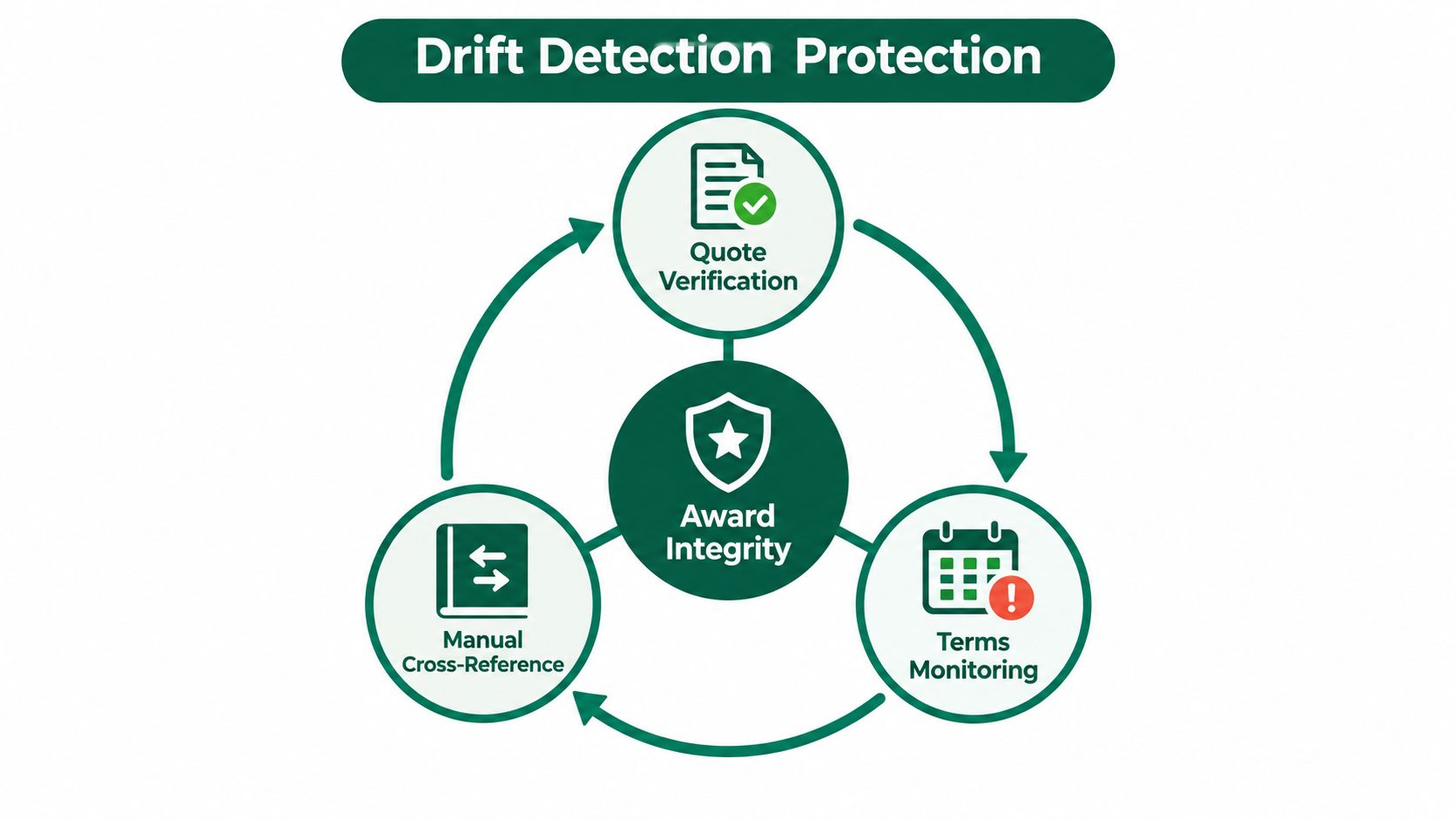
What the control checks
Effective drift detection looks for more than changed product names. It should compare:
Technical values: Capacity, compatibility, performance conditions, materials, and configuration.
Service obligations: Response commitments, support coverage, maintenance scope, and escalation terms.
Commercial conditions: Price basis, delivery timing, renewal language, warranty limits, and payment requirements.
Acceptance logic: Tests, documentation, milestones, and the evidence needed to approve delivery.
The system should preserve the original wording rather than merely displaying a warning. A reviewer needs to understand whether the difference is a harmless clarification, an approved alternative, or a material departure from the request.
Connect deviations to the award record
Drift findings become more useful when they feed into compliance scoring. A supplier that appears fully compliant at summary level may have a material exception buried in a manual. The final record should show whether the team accepted, priced, mitigated, or rejected that exception.
This also protects the contract handoff. Approved deviations should be carried into the agreement and purchase order, with an owner responsible for checking them during receipt. Unapproved deviations shouldn't disappear when the sourcing workspace closes.
The award is only as sound as the assumptions that survive from specification to signature.
Procurement leaders should test drift detection with documents that contain conflicting warranties, delivery windows, and payment terms. A tool that finds only obvious keyword differences won't protect the event from the subtle changes that cause disputes.
Metrics That Actually Measure Procurement Health
A dashboard can make a weak process look busy. Counting sourcing events, approvals, or supplier records doesn't show whether the organization makes sound decisions or controls execution. Procurement health requires measures with stable definitions, reliable baselines, and named owners.
The first distinction is between operational speed and financial outcome. The two can move in opposite directions. A team may issue purchase orders quickly while accepting poor specifications, weak competition, or terms that later create invoice exceptions.
Start with definitions
Requisition-to-order cycle time should measure the elapsed time from purchase requisition approval to purchase order issuance, rather than from an informal request or an earlier sourcing activity. That benchmarked definition is provided in Amazon Business's procurement KPI guidance. Keep the start and end events consistent across categories so managers can identify process bottlenecks rather than debate the measurement.
Cost savings require equal discipline. Calculate savings against an approved baseline unit cost, not against an arbitrary universal percentage target. The baseline should be documented before the event, approved by the relevant business owner, and adjusted only through a controlled change process.
A practical KPI set can include:
Baseline savings: Approved baseline unit cost minus awarded unit cost, multiplied by the relevant quantity, with scope and assumptions recorded.
Requisition-to-order cycle time: Elapsed time between approved requisition and issued purchase order.
Specification exception rate: The number of material deviations identified during evaluation or execution, categorized by technical and commercial impact.
Evidence completeness: The share of evaluated requirements with a source, reviewer, and resolution recorded.
Invoice exception themes: Recurring mismatches grouped by price, quantity, receipt, milestone, or contract term.
Benchmark the full lifecycle
Benchmarking works when it covers the whole procurement lifecycle, including sourcing, contracting, supplier management, purchasing, and invoice processing. The Hackett Group describes procurement benchmarking as a way to identify performance gaps against leading organizations and improve savings, supplier performance, and operational efficiency in a full-lifecycle benchmarking framework.
Benchmarking shouldn't become a race to copy someone else's target. It should reveal where control breaks. A long cycle time may reflect weak intake, unclear specifications, or excessive approvals. A low exception rate may mean the process works, or that the team doesn't record exceptions consistently.
For readers tracking automation and emerging procurement practices, the AI procurement coverage from AI Frontiers offers useful context. The operating principle remains simple: measure the mechanism that produces the outcome, not the activity that merely resembles progress.
Choosing Your Sourcing to Pay Approach
The right approach depends on the risk profile of the work, not on whether a platform has an impressive feature list. A manual process can work for a contained purchase with clear requirements, familiar suppliers, limited stakeholders, and modest audit exposure. It needs stronger controls as complexity rises.
Use four questions to decide where to invest:
Can you defend the specification? If requirements, revisions, and acceptance criteria sit across email and documents, start with specification control.
Can you explain the shortlist? If supplier discovery and eliminations aren't recorded, strengthen market evidence before optimizing approvals.
Can you prove compliance? If evaluator answers lack citations, create a requirement-level evidence record.
Can execution follow the award? If purchase orders, receipts, milestones, and invoices don't share the same commercial baseline, connect those handoffs.
A free test run or gap analysis makes sense when the team wants to validate the process on shared documents before committing to a broader rollout. Select a real event with known ambiguity, conflicting supplier materials, or a difficult audit trail. Judge the result by whether the tool surfaces risks the current process misses, not by how quickly it produces a polished report.
Technology should support collaboration, role-based review, document ingestion, weighted comparison, drift detection, and exportable audit records. It shouldn't hide the reasoning behind a score or encourage teams to accept supplier claims without evidence.
Procright supports sourcing workflows from specification drafting through supplier discovery, evidence-backed compliance comparison, weighted scoring, and drift detection before award. If your team needs a verifiable record for complex purchasing, visit Procright to review the platform and explore a test run.
Try it on a real buy
Bring one category. Watch where the flags land.
We use a little analytics to see which pages actually help. Nothing else, no ad trackers.