Strategic Sourcing Consulting: A Practical Enterprise Guide
Strategic sourcing consulting can help when internal teams stall, but only when the buyer knows what outcome to purchase and how to retain ownership.
In this article
A mid-sized manufacturer has spent twelve weeks running an IT services RFP. The scope still contains conflicting requirements, Finance doesn't trust the savings estimate, and the three suppliers most likely to deliver have declined to bid. The sourcing team is busy, but the project isn't moving.
That pattern is common. Internal teams usually stall because the spend data can't support a baseline, the category strategy hasn't been refreshed, or stakeholders agree in principle and then challenge the requirements when the award reaches review. Strategic sourcing consulting can help, but only when the buyer knows what outcome to purchase, how to test a firm's claims, and how to retain ownership after the consultants leave.
This guide treats the consulting engagement itself as a sourcing decision. The question isn't whether a polished team can produce a presentation. It's whether the firm can create a defensible award, improve the economics and risk profile of the category, and transfer a repeatable method to your people.
When Internal Sourcing Efforts Stall
Internal sourcing efforts rarely fail because nobody knows how to send an RFP. They fail because the work before the RFP remains unresolved. A category manager may have a supplier list, a few old contracts, and a savings target, but still lack a reliable view of demand, specifications, incumbent performance, and business constraints.
Start by diagnosing the stall rather than commissioning consultants immediately.
Find the actual blockage
Ask three questions:
Can Finance reproduce the baseline? If procurement and Finance use different spend classifications, every savings discussion becomes a debate about arithmetic.
Can the business agree on the need? If engineering, operations, and IT describe different outcomes, suppliers receive a scope they can't price consistently.
Can the team protect time for the event? A sourcing project competing with daily purchase orders, supplier escalations, and contract renewals will lose priority.
These problems also appear in supply chain technology decisions. Teams comparing platforms may benefit from a structured guide to compare visibility software architectures, especially when the buying decision involves data integration, operational ownership, and supplier participation rather than a simple feature checklist.
Practical rule: Hire outside help to remove a specific constraint, not to make an internal problem look more sophisticated.
Consulting makes sense when internal capability is missing, organizational politics prevent an objective decision, or an executive deadline leaves no room for another stalled cycle. It can also provide neutrality after a failed event has damaged trust between procurement and the business.
It isn't automatically worth the cost. If the category is small, the requirements are stable, and the team already has the necessary market knowledge, a consultant may add ceremony without adding value. Before you invite firms to pitch, write down the decision that has remained blocked, the evidence currently missing, and the action you expect a consultant to own.
What Strategic Sourcing Consulting Actually Means
Strategic sourcing consulting applies portfolio management discipline to buying decisions. A financial advisor considers allocation, exposure, return, liquidity, and long-term fit rather than judging an investment only by its immediate price. A sourcing consultant applies that discipline to supplier choices, category demand, contract structures, operational dependencies, and risk.

Strategic sourcing consulting is a paid engagement in which external specialists analyze spend, clarify business requirements, study the supplier market, redesign selection criteria, run a structured RFx and negotiation, and support implementation. The work connects supplier selection with contract execution and performance governance. It does not end when a preferred bidder is announced. This end-to-end approach aligns with the strategic sourcing framework described in Ivalua's strategic sourcing process guide.
What you're buying
A worthwhile engagement produces decisions and evidence, not just activity. Require outputs such as:
A category baseline: normalized spend, demand assumptions, current suppliers, contract coverage, and known data limitations.
A sourcing strategy: choices involving consolidation, lotting, incumbent treatment, supplier diversification, and commercial structure.
A market view: credible suppliers, capability constraints, market conditions, and documented reasons for excluding candidates.
An award recommendation: weighted evaluation, commercial comparison, risk treatment, stakeholder approvals, and implementation implications.
A realization mechanism: contract actions, owners, timing, and a savings or value tracker accepted by Finance.
Strategic sourcing consulting is not body-shopping. A contractor who updates supplier records or administers an event can add execution capacity, but that work does not replace category diagnosis and decision design. Consulting is also different from software implementation, although a consultant may configure or work alongside procurement platforms. Nor does it automatically amount to procurement transformation, which can change the function's operating model, technology, governance, roles, and processes.
The buying decision should match the constraint. Purchase staffing when temporary execution capacity is the problem. Purchase strategic sourcing expertise when the category decision must change demand, supplier structure, risk allocation, and contract governance. The recommendation should be defensible in the steering committee, clear to Finance, and usable by the team responsible for implementation.
Engagement Models and How Firms Charge
Pricing structure reveals the firm's incentives. A low fixed fee may buy a narrow event with limited implementation support. A success fee may create strong commercial alignment, but it can also turn the definition of savings into the central negotiation. Managed services can provide continuity, yet they may leave the client dependent on an external operating model.
Engagement Model | Fee Structure | Typical Duration | Best Fit For |
|---|---|---|---|
Fixed project fee | Agreed fee for defined category, deliverables, and milestones | Tied to the project plan | A single telecom, logistics, IT, or facilities event |
Retainer advisory | Recurring fee for agreed access, reviews, and category support | Ongoing advisory relationship | A procurement team needing continuing category counsel |
Gain sharing or success fee | Fee linked to validated savings or another agreed outcome | Through award and validation | A large program where Finance can validate the baseline and benefit |
Managed services or outsourced procurement | Recurring operating fee for running defined procurement activities | Multi-period operating arrangement | A business without sufficient internal capacity to operate the category |
Fixed fees
A fixed fee works when the category boundaries are clear and the buyer can specify what must be delivered. It shifts some delivery risk to the consulting firm, but buyers should watch for a shallow finish. A firm may complete the report and leave before adoption, supplier transition, or savings tracking creates value.
Tie payment to decision gates, not calendar dates. Require acceptance of the baseline, strategy, award recommendation, and handover materials. Define what happens if the spend file is incomplete or stakeholders change the scope.
Retainers
Retainers suit organizations that need recurring access to experienced category leaders, especially when internal managers can execute but need external challenge. The risk is unused capacity. Set a clear monthly agenda, response expectations, review cadence, and deliverable threshold.
Gain sharing
Gain sharing aligns fees with outcomes, but the contract must define the baseline, implementation timing, volume changes, specification changes, cost avoidance treatment, and Finance approval. A supplier price reduction isn't necessarily a realized benefit if the business changes demand or never adopts the negotiated terms.
Managed services
Outsourcing fits a capacity problem, not a leadership vacuum. Require named roles, service levels, approval rights, escalation paths, data ownership, and a transition plan. Otherwise, the provider can run transactions efficiently while strategic knowledge leaves the organization.
How a Typical Consulting Engagement Unfolds
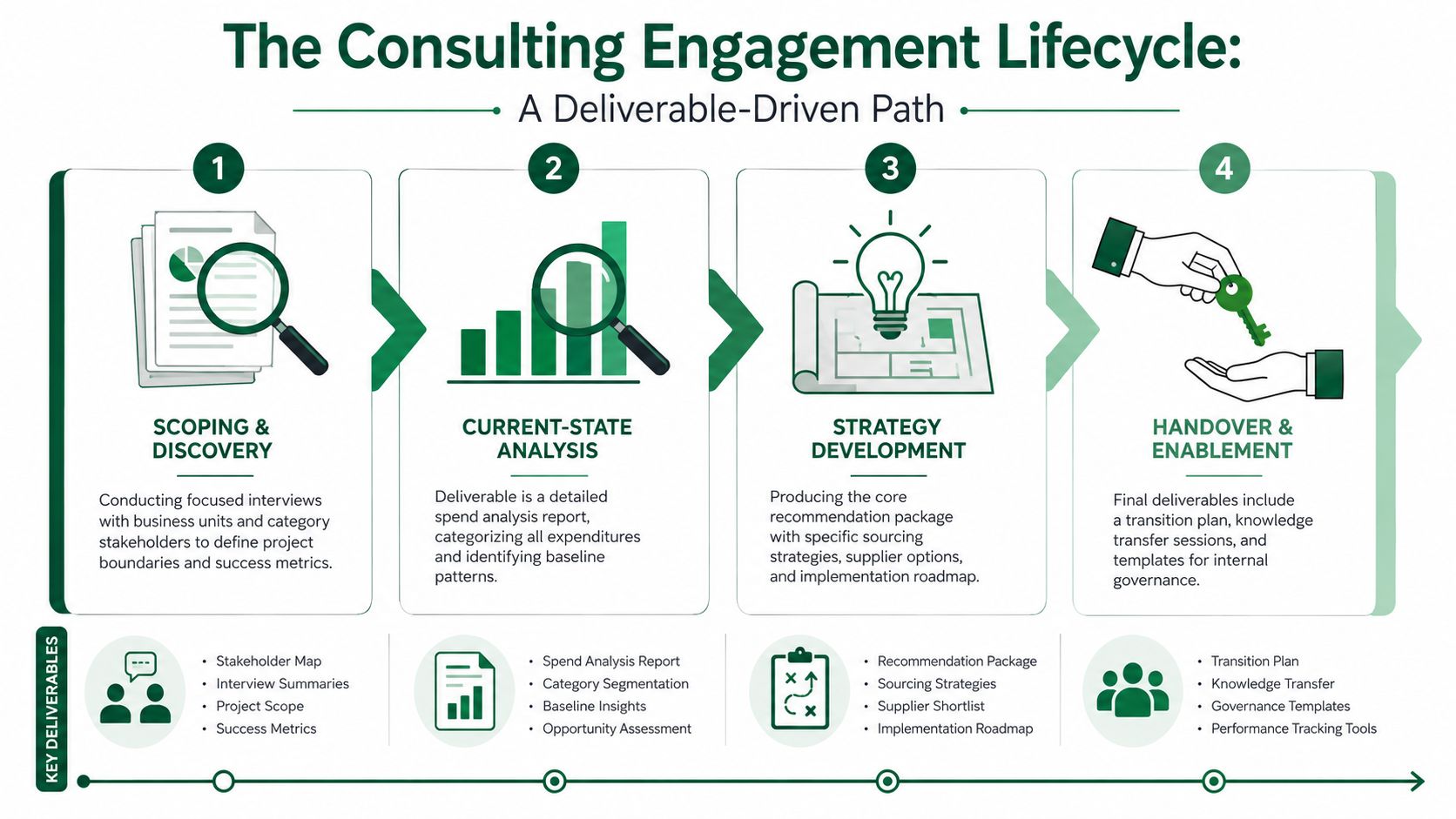
A good engagement is easy to inspect because every phase produces a usable decision artifact. Don't accept a statement of work built around vague activities such as “stakeholder engagement” or “market intelligence” without specifying what your team will receive and approve.
Discovery establishes the boundary
The consultant interviews procurement, Finance, operations, technical owners, legal, and incumbent relationship managers. The output should be a scope brief that identifies the category, business need, contracts, stakeholders, constraints, decision rights, and success measures.
The next gate is the current-state baseline. The firm should use client data, reconcile classifications, identify missing fields, and distinguish observed spend from assumptions. Procurement benchmarking treats sourcing cycle time as the elapsed period from an internal request through contract signature, including waiting time, as described in APQC-related procurement benchmarking guidance. That definition matters because approval delays and rework belong in the operating diagnosis, not outside it.
Strategy turns analysis into choices
The consultant should present more than a preferred supplier. The strategy package should show viable options, including demand aggregation, lotting, incumbent negotiation, competitive sourcing, dual sourcing, service-level changes, and risk controls. Each option needs a transparent view of value, feasibility, stakeholder impact, supplier response, and implementation effort.
The RFx then mirrors that strategy. If resilience matters, the evaluation must score resilience. If service continuity matters, the pricing template must capture transition costs, service credits, and operational dependencies. A rate-only bid form can undermine an otherwise thoughtful category plan.
Use a practical sourcing strategy template to expose gaps before the event, including missing requirements and weak evaluation logic. The AI-focused sourcing strategy template is relevant when teams need a structured way to challenge incomplete specifications.
Negotiation support should include supplier briefing, internal walk-away positions, scenario analysis, role preparation, and documented concessions. The award gate should produce a recommendation memo with normalized commercial comparisons, weighted scores, evidence for exclusions, contractual risks, and an approval record.
The final handover isn't a farewell meeting. It should include the savings realization log, contract obligations, supplier governance calendar, playbooks, stakeholder roles, and training for the internal team.
A short visual or recorded explanation can help stakeholders understand the lifecycle, but it can't replace the underlying files and decision trail.
When Hiring a Consultant Makes Sense
Use a decision matrix, not frustration, to decide whether to hire. External help earns its keep when the category's consequences exceed the team's available capacity or experience.
Situation | Recommended Path | Reasoning |
|---|---|---|
Concentrated, high-stakes category | Hire specialist support | A poor award can affect operations, service continuity, or compliance |
Team absorbed by business-as-usual work | Hire targeted project support | The event needs protected capacity and disciplined governance |
Missing expertise in software, logistics, or industrial services | Hire category expertise | Market structure and commercial terms may be unfamiliar internally |
Failed prior event damaged confidence | Use a neutral third party | An independent process can restore stakeholder and supplier trust |
Savings target requires Finance approval | Hire or validate methodology externally | The baseline, assumptions, and realization logic need to withstand review |
Small tail spend with stable requirements | Build internally or use standard process | Consulting overhead can exceed the value available |
Mature category team and repeatable playbook | Build internally | External advice may duplicate existing capability |
Purely transactional purchasing | Use operations or technology support | The problem is execution efficiency, not strategic category design |
The strongest hiring triggers
Bring in a consultant when a category combines material business exposure, unclear requirements, and weak internal bandwidth. The combination matters. A technically difficult category may still be manageable if the organization has a strong category manager and engaged stakeholders. A familiar category can justify help when the internal team can't dedicate time to run the event properly.
Executive visibility is another trigger. If the sourcing result will support a board commitment, restructuring plan, or Finance target, the methodology must be explainable to people who weren't involved in the project. A consultant can add independent challenge, but only if the firm documents assumptions rather than hiding them behind a savings headline.
Before requesting proposals, build the internal business case. Guidance on building a procurement business case your CFO will approve can help frame the decision around business impact, resources, governance, and measurable ownership.
Don't hire consultants to compensate for a missing executive decision. If leadership won't choose between service levels, supplier concentration, or speed and control, an external team will produce options that still can't be approved.
Where Enterprise Sourcing Projects Really Fail
Negotiation is visible, so organizations overvalue it. The dramatic supplier meeting, the final concession, and the redlined contract create a compelling story. In practice, the largest losses often occur before suppliers see the RFx.
Consider a logistics event scored on rate per mile. The team negotiates aggressively, selects the lowest apparent rate, and discovers later that accessorial fees, appointment charges, and exception handling weren't normalized. The negotiation worked against an incomplete commercial model.
An IT services team can make the same mistake with more expensive consequences. Consultants may push every bidder for a lower blended rate while the scope still contains contradictory support boundaries, unclear service ownership, and unpriced transition work. Facilities teams often issue technically detailed specifications that engineering hasn't validated, which forces suppliers to price different interpretations of the requirement.
The three points of value loss
Upstream failures: Poor requirements, unreliable spend data, and missing stakeholder decisions narrow the market before competition begins.
Midstream process gaps: Weak evaluation governance, inconsistent supplier communication, and opaque scoring create rework and disputed results.
Downstream misdiagnosis: Teams focus on negotiation tactics while ignoring adoption, contract compliance, transition risk, and total cost.
Consultants justify their fees when they force the upstream work internal teams skip under deadline pressure. That means challenging the specification, reconciling demand, testing supplier assumptions, and making stakeholders sign off before bid release. It doesn't mean bringing a more forceful negotiator into a broken event.
The lowest quoted unit price can't rescue a category strategy built on the wrong scope.
A defensible sourcing project evaluates total commercial and operational impact. The decision record should show why a supplier won, why alternatives were eliminated, what assumptions support the comparison, and what must happen after signature. Sourcing connects to transformation discipline here. Teams evaluating broader change can also review why procurement transformation programs stall, particularly around ownership and adoption.
How to Evaluate and Compare Consulting Firms
Don't compare sales decks. Compare the people, evidence, incentives, and handover commitments behind them. Ask every firm to respond to the same case materials, then score the responses before chemistry influences the decision.
Use a one-page scorecard. Adjust the weights to reflect the category and your risk. A large IT sourcing project should give category experience greater weight than a smaller organization testing an unfamiliar direct materials category, where knowledge transfer may matter more.
Evaluation Criterion | Weight | What to Score | Red Flag |
|---|---|---|---|
Category and industry experience | Set by buyer | Relevant sourcing outcomes, market knowledge, and comparable complexity | Generic procurement credentials |
Named consultant resumes | Set by buyer | Actual team experience and availability | Only the partner appears in meetings |
Savings methodology | Set by buyer | Baseline, validation, volume effects, and realization logic | Guaranteed savings percentage |
Technology neutrality | Set by buyer | Ability to work with the current stack and recommend fit-for-purpose tools | Platform recommendation before diagnosis |
Reference quality | Set by buyer | Recent clients willing to discuss the work directly | Refusal to provide callable references |
Fee transparency | Set by buyer | Travel, expenses, analysts, subcontractors, and change control | Open-ended pass-through costs |
Knowledge transfer | Set by buyer | Playbooks, training, ownership, and post-award governance | Handover limited to a final slide deck |
Test the firm's evidence
Request a redacted baseline, sample award recommendation, savings validation model, and handover checklist. You don't need confidential client data. You do need to see whether the firm can show assumptions, source documents, scoring logic, and unresolved risks.
Ask who performs the analysis, who attends stakeholder sessions, and who negotiates with suppliers. A senior partner's presence in the pitch doesn't prove that the assigned team can manage the category.
Technology should support the decision rather than determine it. If supplier risk remains an issue after award, buyers may also review how to reduce risks with a vendor management system, but the consulting firm should first explain the process, data, and governance required for the control to work.
Run two parallel scoping conversations before selecting. Eliminate any firm that promises a predetermined savings outcome, refuses to define the baseline, hides the delivery team, or treats knowledge transfer as optional. A confident sales meeting is not evidence of sourcing capability.
Your Next Steps and What to Ask First
You can create a credible shortlist within a week if you keep the first phase disciplined.
Write a one-page brief. State the category, the stalled result, current contracts, key stakeholders, decisions that remain unresolved, and the evidence you need from a consultant. Include what success must look like at the end of the initial diagnostic, not just a general ambition to save money.
Identify three to five firms. Use the scorecard, your industry network, and category-specific references. Don't invite every broad procurement adviser. A firm that knows transformation may not know the supplier market or commercial mechanics of your category.
Send identical discovery prompts. Ask for methodology, named team members, deliverables, timeline, fee structure, assumptions, reference contacts, data requirements, and handover approach. Standard prompts make the answers comparable and expose firms that rely on presentation language.
Shortlist two firms for a paid diagnostic or pilot workshop. Paid work is useful when it produces a real baseline, requirement review, market hypothesis, or decision map. Avoid unpaid consulting contests that encourage firms to give away generic ideas and buyers to mistake volume for quality.
Run a focused scoping call. Ask three direct questions:
What will success look like at week twelve?
Who specifically will perform the work?
How will my team own the method and decision record afterward?
Listen to the questions the consultant asks you. Strong practitioners probe demand, specifications, decision rights, supplier economics, data quality, and implementation constraints. Weak ones jump straight to savings claims and a familiar process diagram.
The best first conversation is diagnostic, not commercial. Give the firm enough information to expose its thinking, but don't let it define the problem before your team has written down the failure you're trying to correct.
Procright supports sourcing teams with specification refinement, supplier discovery, evidence-based compliance comparison, weighted scoring, document ingestion, and an audit-ready decision record. Visit Procright to test whether a more traceable sourcing workflow can strengthen your next consulting-led award.
Try it on a real buy
Bring one category. Watch where the flags land.
We use a little analytics to see which pages actually help. Nothing else, no ad trackers.