Strategic Sourcing Process 7 Steps: A 2026 Field Guide
By the time you negotiate, the specification, bidder list, and scoring logic are already locked. Treat each sourcing step as an audit-ready decision gate.
In this article
Most sourcing advice tells you negotiation is where value is won or lost. That's backwards. By the time you're negotiating, you've already accepted the specification, the bidder list, and the scoring logic that produced the finalists. If any of those were weak, you're just bargaining efficiently inside a flawed decision.
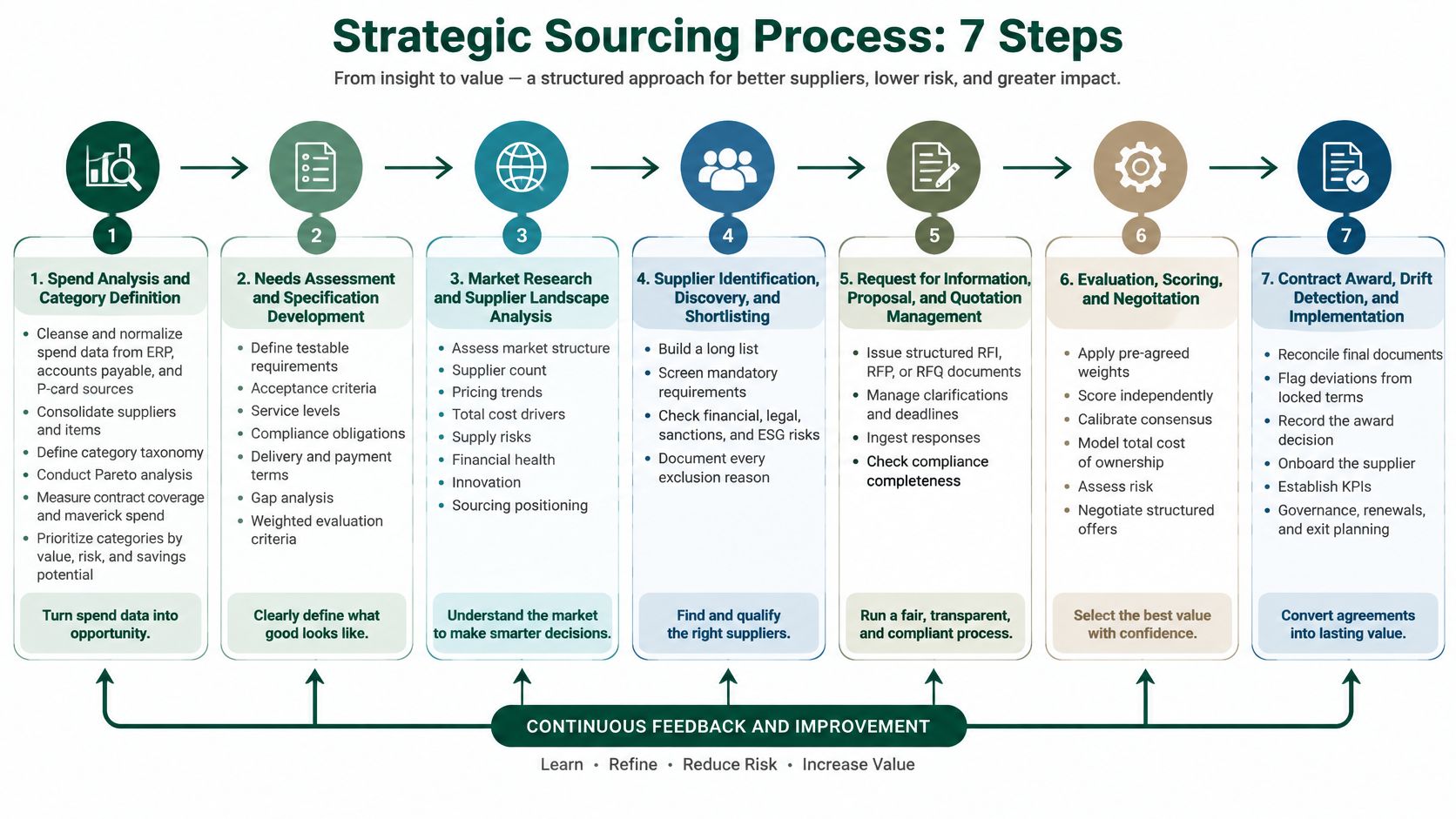
Treat the strategic sourcing process 7 steps as a chain of audit-ready decision gates, not a cycle diagram. One widely used formulation runs from spend and demand analysis through supplier market assessment, strategy, RFx, negotiation, onboarding, and continuous monitoring, with each stage producing inputs for the next, as described in SAP's strategic sourcing process overview. Skip a gate and the cost surfaces later as a change order, a protest, an unqualified winner, or a contract nobody can defend.
Each step below names the failure mode that breaks the chain, the evidence you should keep, and the automation lever that shortens cycle time. You'll also find practical templates in principle, what fields to capture, what to lock, and what to record. Get to the list quickly, because that's where the work is. The point isn't to run seven activities. It's to pass seven gates with a record that still holds up after signature.
1. Spend Analysis and Category Definition
If you can't state what you bought, from whom, and at what price, every savings target after this point is a guess. Pull accounts payable, purchasing card, contract, and ERP data into one view, cleanse supplier names, and group the result into categories you can source, such as IT and cloud licensing, MRO, or facilities.
What the gate requires
Normalized spend data: Consolidate duplicate vendors and fragmented item descriptions across business units so totals are comparable.
Category taxonomy: Use UNSPSC or a consistent internal hierarchy, then apply it the same way everywhere.
Contract coverage: Measure maverick spend separately. High spend with low coverage is your strongest sourcing signal.
Prioritization matrix: Score categories by value, risk, and realistic savings potential before you commit scarce sourcing time.
The National Academies framework frames the pre-award data questions as what is bought, where it is bought, at what prices, who can supply it, and what total delivery costs, a structure set out in its strategic sourcing procurement materials. That discipline is what turns a spend dump into a baseline. For segmentation mechanics, see this guide to category management and spend segmentation for better buying decisions.
Automation lever: automated cleansing and supplier consolidation. It removes weeks of manual spreadsheet work, but it doesn't fix inconsistent taxonomies between units. That's a governance decision. Gate test: don't proceed until finance and the budget owner both accept the baseline figure. An unagreed baseline makes every later savings claim contestable.
2. Needs Assessment and Specification Development
Most sourcing cycles die at this gate. A vague specification doesn't produce competitive bids. It produces suppliers quoting different things, then a contract full of assumptions you discover during delivery. Write requirements as testable statements about outcomes, tolerances, response times, and acceptance, not as a description of the incumbent's product.
Run a gap analysis before you lock anything. Look for missing acceptance criteria, undefined remedies, conflicting delivery terms, and compliance obligations around data protection, security certification, and accessibility. Then run a single-bidder check. If only one supplier can meet a line as written, either justify it in writing or rewrite it. A spec that names a brand by implication kills competition and inflates price.
Practical rule: Agree the weighted evaluation criteria before supplier responses arrive. Weights set afterward aren't evaluation. They're rationalization.
Agree service levels with defined remedies, not aspirations. "Responsive support" isn't enforceable. A response window with a service credit is. This structured approach, gap analysis plus a single-bidder check on every restrictive line, is what turns a draft spec into a locked one. A requirements gathering template that feeds directly into procurement specs gives the front end of that work a repeatable format.
Automation lever: structured requirement fields with immutable versioning once locked. Trade-off: lock too early in a fast-moving category and you'll freeze outdated needs. Lock the outcomes and acceptance tests, leave implementation detail open where suppliers can differ. Gate test: every restrictive line either passes the single-bidder check or carries written justification, and a stakeholder outside procurement has signed the spec.
3. Market Research and Supplier Landscape Analysis
Don't approach suppliers until you know where power sits. Count credible suppliers, check capacity and geographic coverage, review financial stability signals, and identify the cost drivers behind quoted prices. Kraljic positioning and Porter's Five Forces are useful here, not as academic exercises, but to decide whether you're in a market where competition works or a bottleneck market where continuity matters more.

Price is only one axis. In recent survey data, 64% of procurement decision-makers and 69% of senior leaders rated resilient and agile supply chains as very important or a top priority for the following one to two years, according to the Amazon Business 2025 State of Procurement Data report. That means your analysis should test concentration risk and substitution options explicitly, not assume the lowest bidder is the safest answer.
Sector-specific channels matter too. The ATEK Distribution contractor sourcing guide is a reminder that in categories like electrical equipment, distribution routes shape availability and lead times as much as manufacturer list prices do.
Where this gate fails
Teams overweight well-known brands, rely on vendor-supplied market claims, and miss qualified niche suppliers. Public data on private companies is often incomplete, so record what you couldn't verify. Automation lever: automated market scanning across many vendors at once. Gate test: you can explain expected price range, supply risk, and credible alternatives before the RFx opens.
4. Supplier Identification, Discovery, and Shortlisting
Shortlisting converts research into a defensible invitation list. Screen the long list against mandatory requirements from the locked specification, certifications, geographic coverage, capacity, insurance, and minimum relevant experience. Pass or fail. Don't score mandatory items, because averaging lets a supplier fail a requirement and still advance.
Document the reason for every exclusion while you make it. Reconstructing elimination rationale months later, during an audit or a bidder challenge, is where records fall apart. Add conflict-of-interest declarations for evaluators at this stage, not after scores are in.
Consider structural alternatives before you finalize the list. For some categories, cooperative purchasing for schools and healthcare can deliver pre-competed terms without a full event, which is worth testing against running your own competition where volume is modest.
Balancing the shortlist
Too strict: You exclude smaller suppliers and shrink competition.
Too loose: You waste evaluation effort on bidders who were never credible.
Incumbent only: You get continuity, but no price tension and no market test.
Evidence-backed exclusions: You can defend the list to auditors and unsuccessful bidders.
Sustainability and diversity requirements belong here too, weighted transparently rather than added as unspoken preferences. Automation lever: pass or fail screening against structured mandatory fields with risk checks for financial, legal, sanctions, and ESG indicators. Gate test: every invited supplier can credibly meet the spec, and every excluded supplier has a recorded, requirement-based reason.
5. Request for Information, Proposal, and Quotation Management
Choose the instrument. An RFI gathers market information. An RFQ prices something already well defined. An RFP asks for a solution where approach matters alongside price. Running an RFP when you needed an RFQ wastes supplier effort. Running an RFQ for a complex service buys you precise prices for an undefined scope.

Force comparability through structure. Use standardized response templates, required fields, and a compliance matrix where every requirement gets answered individually. Manage clarifications through one channel, share answers with all bidders, and keep version control tight. Suppliers will still send PDFs, spreadsheets, and manuals, so plan for document ingestion and normalization rather than hoping formats align. Specialist categories show why this matters; teams sourcing laboratory capability, for example, often need to find lab RFP analysis tool support because technical responses rarely arrive in comparable form.
Cycle time is a control metric here, not a vanity number. SAP procurement benchmark data reports a 46.4-day average sourcing-event cycle from event creation through closure, as published in the SAP Ariba benchmarking report. Closing faster means little if responses are incomplete.
Automation lever: structured intake plus response completeness checks before evaluation starts. Trade-off: long RFx documents discourage smaller suppliers. Ask only what you will score. Gate test: every response is complete, comparable, and traceable to the locked specification.
6. Evaluation, Scoring, and Negotiation
Apply the weights you agreed at step two. Evaluators score independently first, then calibrate in a documented consensus session. If you start with group discussion, the loudest voice anchors everyone and your independent evidence disappears.
Score on evidence, not presentation quality. Require suppliers to support compliance claims with primary sources, manuals, certifications, references, rather than marketing statements. Model total cost of ownership across acquisition, operation, switching, and exit. Headline price routinely hides implementation, training, consumables, and termination costs. A clear explanation of the mechanics is in this breakdown of the weighted scoring model.
A lower-scoring supplier may be the right award only where the disclosed award rules and applicable law allow it and it materially reduces concentration, regulatory, or disruption exposure. Record that reasoning explicitly instead of quietly adjusting scores to reach the answer.
Technology supports this gate, but doesn't replace judgment. Hackett Group 2025 findings report 70% e-sourcing adoption alongside 83% for contract lifecycle management, figures summarized in Zycus reporting on Hackett Group procurement technology insights. Widespread tooling hasn't eliminated manipulated weights or overstated claims.
Negotiate with a plan, priorities, concessions you can trade, and walk-away positions. Use a best and final offer round when finalists are close. Automation lever: configurable weighted scoring with attribute-level evidence links. Gate test: an outsider can reconstruct why the winner won from scores, evidence, and negotiation records alone.
7. Contract Award, Drift Detection, and Implementation
Award isn't signature, and signature isn't value. Between selection and signing, commercial negotiation changes delivery dates, warranties, service levels, exclusions, payment terms, and acceptance criteria. That's spec drift, and it's the most under-managed risk in the whole process. A supplier can win on one set of commitments and sign another.

Reconcile the final contract, quote, order form, and manuals against the locked specification before anyone signs. Drift detection tooling can flag conflicting warranties, delivery windows, and payment terms automatically, but a disciplined reviewer working from a deviation log catches most of it too. Classify every deviation as compliant, partial, or non-compliant, record its operational and financial impact, and define who can approve it.
After signature
Onboarding plan: Named owners, kickoff milestones, and transition risks assigned.
Performance baselines: KPIs, review cadence, and escalation paths set at award, not invented later.
Decision record: Requirements, scores, eliminations, negotiation changes, and final deviations filed together.
Exit provisions: Renewal triggers and termination rights documented while you still have negotiating power.
Automation lever: document reconciliation that flags conflicting warranties, delivery windows, and payment terms automatically. Manual review can miss these when they're buried across files. Gate test: the signed commitment still satisfies the evaluation logic that selected the supplier.
7-Step Strategic Sourcing Process Comparison Matrix
Sourcing Step | 🔄 Complexity and Resources | 📊 Expected Outcomes | Ideal Use Cases | ⭐ Key Advantage |
|---|---|---|---|---|
1. Spend Analysis and Category Definition | High data effort; requires finance, IT, and business input | Reliable spend baseline, category priorities, and visibility into savings and risk | Organizations with fragmented spend data or unclear contract coverage | 💡 Directs sourcing effort toward the highest-value opportunities |
2. Needs Assessment and Specification Development | High collaboration effort; requires procurement and technical expertise | Measurable requirements, clear evaluation criteria, and fewer disputes | Purchases with complex, regulated, or service-level requirements | ⭐ Supports fair competition and comparable supplier proposals |
3. Market Research and Supplier Landscape Analysis | Moderate-to-high research effort; may require analyst and financial data | Market benchmarks, supplier alternatives, and early risk visibility | Categories with uncertain pricing, limited suppliers, or supply risks | 💡 Improves negotiation expectations and sourcing strategy |
4. Supplier Identification, Discovery, and Shortlisting | Moderate screening effort; requires consistent criteria and risk checks | Qualified supplier shortlist with documented exclusions | Events needing credible competition and early compliance screening | ⚡ Reduces evaluation effort while supporting transparency |
5. Request for Information, Proposal, and Quotation Management | Moderate-to-high coordination effort; requires structured templates and event controls | Consistent, complete supplier responses for comparison | Competitive events requiring formal bids, clarification, or evidence | 🔄 Standardizes supplier submissions and improves auditability |
6. Evaluation, Scoring, and Negotiation | High evaluator effort; requires scoring, cost modeling, and negotiation preparation | Evidence-based award recommendation and improved commercial terms | High-value or complex decisions involving multiple criteria | ⭐ Balances cost, capability, and risk in supplier selection |
7. Contract Award, Drift Detection, and Implementation | High document and implementation effort; requires legal and contract-owner involvement | Aligned contract terms, audit record, and supplier performance governance | Awards with complex terms, significant commitments, or ongoing service needs | ⚡ Identifies deviations before signature and establishes performance oversight |
Run the Seven Steps as Gates, Not a Checklist
A checklist asks whether you did the activity. A gate asks whether the evidence is good enough to proceed. That distinction is the whole argument. Spend analysis that nobody agreed, a specification nobody locked, a shortlist nobody can explain, scores nobody evidenced, and a contract nobody reconciled will still look like a completed seven-step process on a slide. It won't survive delivery problems, an internal audit, or a supplier dispute.
The cheapest place to fix a sourcing problem is always the earliest gate where it appears. Correcting a category baseline costs an afternoon. Correcting an ambiguous acceptance criterion costs a clarification round. Correcting the same ambiguity after signature costs a change order, a strained supplier relationship, and sometimes a re-procurement. Work backwards from that arithmetic and the sequence stops feeling bureaucratic. It's just where the risk is cheapest to remove.
Here's a compact action plan you can run on one category first. Baseline the spend and get finance to sign the number. Lock the specification and the weights before market outreach, with a single-bidder check on every restrictive line. Document every elimination at shortlisting, with the requirement it failed. Score with evidence, independently first, and keep the attribute-level sources attached. Then reconcile every document before signature and classify deviations instead of absorbing them.
Automation earns its place where it shortens that chain without weakening it. Research, classification, response normalization, side-by-side comparison, and drift detection are high-volume, error-prone tasks where tools help materially. Requirements approval, weighting decisions, negotiation trade-offs, and the final award should stay with accountable humans. Platforms such as Procright fit that model when they keep specification, discovery, scoring, and drift checks connected in one audit-ready record rather than automating isolated transactions.
Don't roll this out across every category at once. Pick one meaningful, moderately complex category, run it through all seven gates, and measure what you'd otherwise guess at, time from specification lock to shortlist, response completeness, share of claims backed by primary evidence, and whether post-award KPIs were captured from day one. Fix the friction you find, then scale. A process you've proven on one real event beats a framework you've only presented.
If you're running complex IT, infrastructure, or services purchases and need the decision to hold up long after signature, Procright drafts and checks specifications, discovers and scores suppliers against evidence, and flags contract drift before you sign. Start with one category, run it through all seven gates, and see what an audit-ready record looks like at Procright.
Try it on a real buy
Bring one category. Watch where the flags land.
We use a little analytics to see which pages actually help. Nothing else, no ad trackers.