Weighted Scoring Model for Procurement
A weighted scoring model must let a reviewer understand why each supplier received its score and whether changed assumptions would alter the outcome.
In this article
The most popular advice about a weighted scoring model is also the most dangerous: assign weights, score suppliers, add the results, and select the highest total. The arithmetic may be correct while the award remains weak. A score can hide subjective preferences, inconsistent evidence, optimistic supplier claims, and assumptions nobody documented.
In procurement, the actual test isn't whether a spreadsheet produces a ranking. It's whether an independent reviewer can understand why each supplier received its score, whether reasonable changes in the assumptions would alter the outcome, and whether the decision still stands months or years after signature. A defensible model makes judgment visible, tests its stability, and preserves the evidence behind every material conclusion.
The Illusion of Objectivity in Vendor Selection
A weighted total looks precise. That precision can create false confidence.
Procurement teams often treat the model as a mathematical shield against bias. Once every supplier has a number, the discussion appears to move from opinion to fact. Yet the most consequential choices happened before the formula ran: which criteria were included, how the scoring scale was defined, what evidence counted, and how much importance stakeholders assigned to each factor.
Quality-based selection remains subjective even when evaluators use predefined factors, sliding scales, and averaged panel scores. A panel may agree that a supplier scored highly for implementation quality, but that average doesn't automatically reveal whether reviewers relied on a documented methodology, a persuasive presentation, or an untested claim.
Practical rule: A total score is an output, not an explanation.
The problem becomes sharper when criteria overlap. “Technical quality,” “service capability,” and “implementation confidence” may all reward the same underlying impression. If the model gives each criterion a separate weight, the supplier may receive credit several times for one perceived strength. Cost can also be handled poorly. A linear score may make a small price difference look comparable to a major operational risk unless the scale and rationale are explicit.
What an auditor needs to reconstruct
An award file should let another person follow the chain from requirement to evidence to score. That means retaining more than the final matrix:
Criterion definition: What does the criterion measure, and what does it exclude?
Scoring rubric: What separates a low, middle, or high score?
Evidence record: Which proposal, manual, contract term, test, or clarification supports the score?
Evaluator reasoning: How did the reviewer interpret the evidence?
Disagreement history: Did reviewers challenge the interpretation or request clarification?
Approval record: Who changed a score, weight, or assumption, and why?
A practical source on bias in AI supplier selection teams may miss can help procurement leaders frame the governance problem. The same discipline applies whether the evaluation uses AI, a panel, or a familiar spreadsheet. For a specialist purchase, the team may need to distinguish factual capabilities, security evidence, staffing claims, and service preferences rather than compressing everything into one impression.
The model's value lies in traceability. If the award depends on a subjective preference, record it as a preference. If a supplier's claim is partial or unverified, mark it that way. Calling judgment “objective” doesn't remove judgment. It only makes challenge harder.
Core Mechanics of Multi-Criteria Decision Analysis
A weighted scoring model is the most familiar form of multi-criteria decision analysis, or MCDA. That familiarity creates risk. Teams often treat the spreadsheet as the decision, when it is only a way to expose how judgments were made. In the standard weighted-sum approach, each supplier is scored against each criterion, each criterion is assigned a weight, and the weighted scores are added to produce a final ranking. The highest aggregate score ranks first. ScienceDirect explains the structure of weighted scoring models
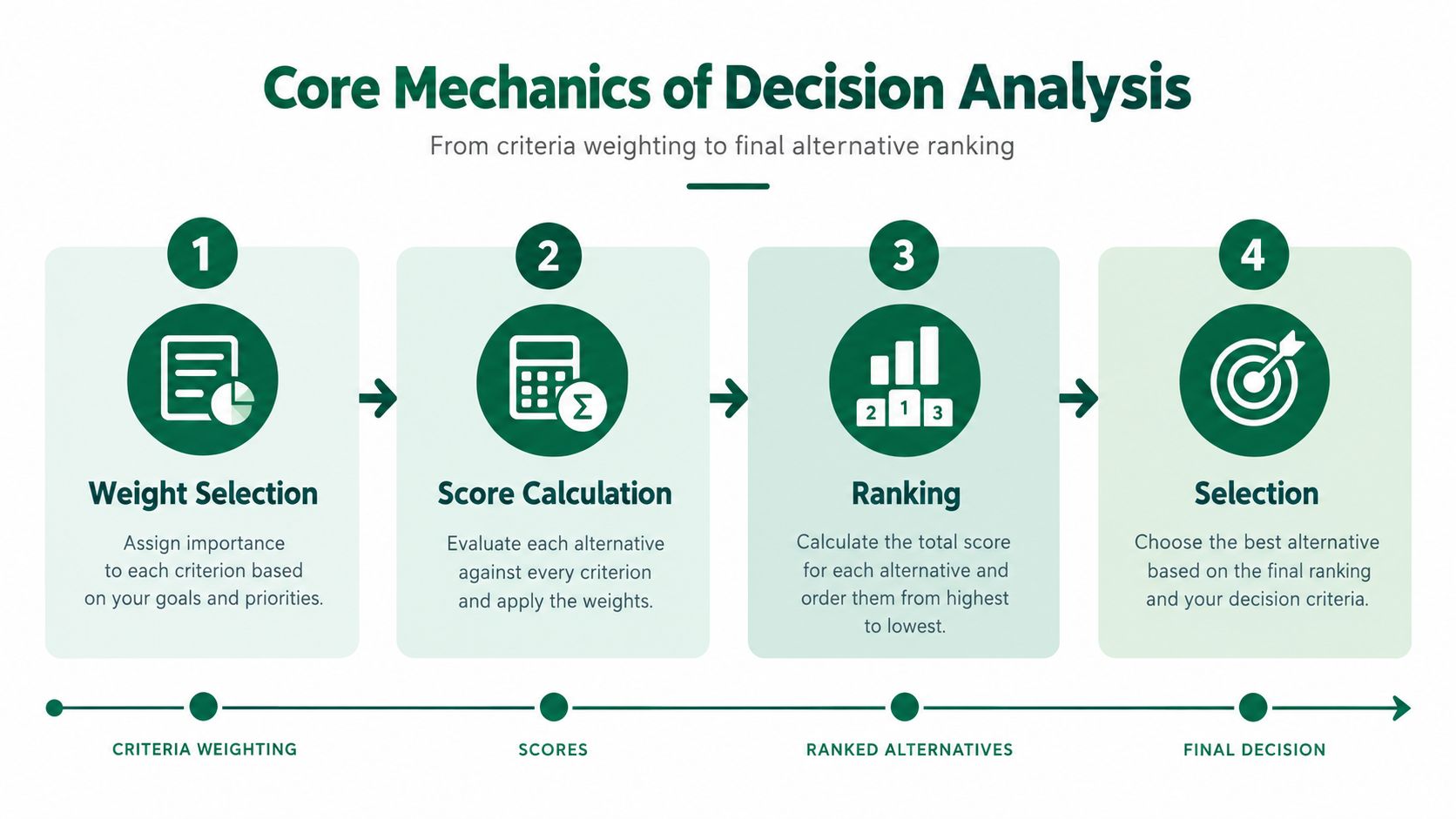
The arithmetic is easy. The hard part is making every input interpretable enough that another reviewer, an auditor, or a disappointed stakeholder can follow it.
Take a typical supplier comparison across price, delivery risk, technical fit, and support. Each supplier gets a score for each criterion. The team multiplies those scores by the agreed weights and adds the results. That creates a common basis for comparison across criteria that started in different units, but only if the scoring logic is consistent and recorded.
Start with comparable scales
Raw values should not go straight into the model. Price may be stated in currency, delivery in days, and support in service commitments. Those figures need to be converted to a common scale so that a higher score always means a more desirable result.
Direction matters. For a benefit criterion such as service coverage, stronger performance should produce a higher normalized score. For a cost or risk criterion, the lower underlying value may need to map to the higher score. Write that transformation down. If the team cannot explain how a raw value became a score, the model will not survive challenge.
Weights express relative importance, not mathematical truth. In the standard formulation, normalized weights sum to 1, which makes each criterion's contribution visible. Equal weighting assigns each of N criteria a weight of 1/N. Rank-sum weighting gives larger normalized weights to the criteria placed higher in priority order. The method is straightforward. The debate is usually about whether the priority order reflects the commercial reality of the purchase.
Keep gates separate from preferences
Required conditions should be handled before discretionary scoring. If a supplier fails a binding legal, safety, or technical requirement, the team should decide eligibility first. Folding a pass-fail issue into a broad quality score creates a predictable audit problem. Strong performance elsewhere can hide a compliance gap that should have excluded the bidder from the ranking.
A practical starting point is a supplier evaluation template covering criteria and weights. The template helps structure the matrix. It does not replace governance. Teams still need clear evidence rules, independent scoring discipline, and approval controls for any change to a weight, assumption, or rubric.
A useful evaluation matrix shows the criteria, weights, normalized scores, weighted contributions, total, and rank. It should also retain the source evidence and the formula behind each result. That is what makes the recommendation defensible. The spreadsheet can calculate the answer in seconds. Procurement still has to show why the answer deserves to stand.
Testing Decision Stability Through Sensitivity Analysis
A weighted scoring model can survive the spreadsheet and still fail the approval meeting. I have seen recommendations collapse because a stakeholder asked one fair question: what happens if we change this weight, or if one contested score moves by a point? If a small, credible adjustment changes the winner, the result is not settled enough to present as a clean conclusion.
Public-sector guidance is clear on the discipline involved. Evaluators should score options independently before weights are applied, because mixing those steps can bias the result. The same guidance recommends testing increases and decreases in criterion weights to see whether the ranking holds under reasonable alternatives, and warns against one party changing weights to force a preferred outcome. The Infrastructure Australia guide to multi-criteria analysis provides this sensitivity and governance guidance
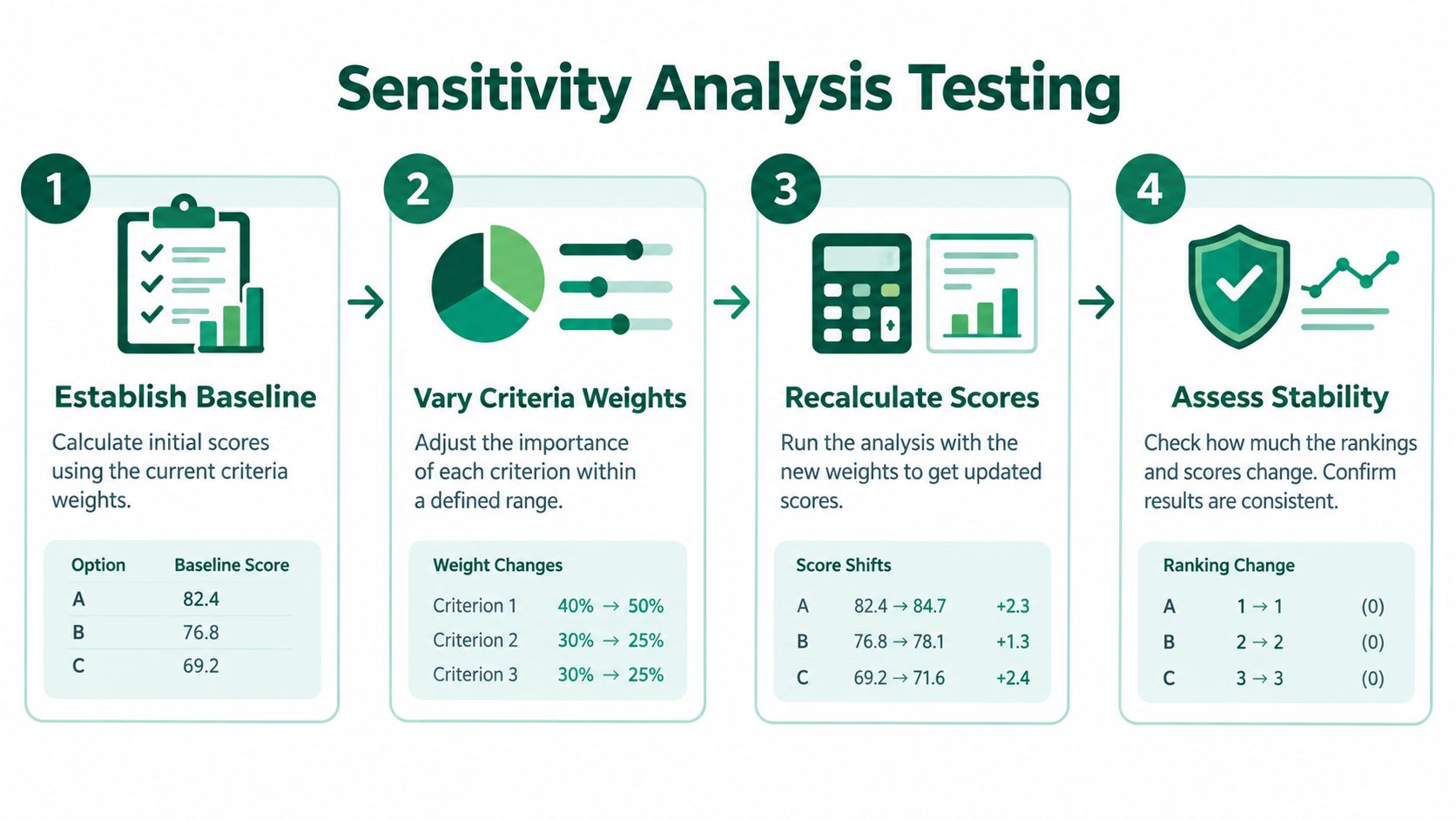
Run the test before the meeting
The cleanest process separates judgment into stages, and records each one so the team can explain the recommendation later.
Score independently. Ask evaluators to assess each criterion against the rubric and source evidence, without letting a preferred weight influence the performance score.
Agree the baseline. Record the approved criteria, weights, normalization method, and supplier scores.
Vary one assumption. Increase or reduce a material weight, or test a plausible alternative supplier score.
Recalculate the ranking. Record whether the leading supplier stays in first place.
Explain the result. Identify which assumptions drive the outcome and whether the ranking is stable enough to defend.
The useful question is rarely whether the ranking changes only under an extreme scenario. The better test is the decision-flip threshold. How much would the price score need to move before another supplier ranked first? How much additional delivery risk would reverse the award? Which weight would need to change, and would that change be credible given the priorities already agreed by the stakeholders?
That threshold turns uncertainty into something executives and auditors can examine. If the leading supplier stays first across credible scenarios, the recommendation is easier to defend. If the ranking flips easily, the summary should say so plainly. Victorian government guidance takes the same line on close weighted totals. If results are sensitive to the chosen weights, that sensitivity should be reported, not buried.
This is also where software helps, without changing the underlying governance. A practical guide to tuning item weights supports the mechanics, but the key value is the evidence trail. Teams need a record of the baseline, the tested scenarios, who approved changes, and which assumptions truly changed the winner.
Show the baseline. Show the equal-weight comparison. Show the plausible stakeholder scenarios. Show the condition that changes the outcome.
Here is a short visual explanation of the stress-test sequence:
Sensitivity analysis belongs in the approval record. If it only appears after someone challenges the result, the team is already on the back foot.
Building a Defensible Evaluation Framework
A defensible evaluation starts before proposals arrive. Lock the specification, define the criteria, and agree how evidence will be interpreted before the team knows which supplier is likely to score well.
The first separation is between factual compliance and preference scoring. A requirement such as an included certification, stated delivery condition, or contractual warranty may be verified against source material. A criterion such as usability, implementation quality, or long-term fit may require professional judgment. Those are different forms of evidence and shouldn't be represented as though they have the same certainty.
Use swing weighting, not just importance labels
Traditional weighting asks how important a criterion is in the abstract. Swing weighting asks how important the movement from the worst acceptable performance to the best acceptable performance would be. That distinction matters. A criterion may sound important, but if every shortlisted supplier performs almost identically on it, the swing across the actual decision range may be limited.
A stakeholder panel should document:
The performance range: What counts as the lowest and highest relevant performance?
The consequence of the swing: What operational or commercial difference does that range create?
The relative priority: Why should this swing receive more or less weight than another?
The owner: Which stakeholder is accountable for the judgment?
This approach prevents teams from assigning large weights to attractive labels without considering the actual difference between suppliers.
Preserve the reasoning behind every score
For each supplier and criterion, capture the source, the relevant passage, the evaluator's interpretation, and the confidence of the conclusion. A score shouldn't stand alone in a cell. It should open a trail that shows how the reviewer reached it.
Record partial and unverified claims explicitly. A proposal that says “available” isn't equivalent to a contract term, a technical manual, or a demonstrated capability. If clarification changes the interpretation, preserve the original claim, the question asked, the answer received, and the resulting score change.
Conflicts also belong in the record. If reviewers disagree, don't erase the disagreement by averaging immediately. Note the different readings, resolve the issue through the rubric or an approved clarification, and document who authorized the final position.
A reviewer should be able to reconstruct the decision without relying on the memory of the evaluation panel.
That standard changes how teams write rubrics. “Excellent support” is weak. A stronger rubric describes the evidence expected for each level and identifies what the supplier must demonstrate. The final file then contains not only a ranking, but a defensible explanation of why the ranking followed from the approved requirements.
Automating Evidence and Traceability with Procright
A spreadsheet handles multiplication well. It handles evidence poorly once evaluators are reviewing proposals, manuals, PDFs, vendor websites, clarifications, and contract terms across a complex event.
Manual evaluation creates familiar failure points. A reviewer copies a supplier statement into a cell without its source. Another records a score but not the interpretation. A clarification arrives by email and never reaches the master file. Someone changes a weight after seeing the result, but the earlier version disappears. The final ranking may still calculate correctly, while the decision record becomes difficult to defend.
AI-driven procurement platforms can address part of this problem by connecting research, compliance review, and scoring in one workflow. Procright can research manuals, PDFs, videos, forums, reviews, and vendor sites, then produce evidence-backed yes, no, or partial compliance answers with source citations. Its weighted comparisons can show how criteria contribute to supplier totals after mandatory-gate screening.
Where automation earns its place
The value isn't just speed. It comes from preserving context around the score.
Source-linked answers: Reviewers can inspect the evidence supporting a compliance conclusion instead of trusting a copied assertion.
Structured partial results: “Partial” can remain visible rather than being forced into an unjustified yes or no.
Specification controls: Gap analysis and single-bidder detection can identify problems before the specification locks.
Drift detection: Quotes, manuals, and terms can be compared with the locked specification, including deviations that affect commercial interpretation.
Custom indexes: Measures such as Market Adoption and Vendor Stability can be included when the event requires them.
Activity records: Changes, decisions, and source material can remain connected to the event for internal review or audit.
Automation doesn't eliminate procurement judgment. It changes where that judgment happens. The team still decides whether a source is relevant, whether a criterion is material, and whether a risk is acceptable. The platform can make the evidence easier to find and the change history easier to preserve.
The comparison with a spreadsheet is therefore not “software versus human expertise.” It's detached arithmetic versus a connected decision record. A simple spreadsheet remains appropriate for a small, one-off evaluation with limited evidence. As the event grows more document-heavy, the cost of losing source context rises sharply.
Use automation carefully. Require reviewers to validate important findings, keep mandatory gates separate from weighted preferences, and retain the original documents. The right system supports an audit trail. It shouldn't turn an unverified extraction into an unquestioned award decision.
Avoiding Common Pitfalls in Weighted Evaluations
Most fragile models don't fail because someone mistyped a formula. They fail because the team treats uncertain inputs as settled facts.
A systematic review of healthcare MCDA applications found that 189 studies, or 86%, used value-measured approaches, most commonly linear additive models or AHP, showing how mainstream these approaches are in applied decision analysis. The same review found that uncertainty governance was uneven: 111 studies, or 50%, addressed uncertainty in criterion weights, while 45 studies, about 20%, addressed uncertainty in performance scores. Only 31 studies, nearly 15%, addressed both types of parameter uncertainty. (The systematic review of healthcare MCDA applications reports these findings)
The lesson for procurement isn't that weighted models are defective. It's that adoption of the method doesn't guarantee disciplined treatment of uncertainty.
Pitfall | Impact on Decision | Procurement Solution |
|---|---|---|
Changing weights after reviewing supplier scores | The model can appear to confirm a preferred supplier | Approve weights before scoring and preserve every version |
Scoring criteria without a shared rubric | Evaluators use different meanings for the same score | Define observable evidence and examples for each score level |
Treating supplier claims as verified facts | Unsupported assertions receive the same treatment as documented proof | Record source, interpretation, and verification status |
Double-counting related criteria | One strength influences the total several times | Test criteria for overlap and consolidate where appropriate |
Applying a weight unilaterally | Stakeholder priorities become hidden rather than agreed | Use a documented panel process and compare alternative scenarios |
Ignoring close totals | A fragile result gets presented as a clear win | Report ranking stability and decision-flip thresholds |
Averaging disagreement too early | Important interpretive differences disappear | Retain individual assessments and resolve the reason for disagreement |
Mixing mandatory gates with preferences | A supplier can compensate for a failure through unrelated strengths | Screen eligibility before discretionary scoring |
A model should also distinguish uncertainty in the weight from uncertainty in the performance score. Stakeholders may agree that delivery risk matters greatly while disagreeing about a supplier's actual risk. Those are separate problems and require separate tests.
Linear additive models remain useful because they make trade-offs visible. They become dangerous when the team presents the aggregate as more certain than the evidence supports. Treat the matrix as a living decision record. Update it when clarification changes the facts, preserve the prior state, and explain why the ranking moved.
Finalizing Your Sourcing Strategy and Next Steps
A weighted scoring model should finish with an award recommendation, but it shouldn't end with a number. The procurement team needs a documented chain from specification to evidence, from evidence to score, and from score to a recommendation that survives reasonable challenge.
Use this checklist before seeking approval:
Validate the specification. Remove ambiguous requirements, identify gaps, and check whether any clause unintentionally limits the field.
Separate gates from trade-offs. Decide which requirements are mandatory and screen them before applying preference weights.
Define the scoring rubric. State what each score means and what evidence supports it.
Approve weights early. Document the rationale and use equal weighting as a baseline when stakeholders haven't yet established a credible priority order.
Score independently. Keep performance assessment separate from the application of weights.
Normalize carefully. Make sure cost, quality, risk, service, and timing values use a common direction and scale.
Run sensitivity tests. Vary important weights and performance assumptions, then record whether the winner changes.
Report close results. Include decision-flip thresholds and explain the assumptions driving the ranking.
Preserve the evidence trail. Retain source documents, interpretations, reviewer disagreements, clarifications, overrides, and approvals.
Plan a review. Revisit the model when material market, technical, commercial, or stakeholder information changes.

Equal weighting works well as a transparent starting point when criteria are comparable or stakeholders haven't agreed on priorities. More deliberate swing weighting is appropriate when the practical difference between supplier performances matters and a stakeholder panel can explain why one performance range matters more than another.
The final choice should also reflect what the model cannot capture. A supplier may rank first while carrying a concentration risk, contractual ambiguity, or implementation dependency that deserves executive attention. The right response isn't to manipulate the score. Record the issue, assess whether it belongs in a gate or a separate approval condition, and make the trade-off visible.
Procurement teams that use AI should apply the same discipline. Automation can maintain source links, compare documents, flag specification drift, and organize supplier evidence, but reviewers still own the judgment. Use it to keep market intelligence and decision records current, not to outsource accountability.
Procright supports evidence-backed supplier discovery, compliance scoring, weighted comparisons, specification checks, and source-linked decision records for complex sourcing events. Visit Procright to see how your team can connect the weighted score to the evidence and approvals behind the award.
Try it on a real buy
Bring one category. Watch where the flags land.
We use a little analytics to see which pages actually help. Nothing else, no ad trackers.