Supplier Codes of Conduct in Sourcing
A code of conduct works when procurement treats it as a testable sourcing spec, not a legal attachment that transfers responsibility without reducing risk.
In this article
The most popular advice about supplier codes of conduct is also the least reliable: write a clear policy, send it to every supplier, collect signatures, and file the evidence. That process creates documentation, but documentation alone doesn't show what happens in a factory, mine, warehouse, or subcontractor's workplace.
A code works when procurement treats it as a testable, risk-weighted sourcing specification. Each requirement needs an owner, evidence standard, review point, escalation rule, and connection to the award decision. Without those controls, the code becomes a legal attachment that transfers responsibility without materially reducing risk.
The Compliance Illusion in Modern Supply Chains
A signed supplier code is often treated as proof of compliance. It isn't. A signature proves that a supplier accepted, or at least acknowledged, a set of expectations. It doesn't prove that workers received required wages, that subcontractors were disclosed, that grievances were resolved, or that corrective actions stayed closed.
The adoption data tells a more nuanced story. A peer-reviewed study in the Proceedings of the National Academy of Sciences found that 52% of companies had adopted at least one of 16 supply-chain sustainability practices, while more than 40% had a supplier code addressing social or environmental issues. Among companies using another supply-chain sustainability practice, 82% also had a supplier code (PNAS research on corporate sustainability practices). Codes became a foundation for screening, audits, corrective actions, and reporting, but they weren't universal.
Where the control breaks
The failure usually happens after Tier 1 onboarding. Procurement collects a signed PDF, an assessment team assigns a score, and the sourcing team moves on to price, delivery, and technical capability. The code remains disconnected from the supplier's operating controls and from the commercial decision.
The risks and compliance perspective for procurement teams is useful here because compliance risk doesn't sit in a document repository. It appears in decisions, evidence gaps, missed follow-ups, and exceptions that nobody formally owns.
Practical rule: Treat a signature as an entry condition, never as an outcome.
A mature program asks different questions. What evidence supports each material requirement? Which risks are inherent to the country, commodity, workforce, or production process? What happens when a supplier submits incomplete evidence? Can the buyer see whether a corrective action changed conditions, or only whether the supplier uploaded a response?
Documentation versus operational reality
A supplier may have a policy prohibiting forced labor and still rely on recruitment channels that charge workers fees. It may publish an environmental commitment while lacking records for waste handling or energy controls. It may pass an audit while hiding subcontracting arrangements outside the buyer's review scope.
The OECD due-diligence framework requires companies to embed standards in management systems, identify and assess impacts, prevent or mitigate them, track implementation and results, and communicate how impacts are addressed (OECD responsible business conduct framework). That is a continuous control loop, not a one-time attestation.
The procurement implication is direct. If the code doesn't influence supplier selection, contract obligations, evidence requests, remediation, and continuation decisions, it functions mainly as liability language. A stronger model converts broad principles into requirements that can be tested before award and monitored after signature.
Anatomy of a Supplier Code and Common Coverage Gaps
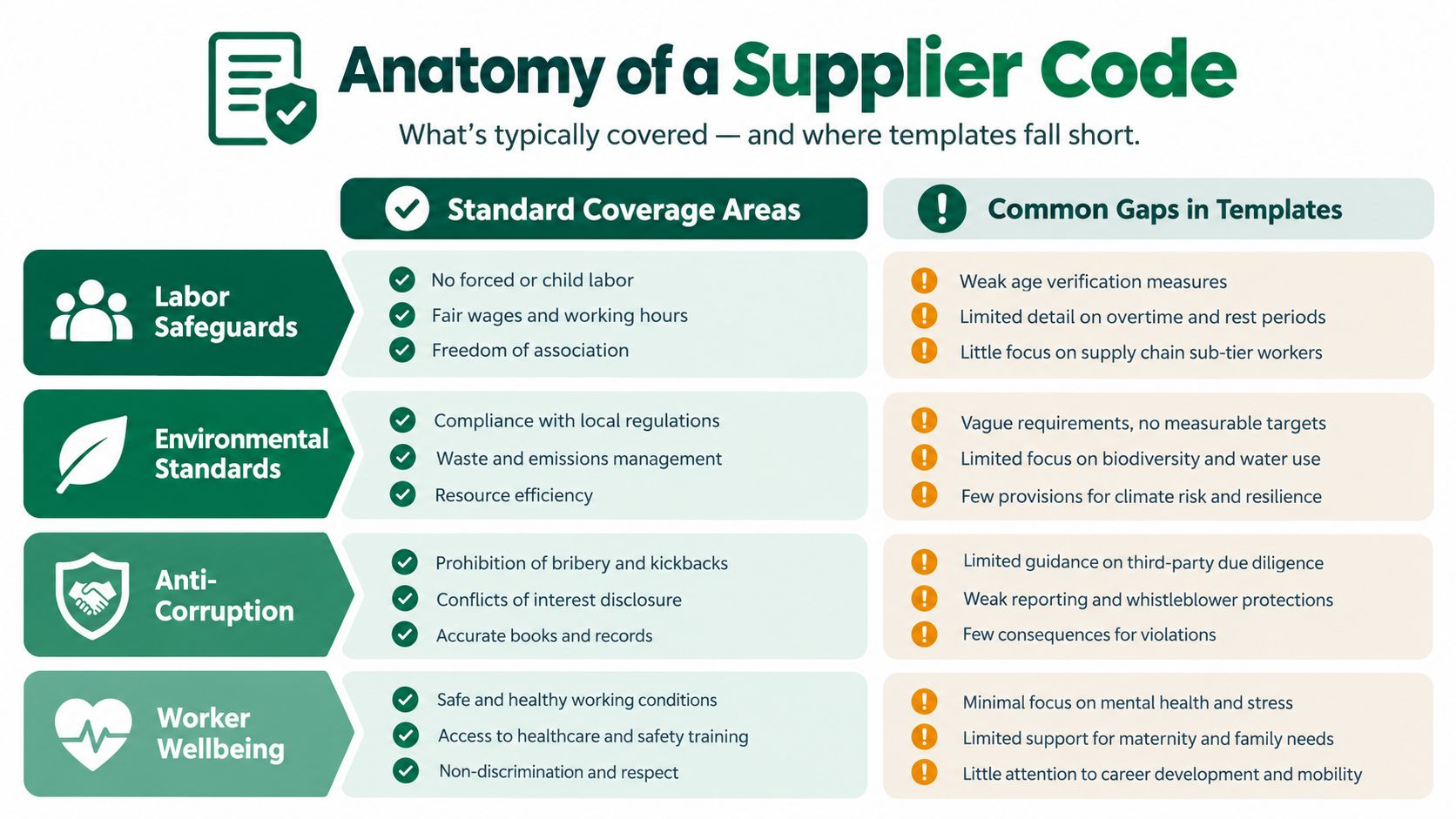
Most supplier codes contain familiar sections: labor rights, health and safety, environmental responsibility, business ethics, anti-corruption, data protection, and cooperation with audits. Those topics are necessary, but a list of topics isn't a control system. The important question is whether each clause tells the supplier what to do and tells the buyer how to verify it.
The mature baseline
Labor protections tend to receive the strongest treatment. The 2024 results of the S&P Global Corporate Sustainability Assessment reported that occupational health and safety appeared in 93% of applicable supplier codes, child labor in 92%, and forced labor in 90% (S&P Global analysis of supplier codes). These provisions are now close to table stakes for serious procurement programs.
Anti-corruption requirements, confidentiality duties, legal compliance, worker voice, and audit cooperation also belong in the baseline. But clauses should define practical expectations, such as access to grievance channels, non-retaliation, incident reporting, accurate records, and disclosure of labor brokers or subcontractors.
The gaps that matter most
Environmental requirements are usually less developed. The same S&P Global assessment found that greenhouse-gas emissions and energy consumption appeared in 45% of codes, while biodiversity appeared in 29%. Resource efficiency appeared in 56% of codes in the 2024 assessment. These figures don't mean every missing clause creates an immediate violation, but they show where standard templates often provide weaker direction.
Screening is another weak point. In the 2023 assessment, 44.5% of 9,688 assessed companies publicly disclosed a supplier code, but only 17.2% disclosed a process for screening new suppliers for sustainability risks. Regional disclosure varied, with Europe at 60.1%, North America at 53.0%, and Latin America at 50.5%. Publishing a code clearly doesn't guarantee that it influences supplier selection.
A useful clause architecture distinguishes between:
Universal requirements, such as compliance with applicable law, prohibition of forced and child labor, accurate records, and cooperation with investigations.
Risk-triggered requirements, such as traceability, independent verification, worker interviews, or sub-tier mapping.
Evidence requirements, which specify documents, records, interviews, or system outputs that support the supplier's answer.
Enforcement terms, which define remediation, escalation, suspension, and termination conditions.
The procurement policy template guidance can help teams challenge generic language before it reaches an RFP. A modern code should be readable, translated where necessary, and commercially connected to the way suppliers are evaluated.
Drafting Testable Requirements for Sourcing Events
A sourcing event should test responsible-business requirements with the same discipline applied to delivery, service levels, cybersecurity, or product performance. “Supplier agrees to maintain ethical operations” is too broad to score consistently. It leaves the buyer with no reliable basis for distinguishing a documented commitment from operational capacity.
Start by decomposing every material principle into four parts:
Required behavior, stated in plain language.
Acceptable evidence, defined before suppliers respond.
Assessment method, including desk review, interview, site visit, worker feedback, or third-party verification.
Failure response, including the owner, deadline, escalation threshold, and closure test.

Convert principles into evidence
Take worker grievance access. A weak requirement asks the supplier to confirm that a mechanism exists. A testable requirement asks the supplier to describe access routes, languages supported, confidentiality protections, non-retaliation controls, case handling, escalation, and anonymized resolution evidence.
For subcontractor oversight, request the approved subcontractor list, flow-down language, review controls, and evidence of monitoring. For critical materials, request traceability records that identify the source, chain of custody, review date, and unresolved exceptions. For high-risk labor conditions, require evidence that goes beyond a policy, such as worker feedback, remediation records, and repeat verification.
Build a scoring model that resists easy points
A practical scoring model separates four dimensions:
Dimension | What it tests |
|---|---|
Documented commitment | Whether the supplier has a relevant policy and accountable owner |
Operational control | Whether procedures, training, records, and responsibilities exist |
Verified performance | Whether independent or reliable evidence supports implementation |
Remediation effectiveness | Whether identified problems were corrected and stayed corrected |
Risk weighting should reflect country, commodity, workforce exposure, subcontracting depth, and incident history. A low-risk office-services supplier shouldn't face the same evidence burden as a supplier operating labor-intensive production in a high-risk environment.
Set the evidence rule before opening responses. If the sourcing team decides after the fact that a signed declaration is sufficient, suppliers with polished paperwork gain an advantage over suppliers with stronger operational controls but less formal documentation.
The specification document template guidance is relevant because a code requirement belongs in the locked specification, not in an appendix that evaluators can ignore.
A requirement is only real when a buyer can test it, score it, and act on the result.
Aligning Purchasing Practices with Supplier Capacity
Procurement teams can undermine their own supplier code through commercial behavior. A buyer may require safe staffing, traceability, grievance access, and corrective action while imposing unpredictable forecasts, aggressive price reductions, compressed lead times, or payment terms that strain supplier cash flow. The contradiction rarely appears in the code. It appears in the supplier's ability to implement it.
OECD guidance identifies purchasing practices and commercial incentives as factors that may impede suppliers from implementing responsible-business policies (OECD due-diligence guidance). That makes the buyer's own behavior part of the control environment.
Test the commercial design
Before issuing an RFP, review the sourcing model against the code requirements:
Forecasting: Does demand volatility make stable staffing and production planning unrealistic?
Lead times: Do promised delivery windows encourage excessive overtime or unauthorized subcontracting?
Pricing: Does the target price leave room for safe equipment, training, fair recruitment, and environmental controls?
Payment: Could delayed payment pressure the supplier to cut worker protections or shift obligations to informal labor?
Change control: Can the buyer change volume, design, or delivery without forcing unsafe operational shortcuts?
This review shouldn't become an excuse to weaken standards. It should identify where the buyer must change the operating model, share cost, adjust timing, or provide clearer demand signals.
Put support into the contract
An enforceable code can include supplier obligations and buyer commitments. The buyer might provide training materials, clarify evidence formats, phase implementation for lower-risk gaps, or coordinate remediation with other customers where the same facility serves several brands.
Commercial leverage also needs discipline. A supplier shouldn't be threatened with immediate termination for a remediable documentation gap while a serious worker-safety issue receives the same treatment. Contracts should distinguish severity, urgency, reversibility, and supplier cooperation.
Don't demand controls that your commercial model makes impossible to maintain.
The strongest arrangements preserve buyer influence while giving suppliers a workable path to compliance. That means clear requirements, realistic implementation conditions, and consequences that reflect the underlying harm rather than merely punishing an incomplete form.
Moving Beyond Signatures to Outcome-Based Verification
The central question is uncomfortable: does signing a supplier code improve worker outcomes, or does it merely improve the buyer's audit file? A signature and self-check are useful starting signals, but they provide low assurance when used alone. Factory visits and audit reports can add context, yet they still measure activity unless the buyer follows findings through to remediation and worker experience.
The International Labour Organization notes that social audits commonly produce compliance scores, while codes become more effective when they connect to internal risk-management systems that trigger concrete action after risks are identified (ILO analysis of social audits and worker outcomes).
Compare assurance levels
Method | What it can show | What it cannot show alone |
|---|---|---|
Signed acknowledgment | The supplier accepted the stated expectations | Whether controls operate in practice |
Self-assessment | The supplier's reported view of its systems | Whether answers are complete or accurate |
Factory visit | Conditions observed at a defined time and location | Whether conditions persist or extend below Tier 1 |
Independent verification | More credible testing of selected controls | Whether remediation changed worker experience |
Worker feedback and repeat review | Signals about implementation and sustained improvement | Every risk across every site and tier |
An outcome-based model links findings to measurable remediation. Depending on the risk, indicators may include repayment of recruitment fees, resolution of grievances, reduction of excessive hours, injury trends, or worker-confirmed completion of corrective actions. The point isn't to force every category into the same metric. The point is to define what improvement would look like before accepting closure.
Make commercial decisions reflect outcomes
Epiroc reported 350 sustainability audits in 2025, including 279 on-site audits, while 64 significant suppliers had not confirmed compliance with its code at year-end. The disclosure illustrates why audit volume and supplier acknowledgment shouldn't be confused with closure. Volkswagen describes a stronger approach in which audit results feed supplier screening, low scores require time-bound action plans, and worker surveys help identify violations and risks.
For operational teams, the workflow should be simple:
Record the finding at requirement level.
Assign a remediation owner and due date.
Define evidence required for closure.
Gather worker or operational feedback where relevant.
Recheck the control.
Connect unresolved risk to award, continuation, escalation, or suspension.
This logic applies beyond manufacturing. Teams evaluating reverse logistics for IT asset disposition should also examine chain-of-custody records, data-destruction evidence, subcontractor controls, and exception handling rather than relying only on a signed sustainability statement.
Enforcing Standards Without Excluding Strategic Suppliers
A rigid code can create a false choice between high standards and supplier diversity. Smaller suppliers may lack formal compliance teams, expensive audit programs, or advanced reporting systems, yet still operate responsible controls. If the buyer accepts only one document format or one certification route, it may reward administrative scale instead of actual performance.
The answer isn't to lower the standard. It is to separate the outcome required from the evidence route used to demonstrate it.
Define proportionality clearly
Universal requirements should apply to every supplier. These include prohibitions on forced and child labor, non-retaliation, accurate records, lawful operations, and cooperation with credible investigations. Risk-scaled requirements can then vary according to the supplier's activities and exposure.
A proportionate model might use:
Basic evidence for lower-risk suppliers, such as policies, responsible owners, training records, and incident declarations.
Enhanced evidence for higher-risk suppliers, such as traceability, subcontractor disclosure, grievance data, site assessments, or independent verification.
Equivalent evidence where a supplier lacks a formal certification but can demonstrate the same control through records, interviews, customer audits, or documented operating procedures.
Supportive remediation where the supplier has a remediable gap and is willing to implement a credible plan.
The evidence must remain comparable enough for evaluators to make defensible decisions. “Equivalent” cannot mean “whatever the supplier submits.” The buyer should define acceptable alternatives in advance.
Preserve leverage without defaulting to exclusion
Following the 2026 amendments, the EU Corporate Sustainability Due Diligence Directive generally covers EU companies with more than 5,000 employees and €1.5 billion in net worldwide turnover; separate turnover-based rules apply to non-EU companies. Member States must apply the amended rules from 26 July 2029 (European Commission CSDDD guidance). Even where a supplier is not directly in scope, customer and contractual expectations can flow through the chain.
That environment makes sub-tier visibility more important, but immediate termination isn't always the best control. A supplier may be strategically important, locally embedded, or capable of improvement. The contract should define severity bands, response deadlines, management escalation, temporary restrictions, and termination triggers.
A defensible program also includes translation, flow-down language, subcontractor visibility, evidence retention, and a record of why the buyer chose remediation or exit. Proportionality protects the supplier base, but it also protects procurement from arbitrary enforcement.
Integrating Compliance into the Digital Sourcing Workflow
The final test is operational. Can the team show how a supplier code requirement influenced the specification, supplier questions, evaluation, award, contract, and post-award follow-up? If the answer depends on searching email threads and reconciling spreadsheets, the program is already fragile.
A digital sourcing workflow should treat each code clause as structured data. The requirement needs a category, risk level, evidence request, response format, evaluator, score logic, and decision consequence.
Lock the requirement before comparing suppliers
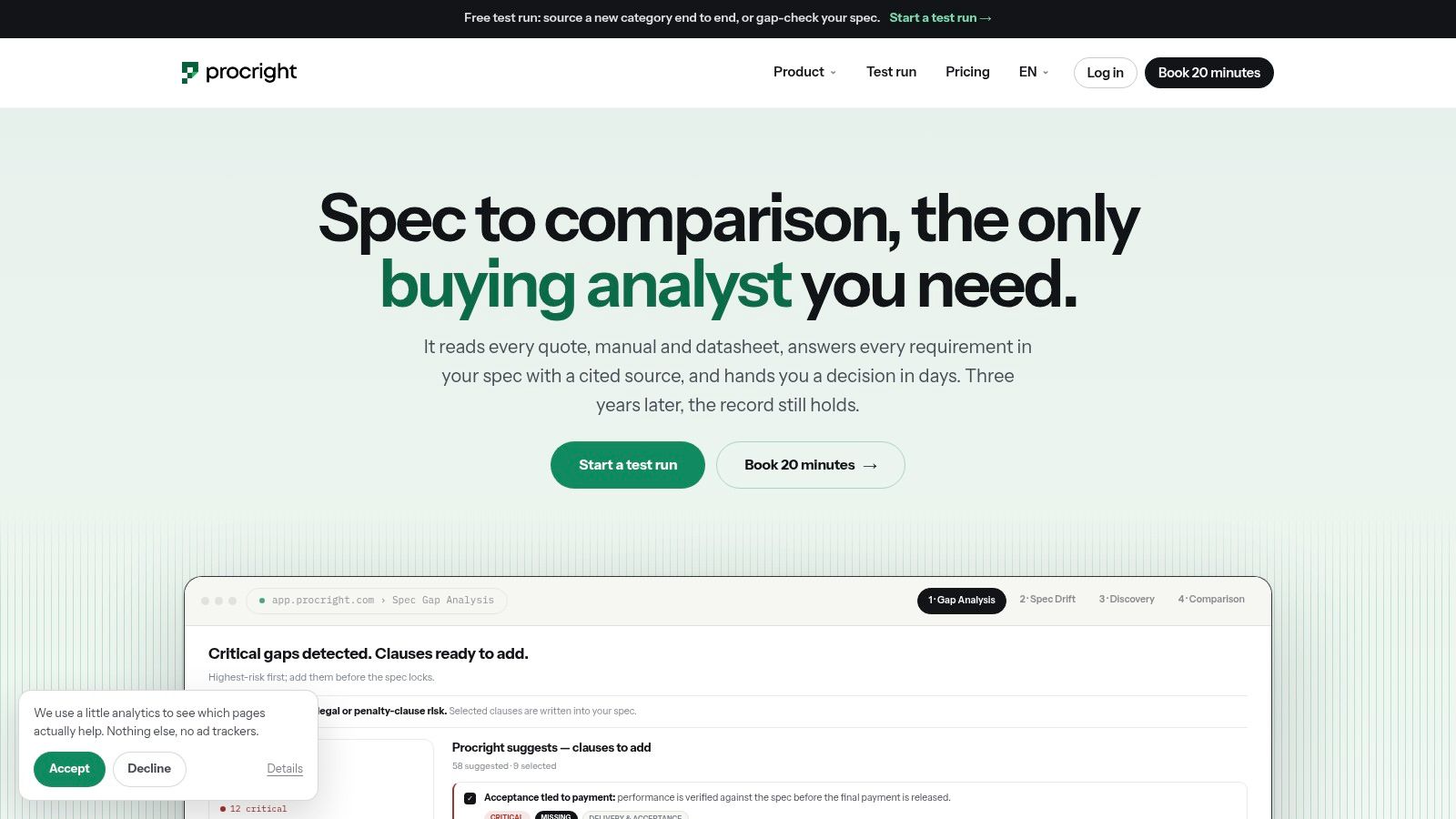
Start with a gap analysis of the draft specification. Look for vague clauses, missing acceptance criteria, single-bidder requirements, inconsistent terminology, and obligations that cannot be verified. Rewrite each material code requirement so suppliers answer the same question against the same evidence standard.
Then centralize supplier responses and source documents. The evaluator should be able to see whether a supplier answered yes, no, or partial, what evidence supports the response, and whether the evidence covers the relevant site, subcontractor, date, and control.
Preserve the decision record
A defensible workflow captures more than a final score. It records:
The requirement version used in the sourcing event.
The supplier's answer and supporting evidence.
The evaluator's rationale.
Any clarification or exception.
The corrective action owner and status.
The reason for elimination, award, continuation, or escalation.
Differences between the locked specification and final commercial terms.
Spec drift detection matters here. A supplier may comply with the original code-related requirement but introduce a weaker subcontracting term, narrower audit right, or different remediation obligation in its proposal or contract mark-up. The buyer needs to identify that change before signature, not during an investigation.
The same system can support ongoing review by linking supplier evidence to risk tiers, renewal dates, corrective actions, and reassessment triggers. That turns compliance from a post-award filing exercise into a sourcing control that remains visible as conditions change.
Procright helps procurement teams turn supplier codes of conduct into locked, evidence-based sourcing requirements, compare supplier responses with cited support, and detect specification drift before award. Visit Procright to test how an AI-driven procurement workflow can create a defensible decision record from first draft through final contract.
Try it on a real buy
Bring one category. Watch where the flags land.
We use a little analytics to see which pages actually help. Nothing else, no ad trackers.