10 Vendor Management Software Options for Enterprises
The longest feature list is the least useful guide for vendor management software. Ten options compared by the procurement problem each one solves.
In this article
The most popular advice about vendor management software is also the least useful: choose the platform with the longest feature list. That approach assumes supplier onboarding, third-party risk, contingent labor, contracts, procurement analysis, and supplier performance are one problem. They aren't. A tool that governs supplier qualification inside an ERP may be a poor fit for staffing suppliers, while a third-party risk platform may not help a buyer prove why one technical bid beat another.
This comparison evaluates 10 enterprise options by the procurement problem each one solves. The criteria are use-case fit, workflow depth, ecosystem dependencies, implementation burden, pricing transparency, supplier adoption, governance, evidence capture, and auditability. The shortlist separates supplier lifecycle management from source-to-pay integration, contingent workforce management, contract workflows, third-party risk, and evidence-backed sourcing.
Procright occupies a distinct segment of the market. It focuses on traceable sourcing decisions from specification through award. It can complement a vendor lifecycle or risk platform, but it shouldn't be treated as a universal replacement for supplier master data, contract administration, or workforce management. Teams comparing suppliers can also browse the Ryken Solutions supplier directory when they need broader market discovery.
1. Procright
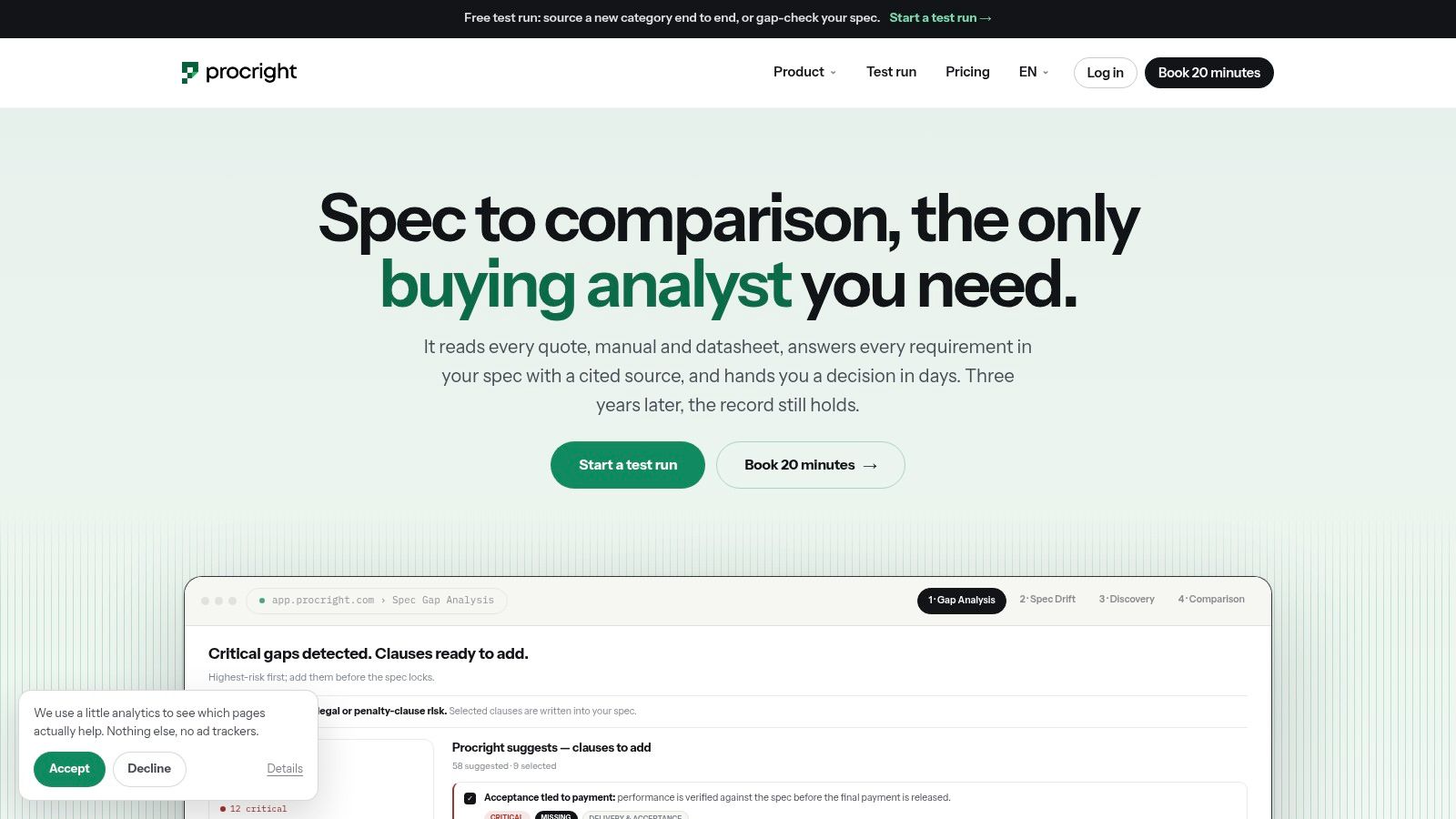
Procright is the strongest option here for a procurement team whose central problem is not “where do we store vendors?” but “can we defend how we selected this supplier?” Its AI-driven workflow turns a sourcing event into a structured decision record, starting with draft specifications and continuing through supplier discovery, requirement scoring, comparison, and award.
The platform reads quotes, manuals, datasheets, videos, forums, reviews, and vendor websites. It answers requirements as yes, no, or partial, and attaches a source citation to each answer. That distinction matters when supplier claims conflict across documents. Procright can also detect specification drift between the locked requirement, quotations, manuals, and commercial terms, helping buyers identify deviations before signature.
The evidence chain is the product's defining boundary and advantage. It doesn't attempt to be a full source-to-pay suite or a complete third-party risk system. Instead, it adds depth where ordinary supplier-management records often become too shallow, particularly for complex IT, infrastructure, equipment, services, and public-sector purchases.
Best fit for evidence-backed sourcing
Procright supports AI-assisted specification creation, gap analysis, single-bidder detection, clause suggestions, supplier invitation, response management, weighted scoring, collaboration, and DOCX or Excel exports. Plan-dependent scoring dimensions include Market Adoption, Vendor Stability Index, Interest Radar, and Local Support.
Its discovery workflow also records why suppliers were eliminated. That gives stakeholders more than a shortlist. It gives them a reasoned path from the market to the award, with source-backed explanations that can be reviewed later.
Practical rule: If your approval committee will ask why a supplier was rejected, test whether the platform can show the answer and its original evidence without reconstructing the event from email attachments.
Procright publishes examples of up to 16× faster spec-to-decision cycles and 3–10% benchmarked price improvements on real events, as described in its product materials. Those figures are not universal promises, so buyers should validate them against their own documents and process. Pricing is tiered across Starter, Growth, Enterprise, and Public Sector plans, but commercial terms are scoped rather than presented as public per-seat pricing.
Security controls include NDA-first engagements, isolated workspaces, role-based access, deletion policies, external sharing controls, and InfoSec review on request. The trade-off is that Procright is selective and relatively early in onboarding customers, so a scoped pilot may be more realistic than an immediate enterprise-wide rollout.
Visit Procright to assess its sourcing workflow and audit-ready decision records.
2. SAP Ariba Supplier Lifecycle and Performance
SAP Ariba Supplier Lifecycle and Performance is designed for organizations that need governed supplier onboarding inside a broad procurement environment. It centralizes supplier information, qualification workflows, risk and performance assessments, templates, and lifecycle reporting.
The platform makes the most sense when SAP Ariba already manages sourcing, contracts, purchasing, or payments. In that setting, supplier records and process controls can connect to the surrounding source-to-pay operating model instead of being maintained in a separate point solution. SAP also offers supplier network reach, which can reduce the effort required to connect with a large supplier population, although supplier experience still needs validation during implementation.
Strong governance, substantial ecosystem dependency
SAP Ariba SLP supports qualification and performance processes that procurement administrators can govern through standardized workflows. Reporting and lifecycle analytics help teams prepare oversight records and monitor supplier status. Its newer supplier-management architecture also means buyers should clarify which deployment model and capabilities apply to their planned environment.
The main risk is architectural, not functional. A non-SAP organization may spend significant effort integrating supplier data, identity, contracts, risk feeds, and purchasing processes. The platform can be powerful, but its value depends on process design, master-data ownership, and implementation expertise.
Choose it when: SAP Ariba is already a strategic procurement platform and supplier governance must sit inside that ecosystem.
Test carefully: Supplier-facing forms, approval routing, administrator workload, and the migration path for existing supplier records.
Expect: Enterprise licensing and implementation planning. SAP publishes a user-per-month licensing signal, but buyers should request a complete commercial model for their configuration.
Explore SAP Ariba Supplier Lifecycle and Performance before treating it as a standalone vendor-management purchase. The product is best understood as part of an integrated procurement architecture, not as a supplier database.

3. Coupa Supplier Management
Coupa Supplier Management suits companies that want supplier self-service tied to business spend management. The platform manages supplier information, onboarding, risk, and performance while connecting those activities to Coupa's wider procurement and spend processes.
Its most visible adoption lever is the Coupa Supplier Portal, which lets suppliers exchange purchase orders, invoices, and supplier information. The portal is free for suppliers, a design choice that can reduce resistance when a buying organization asks a broad supplier base to participate in digital workflows. That doesn't eliminate onboarding effort, but it changes the supplier conversation.
Best for Coupa-centered supplier interaction
Coupa supports configurable forms, APIs, single sign-on, and ecosystem add-ons. Those capabilities make it a reasonable fit for enterprises that need supplier information to move across procurement, finance, and operational workflows without relying on manual re-entry.
The boundary is equally clear. Coupa Supplier Management is most compelling when Coupa core is already established. A buyer selecting it independently may face integration work that a Coupa customer has already absorbed. Pricing is quote-based and isn't publicly listed, so the business case should include supplier rollout, integration services, data migration, and administration rather than only subscription fees.
Supplier adoption isn't a cosmetic issue. A workflow that procurement approves but suppliers avoid will leave the organization with incomplete records and manual exceptions.
Procurement teams should test whether the supplier portal handles the specific documents, approvals, and data exchanges they use. They should also check how risk information is displayed to business owners and how supplier performance connects to sourcing and purchasing decisions. For a focused review of the onboarding layer, see this guide to supplier onboarding software features that matter for procurement teams.
Review Coupa Supplier Management if supplier network participation and source-to-pay continuity matter more than having a lightweight standalone tool.
4. Ivalua Supplier Management
Ivalua is the option for enterprises that need deep process configuration across a complicated global supplier environment. Its supplier-management capabilities span onboarding, qualification, performance, risk, sub-tier visibility, and contract-related supplier information. The platform also uses a shared data model across sourcing, contracts, and supplier relationship management.
That common model addresses a familiar procurement failure. A supplier can have one identity in sourcing, another in contracts, and a third in performance reporting. Ivalua's design aims to keep those records connected, allowing teams to view the supplier relationship across multiple processes rather than treating each stage as a separate record.
Flexibility creates implementation responsibility
Ivalua's configurable forms and workflows are useful when categories have different approval, evidence, or qualification requirements. A global manufacturer, financial institution, or complex services organization may need that flexibility. A smaller team with simple onboarding may find the same flexibility difficult to govern.
The implementation trade-off deserves direct attention. Configuration power can lengthen design cycles because the buyer must decide which processes should be standardized and which should remain category-specific. Without strong process ownership, teams can reproduce organizational complexity inside the software.
Strongest fit: Complex supplier lifecycles, nuanced category rules, and a need to connect sub-tier or contract risks to supplier records.
Main constraint: The platform isn't a quick point solution. Design governance and implementation expertise matter.
Commercial question: Pricing and licensing are quote-based, so request costs for configuration, integrations, support, and future workflow changes.
See Ivalua Supplier Management when a unified supplier data model is more important than rapid deployment. Its value comes from coverage and adaptability, not from minimal setup.

5. JAGGAER Supplier Management and Performance
JAGGAER targets organizations that want a 360-degree supplier view across sourcing, contracts, and procure-to-pay. Its supplier-management capabilities include supplier master data, segmentation, onboarding, qualification, risk assessment, performance management, and a configurable supplier portal.
The important buying distinction is continuity. JAGGAER's shared data layer is intended to carry supplier information across procurement modules, reducing the need to reconcile separate sourcing, contract, and purchasing records. That can help procurement teams maintain consistent supplier context as a relationship moves from selection to active performance.
A platform for operating-model change
JAGGAER also uses embedded intelligence and product briefs to help stakeholders understand procurement workflows. Those materials may support internal adoption, but they don't replace a process owner. Enterprises still need to define who owns qualification, who approves exceptions, and what performance evidence should trigger remediation.
Implementation and change management are the main trade-offs. A broad lifecycle platform can reduce silos, but it also asks business users and suppliers to change established habits. Buyers should run a demonstration using their own onboarding forms, segmentation rules, performance measures, and approval paths.
Good match: Organizations seeking an integrated S2P data layer with supplier lifecycle coverage.
Less suitable: Teams that need only a small vendor intake and contract repository.
Validate: Portal usability, reporting flexibility, integration dependencies, data stewardship, and the work required to migrate supplier records.
Procurement leaders focused on post-award governance can also review this explanation of supplier performance management after the contract is signed.
Explore JAGGAER when the goal is to connect supplier management to a wider procurement operating model rather than purchase an isolated onboarding application.

6. GEP SMART Supplier Management
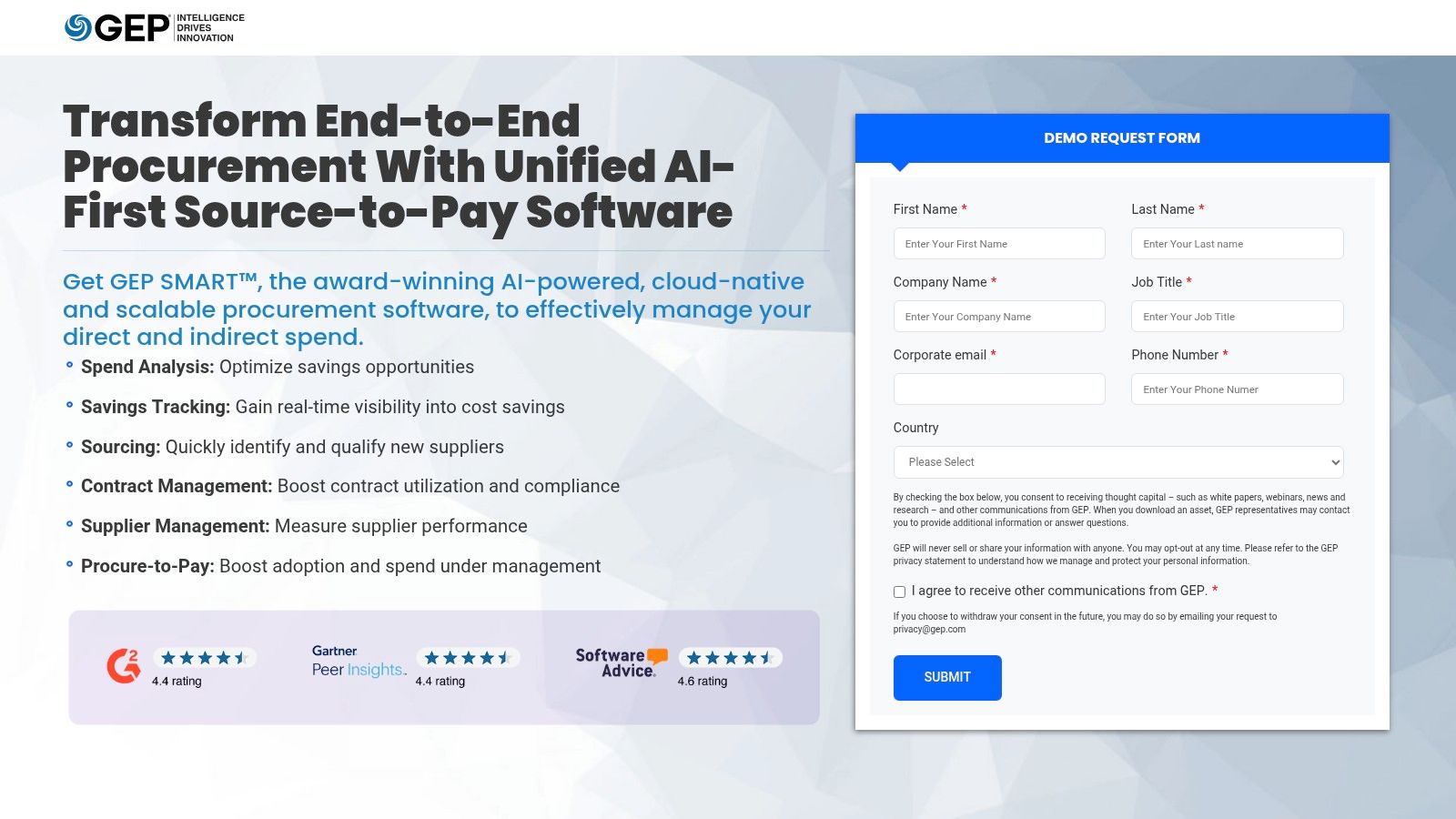
GEP SMART is built for buyers that prefer one source-to-pay provider across sourcing, supplier management, contracts, and purchasing. Its supplier capabilities include centralized supplier records, onboarding, performance KPIs, and reporting tied to procurement activity.
The appeal is operational simplicity. A unified suite can give procurement, finance, and sourcing teams a shared data model and common reporting environment. GEP also combines software with services, which may help an organization that needs assistance translating a procurement strategy into workflows and adoption plans.
Suite breadth versus point-solution precision
GEP's AI-first positioning emphasizes insights across procurement operations. For an enterprise consolidating fragmented tools, that broad view may be more valuable than a specialized supplier-management feature set. The buyer should still distinguish between an insight on a dashboard and evidence that supports an approval, audit, or supplier remediation decision.
The central trade-off is scope. A company looking only for vendor onboarding may pay for a larger operating model than it needs. Conversely, an enterprise attempting to consolidate multiple procurement processes may find the suite approach reduces integration overhead and governance fragmentation.
Don't compare GEP SMART with a point solution only by counting screens. Compare the number of systems your team must govern after implementation.
Pricing is quote-based and not publicly listed. Request a commercial breakdown that separates software, services, integrations, data migration, and ongoing configuration. Also confirm whether supplier performance measures can connect to sourcing outcomes and purchasing behavior, rather than remaining inside a separate reporting layer.
Review GEP SMART procurement software if suite consolidation is the primary procurement problem. It isn't the obvious choice for a narrow, low-complexity vendor-management requirement.
7. Oracle Fusion Cloud Supplier Qualification Management
Oracle Fusion Cloud Supplier Qualification Management is the natural candidate for Oracle ERP and SCM customers that want supplier qualification governed inside the Oracle stack. It supports onboarding, qualification models, assessments, documentation capture, and compliance checkpoints through the supplier lifecycle.
The platform's rule-based qualification approach helps organizations define who can participate in sourcing and under what conditions. That matters when procurement eligibility depends on certifications, category requirements, regional rules, or internal approval gates. Oracle's published functional documentation and datasheets can also give IT and audit stakeholders a clearer basis for validating intended controls.
Best fit for first-party traceability
The strongest argument for Oracle SQM is integration friction. If supplier, sourcing, purchasing, and financial data already live in Oracle Fusion Cloud, keeping qualification in the same environment can reduce duplicate records and handoffs. It also supports traceability from supplier solicitation and eligibility through downstream procurement activity.
The limitation is ecosystem dependence. Organizations outside an Oracle-centered technology ecosystem should not assume that native integration automatically outweighs the work of connecting other ERP, contract, risk, or identity systems. The demonstration should include the buyer's actual qualification documents, exception routes, expiry rules, and evidence exports.
Choose it when: Oracle is the system of record for procurement and supplier qualification.
Check: How business users maintain qualification models without excessive technical support.
Clarify: Pricing, implementation services, integration scope, and the export format required for audits.
Learn about Oracle Fusion Cloud Procurement before assessing the supplier qualification module in isolation. Its strongest value appears when qualification is one controlled step in a larger Oracle process.

8. SAP Fieldglass
SAP Fieldglass addresses a procurement problem that general supplier platforms often leave separate: contingent workforce and external services management. It records staffing suppliers, contractors, statements of work, time and expense, rate governance, worker eligibility, compliance, and related approvals.
Its value depends on operational detail. A temporary worker or services provider requires controls for requisitions, assignments, timesheets, expenses, rate cards, eligibility checks, and SOW milestones. Fieldglass organizes those records around the work arrangement, rather than treating the supplier as only a profile in a master database.
The product fits enterprises that need a defensible record of labor and services activity. Its audit trail is most useful when managers must show who performed work, under which arrangement, at what rate, and with what approval history. Staffing supplier onboarding, compliance workflows, enterprise integrations, and help resources support that operating model.
Fieldglass has a defined boundary. It is not a general supplier lifecycle platform, strategic sourcing suite, or procurement-analysis system for equipment and software purchases. Organizations may therefore run it beside broader procurement tools, particularly when contingent labor requires separate governance, permissions, and reporting.
Best fit: Global contingent workforce, staffing supplier, and SOW governance.
Poor fit: General supplier onboarding without workforce or services complexity.
Validate: ERP and HR integrations, worker-data permissions, rate-card administration, supplier adoption, and exit workflows.
Explore SAP Fieldglass when external labor or services is the control gap. For ordinary supplier records, its specialization may add implementation and operating overhead without solving the core problem.

9. Gatekeeper
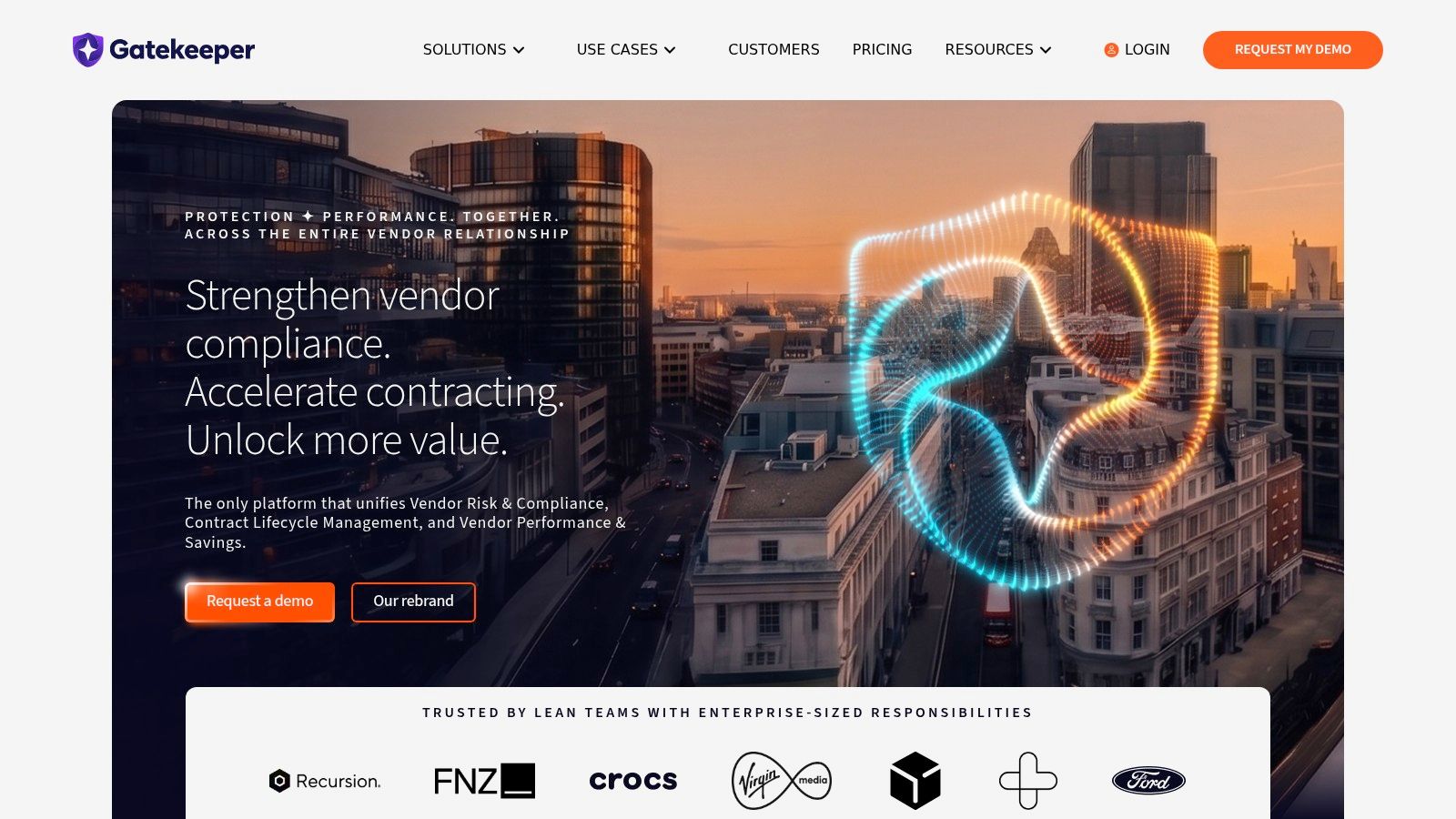
Gatekeeper addresses a defined procurement problem: vendor intake connected to contracts, renewals, and risk workflows. It combines vendor records, a branded supplier portal, risk assessments, contract lifecycle management, onboarding playbooks, and AI assistants in one interface.
Its main trade-off is breadth versus deployment effort. Compared with larger source-to-pay suites, Gatekeeper presents a narrower operating model and published pricing tiers, which can help buyers assess commercial fit earlier. Its pricing information also states that plans include unlimited e-signature licenses, although the selected plan's terms require confirmation.
A fit for contract-centered governance
Gatekeeper is relevant when requests arrive by email, contracts sit in separate locations, and renewal ownership is unclear. Prebuilt workflows and the supplier portal can standardize intake without requiring a broader procurement transformation.
The product's boundary matters. Gatekeeper does not replace a full source-to-pay platform for advanced sourcing, purchasing, spend analysis, or ERP-led procurement operations. Integrations may be needed for those functions, as well as specialized third-party risk feeds. Risk capabilities also vary by plan, so a feature-level demonstration is more informative than a general product overview.
Assess the platform through one complete operating scenario: a vendor request, supplier submission, contract approval, renewal notice, risk review, and evidence export. That sequence reveals workflow depth, supplier experience, audit visibility, integration requirements, and implementation effort more clearly than a feature checklist.
Strong fit: Contract intake, renewal control, and vendor governance where a direct implementation path matters.
Watch closely: Integration depth, plan-specific risk functions, and supplier portal adoption.
Ask for: Ownership rules, approval history, evidence retention, export formats, and the process for changing or closing a vendor record.
Review Gatekeeper's vendor management platform when contract governance is the central control gap. It is less suitable as the sole platform for complex sourcing and procure-to-pay operations.
10. Aravo
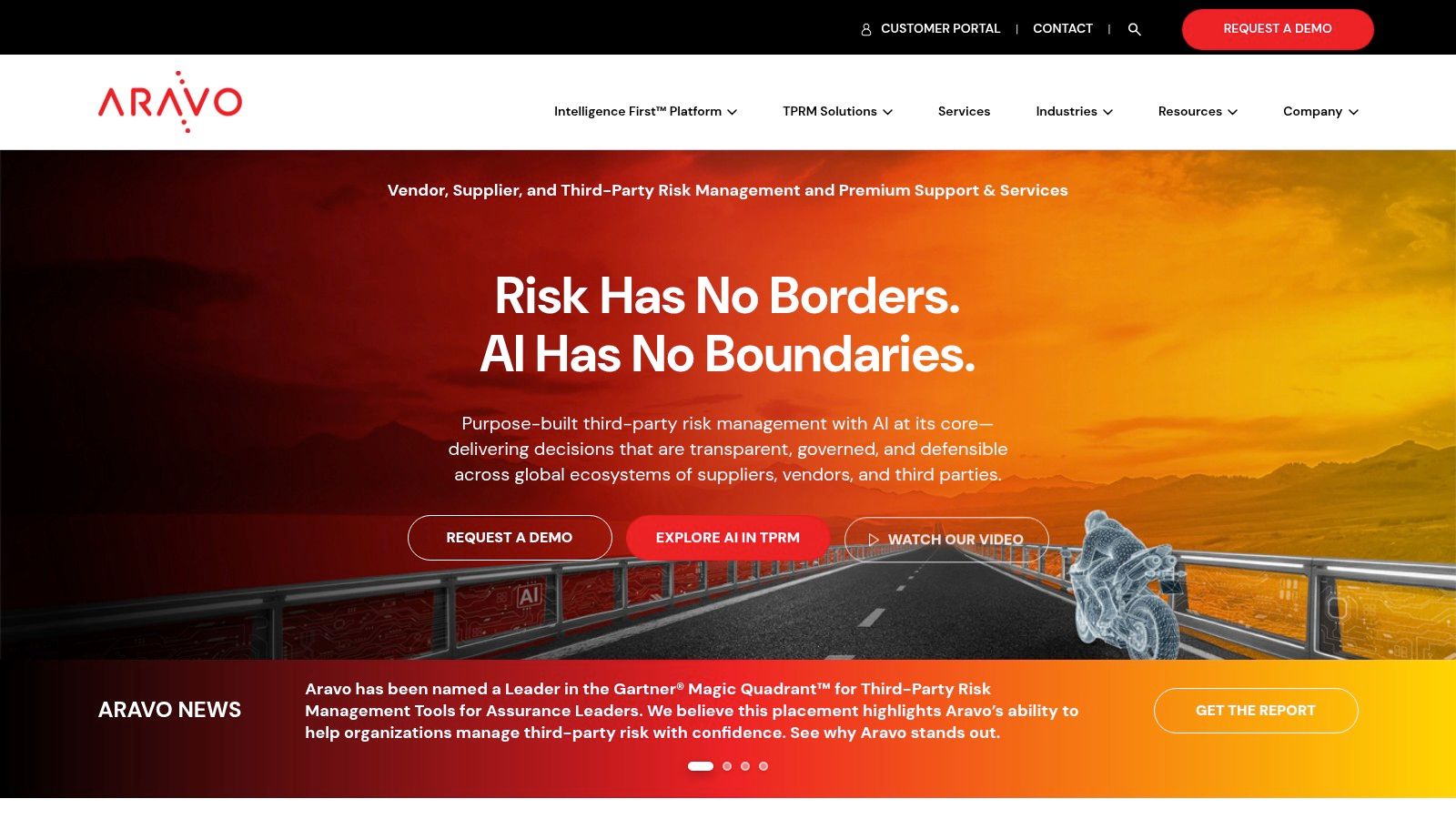
Aravo fits enterprises whose primary procurement problem is third-party risk governance, not transactional purchasing. It supports deep third-party risk management, due diligence, continuous monitoring, and evidence capture across security, compliance, legal, finance, and operational reviews. That scope makes it relevant to regulated organizations and global supply chains with complex approval requirements.
Its operating model centers on assessments, workflow orchestration, remediation tracking, monitoring, and supporting evidence. Multi-tier workflows can extend oversight to subcontractors and downstream parties, rather than limiting review to the immediate supplier.
Aravo usually sits beside a source-to-pay suite. Procurement can retain separate systems for sourcing, contracts, and purchase orders, while Aravo controls the risk decision for approval, renewal, or escalation. This separation can improve governance, but it increases implementation work.
Before selection, map the handoffs. Identify the system that owns supplier identity, starts assessments, stores evidence, and sends risk-status changes to procurement and business owners. A vendor due diligence checklist for what to verify before a contract exists can help define pre-contract evidence requirements. Teams should also include supply chain cyber risks in the control design, particularly where downstream dependencies affect security review.
A focused evaluation should test one supplier journey from intake through renewal, remediation, and evidence export. That sequence exposes monitoring coverage, audit depth, ownership rules, integration needs, and supplier effort more clearly than a feature list.
Choose Aravo when: Third-party risk and audit oversight are the main control gaps.
Do not expect: Full sourcing, purchasing, or procurement spend analysis.
Validate: Assessment workflows, monitoring sources, evidence retention, remediation ownership, and connections to ERP, CLM, and procurement systems.
Explore Aravo where risk control justifies a dedicated governance layer beside the procurement suite.
Top 10 Vendor Management Software Comparison
Product | Core features | Quality & outcomes | Value & pricing | Target audience | Unique selling points |
|---|---|---|---|---|---|
Procright 🏆 | AI spec drafting, gap & single‑bidder detection, autonomous market discovery, one‑click evidence, spec‑drift detection ✨ | Audit‑ready traceability; faster cycles (up to 16×); benchmarked savings 3–10% ★★★★☆ | Tiered (Starter→Public Sector); bespoke scoping; free test runs 💰 | 👥 Enterprise procurement, IT/infrastructure, category managers, compliance | Full evidence citations + autonomous multi‑media research; public‑audit readiness ✨ |
SAP Ariba SLP | Central supplier master, workflows, risk & performance analytics | Enterprise governance & audit reporting; strong network effects ★★★★ | Licensed (user/month); enterprise pricing model 💰 | 👥 Large orgs on SAP/Ariba | Tight Ariba sourcing/CLM/P2P integration; broad supplier reach ✨ |
Coupa Supplier Management | Supplier info/risk, configurable forms, Coupa Supplier Portal (CSP) | Strong supplier adoption; mature APIs; good self‑service UX ★★★★ | Quote‑based; CSP free for suppliers 💰 | 👥 Orgs standardizing on Coupa, supplier‑centric programs | Free CSP, strong network effects and extensibility ✨ |
Ivalua Supplier Management | End‑to‑end lifecycle, unified data model, highly configurable workflows | Flexible for complex/global categories; deep sub‑tier visibility ★★★★ | Quote‑based pricing; high configurability costs 💰 | 👥 Complex global procurement, nuanced category processes | High configurability; unified model across sourcing/CLM/SRM ✨ |
JAGGAER Supplier Mgmt & Performance | Supplier portal, 360° view, shared data layer, embedded intelligence | Good lifecycle coverage; stakeholder briefs accelerate buy‑in ★★★ | Quote‑based enterprise pricing 💰 | 👥 Organizations needing integrated S2P data layer | Embedded intelligence + continuity across sourcing/CLM/P2P ✨ |
GEP SMART, Supplier Mgmt | Centralized KPIs, onboarding, unified S2P data model, AI insights | Unified reporting & governance; combined services+software model ★★★ | Quote‑based (suite pricing) 💰 | 👥 Teams wanting single‑vendor S2P and consolidated governance | Single data model + services to accelerate adoption ✨ |
Oracle Fusion SQM | Rule‑based qualification, assessments, embedded in Oracle Procurement | Strong traceability inside Oracle stack; rich functional docs ★★★★ | Quote‑based; best value within Oracle ecosystem 💰 | 👥 Oracle ERP/SCM customers | Native Oracle integration and comprehensive audit support ✨ |
SAP Fieldglass (VMS) | Purpose‑built VMS for contingent labor: onboarding, SOW, time & expense | Depth in staffing & SOW governance; global deployments ★★★★ | Quote‑based enterprise pricing 💰 | 👥 Contingent workforce & services procurement teams | Purpose‑built VMS with mature rate/cardinality controls ✨ |
Gatekeeper (Vendor & CLM) | Vendor onboarding, branded supplier portal, playbooks, AI assistant | Faster implementation; visible pricing tiers; good UX ★★★★ | Published pricing tiers; transparent packaging 💰 | 👥 Mid‑market to enterprise needing fast time‑to‑value | Transparent pricing, playbooks, unlimited e‑sign on plans ✨ |
Aravo (TPRM) | Third‑party risk mgmt, due diligence, continuous monitoring, evidence capture | Deep TPRM for regulated industries; strong audit orientation ★★★★ | Quote‑based; enterprise TPRM pricing 💰 | 👥 Risk/compliance teams, regulated/global programs | Multi‑tier risk workflows and robust evidence capture ✨ |
Match the Platform to the Control You Need
The vendor management software market has expanded quickly. One industry estimate valued the global category at about USD 5.7 billion in 2024 and projected it to exceed USD 11.9 billion by 2030, with a 12.5% CAGR, according to Strategic Market Research's vendor management software analysis. A separate market estimate put the category at USD 11.84 billion in 2025 and projected USD 21.99 billion by 2030, at a 12.7% CAGR, which reinforces the broader conclusion that this is now an established enterprise software category. These estimates differ in scope and methodology, so buyers should use them as market context, not as a business case.
The category's growth reflects real operational pressure. Global supply-chain complexity, supplier compliance tracking, procurement digitization, outsourcing, and enterprise contract management have pushed vendor controls beyond simple spreadsheets and renewal reminders. The Business Research Company's market report also describes a forecast increase of USD 14.28 billion between 2024 and 2029, at an 18.6% CAGR, while identifying retail as a notable early-adopter segment with a value of USD 2.53 billion in 2019. Those figures describe market estimates, not guaranteed outcomes for an individual buyer.
Start with the control gap, not the vendor name:
Supplier lifecycle governance: Consider SAP Ariba SLP, Ivalua, JAGGAER, GEP SMART, or Oracle SQM when onboarding, qualification, supplier master data, performance, and procurement integration are the core requirements.
Source-to-pay consolidation: Focus on the suite that already matches your ERP, sourcing, contracts, and P2P architecture. SAP Ariba, Coupa, Ivalua, JAGGAER, GEP SMART, and Oracle can be strong choices when ecosystem fit reduces duplicate records and integration work.
Contingent workforce control: Choose SAP Fieldglass when staffing suppliers, workers, rates, time, expenses, or SOWs define the operating model.
Contract and vendor intake: Evaluate Gatekeeper when the immediate exposure sits in intake, contract storage, approvals, risk workflows, renewals, and supplier self-service.
Third-party risk and audit evidence: Evaluate Aravo when due diligence, continuous monitoring, multi-tier risk, remediation, and evidence retention are more important than sourcing or purchasing features.
Evidence-backed sourcing: Choose Procright when the difficult question is why a supplier won, whether every requirement was met, and whether the final decision can be reconstructed from original evidence.
Cloud deployment now dominates the category. One market report estimated cloud deployment at 63.2% of the market in 2024 and projected a 12.9% CAGR through 2030, while another estimated cloud-based deployment at 58.3% share, as reported by Mordor Intelligence's vendor management software market analysis. That makes cloud architecture less of a differentiator by itself. Buyers should test API maturity, ERP and CLM integration, role-based access, audit logging, identity management, data residency, and the quality of risk feeds.
Third-party risk is also changing the buying question. Independent survey data cited in The Business Research Company's third-party risk market material says 64% of organizations use dedicated third-party risk management software, adoption rose 19% year over year, spreadsheet-based methods fell 29%, and the hybrid operating model reached 52%. The practical implication is that many enterprises won't replace every tool with one platform. They'll need to define ownership across procurement, risk, security, legal, finance, and operations.
Ask each vendor to demonstrate your own documents, approval paths, supplier responses, risk evidence, renewal terms, and export requirements. Don't accept a generic demo that hides exception handling. Validate implementation ownership, data migration, supplier experience, integration dependencies, pricing structure, support, audit history, and what happens when a supplier fails to respond or a document conflicts with a prior submission.
A scoped test or proof of concept is sensible when the boundary between platforms remains uncertain. Run one representative sourcing event, one onboarding path, or one high-risk supplier review. Measure whether the selected platform closes the highest-risk gap without creating unnecessary suite complexity, duplicated records, or a new manual reconciliation process. For control documentation and audit planning, buyers may also consult this SOC 2 audit software guide, while remembering that audit tooling and vendor-management tooling serve different purposes.
Procright helps procurement teams draft and refine specifications, discover suppliers, compare evidence, detect specification drift, and produce an audit-ready record from first draft to final award. Visit Procright to test whether traceable sourcing analysis can close the evidence gap in your vendor-management process.
Try it on a real buy
Bring one category. Watch where the flags land.
We use a little analytics to see which pages actually help. Nothing else, no ad trackers.