Bias in AI Supplier Selection: What Teams Miss
AI supplier rankings can inherit bias from past awards, labels, and scoring—audit data, rules, and segment gaps first.
In this article
AI can shorten supplier selection from 16 weeks to under 7 days - but fast rankings can still repeat old mistakes. If I trust the score without checking the data, labels, and score gaps, I can end up narrowing competition and making award decisions harder to defend.
Here’s the short version:
Bias usually enters in 3 places: past award data, inconsistent labels, and scoring rules
Teams often miss it for 3 reasons: they assume model output is neutral, ownership is split, and testing stops after launch
The fix also comes down to 3 checks: audit historical data, test labels and logic, and review score gaps by supplier group before awards move ahead
A few facts make this hard to ignore:
Only 8% of procurement leaders say their purchasing data is “very good”
50% say poor data quality is a major barrier to AI use
A model can look fine on average while still scoring smaller, newer, or regional suppliers lower
My takeaway: bias in supplier selection is usually not just a model issue. It’s a process issue. If I want cleaner award decisions, I need clear ownership, repeat checks, and an audit trail tied back to source evidence.
That’s the core point of this article.
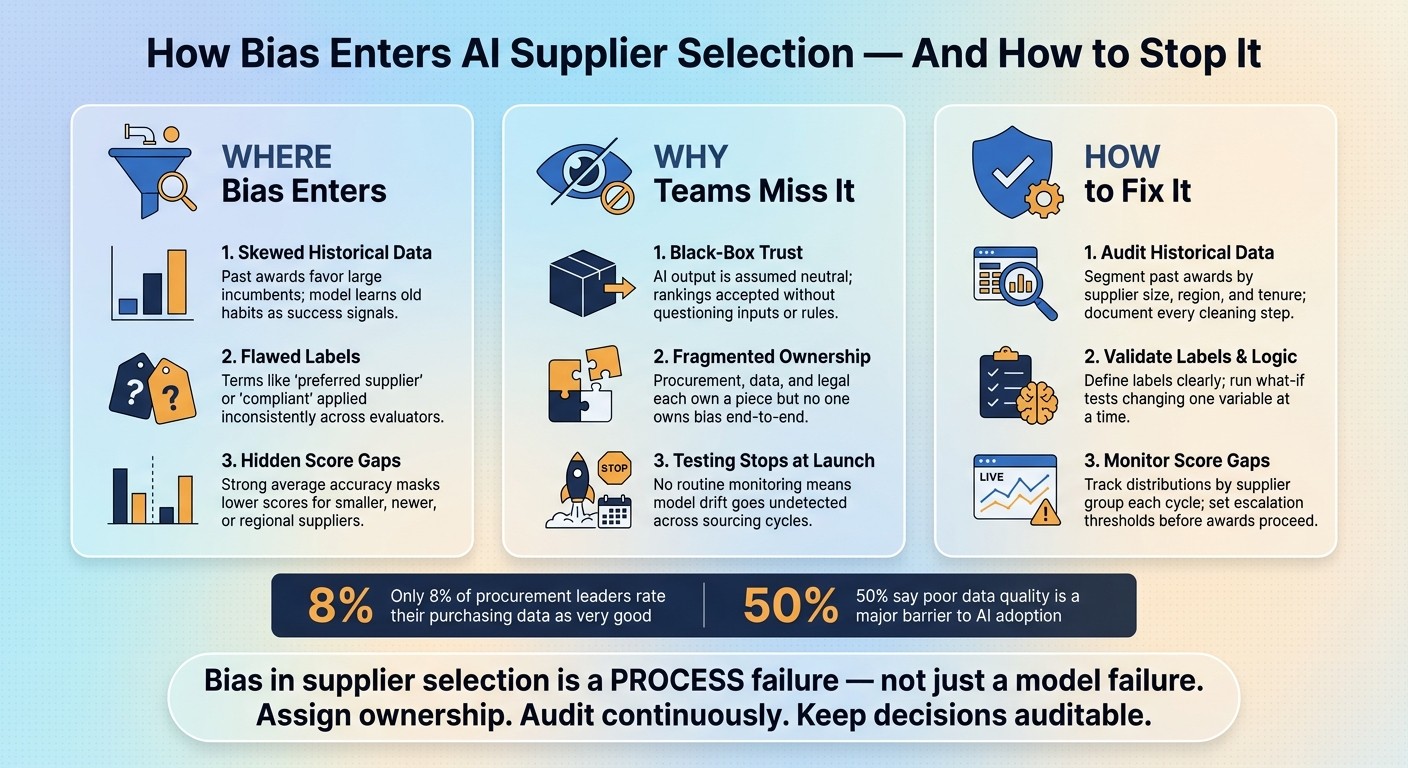
How Bias Enters AI Supplier Selection (And How to Stop It)
4 Biggest Risks of Using AI in Procurement (And How to Avoid Them)
Where Bias Enters the Supplier Selection Pipeline
If weak data opens the door to bias, the pipeline decides how far that bias travels. In supplier selection, it usually shows up in three places: historical data, labels, and final scoring.
Skewed training data from past awards and supplier history
The first problem starts with what the model learns from the past. Most AI supplier scoring systems train on historical records like prior awards, contract renewals, and performance ratings. That sounds sensible. But those records may reflect old buying habits, not current supplier quality.
Say a company spent years giving contracts to a small group of large incumbent vendors in certain regions. The model can learn to read those patterns as signs of success. And once that happens, history starts to look like proof.
That can trap the model in incumbent-heavy patterns and push newer suppliers to the margins. A simple way to check for this is to review score distributions by supplier size, geographic region, and contract tenure. If long-tenured suppliers keep scoring higher than newer entrants on similar specs, that’s a signal to dig deeper.
Flawed labels and inconsistent evaluation rubrics
The next weak spot is labeling. Terms like preferred supplier, high risk, or compliant only help if people use them the same way over time. In many teams, that doesn’t happen.
One evaluator may mark a supplier as "compliant" based on a general impression. Another may require documented proof for every line item. Same label, different standard.
When familiarity starts standing in for quality, the model picks up the wrong lesson. And once that label becomes part of training, the system can keep treating familiarity as if it were proof of performance.
Score gaps that hide inside average results
A model can look accurate at the top level and still produce uneven results underneath. That’s where things get slippery. Average metrics often hide segment-level gaps: smaller firms, newer entrants, and underrepresented regions may score lower.
So a model may post strong overall accuracy while still treating parts of the supplier base unevenly. That’s how skewed outcomes stay hidden in plain sight.
Watch for patterns in:
score distributions
rejection rates
error rates
Break those out by supplier size, region, and tenure.
Why Teams Miss These Problems
Knowing where bias can slip into the pipeline isn't the same as catching it. In practice, these issues stick around for a few plain reasons: teams trust what the model shows them, ownership gets split across departments, and testing often stops once the system goes live.
Treating model output as automatically objective
A lot of teams start with the idea that AI output is neutral because it comes from data instead of a person. On the surface, that feels reasonable. If a ranked supplier list appears on screen, it can look like a clean, unbiased result.
But that's where things go sideways. Reviewers may treat the ranking as objective and stop questioning the inputs or the rules behind it. This is black-box thinking: accepting model outcomes without active challenge. And if no one checks what the model is learning from, that trust can turn into a problem fast.
Fragmented ownership across procurement, data, and legal
Bias almost never has one clear owner. Procurement owns the category. Data owns the model. Legal reviews risk. But across the full workflow, no one person or team is watching for bias from end to end.
That gap matters. It gives things like location, supplier history, or other inputs room to act as stand-ins for geography or identity without anyone flagging them early.
No routine bias testing or outcome monitoring score gaps
Many teams validate the system once at launch and then move on. The problem is that supplier markets shift, policies change, and supplier segments don't stay still. A model that looked fine on day one can drift over time.
Without repeat reviews by supplier segment, category, and policy updates, score gaps can slowly get worse and stay hidden until they've already shaped award patterns - including against newer, smaller, or regional suppliers. And as sourcing cycles move faster, regular monitoring matters even more.
The next step is to test those inputs, labels, and score gaps before awards move forward.
How to Detect and Reduce Bias Before It Affects Awards
Bias needs to be checked before an award moves ahead, not after the damage is done. The good news is that the usual weak spots are easy to test: the data, the scoring rules, and the live results.
Audit historical data before training or updating models
Start with the data. Review past awards and see how data-driven procurement decisions shaped the results. Pay close attention to whether location or company size is working like a stand-in for something else.
A simple way to do this is to segment past data by supplier size and region, then look for repeat patterns of low scores or rejections. If one group keeps scoring low across several cycles, dig into it before that pattern gets baked into the next model update.
Also, document every cleaning step. That paper trail matters for audits.
Validate labels, rules, and scoring logic
Once the data is cleaned up, shift to the rules. Define each label clearly, and make sure the scoring logic matches current policy instead of old assumptions that may have carried over for years.
Run what-if tests that change one variable at a time. This makes hidden bias easier to spot. For example, if a supplier’s location changes and the score moves even though the performance data stays the same, that’s a sign you should inspect.
Monitor score gaps with transparent tools and governance
After launch, keep those same checks in place during every scoring cycle. Track score distributions across supplier groups and geography. Then set clear escalation thresholds for score gaps. If the gap between similar supplier groups crosses that line, trigger a review before any award moves forward.
The scoring layer needs to be just as open to review as the approval process. Procright ties compliance scores to source documents, which makes reviews auditable.
Conclusion: Build Fairer Supplier Selection Into the Process
The problem is clear: the control point is process design. Bias in AI supplier selection rarely shows up in obvious ways. It hides in plain sight because it can look like normal model behavior.
That’s what makes it hard to catch. Bias can enter through data, slip past weak controls, and stay there unless teams keep checking for it. The fix comes down to three controls:
Audit data
Validate rules
Monitor segment-level gaps on a continuous basis
Fair supplier selection depends on explainable controls, auditable data, and clear verification paths. This often requires template-based AI comparisons to ensure consistency. Put simply, bias in supplier selection is a process failure, not just a model failure.
And controls don’t work by magic. Someone has to own them. Assign one person to handle bias monitoring, escalation, and outcome review.
Procright supports this by linking compliance risk scores to source evidence, keeping reviews auditable.
FAQs
How can I tell if supplier scores are biased?
Watch for limited transparency, missing source details, and data that hasn’t been checked. Bias often creeps in when scores come from black-box logic or marketing-heavy materials instead of verifiable technical specs.
Look at whether each score is tied to a clear source citation, like a web page, PDF, or product video. Binary pass-fail ratings can hide holes in the data too, instead of showing where a product only meets part of the requirement.
Who should own bias checks in supplier selection?
Bias checks should be a shared, ongoing responsibility across the procurement team. They shouldn't be left to vendor marketing or black-box scores.
Teams need clear, standards-aligned specifications. They also need transparent verification of vendor claims against source documentation, plus regular reviews, audits, and pilot phases. That’s how you keep AI outputs aligned with organizational values and legal standards.
How often should AI supplier rankings be reviewed?
Review supplier performance and rankings on a regular basis against market benchmarks so you can see how things shift over time. A lot of organizations still lean on annual assessments, but continuous monitoring works better than an occasional check-in.
Scorecard-based systems can also mask what’s going on underneath. That’s why ongoing, cross-functional oversight matters. It helps keep rankings accurate and in step with current business needs and market conditions.
Related Blog Posts
Try it on a real buy
Bring one category. Watch where the flags land.
We use a little analytics to see which pages actually help. Nothing else, no ad trackers.