What Is an SBE in Procurement? Definition and Impact
In this article
In U.S. government and enterprise procurement, SBE typically means Small Business Enterprise, a supplier that meets applicable size standards and may qualify for set-asides or contract preferences. The same acronym can also mean School-Based Enterprise in education or Simple Binary Encoding in financial technology, so context determines the correct definition.
What is an SBE in procurement if the label doesn't tell you which rulebook applies? That question exposes the practical gap in many sourcing guides. Buyers often recognize the acronym but still don't know which agency's certification standard controls the event, which size test applies, or whether a supplier's status is valid for the specific contract.
For a category manager, SBE isn't merely a descriptive label. It can affect who may bid, how suppliers are evaluated, what subcontracting credit is available, and whether an award survives review. The safest approach is to identify the relevant jurisdiction and contract standard before publishing an RFX.
Table of Contents
The Confusion Around SBE Starts With One Acronym
Search for SBE without adding an industry term and you'll encounter several unrelated definitions. In career and technical education, School-Based Enterprise means a student-run business inside a school that sells goods or services to people other than the students themselves. The Nebraska education guidance on school-based enterprises describes the model as hands-on learning connected to responsibility, teamwork, leadership, and decision-making.
In high-performance trading, SBE usually means Simple Binary Encoding. The FIX Trading Community specification defines it as a wire-format approach designed for low-latency encoding and decoding while preserving FIX semantics and interoperability. That meaning belongs in a technical architecture discussion, not a supplier diversity review.
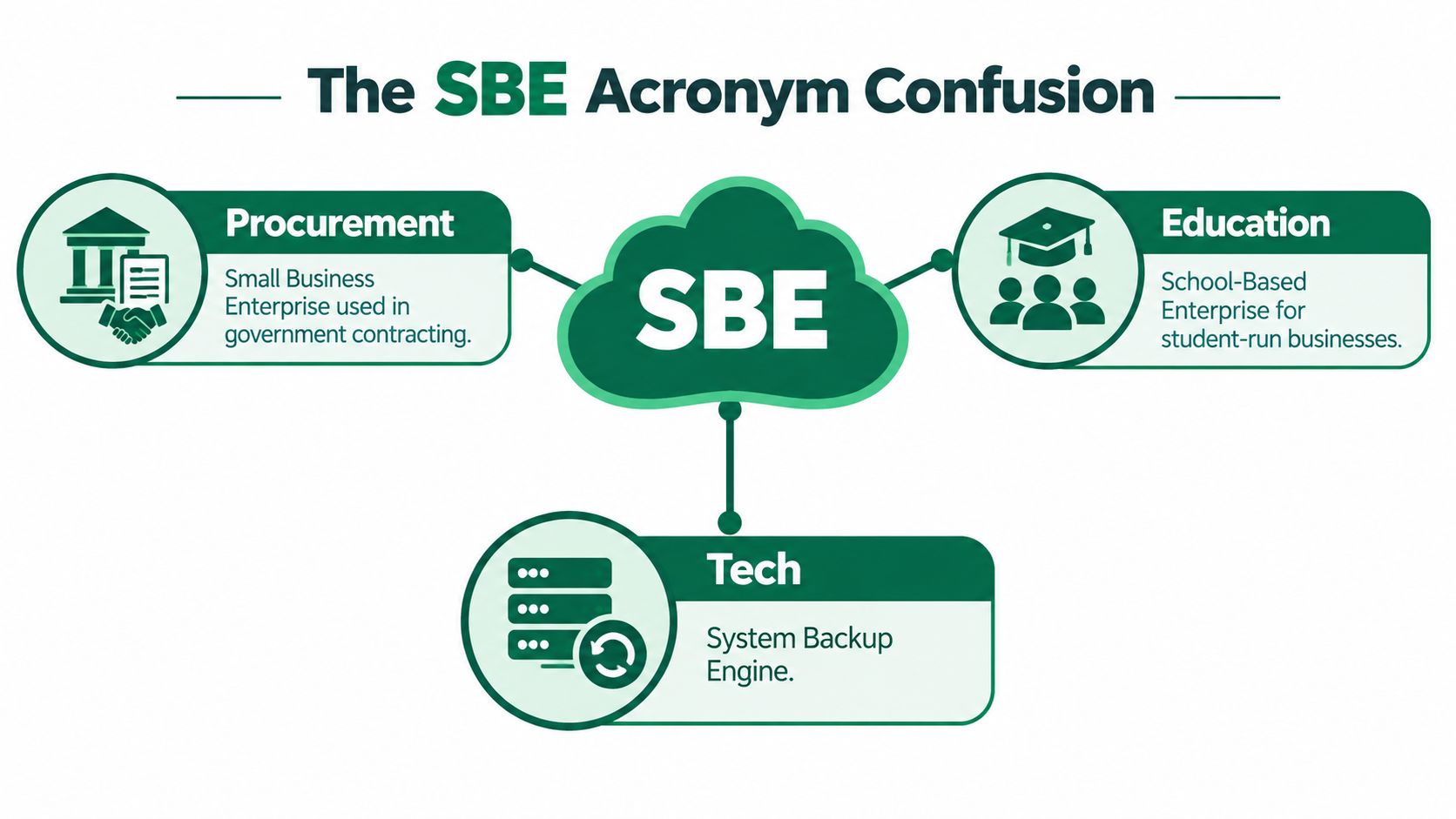
A fast disambiguation method
Use the surrounding nouns to identify intent:
Contract, bidder, certification, set-aside, or subcontractor usually points to Small Business Enterprise.
Students, school store, curriculum, or employability skills points to School-Based Enterprise.
FIX, messages, encoding, latency, or market data points to Simple Binary Encoding.
The procurement meaning deserves special care because it changes sourcing access. Education and technology definitions describe operating models or technical specifications. Procurement SBE status acts as a qualification and participation mechanism, which means an acronym error can become a bid-process error.
Practical rule: Never approve an SBE field in a sourcing template without also naming the jurisdiction, certifying body, and applicable contract standard.
What an SBE Means in Procurement
What does Small Business Enterprise mean when it appears in a solicitation? In U.S. government contracting, it generally identifies a business that meets the small-business requirements applicable to the purchase. Those requirements often connect to NAICS codes and SBA-style size standards. Depending on the industry, the test may use average annual receipts or average employee counts, as described in the U.S. Department of State explanation of small-business standards.
That definition gives buyers a starting point, not a universal certificate. SBE eligibility may be established by a state or local program, and the governing agency may apply its own rules for size, ownership, control, certification, or documentation. One city may require its own certificate and receipts limit, while another contract may point to an SBA-based standard.

SBE is a procurement instrument
Treat SBE status as a contract-specific access mechanism. A supplier may meet the applicable test for one category and fail another if its receipts or headcount exceed that sector's threshold. Its eligibility may also change under a different city or agency certification program.
For buyers, the working questions are:
What does SBE mean in this solicitation?
Which authority defines eligibility?
What evidence must the supplier provide before award or payment?
A supplier's marketing statement does not answer those questions. The procurement file should record the governing standard, the relevant NAICS classification or local category, the certification authority, and the date or status evidence reviewed.
The short walkthrough below shows how the same SBE label resolves differently under a state certificate versus an SBA-style size standard.
SBE status can affect access to work, but it does not replace commercial evaluation. A certified supplier must still meet the specification, delivery requirements, insurance conditions, service levels, and other contractual obligations.
How to Verify SBE Status and Spot Local Variations
Verification should begin with the contract, not the supplier's profile. Before contacting vendors, identify the buyer jurisdiction, funding source, agency policy, and solicitation language that determine which SBE definition applies.
A verification sequence that holds up
Start with the governing authority. Determine whether the event points to a federal-style SBA size standard, a state program, a city certificate, or an agency-specific supplier database. Don't assume that a familiar SBE program controls just because the buyer operates in the same region.
Match the supplier to the correct category. Check the NAICS code or local industry classification used for the purchase. The supplier's status may depend on the category assigned to the contract, not just on its general business description.
Apply the specified size test. Confirm whether the rule uses receipts, employees, ownership, control, or a combination of requirements. A supplier can qualify under one test and fail under another, particularly when different agencies define eligibility differently.
Review certification evidence. Record the issuing body, certificate or registration identifier, covered category, status date, and any conditions. If the program requires renewal or recertification, note the applicable review point in the event file.
Ask for clarification before bids close. If the solicitation uses SBE without defining it, issue a formal clarification or amendment. A private email exchange with one supplier won't provide the same protection as a rule stated consistently for all bidders.
A structured vendor due diligence checklist can help teams capture the evidence alongside financial, operational, and compliance checks. The key is to preserve the rule applied, not merely the conclusion that a supplier was marked eligible.
How Buyers Treat SBEs in Sourcing Decisions
SBE status can influence sourcing at several points, but its effect depends on the solicitation design. In a set-aside, certification may determine whether a supplier can participate. In a broader competition, it may support preference scoring or subcontracting credit. In another event, it may only be a reporting attribute.
Sourcing Step | Typical SBE Effect |
|---|---|
Market research | Helps identify suppliers eligible for a restricted or targeted event |
Supplier screening | Requires confirmation of the applicable certification and size standard |
Solicitation design | May shape set-aside terms, participation requirements, or subcontracting provisions |
Bid evaluation | Can affect preference treatment where the rules allow it |
Award review | Requires evidence that the selected supplier met the stated standard |
Contract administration | May affect subcontracting credit, reporting, and audit records |
Certification and capability are different tests
A certified SBE isn't automatically the right supplier. The buyer still needs to compare technical compliance, capacity, implementation approach, commercial terms, risk, and references where those requirements are relevant. Treating certification as a substitute for capability creates a different kind of sourcing failure, especially when the supplier cannot meet a demanding specification.
The reverse error is also common. A buyer may select a capable small supplier but fail to apply the stated preference or document why the supplier did or didn't receive SBE treatment. That gap can create questions during approval, award protest, subcontracting review, or audit.
Use a supplier evaluation template with weighted criteria to separate eligibility, mandatory compliance, and comparative scoring. Those are different decision layers and should remain visible in the evaluation record.
Evaluation principle: SBE status can open the door, but the specification and evaluation method determine whether the supplier should win.
Real Procurement Examples and Common Pitfalls
A facilities buyer can make the wrong SBE decision with accurate paperwork. Suppose a regional services supplier provides a certificate from its local program, while the solicitation follows a different agency's standard, size test, and documentation process. The certificate may be genuine, yet it does not establish eligibility for that event.
That distinction matters during supplier screening. The issue is a mismatch between the certificate reviewed and the rule written into the solicitation, rather than evidence of supplier misconduct. Record the governing program before accepting any certification.
Classification creates another practical risk. A supplier may satisfy the applicable receipts test for one line of work, while the buyer assigns the purchase to another NAICS category that uses an employee-count test. Without a documented classification decision, reviewers cannot easily understand or defend the screening result.
A simple spreadsheet answer is rarely enough. A column marked “SBE, yes or no” leaves out the facts needed to review the decision:
Applicable rule: Identify the agency, city, state, or federal standard.
Business classification: Record the NAICS code or local category used.
Evidence reviewed: Save the certificate, registry result, or supplier declaration.
Decision logic: State how the evidence satisfies, or fails to satisfy, the solicitation requirement.
Timing: Record the verification date and whether another review is needed before award.
Keep the record tied to the procurement file, not only to the supplier profile. A certificate can apply to one program, service category, or period and have no bearing on another purchase.
Do not change the standard informally after bids arrive. If the solicitation language is unclear, correct it through the formal process and provide the same information to every bidder. Early clarification protects consistent treatment and gives evaluators a defensible basis for applying SBE rules.
Why SBE Verification Belongs in Early Sourcing Planning
Why verify SBE status before the sourcing event opens? Because the decision can shape competition, solicitation language, and the buyer's ability to defend the outcome. Discovering the governing rule after bids arrive may force the team to revisit the supplier pool, amend the solicitation, or explain why participation did not match the program's intent.
Planning also gives buyers time to test the requirement itself. An unnecessarily narrow specification can exclude capable small businesses. An unclear certification clause can invite suppliers that do not meet the applicable standard. Resolve both issues before the event is locked.

Make SBE a planning decision, not an award-stage surprise
During sourcing design, assign clear ownership:
Policy owner: Confirms the jurisdiction and program governing the event.
Category owner: Maps the purchase to the appropriate industry classification.
Evaluation owner: Defines how eligibility relates to mandatory requirements and scoring.
Records owner: Saves evidence and maintains the decision trail.
The benefit is operational. Each stakeholder can see who set the standard, how the purchase was classified, and where the supporting evidence sits. That record helps legal, finance, compliance, and business teams review the same decision rather than reconstructing it after bids arrive.
A sourcing strategy template for identifying planning gaps can place certification requirements beside specifications, supplier discovery, evaluation criteria, and approvals. Procright can support that workflow by drafting specifications, comparing suppliers against requirements, and retaining source-backed evidence in the decision record.
Planning rule: Define the SBE standard before deciding how suppliers will be scored.
Key Takeaways for Procurement Teams
The practical answer to what is an SBE depends on context, but procurement teams usually mean Small Business Enterprise. In that setting, SBE status can affect participation, set-asides, preference treatment, subcontracting credit, supplier screening, and the evidence required for award review.
Use this checklist before issuing an RFX:
Name the governing jurisdiction and agency.
State the applicable SBA-style or local size test.
Map the requirement to the correct NAICS code or category.
Define acceptable certification evidence and review timing.
Separate SBE eligibility from technical and commercial scoring.
Document the decision so another reviewer can reproduce it.
Resolve ambiguity through the formal solicitation process.
The central lesson is simple. SBE isn't a universal business label, and a supplier's general claim doesn't answer whether it qualifies for your contract. Treat the acronym as a procurement control with a defined rule, evidence standard, and audit trail.
Procright helps procurement teams draft and refine specifications, discover and compare suppliers with cited evidence, and maintain an audit-ready decision record. Visit Procright to test how its sourcing workflow can support SBE verification and supplier evaluation.
Try it on a real buy
Bring one category. Watch where the flags land.
We use a little analytics to see which pages actually help. Nothing else, no ad trackers.