What Is MRO Procurement and How It Works
In this article
MRO procurement is the sourcing of maintenance, repair, and operations inputs that keep equipment and facilities running, and it usually sits in indirect spend rather than direct materials. In many industrial organizations, it accounts for only about 5 to 8% of total procurement spend while generating 40 to 60% of all procurement transactions (Verdantis), which is why it feels small on paper but chaotic in real life.
If you're asking what MRO procurement is, you're probably not doing it from a quiet conference room. You're doing it because a storeroom is full of odd parts nobody trusts, a plant manager is asking why buyers approved three versions of the same seal, or a technician is standing beside a stopped machine saying, "I just need the part now."
That tension is what makes MRO different. The item is often cheap. The consequence of not having it isn't.
A new category manager usually learns this the hard way. Direct materials are visible, forecasted, and tied to production plans. MRO is different. It hides in handwritten requisitions, emergency buys, supplier counters, card purchases, and old part numbers that only one maintenance lead understands. If you treat it like a standard price-negotiation category, you'll miss what matters: uptime, specification discipline, and whether the supplier can prove the part is the right one.
Table of Contents
What MRO Procurement Actually Means in Practice
At 2 a.m., a palletizer stops because a small fastener is missing. The maintenance technician starts calling around. One distributor doesn't answer. The storeroom clerk says the bin is empty. The buyer sees an old PO for a similar item, but the description is vague. Saturday night turns into a scavenger hunt.
That's MRO procurement in practice.
The working definition on a plant floor
MRO procurement means buying the parts, consumables, tools, safety items, and outside services that keep equipment and facilities operating. It includes spare parts, lubricants, PPE, hand tools, filters, cleaning supplies, and contracted maintenance work. These items support production, but they don't become part of the finished product, which is why MRO is usually treated as indirect spend (Amazon Business on MRO procurement).
That indirect label confuses a lot of new buyers. Indirect doesn't mean unimportant. It means the item supports the operation instead of shipping to the customer inside the product.
Why buyers lose control so easily
In direct materials, engineering usually defines the spec, planning forecasts demand, and procurement buys against known volumes. In MRO, the buyer often isn't the end user. A technician, planner, or supervisor may raise the request with whatever description they have at the moment.
That creates drift fast.
A centrifugal pump seal might first appear on a handwritten note with a brand name and half a part number. Procurement buys it once as an emergency. Nobody cleans up the description. Next time the seal fails, another person orders a near-match from a different supplier. Now you have duplicate SKUs, inconsistent stock, and no clean catalog record.
MRO trouble usually starts long before the invoice arrives. It starts when nobody captures what the part must do, what asset it fits, and what substitutions are acceptable.
The same issue shows up in newer production methods too. Teams evaluating MRO applications in additive manufacturing often run into the same core question: are you buying a one-off fix, or are you creating a controlled, repeatable sourcing path for maintenance parts?
A practical way to think about MRO is simple:
If it keeps the plant running, it's probably MRO
If it goes into the finished product, it probably isn't
If nobody can clearly describe it, procurement has a specification problem first, not just a sourcing problem
Why MRO Is a High-Volume, Low-Visibility Spend Category
At 2:00 a.m., a filler line is down because of a failed sensor. The replacement part costs less than a team lunch. Getting the right part to the line, approving the buy, receiving it, matching the invoice, and explaining why it was bought can still consume more effort than a much larger planned purchase.
That is the MRO spend-versus-transaction paradox.
Boston Consulting Group notes that MRO often represents only 6% to 10% of total spend while generating 75% to 80% of procurement transactions in many operations (BCG on capturing MRO advantage). New category managers miss this at first because the spend looks modest in the annual report. The workload shows up somewhere else. In buyer queues, emergency orders, supplier master sprawl, invoice exceptions, and storerooms full of near-duplicate parts.
Why the transaction count gets so high
Direct materials usually move on a schedule. MRO does not. A plant can burn through gloves, filters, and lubricants every week, then suddenly need an unusual coupling, relay, or seal kit because an older asset failed without warning.
Older equipment makes this harder. As assets age, failure points multiply and OEM documentation gets less reliable. The business then faces a trade-off every maintenance team knows well. Hold more stock and tie up cash, or hold less stock and risk longer downtime when an old machine needs an odd part now.
Procurement sits in the middle of that trade-off. If item descriptions are loose and substitution rules are unclear, each request becomes a fresh sourcing event.
Dimension | Direct Materials | MRO |
|---|---|---|
Demand pattern | Usually planned against production | Often irregular, urgent, or site-driven |
Link to finished goods | Becomes part of the product | Keeps assets and facilities operating |
Typical visibility | Higher | Lower |
Share of transaction volume | Lower relative to spend | Much higher relative to spend |
Main control method | Forecasting, contracts, supplier scheduling | Clean item data, catalog discipline, inventory rules, supplier evidence |
Why spend stays hard to see
MRO leaks across many channels. Some orders go through ERP. Some go on a P-card. Some come through a local distributor counter because the maintenance supervisor cannot wait for the normal queue. By month-end, finance may see five descriptions for what is functionally the same bearing and one generic line that says only "maintenance supplies."
That is why MRO behaves like tail spend with operational consequences. The values look small one by one, but the volume, fragmentation, and weak descriptions create real control problems. If you want a practical explanation of that pattern, this guide on tail spend management in procurement lays it out well.
Why low visibility turns into reliability risk
The cost problem is only half the story.
In MRO, poor visibility often hides a specification problem. A storeroom may carry three "equivalent" belts, but only one has evidence that it can handle the load, temperature, and duty cycle of a specific conveyor. A buyer may save money on a substitute bearing, then lose ten times that amount when premature failure stops production for six hours.
That is why disciplined specification matters so much in this category. For aging assets especially, the question is not only "What is the cheapest way to buy this item?" It is "What evidence shows this item will perform on this asset, under these operating conditions, with these acceptable substitutes?"
Analysts at Grand View Research estimated the global MRO procurement category at USD 643.04 billion in 2023 and projected 2.2% CAGR from 2024 to 2030 (Grand View Research MRO procurement intelligence overview). The category is large enough to matter financially, but the bigger lesson for a category manager is operational. Once you clean up specifications, standardize descriptions, and require supplier evidence for substitutions, MRO stops behaving like background noise and starts acting like a reliability lever.
The Main Sub-Categories Inside an MRO Budget
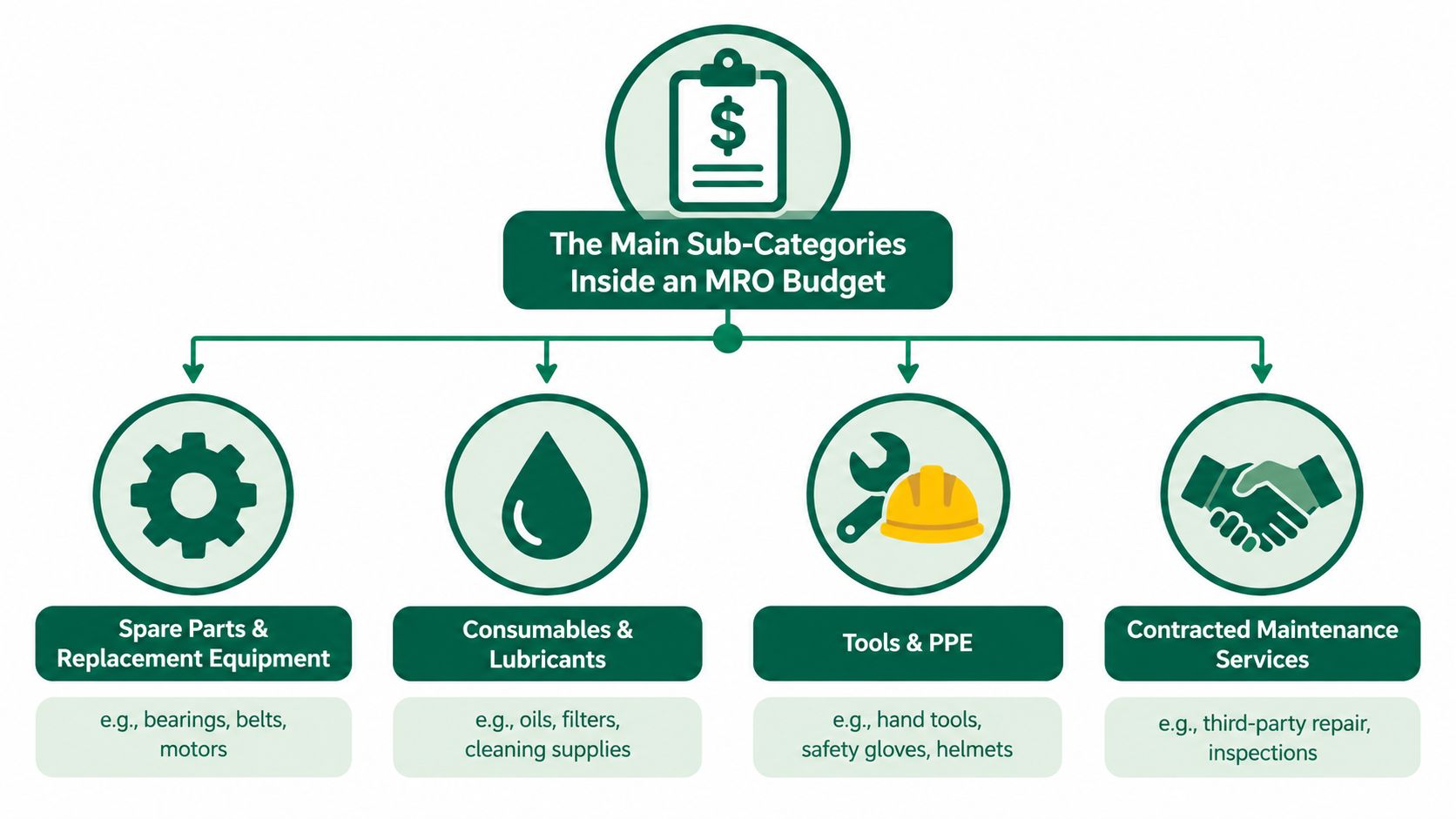
Before you try to negotiate anything, sort the spend into buckets that make operational sense. Most MRO budgets become easier to manage when you group them into four working categories.
Spare parts and replacement equipment
This bucket covers the items tied directly to asset repair and restoration. Think of a V-belt for an HVAC blower, a motor for a conveyor, a bearing, a seal kit, or a replacement sensor.
These are the parts most closely tied to downtime risk. They also create the biggest specification problems when descriptions are loose or legacy part numbers are copied without validation.
Consumables and lubricants
A lot of hidden repeat buying lives here. Hydraulic oil, grease, filters, absorbents, tapes, janitorial items, and cleaning chemicals all sit here.
These purchases often look routine, which is exactly why catalogs proliferate. One site buys one grease under one description. Another site buys an equivalent item under a distributor label. Nobody notices until inventory reports become impossible to read.
Practical rule: If the same material is consumed repeatedly across multiple assets, standardize the description before you negotiate the price.
Tools and PPE
This bucket includes calibrated torque wrenches, drill bits, hand tools, gloves, hard hats, eyewear, and other safety items. These purchases may be individually small, but they need tighter control than many teams expect because tool quality, calibration status, and safety compliance matter.
Poor control here creates audit exposure fast. If a site buys substitute PPE outside preferred channels, procurement may not know whether the item meets the required standard.
Contracted maintenance services
Not everything in MRO is a physical item. Vibration analysis, inspection work, specialist repair support, and scheduled service visits belong here.
This category often overlaps with the others. A lubrication program, for example, may combine grease, dispensing equipment, and a service technician performing the lube route. If you evaluate those spend lines separately, you can miss the fact that they support the same asset strategy.
A simple mapping prompt helps: pull your spend file and ask which line items are parts, which are consumed, which equip the worker, and which bring in outside labor. That first sort usually reveals where control is weakest.
Common Challenges Teams Run Into Managing MRO
A technician at Plant A needs a coupling by 2 p.m. The local vendor is out of stock. He drives to another industrial supply shop, buys a near-match, and submits the receipt against a generic maintenance cost center. Nobody links the purchase to a recurring failure pattern. Nobody checks whether Plant B already had the part on a shelf.
That story is ordinary. That's the problem.
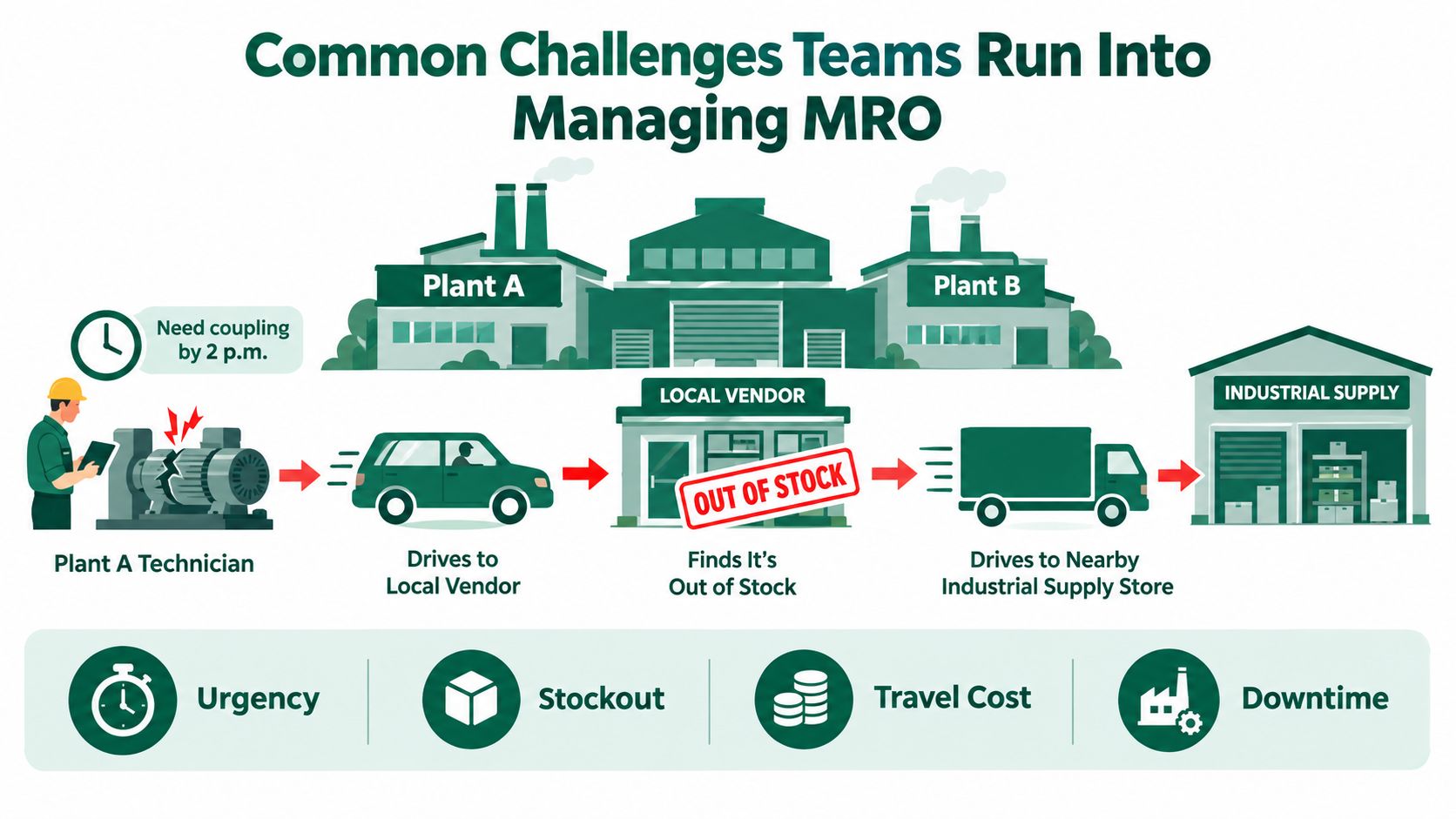
Four structural problems hide inside one urgent buy
The first problem is supplier sprawl. Every emergency buy creates another vendor record, another invoice format, and another point of failure.
The second is inconsistent specification. If the technician buys "something that fits," procurement may never know whether the substitute is equivalent, temporary, or risky.
The third is weak demand signals. Emergency buys bypass normal channels, so historical usage data becomes incomplete. That makes it harder to set stock levels or standardize parts later.
The fourth is audit exposure, especially on safety items and regulated maintenance work. If sites buy ad hoc, the organization may struggle to prove what standard was met, what was substituted, and who approved it.
This short video gives a useful operational view of why these issues keep repeating in plants:
Why the problem is getting sharper
Recent indirect procurement survey results show why MRO teams feel squeezed. In 2025, 62% of respondents cited inflation and higher costs as the biggest challenge, 60% reported reduced operational budgets, 40% said they were under pressure to cut inventory costs, and 39% identified maintaining ageing assets as a challenge (RS indirect procurement survey summary).
That changes the MRO conversation. You're not only buying parts cheaper. You're trying to extend the life of older equipment while carrying less stock and answering tougher budget questions.
What readers often miss
Aging assets create strange buying behavior. Old machines often depend on legacy parts, local know-how, and tolerated substitutions that were never formally approved. Buyers inherit that mess after years of workarounds.
When an asset gets older, the procurement job gets harder. Fewer clean specifications exist, acceptable substitutes matter more, and every rushed purchase teaches the organization the wrong lesson.
How to Segment MRO Items by Risk and Frequency
Not every MRO item deserves the same buying method. If you apply one policy to everything, you'll either overstock cheap items or under-protect the parts that can stop a plant.
A useful starting point is a simple matrix built on failure consequence and order frequency.
Three practical tiers
Call the first tier critical. These are items whose failure has serious operational consequences and where the wrong substitute can create major disruption. A matched bearing for a large compressor fits here. So does a unique drive component for a bottleneck asset.
Call the second tier essential. These items matter, but they are more repeatable and easier to replenish. A hydraulic hose used across many lines, standard filters, or common belts often land here.
Call the third tier general. These are lower-risk support items with broad availability, such as office-grade nitrile gloves, janitorial consumables, or standard hand tools used outside constrained assets.
Tier | Item Examples | Inventory Policy | Sourcing Tactic |
|---|---|---|---|
Critical | Matched bearings, unique seals, specialized sensors | Stock based on consequence of failure and replacement difficulty | Approved supplier list, strict specification control, substitution review |
Essential | Common hoses, filters, standard belts, routine lubricants | Min-max levels or managed replenishment | Framework pricing, catalog control, agreed equivalents |
General | Basic gloves, cleaning products, common tools | Catalog-only or buy-to-policy | Spot-buy catalogs, limited supplier panel |
How to assign the tier quickly
Use two questions.
What happens if this item fails or isn't available?
How often do we buy or consume it?
If the consequence is severe, treat it as critical even if demand is infrequent. If the item is used often across many assets, build a repeatable replenishment path even when the part itself isn't expensive.
For a broader procurement lens on how to structure categories before you source them, this piece on category management in procurement and spend segmentation is worth keeping nearby.
What changes once items are segmented
Segmentation should affect both inventory and sourcing.
Critical items need tighter approval rules, cleaner specs, and more supplier evidence. Essential items benefit from standardization and stable replenishment rules. General items should be easy to buy, but only through controlled channels.
If you're still asking "what is MRO procurement," the answer becomes practical. It's not just buying plant supplies. It's deciding which items need engineering-grade control and which need transaction efficiency.
When Supplier Consolidation Helps and When It Backfires
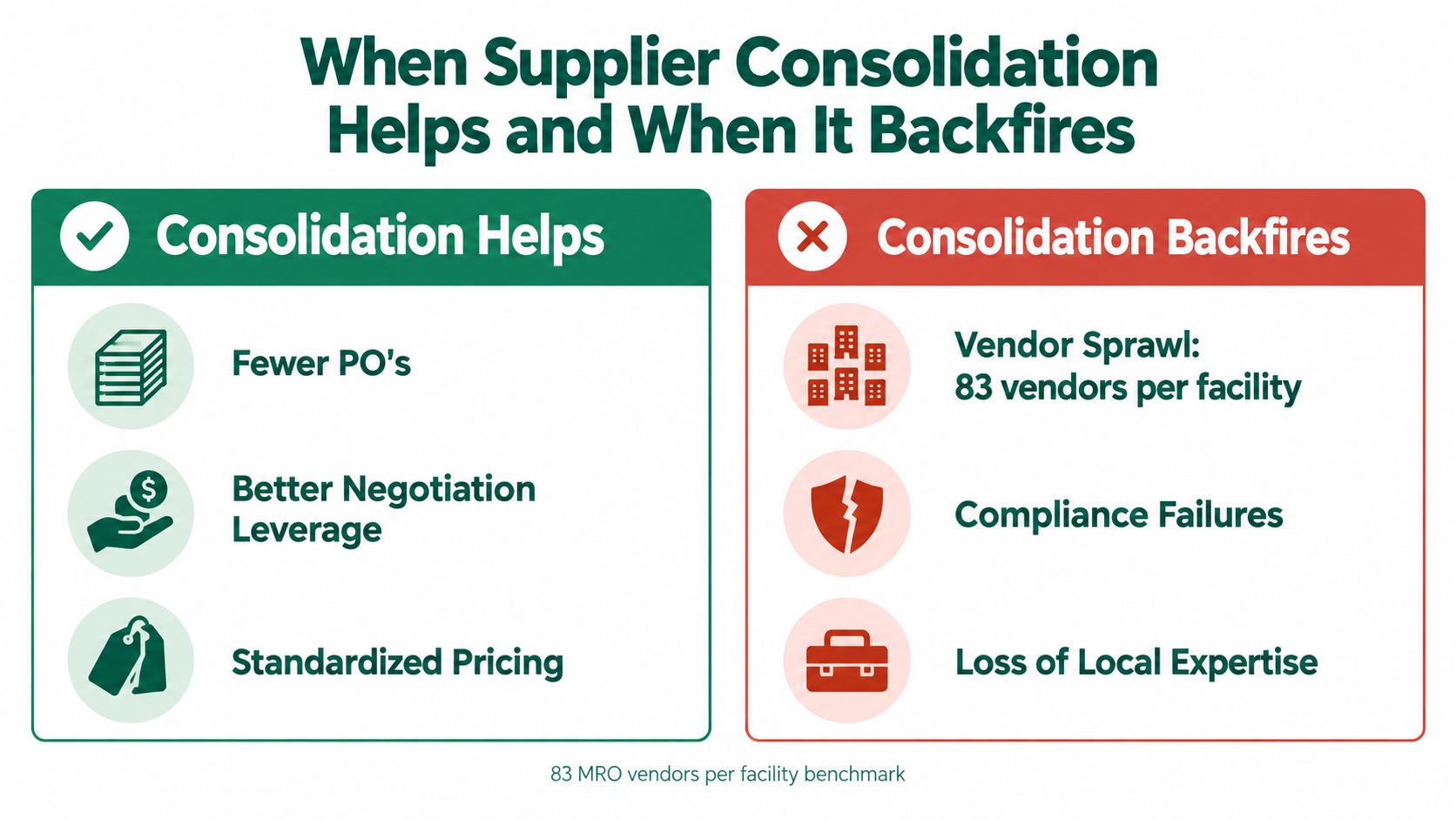
Supplier consolidation sounds like an obvious win in MRO. Fewer vendors should mean fewer POs, cleaner pricing, and better control. Sometimes that's true. Sometimes it creates a different problem.
Recent UK and Ireland survey data found that organizations used an average of 83 MRO suppliers in 2026, down from 92 the prior year, while average reported MRO spend fell 16% to £1.7 million. The same survey found 35% struggled with contract compliance with preferred suppliers, 33% found managing stakeholders across multiple sites difficult, and 50% reported supplier consolidation as a common efficiency measure (RS on MRO control, consolidation, and clarity).
When consolidation helps
Consolidation helps when the supplier can cover a broad share of routine demand with dependable service, clear item data, and site-friendly ordering. It also helps when plants are buying the same items under different descriptions and nobody can see aggregate demand.
The gain isn't just lower supplier count. The gain is cleaner control.
When it backfires
Consolidation backfires when procurement cuts suppliers by spreadsheet logic and ignores asset reality. One or two distributors may cover everyday consumables well, but they may not be the right answer for a specialized bearing, legacy controls part, or safety-critical PPE line.
A site may also resist a consolidated supplier if local service disappears. When an urgent need arises, people will go around the contract if they don't trust response time.
Count suppliers if you want. But don't confuse a smaller vendor list with a stronger MRO strategy.
Three tests before you remove a supplier
Use evidence, not preference.
Critical spares coverage: Can the supplier support the high-consequence items your assets depend on?
Safety and compliance proof: Can they provide the documentation needed for PPE, regulated components, or technical service work?
Swap cost: If they fail, how hard is it to move volume elsewhere without disruption?
If you're tightening supplier governance after award, a practical framework for supplier performance management and vendor scorecards can help structure reviews around service evidence instead of anecdotes.
Building an Evidence-Based MRO Sourcing Playbook
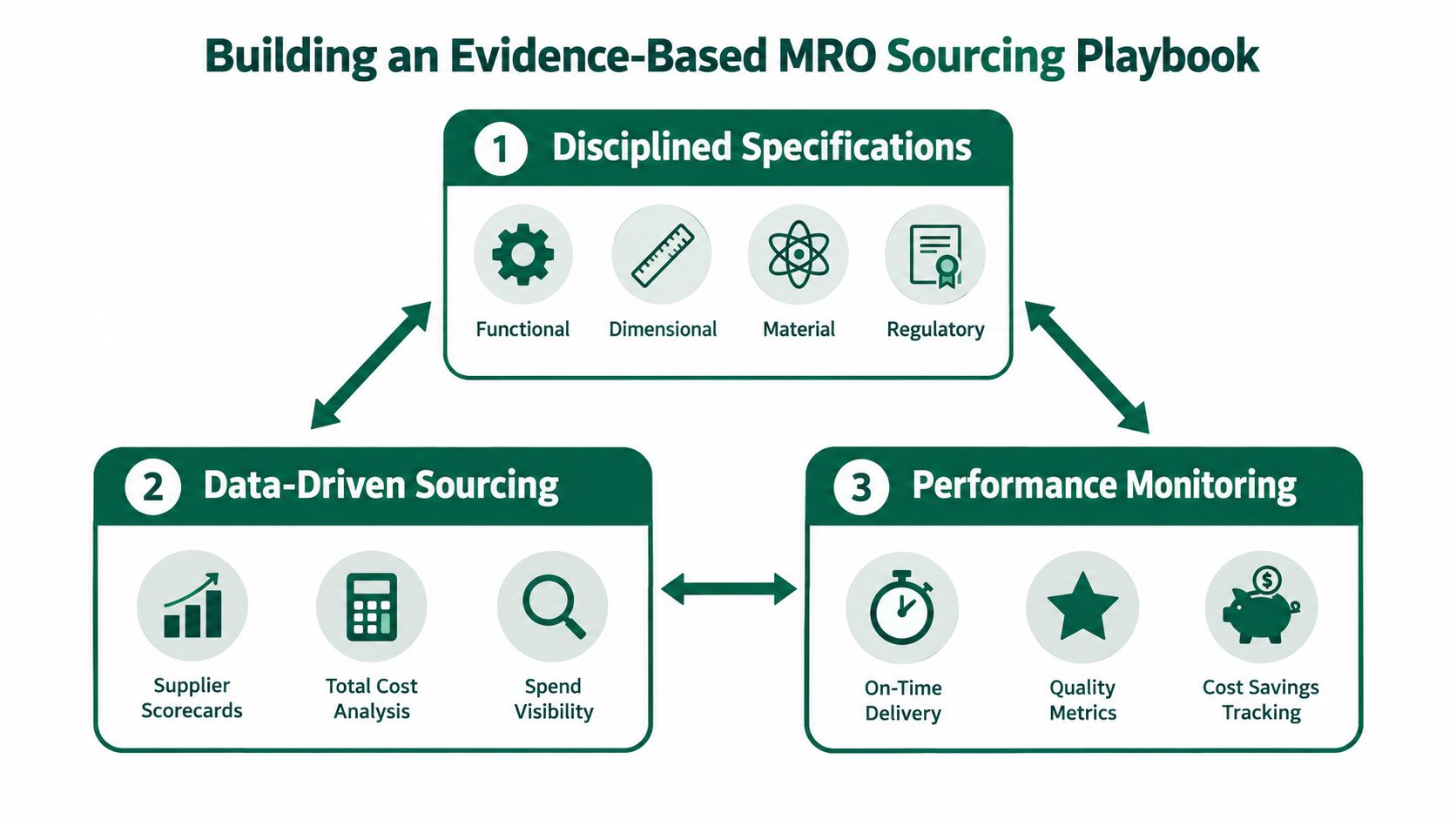
Most MRO programs stay reactive because they treat each request as a separate event. A better approach is to build a repeatable system around three things: specification discipline, supplier evidence, and drift detection.
Start with disciplined specifications
For MRO, a usable specification doesn't need to sound academic. It needs to tell the next buyer exactly what must be true.
For a replacement part, capture the functional requirement, the dimensions, the material, the asset or model fit, and any regulatory or safety constraints. For services, define scope, response expectation, documentation, and acceptance criteria.
This is the step many skip. Then they wonder why every quote looks different.
Score suppliers on evidence, not familiarity
A preferred supplier should be preferred for a reason you can document. On-time delivery history, technical certifications, service records, safety documents, audit history, and traceable quality information matter more than whether a plant has "always used them."
Some teams manage this in spreadsheets. Others use procurement suites or sourcing tools that compare requirement compliance against source documents. Procright, for example, supports specification drafting, supplier discovery, evidence-backed yes/no/partial requirement checks, and spec drift detection in a single sourcing workflow.
Watch for drift after the quote
Even a strong sourcing event can go off course if substitutions, revised terms, or item-description shortcuts creep back in. You need a simple review habit for pricing variance, substitution patterns, and changes to item descriptions after contracts are signed.
A workable playbook usually includes:
Locked descriptions: Standard naming for approved parts and consumables
Approved substitutions: Clear rules for when an alternate is acceptable
Quote-to-spec checks: A review step before award or release
Recurring performance review: Delivery, quality, and service issues logged by site
Field advice: If a supplier quote can't be matched cleanly to the requested spec, pause the buy. Fast mistakes create slow cleanup.
MRO becomes more than a back-office category. When buyers control specifications and demand evidence from suppliers, they help maintenance teams protect uptime and help the business stay audit-ready.
A First-Quarter Plan to Tighten MRO Control
A new category manager doesn't need a giant systems project to make MRO better. The first quarter should focus on visibility, a few disciplined controls, and one pilot that people at site level will use.
Days 1 to 30
Start by pulling the last year of MRO spend by plant, supplier, and item description. Don't chase perfection. You're looking for patterns.
Then sit down with maintenance leads, storeroom staff, and site buyers. Ask which parts stop production, which purchases bypass the process, and which suppliers people trust when things go wrong.
Look closely at maverick vendors by transaction count, not just by spend. In MRO, the small repeat leaks often tell you more than the large one-off buys.
Days 31 to 60
Segment the spend into critical, essential, and general tiers. Then choose a handful of high-risk items and write proper standardized specifications for them.
At this stage, a request for information is often more useful than jumping straight to a tender. You want to see who can meet the requirement cleanly, what documentation they provide, and where substitutions start to appear.
For teams dealing with fluid power or similar plant dependencies, practical guidance on managing hydraulic supply partnerships can be useful because it shows how technical reliability and vendor relationship management fit together.
Days 61 to 90
Pick one commodity family for a pilot. Bearings, gloves, lubricants, filters, or common hoses all work if usage is broad enough to reveal control issues.
Stand up a simple catalog or approved-item list for that family. Put framework terms in place. Then hold a monthly review with operations, maintenance, and procurement to check three things:
Downtime link: Did unavailable or incorrect items contribute to stoppages?
Stock discipline: Are sites ordering around the agreed process?
Compliance: Are preferred suppliers and approved specs being used?
By the end of the quarter, you'll usually see the next set of gaps clearly. Item descriptions may need cleanup. Stakeholder roles may be fuzzy. One plant may follow the process while another ignores it. That's normal. MRO control improves through repeated tightening, not one policy memo.
If you're trying to turn MRO from scattered plant buying into a controlled sourcing process, Procright can help you draft tighter specifications, compare suppliers against evidence, and keep an audit-ready record of why a supplier or product was selected. It's built for the kind of sourcing work where part fit, compliance, and quote-to-spec accuracy matter as much as price.
Try it on a real buy
Bring one category. Watch where the flags land.
We use a little analytics to see which pages actually help. Nothing else, no ad trackers.