Data-Driven Risk Mitigation in Procurement Decisions
Cut procurement disruptions with clean data, supplier scoring, AI alerts, workflow controls, and KPI-driven governance.

Procurement risk is easier to control when I treat it like a data problem, not a judgment call. The article’s core point is simple: I can cut disruption, compliance misses, supplier concentration, and off-contract buying by using clean data, clear scorecards, workflow checks, and fast alerts. That matters because nearly 70% of organizations faced a major procurement disruption in the last year, and long-run supply chain shocks can drain as much as 45% of one year’s profits.
If I boil the article down, it says I should do five things:
Define risk with numbers like delivery rate, defect rate, maverick spend, contract coverage, and source concentration
Fix the data first by cleaning supplier records, linking internal spend data with outside risk signals, and classifying spend by category, location, and business impact
Use analytics and AI to score suppliers, flag early stress signs, and check specs and compliance before approval
Put controls into the workflow at intake, screening, award, contracting, post-award review, and renewal
Assign owners and track KPIs so alerts go to the right team and issues get handled before they turn into cost or delay
A few numbers stand out. Poor data quality costs organizations about $12.9 million per year. Maverick spend can wipe out 10% to 20% of negotiated savings. And predictive monitoring can reduce emergency buying costs by 40% to 60% when teams act on alerts in time.
What I like about this piece is that it frames procurement risk in plain business terms: where money, supply, and compliance can break down - and how to set rules to catch those issues early.
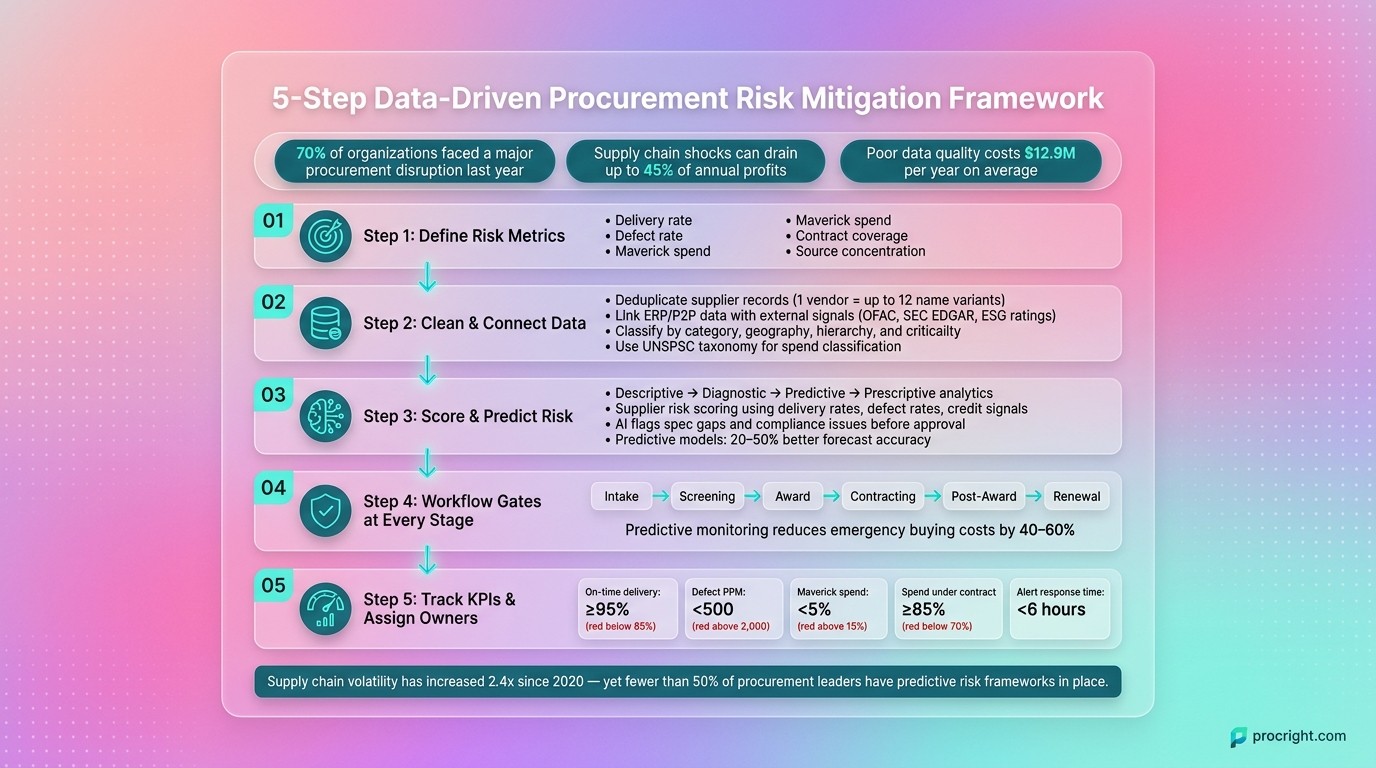
5-Step Data-Driven Procurement Risk Mitigation Framework
AI in Procurement & Supply Chain Risk Management | Analytics and Supplier Intelligence | Uplatz
Build the Data Foundation for Risk-Aware Procurement
Risk scoring only works when your procurement data is clean, connected, and complete. The same data that tracks day-to-day buying also powers the KRIs you monitor. If that data is messy, your risk signals will be messy too.
This isn't a small issue. Poor data quality costs organizations an average of $12.9 million per year. That makes data hygiene a core part of risk control, not just an admin task.
Collect Internal and External Data That Supports Risk Assessment
Start with 12–24 months of purchase history from your ERP or procure-to-pay system. Pull the basics first: supplier names, invoice amounts, GL codes, cost centers, and purchase dates. Then add contract records and audit logs. That gives you a much better view of how procurement works in practice, not just how it looks on paper.
Internal data tells you what happened inside your business. External data shows what your systems can't see.
Supplier financial statements from SEC EDGAR, credit bureau scores, commodity price indices, OFAC sanctions lists, and ESG ratings all add context to the risk picture. A supplier may look fine in your ERP, but outside signals can point to financial stress, sanctions exposure, price volatility, or reputational issues.
Data Source | Examples | Risk Types Supported | Key Fields |
|---|---|---|---|
Internal | ERP, P2P, AP records, contracts, audit logs | Operational, financial, compliance | Supplier ID, spend volume, payment terms, delivery dates, contract clauses |
External | SEC EDGAR, OFAC sanctions, Dun & Bradstreet, ESG ratings, commodity indices | Financial, regulatory, reputational | Credit scores, ownership structure, sanctions status, carbon footprint, news alerts |
Of course, gathering data is only half the job. If the records don't match up, the analysis falls apart.
Clean, Normalize, and Classify Procurement Data
Raw procurement data is almost never ready to use on day one. In messy systems, one vendor can show up under 6–12 different name variants. That's a problem because your risk scoring may spread exposure across duplicates and make the supplier look less risky than they are.
So start with deduplication and entity resolution. In plain English: make sure each supplier appears once, and only once, in your data.
Then standardize the rest:
Units of measure
Date formats
Currency fields
Timestamps
That step lets you compare spend across categories and regions without fixing records by hand every time.
After cleanup, classify each record across four dimensions:
Spend category using a taxonomy such as UNSPSC
Geography
Supplier hierarchy
Criticality to operations
This part matters because not all suppliers carry the same weight. A supplier tied to a mission-critical operation should rank as higher risk than one tied to a low-impact purchase. Keep one validated supplier record per legal entity, and verify it with tax ID and bank ownership before ERP activation.
Once that structure is in place, your spend data starts to say something useful.
Use Spend Analysis to Find Hidden Risk Concentration
Risk assessment should start before supplier selection, not after the contract is awarded. When your data is clean and classified, spend analysis turns that data into clear risk signals.
One of the main things to look for is concentration risk. If one supplier controls more than 60% of category spend, flag it. That's the kind of pattern that can leave you exposed fast if the supplier fails, delays, or runs into compliance trouble.
It also helps to use the 80/20 rule. In many cases, the top 20% of suppliers by spend account for 80% of total financial exposure. That's where deeper risk assessment should begin.
Spend analysis can also reveal maverick spend - purchases made outside approved contracts. Those transactions slip past standard risk and compliance checks, which makes them a direct warning sign. If maverick spend is showing up often, procurement controls are being bypassed.
Apply Analytics and AI to Predict and Reduce Risk
Once your data is clean, the next step is simple: use analytics and AI to turn visibility into action. Start with analytics to spot exposure. Then use AI to rank risk, flag issues, and route decisions to the right people.
Match Analytics Levels to Procurement Decisions
Different decisions call for different types of analytics. One level explains what already happened. Another helps you see why it happened. From there, you can estimate what may happen next and decide how to respond.
Analytics Level | What It Answers | Risk Mitigation Value |
|---|---|---|
Descriptive | What happened? | Identifies past leakage and baseline performance |
Diagnostic | Why did it happen? | Prevents recurrence of known failures |
Predictive | What's likely to happen? | Enables early warning signals and planning ahead |
Prescriptive | What should we do? | Supports automated decisions and resilience planning |
Machine learning models use historical and external signals to forecast supplier delays, shortages, and failures. Organizations using predictive models report 20% to 50% better forecast accuracy. Prescriptive analytics goes a step further. It can suggest which backup supplier to contact, whether to split an award, or how a proposed supplier performs under a demand stress test.
Once you know which analytics level fits the decision, turn that into supplier-level risk scores and alerts.
Build Supplier Risk Scores and Early Warning Signals
Using the cleaned spend and performance data from the prior section, combine internal data - like delivery rates, defect rates, and invoice disputes - with external signals such as credit ratings, sanctions list changes, and real-time news. Then score suppliers into tiers that shape oversight and response time.
A supplier that looks fine on paper can still show signs of strain in day-to-day activity. That’s why it helps to track payment-pattern shifts and the aging of open issues as early stress signals. AI-driven models can monitor these patterns all the time instead of waiting for an annual review.
Risk scoring helps cut supplier exposure. AI can also step in even earlier, before sourcing starts.
Use AI to Improve Specification Quality and Compliance Checks
A lot of procurement risk starts at the specification stage, long before a supplier is chosen. If specs are vague or incomplete, teams end up with mismatched products, compliance issues, and expensive rework. AI helps by reading complex requirements, spotting missing technical details, and checking candidate products against defined criteria before a purchase is approved.
Natural Language Processing can also scan unstructured documents - such as audit reports, supplier disclosures, and email threads - to surface recurring themes like "documentation gaps" or "process not followed".
This is one of the fastest places to cut avoidable risk. Procright automates specification creation, product discovery, and compliance scoring so teams can catch gaps before approval.
Use AI as decision support, not the final decision-maker. Keep human review in place for disqualification and other high-stakes actions.
Embed Risk Controls Across the Procurement Workflow
Analytics and AI can give teams more visibility. But visibility by itself doesn't cut risk. It only matters when it changes what people do at the points where decisions get made.
That means turning supplier risk scores and early-warning signals into actual workflow gates at intake, screening, award, contracting, and renewal.
Add Controls at Requirements, Supplier Screening, and Award Stages
Start by turning the risk scores from the previous section into clear decision rules.
At the requirements stage, flag vague or incomplete requirements before sourcing starts. If the request is fuzzy, the whole process can go off the rails. A weak spec often leads to bad supplier matches, missed compliance needs, and rework later.
Supplier screening should also move beyond one-time onboarding surveys. It needs to become continuous due diligence. That includes real-time sanctions screening, financial health checks, and ESG attestations. If a supplier fails a non-negotiable check, the process should stop right there.
Non-negotiable checks can include:
Financial stability
Required certifications
Product fit
Delivery capacity
Documentation completeness
Any hard "No" on one of those items should trigger an automatic stop.
At the award stage, use weighted scoring that puts more weight on the factors that matter most: compliance, product fit, security posture, delivery reliability, and total cost of ownership in U.S. dollars. Then move that same discipline into contracting with clause libraries, deviation review, and conditional approval for higher-risk suppliers.
Use Procright for Specification, Discovery, and Compliance Scoring
One of the biggest problems in procurement is the gap between what a team says it needs and what it ends up buying.
Procright helps close that gap by letting teams generate specifications, compare products against those specs, and surface source-backed compliance scores in one workflow. In plain terms, it gives the award decision an evidence trail.
That matters because each compliance call becomes traceable and defensible, not just a gut check or a spreadsheet guess.
Once the award is made, keep that same evidence standard in contracting and performance monitoring.
Monitor Contracts and Supplier Performance Continuously
Supplier problems usually show up before a formal failure. A missed delivery here. A quality issue there. An invoice that looks off. Those are often early signs of distress.
Track signals like SLA performance, delivery variance, quality exceptions, invoice anomalies, and certification expirations. Continuous monitoring should refresh the supplier risk score so it stays linked to the early-warning system built in the prior section.
When a supplier's risk score crosses a predefined threshold, the system should generate an alert and send it to the right person. The same should happen when an outside trigger fires, like a regulatory action or an ownership change.
For critical suppliers, refresh risk signals every 30 to 90 days instead of waiting for an annual review. Used this way, predictive insights can cut emergency procurement costs by 40% to 60%.
Stage | Key Controls | Risk Indicators to Watch |
|---|---|---|
Requirements / Intake | AI-driven spec creation, risk-based supplier segmentation | Missing requirements, vague language |
Screening | Sanctions checks, financial health checks, ESG attestations | Incomplete documentation, certification gaps |
Award | Weighted scoring, compliance review against each requirement, TCO analysis | Low compliance scores, missing evidence |
Contracting | Clause libraries, AI-powered deviation flagging, conditional approval workflows | Non-standard terms, missing liability or ESG commitments |
Post-Award | SLA tracking, delivery variance monitoring, risk re-scoring | Delivery shortfalls, quality exceptions, invoice anomalies |
Renewal | Risk re-scoring, performance review | Score deterioration, disputes |
These controls need clear ownership and regular KPI review to work as intended.
Governance, Metrics, and Conclusion
Set Ownership, Policies, and Model Oversight
Once controls are built into the workflow, governance is what keeps them in place. If no one owns the process, alerts get missed, data gets old, and AI models slowly drift away from what’s happening on the ground.
A practical setup splits responsibility across five groups. Procurement and category leads manage supplier relationships and run category-specific risk playbooks. Finance owns financial risk reviews, at-risk spend metrics, and budget oversight. Legal and compliance manages contract risk, ESG disclosures, sanctions screening, and regulatory alignment. IT and security handles cybersecurity due diligence, data privacy standards, and AI model oversight to spot drift, bias, and data-quality issues. Business stakeholders set use-case requirements and performance thresholds.
Roles alone aren’t enough. You also need a clear escalation path. Risk alerts should go straight to the right owner automatically. A credit downgrade should route to Finance, while an ESG violation should go to Legal. AI models should be reviewed every month, with faster updates when major geopolitical events or supplier changes shift risk conditions. It also helps to tie the framework to known standards like ISO 31000:2018 for Risk Management and ISO 28000:2022 for Supply Chain Security.
Track the KPIs That Show Whether Risk Controls Are Working
Governance means little if no one measures results against clear thresholds. A lot of teams track activity. That’s not the same as tracking whether exposure is going down.
A practical KPI set should cover both performance and risk. Here are the core metrics:
Supplier on-time delivery rate should stay at or above 95%, with a red threshold below 85%.
Defect parts per million should stay under 500, with a red threshold above 2,000.
Maverick spend should stay below 5% of total spend, with a red threshold above 15%.
Spend under contract should stay at or above 85%, with a red threshold below 70%.
For risk detection, the target is under six hours from a trigger event to a stakeholder alert.
Manual review tends to be slow and uneven. Automated monitoring is faster, more consistent, and easier to audit.
It makes sense to track a broad KRI set behind the scenes, but only report the top 8 to 12 each quarter. That keeps teams focused and helps avoid monitoring fatigue.
Conclusion: A Step-by-Step Model for Safer Procurement Decisions
Once ownership and KPIs are set, the last piece is keeping the system current.
The model in this guide comes down to five steps. Define risk in measurable terms, including financial exposure, compliance gaps, concentration, and supply volatility. Build clean, connected data by standardizing supplier records and linking internal spend data with external signals. Use analytics and AI where they help decisions, such as predictive risk scores and early-warning alerts, while keeping people involved for judgment calls. Put controls into each stage of the workflow, from intake through renewal. Then govern the process with clear KPIs and accountability, refresh AI models on a regular schedule, and send alerts to the right owners automatically.
Taken together, these steps create a closed loop: data feeds scoring, scoring drives alerts, alerts trigger escalation, and governance keeps each layer accountable. Supply chain volatility has increased 2.4x since 2020. More than 70% of procurement leaders report a rise in supplier risk, but fewer than 50% have built predictive risk frameworks into their operations. That gap between knowing and doing is where disruption tends to hit. Closing it doesn’t call for a total rebuild. It calls for the right data base, the right tools at the right decision points, and clear accountability at every stage.
FAQs
How do I start if my procurement data is messy?
You don't need perfect procurement data before you start. That's a nice idea in theory, but in practice, it usually slows everything down.
Start with spend areas where the data is good enough to guide decisions, flag risks, or kick off workflows. That gets the process moving while giving your team room to clean things up over time.
Procright can help by turning scattered specifications into one clearer document. Its AI can combine past specs or reverse-engineer requirements, which makes it easier to spot gaps and inconsistencies fast and improve data quality as you go.
Which procurement risk KPIs matter most first?
Prioritize KPIs that track supplier reliability, market acceptance, and technical compliance before you commit to a purchase.
That gives your team a clearer read on product fit, vendor dependability, and whether an option meets the specs you can’t afford to miss.
Procright supports this approach with supplier reliability scores, market acceptance rates, and product compliance scores. In plain terms, that helps teams cut product-selection risk, avoid budget gaps, and make decisions based on transparent, traceable data.
Where should AI be used in the procurement workflow?
AI belongs across the full procurement workflow. It shifts work from manual and reactive to data-led and forward-looking.
That means help with specification drafting, product discovery, and side-by-side comparison. It also means steady risk monitoring and supplier intelligence, backed by traceable evidence and real-time market data.
The result is simple: teams can move faster and make decisions with more confidence.