NLP in Procurement: Product Search Use Cases
NLP converts free-text requisitions into matched catalog items, speeds supplier discovery, and enforces spec compliance.

If your buyers search with plain language but your catalog stores part numbers, search will fail. In procurement, NLP helps turn messy requests into usable filters, match items across supplier catalogs, check specs against rules, and map terms across languages and standards.
Here’s the short version:
I see 4 main AI procurement use cases in this piece:
Free-text requisition matching
Semantic search across supplier catalogs
Spec-based, compliance-aware search
Cross-language and terminology normalization
I also see the main business outcomes:
30% higher match accuracy for technical requirements
40%–60% faster supplier discovery
Up to 80% less manual verification
Lower cycle times, fewer wrong-item buys, and less off-contract spend
And I see what rollout depends on:
In plain terms, this article says one thing: keyword search is not enough for procurement. Buyers search by need, condition, budget, standard, and risk. NLP helps convert that into product matches that teams can review, document, and approve.
Use case | What NLP does | Main result |
|---|---|---|
Free-text requests | Turns buyer wording into product attributes | Fewer clarification emails |
Supplier catalog search | Matches meaning, not just exact terms | More supplier options found |
Spec and compliance search | Reads specs and checks fit by requirement | Lower wrong-choice risk |
Global sourcing normalization | Maps terms, units, and standards | Fewer missed equivalents |
If I had to sum it up in one line: NLP helps procurement teams find the right product faster when requests, catalogs, and compliance data don’t use the same language.
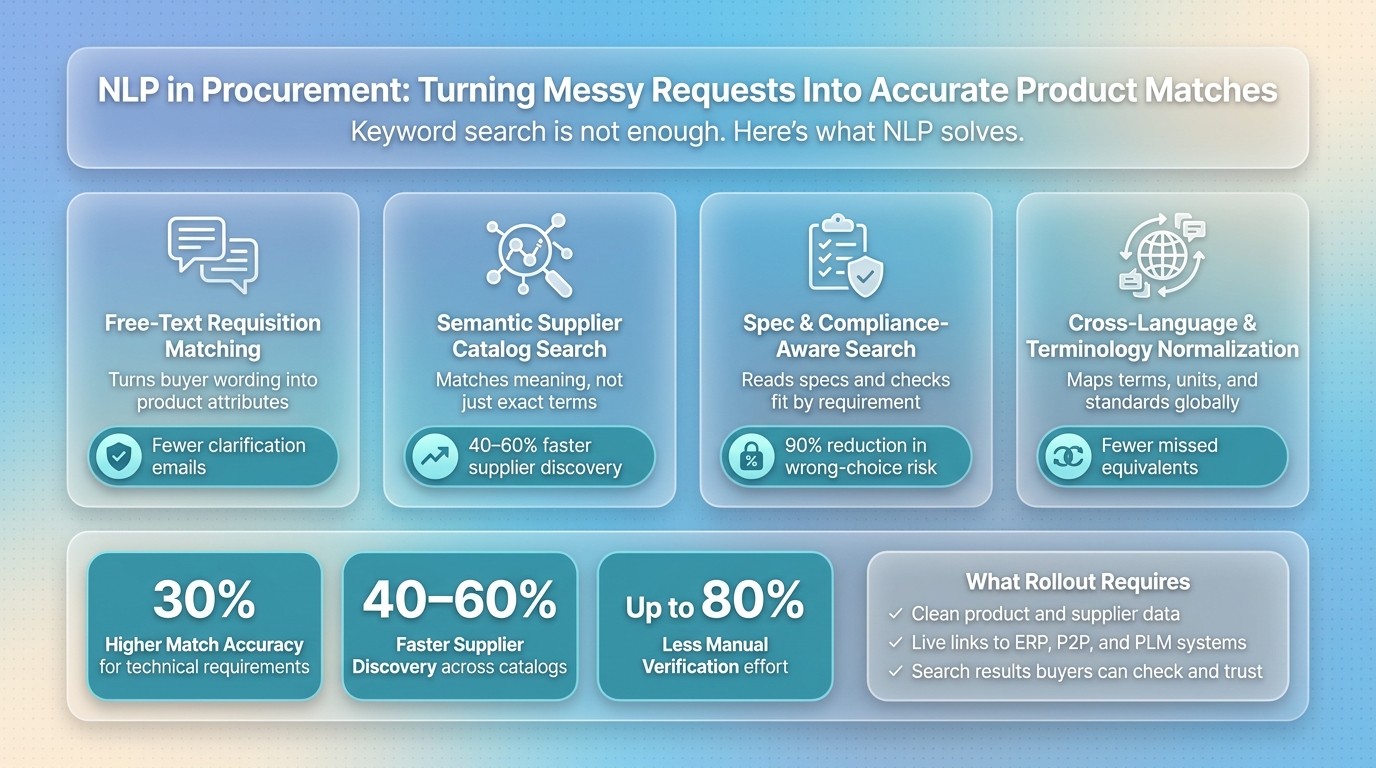
NLP in Procurement: 4 Use Cases, Key Metrics & Business Outcomes
AI and NLP Powered Part Sourcing: Made by EEs for EE’s
Where Product Search Breaks Down Without NLP
Without NLP, product search tends to fall apart in three places: request intake, catalog matching, and compliance checks. In plain terms, procurement teams end up relying on exact wording, manual review, and the same follow-up questions over and over. When a request is too vague to source, a buyer often has to pull in an engineer or supplier rep just to figure out what the person meant. What should've been a product discovery process turns into a slow back-and-forth.
Unstructured Requests and Inconsistent Catalog Data
The main issue is simple: people describe products one way, but systems store them another way.
A buyer may submit a plain-English request, while the catalog has that item listed only as a part number or an older model name. ERP search usually looks for exact matches, so it won't connect the two unless someone has already linked them by hand.
The catalog itself also adds friction. Multi-source product data aggregation is difficult because details are spread across hundreds of PDFs, and older files often use different headers, units, and naming patterns. That makes automated comparison hard to pull off. On top of that, a lot of useful know-how about substitutes and configurations lives only in people's heads. When experienced staff leave, that knowledge goes with them.
Business Impact of Poor Search Quality
Weak search quality leads to longer cycle times, more off-contract purchases, and a higher chance of choosing the wrong item. In industrial settings, that mistake can be serious. A wrong material standard can lead to equipment failure and real liability exposure.
When internal systems don't surface the right product, buyers go outside approved channels. That hurts compliance and pushes costs higher. Put another way, old-school search can find matching words, but not the answer behind the request. NLP product search is built to deal with those gaps in the use cases that follow.
4 Product Search Use Cases for NLP in Procurement
These use cases turn messy free-text requests into structured items, clean up broken catalog data with AI-driven data validation, and help teams stay inside technical rules. In practice, the same weak spots show up in three places: intake, catalog normalization, and compliance.
Free-Text Requisitions Matched to Structured Catalog Items
When a buyer types "stainless outdoor bolt, 1/2 in., saltwater exposure," a plain keyword search can miss the item completely or pull the wrong result. An NLP system reads that request more like a person would. It breaks the text into attributes such as material, size, use condition, and performance need, then maps those details to catalog items.
Here’s the key split: NLP figures out the intent, and rules check whether the match holds up. That cuts back on back-and-forth emails and helps teams move from intake to purchase much faster, with fewer mistakes.
Metric | Before NLP | After NLP |
|---|---|---|
Cycle Time | Days (manual emails, clarification) | Minutes (automated matching) |
Order Accuracy | Prone to part number errors | Lower error rates via context understanding |
Semantic Search Across Fragmented Supplier Catalogs
Most procurement teams deal with a pile of supplier catalogs, and each one tends to describe the same item in a different way. Units differ. Names differ. Terms differ. That’s where semantic search starts to pull its weight.
Instead of relying only on exact keywords, NLP normalizes text and handles synonyms so the system can build a shared vocabulary across scattered supplier data. In technical catalogs, teams often pair semantic search with keyword search to make sure exact model numbers or voltage ratings still show up when they matter.
The payoff is simple: buyers search once and find equivalent items across many suppliers, including contract-aligned options they might have missed. Early adopters report 40%–60% faster supplier discovery and 30% higher match accuracy for niche requirements.
Metric | Single-Supplier View | Cross-Supplier Semantic View |
|---|---|---|
Search Quality | Keyword-dependent; misses equivalents | Intent-based; handles synonyms and normalization |
Policy Adherence | Manual check against contracts | Automated surfacing of contract-aligned items |
Discovery Speed | Manual cross-referencing | 40%–60% faster discovery |
Spec-Driven and Compliance-Aware Search for Technical Products
If semantic search opens the door, spec-driven search narrows the field to products that actually fit. That matters most in technical procurement, where a missed material grade or the wrong voltage rating can lead to equipment failure or a compliance problem.
NLP helps by pulling dimensions, materials, performance needs, and standards straight from spec documents, then ranking products based on how closely they match. The output should make the result easy to check, with a pass/partial/fail view for each requirement.
Procright is a practical example of this in action: it analyzes specs against product data from web pages, PDFs, and videos, then scores each product with a clear Yes/Partially/No breakdown, reducing the guesswork that typically slows down technical sourcing.
That kind of setup shifts sourcing from document-by-document review to a much tighter screening process.
Metric | Manual Spec Review | NLP-Assisted Compliant Search |
|---|---|---|
Sourcing Speed | Days or weeks of document review | Minutes to seconds |
Error Risk | High (overlooked technical details) | 90% reduction in wrong-choice risk |
Audit Effort | High (manual document tracking) | 80% reduction in manual verification |
Cross-Language and Terminology Normalization in Global Sourcing
Global sourcing adds another layer of friction. The same product can show up in different languages, under different regional standards, or with industry-specific wording that doesn’t line up across catalogs. A part listed under IEC standards by a European supplier may appear under ANSI or ASTM equivalents from a U.S.-based supplier. Without normalization, buyers either miss solid options or burn hours cross-checking standards by hand.
NLP helps by mapping regional terms, measurement systems, and standards into one internal schema. So if a buyer searches for a component tied to a U.S. standard, the system can also surface equivalent items certified to international counterparts. That’s a big deal in regulated sectors like medical devices, aerospace, and defense, where standards equivalency has to be documented, not guessed.
Metric | Without Normalization | With NLP Normalization |
|---|---|---|
Standards Coverage | Limited to known regional terms | Cross-standard mapping (e.g., ANSI ↔ IEC) |
Missed Sourcing Options | High (terminology gaps block results) | Reduced via synonym and standards mapping |
Compliance Documentation | Manual cross-reference required | Automated equivalency mapping per requirement |
How to Roll Out NLP Product Search in Procurement
Once the use cases are clear, rollout comes down to three things: clean data, connected systems, and buyer trust.
Data, Systems, and Model Readiness
Before NLP search goes live, the data underneath it has to be in good shape. That starts with classifying incoming requests and documents, cleaning and normalizing supplier data into one shared product language. At ingestion, units, formats, and terms should be standardized so the system can treat "304 SS" and "stainless steel" as the same material, or match inches with millimeters as the same attribute.
The AI also needs live connections to ERP, P2P, and PLM data. If search runs on old snapshots, buyers end up working from outdated source records. That’s a problem in procurement, where specs, pricing, and supplier data can shift fast. The AI should sit on top of those systems as an interface layer, not become a second system of record.
Once the data layer is stable, the next job is shaping the workflow around how buyers actually search, review, and approve results.
Process Design and Stakeholder Adoption
Getting the tech in place is only half the job. The other half is getting procurement, IT, and operations on the same page before rollout starts. Teams need to agree on required product attributes, approval rules, and what a good search result looks like for each category.
A 4-week proof of concept helps make that concrete:
Week 1: ingest and classify documents
Week 2: benchmark search
Week 3: test buyer follow-up prompts
Week 4: validate the UI
At each step, the aim is simple: better search quality, more buyer trust, and faster approval.
For adoption to stick, buyers need rankings they can understand. If the system shows why one result appears above another, people are far more likely to use it instead of working around it.
Where Procright Fits in the Workflow

In day-to-day use, Procright sits in the discovery layer between intake and approval. It brings together AI-driven specification creation, product discovery across web, PDF, and video sources, and compliance scoring with Yes/No/Partial results for each requirement. It also includes direct links back to the source documents, so buyers can check where each result came from.
Conclusion: What to Measure and Expect from NLP in Product Search
The real test of NLP in procurement is simple: does it cut dead-end searches, shrink cycle times, and improve compliance?
That’s where NLP earns its keep. It makes product search faster, more accurate, and easier to audit. By reading user intent, pulling technical requirements from unstructured sources, and building compliance checks into each result, it turns procurement into a process teams can rely on again and again. In many cases, teams can see early gains in search quality within days and a working proof of concept within weeks.
Key Metrics for Tracking Results
Use KPIs that show what’s changing and where. The table below focuses on the metrics that matter most, grouped by what they measure.
Category | KPI | How to read it |
|---|---|---|
Efficiency | Search success rate | Fewer "no results" pages; higher first-click relevance |
Efficiency | Requisition Cycle Time | Total time from the initial free-text request to a purchase order |
Savings | Maverick Spend Reduction | More purchases routed through approved catalogs |
Savings | Total Cost of Procurement | Overall reduction in sourcing and processing costs |
Compliance | Compliance Rate | Percentage of results meeting technical, ESG, and regulatory standards |
Compliance | Manual Review Reduction | Decrease in human hours spent verifying certifications (up to 80%) |
User Experience | First-Result Relevance | How accurately the top result matches complex technical specifications |
User Experience | Self-Service Rate | Buyers finding technical parts without calling support or a sales rep |
One KPI to watch closely is zero-result rate - how often a search returns nothing. If that number is high, there’s usually a disconnect between the way buyers describe products and the way those items appear in the catalog. NLP should narrow that gap over time.
Platforms like Procright can also show Technical Match % and Yes/Partially/No scores. That gives buyers a quick way to judge result quality without digging through every line item.
FAQs
How does NLP improve product search in procurement?
Natural language processing (NLP) makes product search in procurement much better because it goes past rigid keyword matching and focuses on the intent behind the request.
That means buyers can search in plain English. Instead of typing exact part numbers, they can describe what they need through material requirements, application context, or budget limits.
Procright supports this with AI-powered discovery that analyzes specifications, compares products against your criteria, and ranks options using transparent compliance scores.
What data is needed to make NLP search work well?
Effective NLP search in procurement takes more than raw text. It needs structured, checked data.
That means using an AI layer to figure out what the user is actually asking for: intent, requirements, business goals, and technical specs. Then, an engineering-based engine turns that input into clear, bounded parameters.
It also needs data pulled from sources like web pages, PDFs, and videos. On top of that, there has to be a validation layer that checks compatibility, standards compliance, and current availability before any results appear.
How can teams measure ROI from NLP product search?
Teams can measure ROI from NLP-powered product search by looking at three things: time saved, risk cut, and fit with company goals.
That usually means tracking metrics like:
Less time spent on search, data scraping, and compliance checks
Fewer wrong-buy decisions
Better compliance scores
Procright backs this up with transparent data and analysis. That gives teams a clearer way to justify their choices and cut costly errors by up to 90%.