Procurement Compliance Checklist for Tech Teams
Tech teams must follow a staged procurement checklist to prevent breaches, enforce contracts, and manage vendor risk.
Procurement compliance is critical for tech teams to avoid costly risks like fines, data breaches, or operational disruptions. This guide breaks down actionable steps to ensure your tech purchases meet security, regulatory, and functional standards.
Key Takeaways:
Set Governance and Roles: Form a cross-functional review board (IT, Legal, Finance, Procurement, Privacy) with defined responsibilities.
Standardize Policies: Use templates for contracts, security questionnaires, and risk assessments to maintain consistency.
Vendor Due Diligence: Evaluate vendors for financial health, certifications (SOC 2, ISO 27001), and data protection practices.
Contract Compliance: Include enforceable terms like SLAs, liability caps, and breach notification clauses.
Ongoing Monitoring: Regularly review vendor performance, certifications, and compliance to avoid gaps.
Why it matters: Third-party compliance failures cost organizations over $4 million on average and pose increasing risks under regulations like GDPR and the EU AI Act. Following these steps can help tech teams mitigate risks and streamline procurement processes.
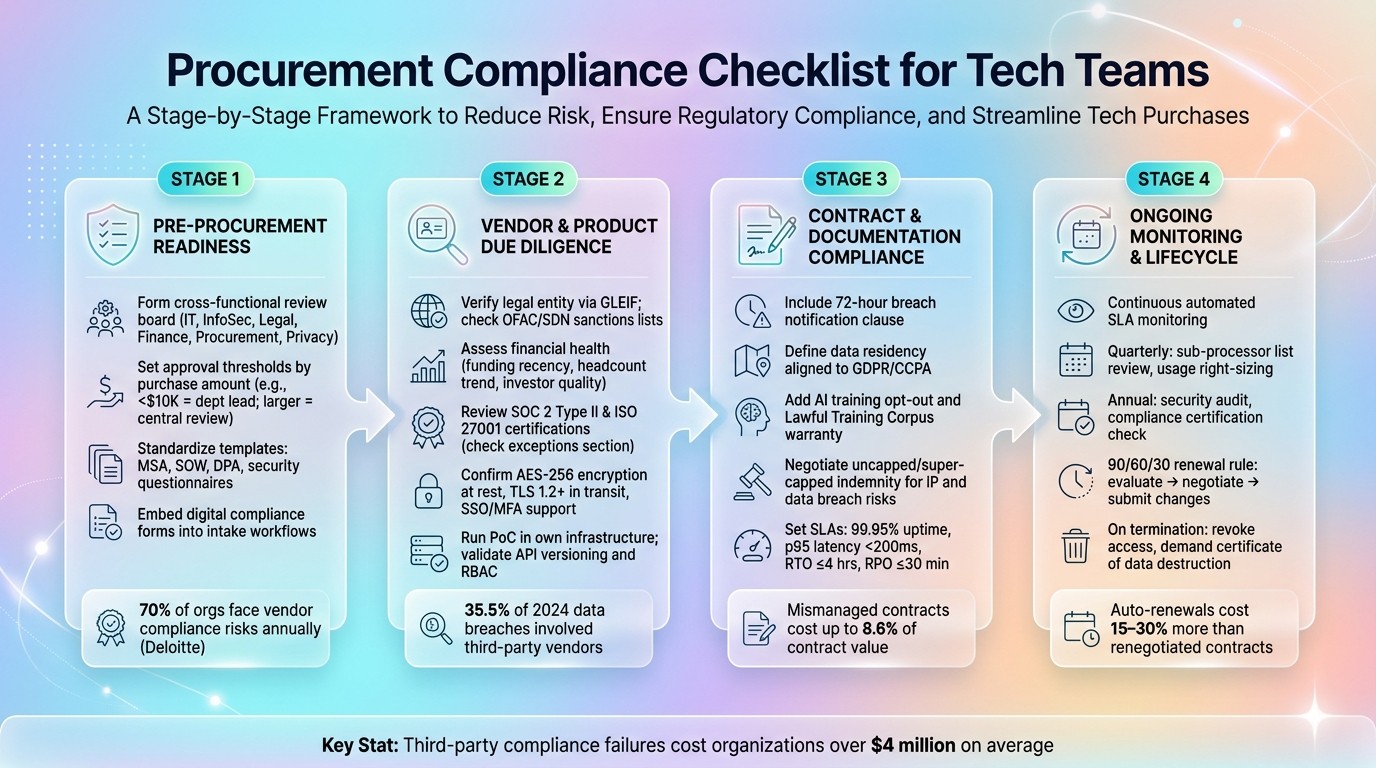
Procurement Compliance Checklist for Tech Teams: 4-Stage Framework
5 Hidden Gems to Boost Your Vendor Compliance Management
Pre-Procurement Readiness Checklist
Laying a solid foundation before diving into vendor evaluations or issuing proposals is crucial. Skipping this step often leads to compliance issues. In fact, Deloitte reports that nearly 70% of organizations encounter vendor-related compliance risks annually, typically because teams outside procurement fail to adhere to established policies.
Set Up Governance and Roles
Clear accountability is the backbone of compliance. Start by creating a cross-functional vendor review board. This board should include representatives from IT, InfoSec, Legal, Finance, Procurement, and Privacy. Each team offers a unique perspective, ensuring no single department shoulders the burden of high-stakes purchasing decisions alone.
Assign specific compliance tasks to each role:
Role | Responsibility | Key Compliance Artifacts |
|---|---|---|
IT / InfoSec | Technical & security vetting | SOC 2, ISO 27001, penetration tests |
Legal | Contractual & regulatory review | MSA, DPA, NDA, anti-corruption policies |
Finance | Budget & tax compliance | W-9/W-8, purchase orders, invoices |
Procurement | Vendor management | Business licenses, diversity certs, COIs |
Privacy | Data protection | Data flow diagrams, subprocessor lists |
Establish approval thresholds based on purchase amounts. For example, purchases under $10,000 might require department lead approval, while larger transactions trigger a centralized procurement review. Additionally, implement regular sanctions screenings - such as quarterly checks against OFAC SDN lists - to reduce legal risks.
Once roles are clearly defined, the next step is to standardize policies, ensuring consistency across the board.
Standardize Policies and Templates
With roles assigned, it's time to ensure everyone follows the same guidelines. Develop clear procurement policies that address vendor selection criteria, cloud adoption, data handling, and AI tool usage. For instance, with the EU AI Act set to become enforceable for high-risk systems by August 2, 2026, it's critical for tech teams to have clear policies for managing AI vendors.
Create a template library that includes essential documents like Master Service Agreements (MSA), Statements of Work (SOW), Data Processing Agreements (DPA), security questionnaires, and risk assessment forms. Using standardized templates helps reduce redundant work, speeds up the procurement process, and ensures compliance with regulations like GDPR and CCPA. According to Gartner, nearly 30% of SaaS budgets are wasted annually on unused or duplicate software.
After standardizing policies and templates, the next step is to integrate compliance into day-to-day workflows.
Embed Compliance Into Workflows
Ensure compliance is built into every stage of the process. Replace manual email-based submissions with digital forms that capture essential compliance details upfront. These forms should require key fields - such as data types, geographic regions, spending amounts, and risk classifications - before any purchase moves forward.
Tools like Procright can simplify this process by automatically enriching requisition data with compliance attributes in real time, identifying gaps before they escalate into problems. Organizations using automated compliance tracking report spending 60% less on audit preparation compared to those relying on manual methods. For AI-related procurements, the intake process should also trigger an EU AI Act risk classification (e.g., high-risk, limited-risk, or minimal-risk) to ensure appropriate scrutiny is applied from the start.
Vendor and Product Due Diligence Checklist
After establishing strong internal controls, the next crucial step in compliance is evaluating vendors thoroughly. This is where many tech teams tend to cut corners, often leading to costly consequences. In fact, third-party compliance issues are a significant risk, with 35.5% of all data breaches in 2024 stemming from third-party compromises. Proper due diligence isn't just a formality - it's a vital part of managing risk.
Check Vendor Background and Stability
Before diving into features, confirm the vendor's legitimacy and financial health. Here are a few essential steps:
Use GLEIF (Legal Entity Identifier) databases to verify the legal entity.
Check domain age through WHOIS records.
Cross-check the company and its key officers against sanctions lists like OFAC SDN, EU, UK, and UN.
Be cautious of vendors with newly registered domains or unclear corporate structures - these are warning signs that warrant deeper investigation.
For startups, financial stability can be a concern. If the last funding round was over 18 months ago and no new funding is on the horizon, ask about their cash runway. Statistics show that 67% of venture-backed SaaS startups fail or stall before reaching Series C. As Priyanshu Anand from TechnologyMatch aptly noted:
"A vendor bankruptcy forces a migration you never planned for." - Priyanshu Anand, TechnologyMatch
To help classify financial risk, use the table below during your review:
Indicator | Green (Low Risk) | Yellow (Medium Risk) | Red (High Risk) |
|---|---|---|---|
Last Funding | < 18 months ago | 18–30 months ago | > 30 months ago |
Headcount Trend | Growing | Flat | Declining |
Investor Quality | Tier-2 VC | Angel only / Unknown | |
Customer Concentration | No client > 10% ARR | One client 15–25% ARR | One client > 40% ARR |
Supplement vendor references by reaching out to peers independently through LinkedIn or user communities. Vendor-provided references often skew positive, with about 80% of these references reflecting favorable sentiment regardless of actual product performance.
Once you've confirmed the vendor's legitimacy and financial stability, the next step is to assess their security and data protection measures.
Assess Security, Privacy, and Data Protection
Certifications are a good starting point, but they require careful scrutiny. For example, when reviewing a SOC 2 report, focus on the auditor's exceptions section instead of just the cover page. A SOC 2 Type II report, which covers a period of 6–12 months, is far more reliable than a Type I, which only provides a point-in-time snapshot. For ISO 27001 certifications, ask for the Statement of Applicability (SoA) to see which controls are implemented and which are excluded.
Align these reviews with your internal compliance processes to ensure findings are documented and actionable. Also, verify technical controls directly:
Encryption should meet AES-256 at rest and TLS 1.2+ in transit standards.
Identity and access management should support SSO (SAML 2.0 or OIDC), SCIM provisioning, and MFA enforcement.
Request independent penetration test reports from the past 12 months, not just vendor-prepared summaries.
For privacy, sign a Data Processing Agreement (DPA) before sharing any data. Review the vendor's subprocessor list to ensure their data storage locations comply with GDPR or CCPA requirements. If you're dealing with AI vendors, confirm whether customer data is being used to train their models. Be wary of "service improvement" clauses that might allow this by default and redline them if necessary.
Confirm Technical Fit and Interoperability
A product that performs well in a demo environment can still create operational headaches in production. To avoid this, conduct a Proof of Concept (PoC) within your own infrastructure rather than relying on a vendor-managed sandbox. Simulate failure scenarios to evaluate error handling and confirm the system meets your Recovery Time Objectives (RTO) and Recovery Point Objectives (RPO).
When reviewing APIs and integrations, pay attention to:
Versioning policies and deprecation timelines.
Rate limits and backward compatibility guarantees.
Compatibility with your identity stack, including SSO protocols, SCIM for user management, and granular Role-Based Access Control (RBAC).
Audit log export capabilities in formats compatible with your SIEM system.
These technical checks are essential for ensuring the tool can be deployed securely and at scale. Incorporate these verifications into your compliance processes to streamline procurement while minimizing risks.
Contract and Documentation Compliance Checklist
Once technical compatibility and security are confirmed, the contract becomes the foundation for compliance and provides a clear, auditable record of commitments. Mismanaging contracts can lead to losses of up to 8.6% of contract value, making attention to detail critical. Below are actionable steps to strengthen vendor agreements with precise clauses, requirements, and performance metrics.
Add Security and Compliance Clauses
Vague security language won't cut it - your contract needs enforceable terms. Include key elements like written audit rights, a 72-hour breach notification window, and specific data residency commitments aligned with GDPR or CCPA requirements.
For AI vendors, insist on a "Lawful Training Corpus" warranty and an opt-out clause to prevent your data and prompts from being used for training. Be cautious of "service improvement" clauses in standard contracts, as they might allow vendors to train on customer data by default. Arjun Pillai, CEO of Docket, emphasizes the importance of digging deeper:
"Teams check the SOC 2 box and think they're done. They never ask the hard follow-up questions about the architecture of the AI."
Negotiate uncapped or super-capped indemnity for issues like third-party IP infringement and data breaches. Typical SaaS liability caps - usually 12 months of fees - are often inadequate for the risks tied to AI. Use AI-powered tools to ensure these clauses are properly included and aligned with your requirements.
Define Functional and Nonfunctional Requirements
Contracts should clearly spell out requirements to ensure accountability beyond flashy demos. Each requirement should be classified as either Mandatory (M) - a dealbreaker if unmet - or Desirable (D), which influences scoring but not eligibility.
Don't accept verbal assurances; vendors should provide solid proof, such as datasheets or live demonstrations, to confirm they meet your needs. For AI platforms, document critical details like model versioning policies, data provenance, and "freeze" capabilities to prevent unplanned updates from disrupting operations. Tools like Procright can help identify incomplete or inconsistent responses before they make it into the final contract.
Set Service Levels and Performance Metrics
After verifying technical and security aspects, service-level agreements (SLAs) ensure vendors maintain performance over time. Define uptime goals specifically for the API endpoint, as performance can differ from the web interface. Include latency benchmarks (p50, p95, p99) and establish clear Recovery Time Objectives (RTO) and Recovery Point Objectives (RPO) for critical services.
"SLAs without monitoring are meaningless - you need documented evidence of performance to enforce remedies, justify renewals or terminations, and hold vendors accountable." - Vik Chadha, Founder & CEO, AppDeck
Active SLA monitoring is key to enforcing remedies and ensuring accountability. Below is a table highlighting essential SLA categories to include in technology procurement contracts:
SLA Category | Example Metric | Why It Matters |
|---|---|---|
Uptime | 99.95% availability on API endpoint | Ensures business continuity |
Performance | p95 latency < 200ms | Guarantees acceptable user experience |
Incident Response | 72-hour breach notification | Limits exposure from security events |
Disaster Recovery | RTO ≤ 4 hours, RPO ≤ 30 minutes | Defines acceptable downtime limits |
To make these metrics actionable, tie service credits or financial penalties directly to SLA breaches. Automate monitoring by linking contract data with operational systems to track performance in real time, allowing you to address issues before they escalate.
Ongoing Monitoring and Lifecycle Compliance
A signed contract isn’t the finish line - it’s just the beginning of managing compliance. Nate Montgomery, Solutions Engineer at SmartSuite, explains:
"Vendor compliance is a discipline, not a checkbox: it's the ongoing work of confirming that the third parties you rely on meet your regulatory, security, contractual, and operational obligations across the full relationship."
For tech companies juggling an average of 130 SaaS tools, each with unique renewal schedules and compliance needs, staying on top of vendor management requires a clear, repeatable process. Once initial compliance is confirmed, the focus shifts to maintaining adherence through onboarding and regular reviews.
Set Up Onboarding and Implementation Controls
Before rolling out a vendor’s solution, ensure their promised technical controls are fully operational. For example, verify that SSO with SCIM, AES-256 encryption, and data retention policies match contract terms. Also, configure logs and access controls to support future audits.
When working with AI vendors, pay extra attention to model versioning policies. Confirm any "freeze" features are enabled to prevent unplanned updates that could disrupt compliance workflows. Silent updates to AI models can create unexpected compliance risks, so pinning production environments to specific model versions is a smart precaution.
Run Periodic Compliance Reviews
Don’t rely solely on vendor self-assessments. Independent reviews are crucial, especially since more than 35% of data breaches involve third-party vendors. Compounding this issue, 95% of companies only understand the risks tied to their tier-one vendors, leaving deeper supply chain vulnerabilities unchecked.
Set a consistent schedule for reviews and prioritize vendors based on their access to sensitive data and their importance to your business. High-risk vendors may need detailed annual security audits, while lower-risk suppliers might only require basic checks. The table below offers a practical framework for scheduling reviews:
Activity | Frequency | Primary Owner |
|---|---|---|
SLA Monitoring | Continuous (Automated) | IT / Operations |
Sub-processor List Review | Quarterly | DPO / Security |
Usage Review (Right-sizing) | Quarterly | IT / Engineering |
Security Review | Annually (or on incident) | Security / DPO |
Compliance Certification Check | Annually | DPO / Compliance |
Contract Review | 90 days before renewal | Legal / Procurement |
When reviewing certifications, don’t just confirm their existence. Request SOC 2 Type II reports, check that they’re no more than 12 months old, and carefully review them for any exceptions or deficiencies. Regularly update sub-processor lists as part of this process.
Consistent monitoring strengthens your compliance efforts and helps reduce risks, ensuring that your vendor management process remains thorough from start to finish.
Plan for Renewal or Termination
While monitoring vendors, plan ahead for contract renewals or terminations. Auto-renewals can cost 15–30% more than renegotiated contracts, so proactive planning is key. Follow the 90/60/30 rule: evaluate usage 90 days before renewal, finalize negotiations by 60 days, and submit changes or cancellations 30 days before the deadline.
If terminating a vendor, demand a certificate of destruction to confirm all data has been deleted. Revoke user accounts, disable API keys, disconnect integrations, and verify that any data retention obligations outlined in your Data Processing Agreement (DPA) are being met. Skipping these steps could leave behind lingering data and potential regulatory liabilities long after the relationship ends.
Procurement Compliance Checklist Summary for Tech Teams
Managing procurement compliance effectively requires a well-organized, stage-specific approach. By structuring tasks around vendors, contracts, and renewal dates - and assigning clear ownership - you can ensure consistency and accountability across the entire process.
Group the Checklist by Procurement Stage
Compliance issues often arise not because of negligence but due to unclear responsibilities. When IT, Legal, Finance, and Procurement teams share tasks without defined handoffs, important steps can be missed. Structuring your checklist by procurement stage helps eliminate these gaps.
Here’s a breakdown of key compliance steps at each stage and their respective owners:
Procurement Stage | Key Compliance Steps | Primary Owner |
|---|---|---|
Intake | Risk tiering, sanctions screening, business justification | Procurement / IT |
Due Diligence | SOC 2 review, COI verification, financial health checks | Compliance / Risk |
Contracting | DPA execution, SLA definition, liability caps | Legal / Procurement |
Monitoring | Performance reviews, certificate renewals, audit rights | IT / Operations |
Not every vendor requires the same level of scrutiny. For instance, a Tier 1 vendor - critical to operations - might need to pass through over 30 compliance checks, taking 12–20 business days for onboarding. In contrast, a Tier 3 supplier may only need basic documentation and can be onboarded in 1–3 days. This structured approach ensures a thorough compliance lifecycle, tailored to the vendor's importance.
Use Procright for AI-Powered Compliance
Streamlining compliance can be challenging, especially when done manually. Manual compliance tracking is not only prone to errors but also comes with a hefty price tag. On average, onboarding a vendor manually costs over $35,000 per supplier, whereas automated solutions can reduce this to under $2,500. Procright’s AI-powered platform makes compliance management more efficient by automating tasks like document validation and generating compliance scores. It also tracks renewal dates for critical items like insurance, certifications, and licenses.
With automated alerts, Procright eliminates the need for manual reminders, ensuring that deadlines are met and compliance remains intact. Its scoring system offers clear, data-driven insights into vendor risk, helping procurement teams stay informed at every stage of the vendor relationship.
Keep Versioned, Auditable Records
A strong compliance process also depends on maintaining centralized, versioned records. These time-stamped logs make it easy to retrieve audit trails when needed. By reducing audit preparation time by up to 60%, such records provide a significant advantage in avoiding regulatory penalties - which have risen by 45% over the past three years. A clear audit trail can mean the difference between a smooth review and costly enforcement actions.
FAQs
How do we decide a vendor’s risk tier?
Vendors are assigned a risk tier through a detailed due diligence process. This involves assessing several key factors, including their security posture, financial stability, legal compliance, technical infrastructure, and alignment with regulatory requirements. To streamline this evaluation, companies often rely on structured frameworks and checklists to classify vendors based on these specific risk areas.
What should we ask for beyond a SOC 2 report?
When evaluating vendors, don't stop at requesting a SOC 2 report. Ask for clear details on data handling practices, model provenance, and governance clauses. It's also important to check for audit rights and confirm their adherence to relevant industry regulations.
For workloads involving high-risk AI or government-related tasks, look for certifications such as FedRAMP or proof of GDPR compliance. These measures help ensure that vendors align with the regulatory and operational standards essential for your procurement requirements.
What should we do 90 days before renewal?
Around three months before a vendor contract renewal, it’s time to get organized and ensure everything is in order. Here’s how you can stay ahead:
Review Certifications, Licenses, and Insurance: Check that all vendor certifications, licenses, and insurance policies are up-to-date. If anything is close to expiring, start the renewal process immediately.
Ensure Compliance: Use automated tools to monitor and track expiring requirements. This helps you stay aligned with regulations and internal policies without missing anything critical.
Conduct Internal Reviews: Take a closer look at your procurement documentation and vendor records. Confirm that all the information is accurate and current so you’re fully prepared for renewal discussions.
By tackling these tasks early, you can avoid compliance issues and set the stage for a smooth and efficient renewal process.