Real-Time Spend Analysis with AI Integration
AI-powered real-time spend analysis unifies data, boosts classification accuracy to 95-99%, and alerts on overspend and compliance gaps.
Procurement teams need faster, more accurate insights to control costs and avoid risks. Traditional spend reports are often outdated by weeks or months, making it hard to act quickly. Real-time spend analysis powered by AI solves this problem by providing continuous, up-to-date data.
Key Benefits of AI in Spend Analysis:
Instant Data Access: Continuous updates replace delayed reports, offering real-time insights into supplier costs, department budgets, and spending patterns.
Improved Accuracy: AI achieves up to 95–99% classification accuracy, compared to 60–75% with manual methods, reducing errors in spend data.
Automated Processes: Tasks like data cleaning, normalization, and classification (supported by AI data validation tools) are handled by AI, freeing analysts to focus on decision-making.
Actionable Alerts: AI-powered dashboards flag budget overruns, unusual transactions, and maverick spending in real time.
Common Challenges Addressed:
Data Silos: AI integrates fragmented systems (ERP, AP, etc.) into unified pipelines.
Poor Data Quality: AI cleans and standardizes messy data, ensuring consistency.
Delayed Reporting: Continuous monitoring eliminates the lag caused by manual processes.
Platforms like Procright go further by analyzing purchase specifications, identifying compliance gaps, and providing transparency through compliance scores. This ensures data-driven procurement decisions while reducing risks and costs.
Takeaway: AI-driven spend analysis transforms procurement by enabling faster, more reliable decisions. Start by auditing your data systems to uncover inefficiencies and explore tools like Procright to enhance your workflows.
🔵 Beyond Human Speed: AI Agents Transforming Real-Time Data Analysis
Common Barriers to Real-Time Spend Visibility

AI vs. Manual Spend Analysis: Key Performance Metrics
Achieving real-time spend visibility isn't easy. The barriers are deeply rooted in the systems and processes that many organizations rely on, and these challenges often feed into one another, making the problem even harder to solve.
Disconnected Systems and Data Silos
In the U.S., most organizations juggle a mix of systems - ERPs, accounts payable platforms, sourcing tools, and even spreadsheets. Each of these tools holds a piece of the puzzle, but they rarely work together seamlessly. A recent survey by Opstream found that 75% of organizations lack a unified semantic data model across their ERP, AP, sourcing, and finance systems. This lack of integration forces teams to rely on manual workarounds, a reality faced by 80% of procurement leaders in a Q4 2025 Opstream survey.
"AI without good data is just expensive automation." - Mor Cohen-Tal, CTO & Co-Founder, Opstream
The result? Data silos and inconsistencies that require constant manual intervention, creating inefficiencies and adding to the complexity of spend management.
Manual Work and Poor Data Quality
Even when systems share data, it's often messy. Supplier names, for instance, might appear differently across platforms - "Acme Corp" in one and "Acme Holdings LLC" in another - leading to duplicate records and skewed spend reports. Without a standardized approach to vendor data, these inconsistencies become routine.
This is a widespread issue: 58% of Chief Procurement Officers cite poor data quality as a major challenge that slows down decision-making and undermines trust in the numbers. Analysts end up spending more time verifying and cleaning data than analyzing it, which delays actionable insights and frustrates teams trying to stay on top of spending.
Delayed and Reactive Reporting
Fragmented systems and manual data cleanup create a bottleneck for reporting. Pulling data from various sources, matching invoices with purchase orders, and categorizing transactions can take days - or even weeks. By the time the report is ready, the data might already be outdated by as much as three months. This lag makes it nearly impossible to respond quickly to changes.
Delayed reporting isn't just inconvenient - it can have serious consequences. According to 67% of CPOs, it’s a major execution gap. For example, if a supplier raises prices mid-quarter or a department exceeds its budget, a monthly report won’t catch it in time to prevent overspending. These delays highlight the importance of addressing the structural issues that stand in the way of real-time spend analytics.
How AI Integration Addresses These Procurement Problems
The challenges of siloed systems, messy data, and slow reporting don’t have to be permanent roadblocks. AI integration directly tackles these issues by replacing manual processes with automated, continuous workflows that ensure procurement data stays accurate and up-to-date. Here's a closer look at how AI-driven automation improves data collection, classification, and real-time monitoring.
Automated Data Collection and Normalization
AI eliminates the need for waiting on monthly data updates by creating real-time data pipelines. These pipelines pull transaction data continuously from systems like SAP, Oracle, NetSuite, and other procure-to-pay platforms. But AI doesn’t stop at just pulling the data - it also cleans and normalizes it instantly. Using natural language processing (NLP), it can identify that "Acme Co" and "ACME Corp" are the same supplier, merging them into a single, consistent record. Additionally, it converts multiple currencies into USD and standardizes dates to the MM/DD/YYYY format.
This automation significantly reduces the time spent on manual data preparation, allowing analysts to shift their focus to more strategic tasks.
AI-Based Spend Classification and Data Cleansing
After collecting and normalizing data, AI takes over the classification process, which traditionally required weeks of manual work in spreadsheets. AI analyzes invoice line items and purchase order descriptions, mapping transactions to standard taxonomies. It also handles inconsistencies like abbreviations and varied naming conventions that traditional rule-based systems often overlook.
AI doesn’t just classify - it enriches. It fills in missing information, such as GL codes or tax IDs, by cross-referencing third-party sources like Dun & Bradstreet. This results in cleaner data that flows seamlessly into reports and decisions, eliminating the need for manual corrections. With this level of accuracy, procurement teams gain reliable data that powers live insights.
Real-Time Dashboards and Spend Alerts
Once data is clean and classified, AI-driven dashboards provide real-time visibility into spend. Teams can monitor spending against budgets as it happens, with automatic alerts for deviations like maverick purchases, budget overruns, or unusual transaction patterns.
"AI-powered spend intelligence matters not because it produces more dashboards, but because it turns fragmented procurement data into trusted intelligence that leaders can act on quickly." - Simfoni
Some platforms even update spend data twice daily and use anomaly detection algorithms to flag irregular transactions before they’re finalized. This quick turnaround transforms how procurement teams address pressing business needs, enabling faster and more informed decisions.
How Procright Supports Real-Time Spend Analysis
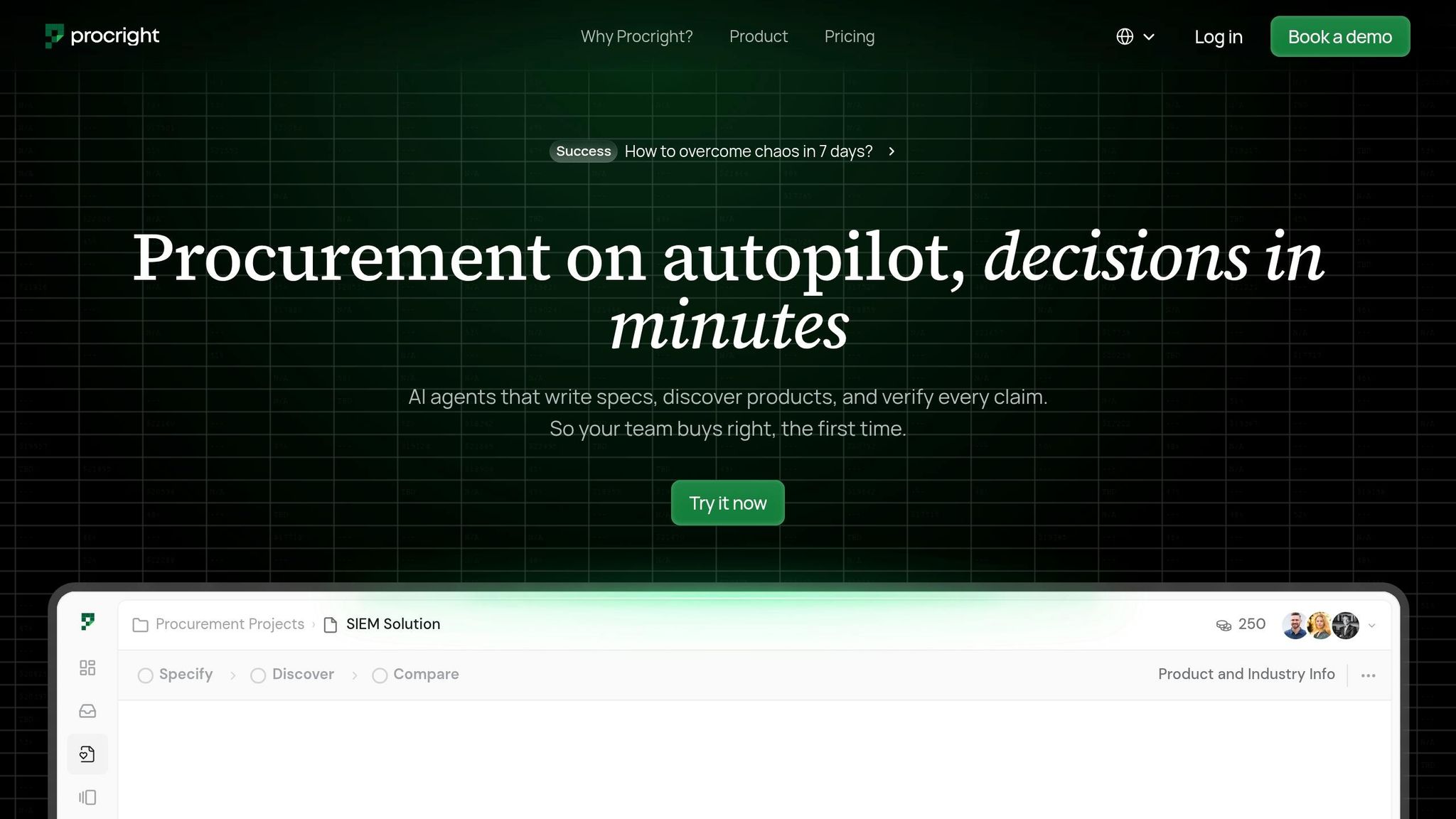
Procright brings a smarter edge to real-time spend analysis. While dashboards can show how money is being spent, uncovering the why behind cost changes - and ensuring purchases align with detailed requirements - needs a deeper, more nuanced approach.
Specification Analysis to Identify Cost Drivers
Vague or incomplete specifications are a major reason budgets spiral out of control. When technical details are missing from the start, teams risk choosing products that might require expensive replacements or fixes later on.
Procright’s AI steps in to analyze specifications, pinpoint gaps, and suggest precise technical details based on established industry standards. According to Procright, using industry-specific templates can cut specification errors by up to 90%, while the platform slashes research and comparison time from an average of 30 days to just a few minutes.
"AI identifies missing requirements and automatically suggests technical details. Content that is compliant with standards and complete." - Procright
Once specifications are fine-tuned, the next step is ensuring that everything complies with necessary rules and standards.
Compliance Scoring and Transparency
Simply knowing that a product appears compliant isn’t enough - teams need to confirm it meets internal policies and external regulations before moving forward with a purchase.
Procright tackles this with its Compliance Score system. Each product is evaluated and given a rating of "Yes", "Partially", "No", or "Not Found" for every specification. These scores aren’t just numbers - they’re backed by references like vendor PDFs, product manuals, or videos, offering teams the transparency to verify the AI’s conclusions. This kind of traceability is especially crucial for industries where audit trails are non-negotiable.
But Procright doesn’t stop at compliance. It also provides Product Maturity Scores, Market Acceptance Rates, and Supplier Reliability metrics. These insights give procurement leaders a clearer view of long-term risks, helping them make informed decisions before committing funds.
Connecting Procright to AI-Driven Procurement Workflows
Procright doesn’t just analyze specs and compliance in isolation - it integrates seamlessly into AI-driven procurement workflows. While spend analysis tools focus on tracking transactions and budgets, Procright zeroes in on the upstream decisions that determine spending in the first place.
For Enterprise users, Procright’s specification and compliance data can be embedded into broader procurement workflows. This adds a structured layer of validation before purchases are made, complementing real-time spend monitoring. Together, this combination of precise specification analysis and compliance scoring ensures procurement decisions are not only timely but also technically sound.
"The most effective procurement teams will be those that successfully integrate AI's analytical power and decision automation with human insight and expertise." - Olaf Komitsch, Chief Procurement Officer, Energie Baden-Württemberg AG
Conclusion: Advancing Procurement with AI and Real-Time Data
Key Points for Procurement Leaders
Traditional manual spend analysis typically achieves only 60–75% classification accuracy, whereas AI-driven methods can reach an impressive 95–99%, resulting in annual cost savings of 6–12%. Beyond accuracy, AI transforms the role of procurement analysts, allowing them to shift focus from spending 70–80% of their time on data preparation to engaging in more strategic initiatives. This evolution enables procurement teams to move beyond analyzing past performance and instead identify anomalies, uncover savings opportunities, and address compliance risks in real time. These advancements highlight the need for procurement practices to adapt swiftly.
Next Steps with AI and Procright
The results demonstrate a clear need for immediate action. Start with a data readiness audit to assess spend coverage, classification accuracy, and the timeliness of your data. Once the audit is complete, focus on high-value categories like IT or professional services, where AI can deliver quick and measurable ROI.
Integrating AI with real-time data empowers procurement teams to act proactively rather than reactively. For organizations struggling with poor specification quality, Procright offers a solution by analyzing purchase requirements line by line. It identifies compliance gaps before purchases are made, helping to prevent costly corrections. This tool works as part of a broader AI-driven procurement strategy, ensuring continuous spend insights rather than operating as a standalone fix. By embedding this validation layer into larger workflows, teams can make purchasing decisions that are both timely and technically accurate.
"The biggest risk is not rolling out the wrong system but hesitating to join this revolution." - Nic Walden, Associate Principal, The Hackett Group
FAQs
What data is required for real-time spend visibility?
To achieve real-time visibility into spending, start by pulling together transaction data from every source: ERP systems, accounts payable, expense management tools, corporate cards, P-cards, and procurement or travel platforms. Once gathered, the raw data needs to be cleaned and standardized - this means removing duplicates and ensuring supplier names and categories are consistent.
From there, AI tools step in to classify the data into a unified taxonomy, map it against budgets, and monitor spending trends. This process helps teams quickly identify compliance issues and make well-informed, data-backed decisions with greater efficiency.
How do we connect AI spend analysis to our ERP and AP systems?
To link AI spend analysis tools with your ERP and AP systems, adopting an API-first integration approach is key. Modern APIs allow for seamless, real-time data sharing, eliminating the need for outdated file transfer methods.
Here's how it works:
Data Extraction: Use APIs like JDBC, OData, or REST to pull transaction data (such as invoices and purchase orders) from systems like SAP or Oracle.
Middleware for Data Normalization: Middleware can standardize the data and ensure it stays in sync with your ERP's financial controls.
Enhanced Decision-Making: Tools like Procright can then utilize this synchronized data to help teams make smarter procurement decisions.
This approach streamlines processes and ensures your systems stay aligned for optimal performance.
How can Procright prevent overspending before a purchase is made?
Procright works to curb overspending by thoroughly analyzing procurement specifications before finalizing purchases. Its AI-driven approach pinpoints missing requirements and recommends essential technical details, ensuring the specifications are both complete and compliant. By offering data-backed comparisons and clear insights, Procright helps reduce budget risks, cuts down incorrect decisions by up to 90%, and ensures the selection of reliable, compliant products.