A Form for Recording Transactions in Chronological Order
In this article
The form for recording transactions in chronological order is the general journal, the foundational book of original entry where every financial event is first captured by date before reaching the ledger. Its purpose is to preserve the sequence, accounts, amounts, and explanation needed to reconstruct what happened.
A procurement review often starts with a simple request: show how the organization moved from an approved requirement to a supplier award and, eventually, a payment. The invoice may be present, and the ledger may show the expense, yet the review can still stall if nobody can establish when the decision was made, which specification applied, and what evidence supported each step. A missing date or an unexplained correction weakens the chain.
That problem is why the chronological journal remains relevant to procurement leaders, finance teams, and auditors. It doesn't merely store figures. It anchors each event to a point in time, then gives finance a reliable source for posting, reconciliation, and later testing. The same discipline can protect a sourcing process from specification drift and supplier disputes.
Table of Contents
Defining the Book of Original Entry
Suppose an auditor asks why a supplier met the required delivery condition when the signed quotation contains different wording from the final contract. Your team may have emails, an approval record, and a purchase order, but the review still depends on the sequence. Which requirement existed first? When was it changed? Who approved the change? Was the award based on the original requirement or a later interpretation?
In accounting, the answer begins with the general journal. It is the book of original entry, meaning transactions are first captured in chronological order before they're posted to the ledger. The journal normally records the date, affected accounts, amounts, debit and credit treatment, and a short description of the event. Diversification's explanation of the general journal describes this chronological first-capture role and its connection to audit trails and period reporting.
The process is straightforward:
A business event occurs, such as a purchase, invoice, payment, adjustment, or correction.
The event is recorded in the journal with its date and accounting impact.
The entry is checked for completeness and balanced debits and credits.
The amounts are posted to the relevant ledger accounts.
Reviewers trace the ledger balance back to the original entry and its supporting evidence.
That sequence separates the event story from the account summary. The journal preserves what happened and when. The ledger later groups the result by account so finance can monitor balances and prepare reports.
Why procurement leaders should care
A journal entry isn't a procurement file, but its control logic is highly transferable. A purchase transaction needs a date, a value, a supplier relationship, and evidence. A sourcing decision needs the same kind of time-linked record, even when the record sits in a procurement platform rather than an accounting system.
Practical rule: If a reviewer can't identify the requirement and evidence that existed at the time of a decision, the record may show an outcome without proving the decision was controlled.
The journal therefore acts as a first line of defense. It creates a date-ordered history that supports audit testing, period-based reporting, and investigation. The Sage comparison of the general journal and general ledger explains why the journal is the source layer while the ledger reorganizes that information for account-level tracking.
The Anatomy of a Chronological Transaction Record
A reliable chronological record needs more than a date and a total. Each field answers a different audit question. Together, the fields let a reviewer reconstruct the transaction without relying on memory or informal explanations.
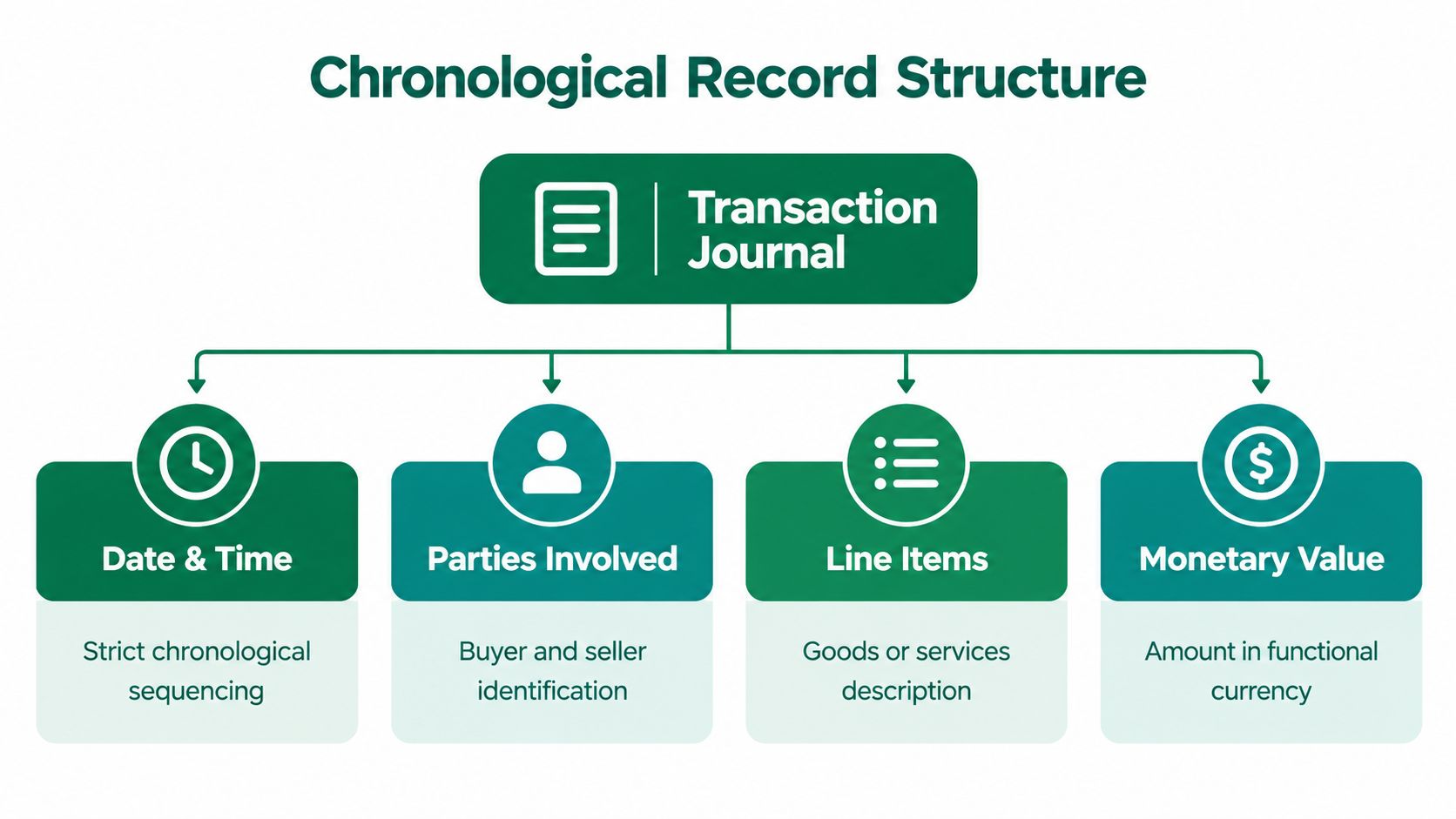
The fields that carry control value
Transaction date establishes when the event occurred or when it was recorded. It supports period allocation and helps reviewers identify entries that appear late, backdated, or out of sequence.
Affected accounts show where the transaction belongs in the chart of accounts. A purchase might affect an expense or inventory account and an accounts payable account. Without the account mapping, a reviewer can see an amount but not its intended financial classification.
Debit and credit amounts preserve double-entry integrity. The offsetting sides must net correctly before posting. This doesn't prove that the transaction was valid, but it confirms that the entry follows the basic structure required for balanced bookkeeping.
Narrative description explains the commercial reason for the entry. “Invoice posted” provides little context. A useful description identifies the purchase purpose, relevant document, and relationship to the underlying event.
Source reference and supporting evidence connect the entry to an invoice, receipt, purchase order, approval, or other originating document. The control implication is important: a balanced entry without evidence can still be difficult to defend.
The HighRadius guidance on general journal controls emphasizes retaining metadata that allows reviewers to reconstruct the transaction path, including dates, source references, account codes, debit and credit sides, and narrative.
A mental model for procurement data
Procurement teams can apply the same structure to sourcing events. Replace “affected accounts” with the requirement or decision category, and replace “debit and credit” with the linked commercial impact and approval outcome. The result is a record that answers four practical questions:
When: What was known and approved at the time?
Who: Which buyer, supplier, evaluator, or approver participated?
What: Which item, service, clause, or specification was under review?
Value: What price, quantity, risk, or financial consequence followed?
A strong record doesn't eliminate judgment. It makes judgment visible. That visibility helps finance reconcile the eventual invoice with the approved purchase and helps procurement explain why a supplier was included, excluded, or selected.
Tracing the Evolution from Clay Tablets to Cloud ERPs
Chronological transaction recording predates modern accounting departments by thousands of years. Accounting education sources describe Mesopotamian merchants using clay tablets around 3000 BCE to track livestock, grain, and trade goods. The medium was primitive, but the underlying requirement was familiar: preserve evidence of exchanges in a form that could be reviewed later. Varsity Tutors' overview of journal-entry recording connects those early records with the later development of standardized journal practice.
The modern framework became widely accessible after Luca Pacioli's Summa de Arithmetica, Geometria, Proportioni et Proportionalità was printed in Venice in 1494. That publication is recognized as the first known printed description of double-entry bookkeeping, helping spread the Venetian method across Europe. The historical arc from clay tablets to printed books matters because it shows that technology changes the container, not the control objective.
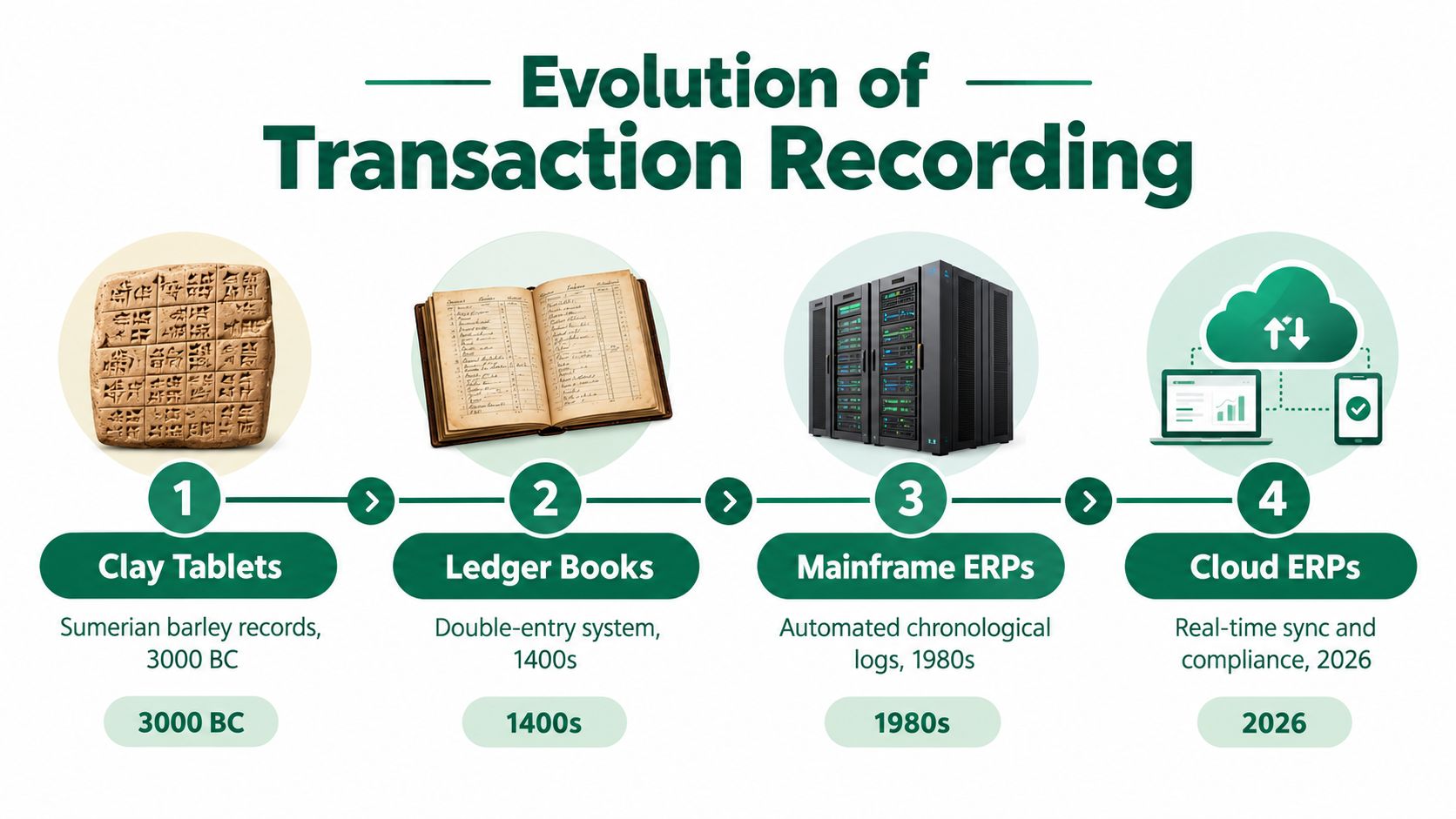
The medium changed, the evidence requirement stayed
Manual books required staff to write entries, preserve pages, and transfer figures into ledgers. Mainframe and cloud ERP systems replaced handwriting with databases, integrations, and automated posting. That shift improved speed and reduced some manual work, but it also introduced new control questions:
Can the system distinguish the transaction date from the import date?
Does a bulk upload preserve the original source reference?
Can a user amend an entry without an attributable change history?
Do automated postings retain the approval and document context?
Can reviewers trace a ledger balance back to the source record?
Modern journal frameworks are still evolving. Microsoft introduced a new ledger account-only journal framework in 2025, while SoftLedger's 2026 release notes describe line-level customer and vendor dimensions and reconciliation changes. Those developments indicate that software journals increasingly depend on rich metadata, not only columns for debits and credits. Microsoft's release-plan documentation provides the relevant framework detail.
The lesson for procurement and IT leaders is direct. A cloud ERP can automate the entry, but it can't decide whether the record contains enough evidence for a later dispute. Human owners still need to define the required fields, approval boundaries, and retention rules.
Why Time Sequencing Protects the Audit Trail
Chronological order gives auditors a way to test the plausibility and completeness of a financial record. If entries follow the underlying activity, reviewers can examine the supporting evidence around a transaction and ask whether the timing, account treatment, and approval make sense together. If entries appear in an unexplained sequence, the reviewer has a reason to investigate.
The journal doesn't make a record automatically truthful. It makes the record testable. A date-ordered sequence can reveal gaps, late entries, unusual reversals, duplicate postings, and transactions recorded after the related decision or reporting period. The OpenStax discussion of journal entries reflects the importance of examining entries as part of the accounting process rather than treating the ledger balance as sufficient evidence.
What auditors can test
An auditor may select a journal entry and trace it to an invoice, receipt, contract, approval, or other supporting document. The purpose isn't only to confirm that a number exists. It is to assess whether the entry represents a genuine event, belongs in the stated period, uses the correct accounts, and has appropriate authorization.
Chronology helps with that testing in several ways:
Sequence review: A late or out-of-order entry can prompt questions about backdating or incomplete capture.
Gap analysis: Missing periods or unexplained breaks can indicate omitted transactions or a failed interface.
Document matching: The date and reference number help connect the entry to its originating evidence.
Change review: Corrections and reversals can be assessed against the original transaction rather than viewed in isolation.
The strongest audit record shows not only the final number, but also the path from source evidence to approved posting.
This logic applies directly to procurement awards. If a supplier's compliance claim appears in the final evaluation but not in the evidence available when the shortlist was created, the organization may struggle to show that the award followed the approved process. A chronological decision record can establish what the buyer knew, what the supplier submitted, and when the requirement changed.
Teams building stronger controls can use this practical guide to audit trail best practices as a reference for documenting user actions, source records, approvals, and changes. The aim isn't to freeze every workflow. It is to ensure that changes remain attributable, explainable, and connected to the prior state.
Comparing the Journal and the General Ledger
The journal and ledger contain related information, but they answer different questions. Confusing them creates avoidable friction between procurement, accounts payable, and finance reporting teams.
The general journal answers, “What transaction occurred, and in what order?” The general ledger answers, “How has this account balance changed?” The journal carries the detailed event record. The ledger reorganizes posted entries by account for balance tracking and reporting.
Journal vs Ledger Comparison
Feature | General Journal | General Ledger |
|---|---|---|
Primary purpose | Capture transactions in chronological order | Group transactions by account |
Position in the process | Book of original entry | Downstream record after posting |
Main detail | Date, accounts, debits, credits, description, and references | Account activity, movements, and balances |
Best audit use | Trace the event and its supporting evidence | Reconcile account totals and reporting outputs |
Procurement relevance | Shows when a purchase-related financial event entered the books | Shows the accumulated effect on expense, liability, or other accounts |
The distinction matters when an invoice is challenged. A ledger may show the total payable to a supplier, but it won't necessarily explain the full sequence of the purchase decision. The journal can point the reviewer to the date, accounts, narrative, and source reference that support the posting.
How the records work together
A transaction begins with source evidence, moves into the journal, and is then posted to the relevant ledger accounts. The ledger groups activity by account, which makes it useful for reconciliations, trial balances, and financial statements. The journal retains the more detailed chronology needed to understand how the balance was formed.
For example, a credit purchase affects at least an expense, inventory, or similar account and an accounts payable account. The journal records both sides as one dated event. The ledger then updates each account separately, allowing finance to monitor the liability and the related cost classification.
Procurement managers don't need to prepare every ledger posting, but they do need to know which system holds the evidence for the decision and which system holds the financial consequence. This distinction becomes especially important when selecting technology. A useful overview of procurement software versus an ERP procurement module can help teams separate sourcing controls from accounting and enterprise-resource functions.
Applying Chronological Records to Procurement Compliance
A technology purchase can expose the weakness of an otherwise polished procurement process. The buyer starts with a locked requirement for compatibility, support, security, and delivery. Supplier responses arrive with different terminology. During evaluation, one requirement is softened because only one bidder appears to meet it. Later, the contract contains a different service condition from the one used in scoring.
Without a time-ordered record, the organization may remember the final outcome but lose the decision path. With one, the buyer can identify when the requirement was approved, which suppliers were assessed against it, and whether a later change altered the competitive basis.

A controlled sourcing sequence
Consider a facilities team sourcing a maintenance service. The initial specification requires defined response conditions, documented qualifications, and clear acceptance criteria. The team records the draft, identifies a gap in the acceptance language, and adds a clause before supplier invitations go out.
One supplier then states that it can't meet the response condition but offers a lower price. If the buyer changes the requirement during evaluation, the record becomes difficult to defend. If the system preserves the original specification, the amendment, the approval, the supplier response, and the scoring event in order, reviewers can see whether every bidder received the same basis for comparison.
A useful procurement decision record should preserve:
Requirement history: The approved wording, amendments, and reasons for each change.
Supplier evidence: The source document or response supporting each compliance conclusion.
Elimination logic: The specific requirement that caused a supplier to leave the shortlist.
Evaluation timing: The point at which scores and recommendations were created.
Commercial consistency: The relationship between the evaluated terms and the final contract.
Control principle: A supplier dispute is easier to resolve when the organization can show the exact requirement, evidence, and approval state that existed at each decision point.
The accounting analogy is useful because the final award resembles a posted balance. It shows the result, but the chronological record shows how the result formed. Procurement teams should align that record with invoice and payment controls, including the documented checks described in accounts payable procedures. That alignment helps finance confirm that the eventual payment relates to the approved scope rather than a modified version introduced later.
Navigating Automated Postings and Modern Journal Controls
Automation doesn't remove the need for journal oversight. It changes the point at which oversight must happen.
An ERP can create postings from invoices, purchase orders, interfaces, recurring rules, or bulk imports. An AI-assisted workflow can draft a classification or extract information from a document. Those capabilities can reduce repetitive entry, but they can also transfer errors at scale. A wrong account mapping, missing source reference, or incorrect transaction date may pass through many records before someone notices.
Controls for system-generated entries
Finance and procurement leaders should define controls around the source, timing, ownership, and change history of every automated record.
Source identity should remain visible. The entry needs a link or reference to the originating invoice, order, approval, or imported file.
Transaction timing should distinguish the date of the underlying event from the date the system received, processed, or posted the record. These dates answer different questions and shouldn't be collapsed into one field.
Approval ownership should identify who reviewed the entry and under which authority. Automation may prepare a record, but approval should remain attributable to a person or controlled role.
Exception handling should route unusual values, missing evidence, duplicate references, and failed account mappings to a reviewer. A system that accepts every record without review provides speed without sufficient control.
Amendment history should preserve the original entry, the change, the actor, and the reason. Replacing a record without retaining its prior state weakens the audit trail.
Microsoft's documented 2025 journal framework work illustrates how accounting software continues to refine journal structures for modern workflows. The broader implication is that audit readiness depends on metadata and permissions as much as on the debit and credit columns.
Procurement systems need equivalent discipline. A sourcing platform should preserve specification versions, evidence citations, supplier responses, scores, approvals, and changes in sequence. Guidance on automated purchase approvals and audit trails is useful for evaluating how automation can accelerate approvals without hiding the decision path.
Procright helps procurement teams draft and refine specifications, compare suppliers against cited evidence, detect specification drift, and preserve an audit-ready decision record from first draft to final award. Visit Procright to test how a chronological sourcing record can strengthen supplier decisions, finance handoffs, and compliance reviews.
Try it on a real buy
Bring one category. Watch where the flags land.
We use a little analytics to see which pages actually help. Nothing else, no ad trackers.