How AI Powers Automated Standards Mapping
NLP, embeddings, and governance convert supplier docs into fast, cited control mappings—cutting mapping time and surfacing gaps.
In this article
One vendor review can take about 8 hours by hand. With AI help, that can drop to under 15 minutes. That’s the core point: AI helps me turn standards, supplier files, and product specs into mapped controls with citations, scores, and gap flags that people can check.
Here’s the short version:
I start with version-locked standards like ISO 27001:2022, SOC 2, GDPR, and NIST CSF 2.0
I clean supplier data from PDFs, Word files, spreadsheets, decks, and URLs
I normalize terms and units to compare products for compliance efficiently
I use NLP to pull out obligation language like “shall” and “shall not”
I use embeddings and similarity scoring to match evidence to control IDs
I send low-confidence matches to people for review
I return coverage scores, gap reports, and source citations
I keep it in check with version control, review triggers, and named owners
A few numbers stand out:
Up to 15% of compliance risk may sit in appendices and exhibits
Domain-tuned models improved F1 by 5.9% for classification and 8.5% for NER
One mapping approach hit about 83.8% F1
Teams using AI-powered mapping can save up to 60% of delivery time
If I had to sum it up in one line, it’s this: AI does the heavy sorting, but people still make the final call.
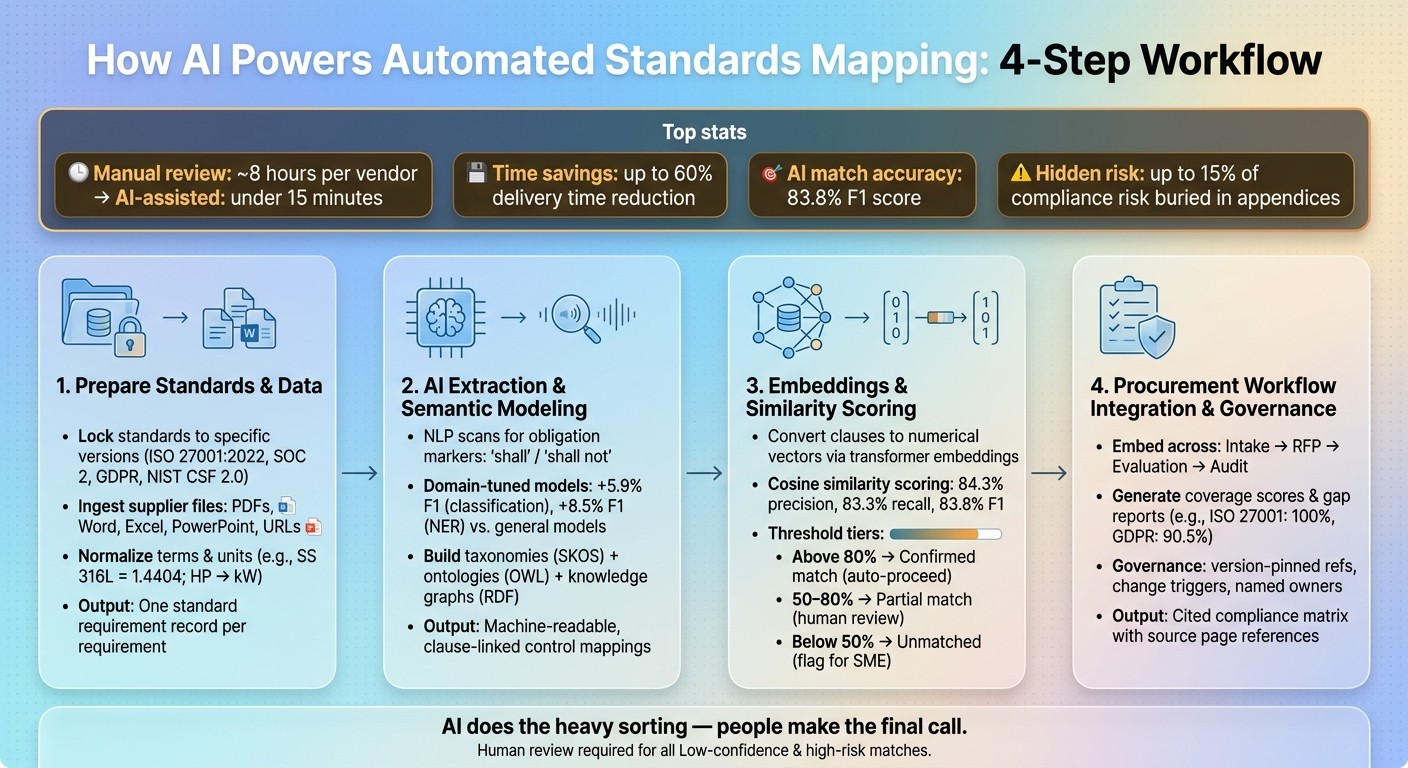
AI-Powered Standards Mapping: 4-Step Workflow
How AI Agents automate Common Control Frameworks and mappings #ai #cybersecurity #compliance
Quick comparison
Area | Manual approach | AI-assisted approach |
|---|---|---|
Review time | About 8 hours per vendor cycle | Under 15 minutes for initial mapping |
Source handling | Split across files and formats | Normalized into one structure |
Match method | Line-by-line reading | NLP + semantic scoring |
Audit support | Hard to trace | Citation-based output |
Risk review | Easy to miss buried clauses | Flags gaps and low-confidence matches |
Change control | Version mix-ups happen | Version-pinned references and review triggers |
So when I think about automated standards mapping, I don’t see it as “AI replacing compliance work.” I see it as a way to make mapping faster, more consistent, and easier to verify across intake, RFPs, evaluations, AI procurement software evaluations, and audits.
Step 1: Prepare Standards, Data, and Semantic Foundations
AI can only map clean, versioned data. The inputs that matter are standards, supplier evidence, and product specs. And before any mapping starts, all three need to be normalized.
Build a Standards Catalog with Scope and Control IDs
Start by gathering the source, version-specific reference files for every framework your organization is responsible for, such as ISO 27001:2022 or NIST CSF 2.0.
Version control matters here. Each catalog should be locked to one framework version, and every control should keep its native control ID. For example, that could mean A.5.1 for ISO 27001, CC1.1 for SOC 2, or Art. 24 for GDPR. Each entry should also list the internal owner in charge of keeping it up to date. This ownership is critical when using AI tools for supplier risk assessment to ensure that flagged compliance threats are addressed by the right stakeholder.
When versions are locked, AI can compare controls cleanly instead of mixing old and current framework language.
Clean and Normalize Specifications and Supplier Data
Supplier data usually comes in a mess of formats: PDFs, Word documents, Excel sheets, PowerPoint decks, and URLs. Before AI can compare any of it, each source needs to pass through a structured normalization process.
The aim is simple: create one standard requirement record for each requirement, covering obligation, source, owner, evidence, and review cadence.
Language needs cleanup too. If two names point to the same material, treat them as one item. For instance, SS 316L and 1.4404 should map to the same material. Units need the same treatment. Convert horsepower to kilowatts or BTUs to watts before mapping, not after.
Once terms and units line up, the system can compare requirements on equal footing.
Build Taxonomies and Ontologies for Shared Meaning
Even when data is clean, teams still use different words for the same idea. That's where things can go sideways. Without a shared vocabulary, AI may split one requirement into several matches, which leads to broken, scattered mappings.
The fix is to define each control concept once and reuse it across frameworks so meanings stay consistent over time. Then map each framework to those shared control concepts and keep using that same layer across standards.
That changes the workload in a big way. When a new framework comes in, teams can add it to the canonical layer instead of rebuilding every old mapping from scratch. And the payoff isn't small: organizations managing four frameworks with normalized control categories can cut remediation overhead by 75%.
These foundations set up the next step, where AI extracts clauses and maps them to controls.
Step 2: Use AI to Turn Standards Into Machine-Readable Mappings
Once standards and supplier data follow the same structure, AI can pull out obligations and connect them to control IDs.
Extract Clauses, Obligations, and Metadata with NLP
Standards documents are dense. And frameworks like the EU AI Act can contain many separate obligations that need to be pulled apart. NLP models help by scanning for obligation markers such as "shall" and "shall not" to isolate the smallest enforceable obligations a system can act on.
This is one area where domain-specific training matters a lot. Models fine-tuned on industry corpora do better than general-purpose models by a measurable margin. Research found that domain-specific pre-training improved F1 scores for text classification by 5.9% and for named entity recognition by 8.5% compared with general models.
Each extracted requirement should stay linked to its source clause so auditors can trace it back and verify it.
Those extracted clauses then move into the semantic layer that lines up overlapping standards.
Model Standards Relationships with Taxonomies, Ontologies, and Knowledge Graphs
Extracted requirements don’t stand alone. One framework may overlap with another, so a simple flat list usually won’t cut it.
Use the simplest representation that fits the mapping job:
Representation | Advantages | Disadvantages |
|---|---|---|
Taxonomies (SKOS) | Flexible; supports broader/narrower concept relationships | Limited reasoning; no formal logic |
Ontologies (OWL) | Supports formal logic, classes, and automated reasoning | High complexity; requires strict data consistency |
Knowledge Graphs (RDF) | Highly extensible; links to external resources; excellent for interoperability | Requires specialized graph database infrastructure |
For most organizations working across many frameworks, a layered setup works well. Use SKOS taxonomies to organize shared terms, OWL ontologies to define formal relationships, and an RDF knowledge graph as the connective layer tying standards, controls, products, and evidence together. Research mapping the EU AI Act extracted 118 separate requirements linked to 46 explicitly defined concepts with this type of semantic web structure.
Match Specifications to Controls with Embeddings and Similarity Scoring
After the requirements are structured, the next step is to score each match against product and supplier evidence using a compliance score calculator.
Embeddings turn natural language - like a clause from a standard or a line from a supplier data sheet - into numerical vectors. Content with similar meaning sits close together in vector space. A cosine similarity calculation measures the distance between two vectors and returns a score showing how closely they match. Transformer-based models using this method achieved 84.3% precision, 83.3% recall, and an 83.8% F1 score.
But raw scores by themselves don’t tell the whole story. A better pattern is threshold-based categorization:
Above 80% similarity: confirmed match
50% to 80% similarity: partial match that needs review
Below 50% similarity: unique or unmatched
This keeps human reviewers focused on edge cases instead of checking every single result.
The result is an AI-assisted, human-reviewed process. AI suggests mappings, but people make the final interpretation and defensibility call.
Those machine-readable mappings then move into procurement workflows for review and scoring. This ensures they align with your procurement checklist for vendor approvals.
Step 3: Apply Automated Mapping in Procurement Workflows
Map Product Specifications and Supplier Evidence to Common Controls
Apply mapped controls directly to product specs and supplier evidence. AI can ingest both structured files and unstructured documents to pull out requirements, materials, and test methods. It can also normalize units and terminology so teams compare like with like, not apples to oranges.
From there, each piece of supplier evidence can be tied to a common control across frameworks. Low-confidence or high-risk matches should go to a subject matter expert for review. Routine matches can move straight into procurement operations. That shift matters because it turns mappings into working procurement checks, not just neat rows of structured data.
Generate Compliance Scores, Gap Analysis, and Coverage Views
Once controls are tied to evidence, roll them up into risk-weighted compliance scores and gap reports for procurement and technical review. Here’s what a standards coverage output can look like in practice:
Standard | Coverage % | Key Gaps | Risk Level |
|---|---|---|---|
ISO 27001:2022 | 100% | None | Low |
SOC 2 TSC | 94% | 3 controls missing (e.g., CC6.5) | Medium |
GDPR | 90.5% | Data subject rights (Art. 15–22) | High |
NIST CSF 2.0 | 85% | Supply chain risk management | Medium |
Every value in this matrix should trace back to a source document, along with a page reference and confidence score.
This gives procurement, security, and technical teams a fast way to see where a vendor lines up with requirements and where the weak spots sit.
Embed Mapping into Intake, RFP, Evaluation, and Audit Workflows
Automated mapping has the most impact when it runs across the procurement lifecycle, not only during evaluation.
During intake, AI flags missing requirements and suggests technical details that align with standards. During RFP and sourcing, it scores vendor proposals item by item against technical compliance criteria. At evaluation, it surfaces specification gaps, including missing controls and undisclosed substitutions, that manual reviews often miss. At the audit stage, it builds compliance matrices with direct citations to source vendor documents, so reviewers can click through to the exact page that supports a match.
Used this way, AI cuts manual effort, improves match quality, and makes audit trails easier to check. The same mapping layer should run across intake, sourcing, evaluation, and audit workflows. The next piece is governance: version control, review thresholds, and change logs keep mappings current.
Step 4: Operational Example and Conclusion
Once mappings start shaping intake, RFPs, and audits, the last move is to put them to work inside the procurement system.
How Procright Supports AI-Powered Standards Mapping
When a single supplier packet has to cover SOC 2, NIST CSF, and GDPR, things get messy fast. Evidence almost never lines up neatly across frameworks. Procright tackles that problem by automating specification creation and compliance verification through AI analysis of supplier PDFs and web sources.
Instead of having someone match vendor evidence to control IDs line by line, Procright pulls clauses and obligations from source documents, maps them to shared controls, and returns cited compliance scores for each match.
Capability | Typical Manual Process | Procright |
|---|---|---|
Speed | Weeks to months of spreadsheet research | Initial gap analysis completed in minutes to hours |
Audit trail | Clause-level citations tied to source documents | Validation flags missing control IDs |
Consistency | Framework-level normalization absent | Normalized control categories applied across frameworks |
Maintenance | Spreadsheets that drift over time | Automated change detection with triggers for human review |
This matters because procurement teams don't just need a score. They need to see why a match was made, what source text supports it, and where the gaps still are. That's where cited outputs and control-level mapping make the process much easier to trust and review.
Governance Practices That Keep Mappings Reliable
Automation works best when review rules are spelled out in plain terms. Each mapping should have a confidence level - High, Medium, or Low. Low-confidence matches should go to human review instead of being accepted on the spot.
A few habits help keep the system from drifting:
Use version-pinned references
Trigger reviews when a product changes
Trigger reviews when a new vendor comes in
Trigger reviews when a system migration happens
Assign clear owners across procurement, compliance, legal, and data governance
Without named owners, mappings tend to slip over time as frameworks change and business processes shift. That's the part teams often miss. The model can do a lot of the heavy lifting, but someone still has to own the rules.
Conclusion: A Practical Path to Scalable Standards Mapping
Scalable mapping usually follows the same path: structure the standards, normalize the data, use NLP and semantic models to map controls, place the results inside workflows, and govern changes over time.
For U.S. teams, the upside is concrete. AI-powered compliance mapping can save up to 60% of delivery time compared with manual work. And work that used to take weeks of manual research can produce an initial cross-compliance matrix in a single 30–60 minute session. In plain English, that means less manual review, more confidence in compliance, and purchasing decisions based on evidence instead of guesswork.
FAQs
How accurate is AI standards mapping?
AI standards mapping can be highly accurate when it uses version-pinned, authoritative reference files instead of generic model knowledge.
That point matters more than it may seem. If the system works from the exact source documents tied to a given version, the mapping stays anchored to the text that people are actually using, not a fuzzy memory of it.
Accuracy also gets stronger when the process includes validation and transparency. That means:
Clause citations
Clear rationales
Confidence indicators
In practice, AI does the heavy lifting on extraction and synthesis. Human experts still make the final call. They interpret the output, check it, and decide what fits their organization.
What still needs human review?
AI can speed up standards review by pulling out requirements, summarizing sections, and tying answers back to specific clauses. That can save time, especially when you're working through long, dense documents.
But human review still matters. People are still needed for final interpretation, compliance calls, and any situation where the evidence is thin or unclear.
The AI is built to support expert judgment, not take its place. It stays anchored to the standard under review, gives traceable outputs, and is clear about where its limits are.
How do you keep mappings current?
Modern systems keep mappings current by treating standards as version-aware, structured data instead of static documents.
When a new revision comes out, AI spots the change, pinpoints the requirements it touches, and flags what that means for internal specifications. That matters because teams no longer have to hunt through PDFs or compare updates by hand. The system does the heavy lifting and points people to what changed.
Procright supports this with automated specification analysis and data-driven compliance verification. Instead of manual tracking, teams can use automated triggers linked to business changes, so updates move through the process with far less guesswork.
Related Blog Posts
Try it on a real buy
Bring one category. Watch where the flags land.
We use a little analytics to see which pages actually help. Nothing else, no ad trackers.