5 Ways NLP Improves Source Analysis in Procurement
Turn supplier text into structured data to extract fields, check compliance, detect risk, and score bids faster with auditable records.
In this article
If you still review supplier documents by hand, you’re losing time. In procurement, manual source analysis can take 4 to 8 hours per vendor, and a 15- to 20-supplier event can eat up as much as 40 hours of bid review.
I’d sum up the article like this: NLP turns messy supplier text into structured data that I can compare, score, and trace back to the source. That helps me move from slow document review to a more consistent process across five jobs:
Extract data from PDFs, scans, emails, and spreadsheets
Classify suppliers, products, and bids into the same labels
Match vendor responses against requirements and compliance rules
Detect supplier risk from contracts, filings, news, and messages
Score bids with the same logic across every submission
A few numbers stand out:
Bid analysis can drop from about 40 hours to 6 hours
Spec comparison can fall from 8 hours to under 15 minutes
NLP can check 100% of mandatory specs
Structured spec extraction can reach 99% accuracy
In plain terms: I use NLP to make source analysis faster, more consistent, easier to audit, and less dependent on manual reading.
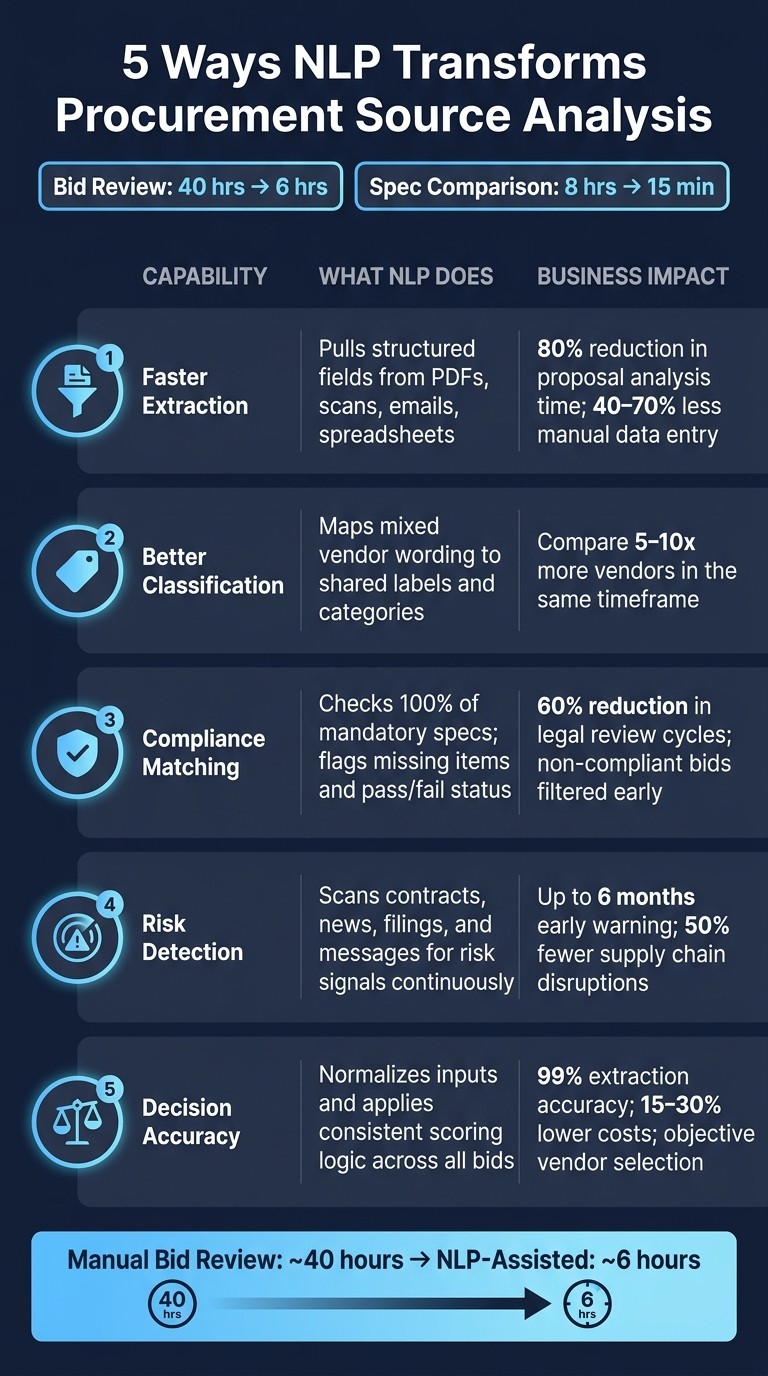
5 Ways NLP Transforms Procurement Source Analysis
Contract Analysis. Using NLP & AI to Decode Procurement Agreements
Quick Comparison
Area | What NLP does | What I get |
|---|---|---|
Extraction | Pulls fields from unstructured files | Side-by-side supplier data |
Classification | Maps mixed vendor wording to shared labels | Cleaner comparisons across bids |
Compliance matching | Pass/fail view and missing-item flags | |
Risk detection | Scans text for warning signs | Early alerts on supplier issues |
Normalizes inputs for scoring | More consistent award decisions |
Bottom line: NLP helps me turn raw procurement documents into a repeatable source analysis workflow instead of a long manual review task.
Why NLP Matters in Procurement Source Analysis
What NLP Means in Plain Language
Natural language processing (NLP) is the AI method that helps computers read and understand human language. In procurement, NLP takes contracts, emails, and product specs and turns them into structured data that teams can line up side by side.
Where Procurement Teams Use NLP
In day-to-day sourcing work, NLP shows up in five main tasks:
RFP and bid review: It scans proposals to spot requirements, flag compliance gaps, and score responses using template-based comparisons to avoid reading every page by hand.
Contract analysis: It pulls out termination clauses, liability caps, and renewal dates from long legal documents.
Supplier communications: It reads supplier emails, including messages in more than one language.
Product spec matching: It standardizes technical data across vendor datasheets and converts units so teams can compare products in the same format.
Compliance documents: It checks certifications and insurance files against a requirements list and flags what passes and what fails.
How Text Analysis Improves Sourcing Decisions
NLP cuts the time needed to extract data, makes reviews more consistent, and checks every required field. A manual specification comparison usually takes 8 hours per cycle. With NLP, that same job can take less than 15 minutes.
It also checks 100% of mandatory specifications against supplier responses, instead of only the items a reviewer happens to catch during a manual pass.
That matters because sourcing teams often deal with a pile of dense documents at once. When the review process is manual, small misses can slip through. NLP helps teams move faster and review supplier information in a more uniform way, which makes side-by-side decisions easier.
1. Faster Extraction From Unstructured Procurement Text
The first big win in source analysis is extraction.
Supplier proposals, bid tables, spec sheets, and contracts show up in all kinds of formats: PDFs, Excel workbooks, scanned images, emails, and slide decks. NLP matters here because it can process those files as they come in, without forcing teams to reformat everything first.
For scanned files, OCR turns image-based text into text the system can read. Then NLP pulls out fields you can compare side by side, such as product names, quantities, prices, delivery dates, and payment terms. After that, standardization puts different vendor wording into one shared format, so "T+1 shipping" and "next-business-day delivery" are treated as the same value.
Once OCR and extraction are done, scattered content from multiple files becomes one comparison view. You end up with a matrix that shows unit costs, payment terms, warranty periods, lead times, and compliance attestations, all pulled together without manual input.
This kind of automated extraction can cut manual entry errors by a large margin compared to manual data entry. It can also shrink bid analysis from about 40 hours to 6 hours when NLP-assisted extraction is used. That means teams can review bids sooner and miss fewer details.
Procright uses this approach by extracting specifications from PDFs and web sources into structured comparison data.
Once that data is in place, the next step is classifying suppliers and bids in a consistent way.
2. Better Classification of Suppliers, Products, and Bids
Once the data is extracted, NLP sorts supplier content into standard categories. That makes it much easier for teams to perform data-driven supplier comparisons without getting stuck in messy wording from different vendors. Put simply: mixed supplier text turns into clean, consistent labels that procurement teams can scan fast.
Source Types
NLP classification can process:
RFP, RFQ, and RFI responses across the procurement lifecycle
supplier proposals
bid documents
pricing sheets
contracts
datasheets
market reports
regulatory filings
NLP Task Performed
NER pulls out products, services, quantities, and delivery terms. Then normalization lines up vendor wording and units into one shared format.
That matters because one supplier might say annual support, another might say maintenance plan, and a third might bundle both into a longer description. NLP helps put those items side by side in a format teams can actually use.
Procurement Output
The output is usually a comparison matrix with source citations, categorized spend reports, and ranked shortlists.
Decision-Making Benefit
Better classification helps teams compare 5–10x more vendors in the same timeframe. That’s a big deal when sourcing teams are buried in bids and every supplier seems to describe the same thing in a different way.
It also helps teams spot maverick spend and Tier-2 and Tier-3 supplier risks earlier. The end result is more consistent source analysis and stronger side-by-side comparisons.
3. More Accurate Compliance and Requirement Matching
Once supplier content is classified, the next job is simple in theory but messy in practice: check whether each vendor meets every requirement. That’s where NLP compliance matching helps.
Primary Text Inputs
NLP engines work across RFPs, contracts, certificates, and regulatory documents. They pull from fields such as specs, pricing, delivery dates, SLAs, clauses, renewal terms, and required certifications.
NLP Task Performed
The system standardizes wording so different vendor phrasing maps to one shared standard. For example, one vendor might write “T+1 shipping,” while another says “next-business-day delivery.” NLP can treat those as the same requirement response.
It also flags unanswered requirements, so any RFP line item a vendor skipped can be found automatically. Unit conversion helps keep mismatched measurements like kW vs. HP from throwing off side-by-side comparisons. And every extracted value links back to its source page.
Procurement Output
The output is a fast, auditable compliance matrix with pass/fail flags, missing-evidence alerts, and clause exceptions.
Decision-Making Benefit
This helps teams screen out non-compliant bids early and spot missing requirements or vague language that reviewers often miss. Procright ties compliance scores to source documents for full traceability.
That sets up the next layer of source analysis: spotting risk signals before they affect award decisions.
4. Clearer Supplier Risk Detection
Once compliance is checked, NLP can spot deeper supplier risk buried in text. A supplier might look fine on paper and still run into trouble because of cash flow issues, labor disputes, or regulatory pressure. NLP helps teams catch those warning signs before they turn into bigger problems.
It can scan contracts, emails, invoices, audit logs, news, social posts, filings, sanctions lists, and ESG sources.
NLP Task Performed
NLP moves supplier risk review from periodic checks to continuous monitoring. Sentiment analysis can flag reputational issues. Entity recognition can map sanctioned or high-risk countries or regions. Anomaly detection can spot fraud or financial stress. Clause extraction can surface missing data protection, indemnity, or non-standard termination terms as risk signals.
Jaguar Land Rover used AI to flag a supplier disruption two weeks before it affected production. That shows what happens when you monitor text all the time instead of only checking at bid close.
Procurement Output
The output is a live risk profile with alerts tied to financial, cyber, sustainability, and regulatory risk. Those signals then feed the final supplier decision.
Decision-Making Benefit
This gives procurement teams earlier warning, so they can act before disruption hits. That might mean switching suppliers or adjusting inventory. Procright also offers automatic source analysis from web, PDFs, and videos, along with transparent compliance scores.
5. Greater Accuracy and Consistency in Procurement Decisions
After compliance and risk checks, teams still need a final award score they can repeat with confidence. That’s where manual bid reviews often fall apart. One reviewer may read a response one way, while another scores the same point a little differently. NLP cuts that swing by applying the same logic to every document and every submission.
NLP Task Performed
The main job here is normalization.
Normalization takes different vendor phrasing and maps it to the same concept. It also converts units so the comparison stays aligned. At the same time, Named Entity Recognition (NER) pulls out specific data points like product names, quantities, delivery terms, and warranty periods. From there, normalization turns narrative responses into the same scoring schema.
Procurement Output
The result is a side-by-side comparison matrix with page-level citations for each value. Teams can review:
weighted quantitative scores
TCO estimates with source citations for each value
Decision-Making Benefit
The lift in accuracy can be major. AI-native extraction can reach 99% accuracy on structured specifications, and manual comparison time can fall from about 8 hours to under 15 minutes.
That shift matters. Teams spend less time on repetitive review and more time on judgment calls that still need a human eye.
Quick Comparison of the 5 NLP Benefits
Each of these five NLP capabilities tackles a different choke point in sourcing. The table below lays out the input, output, and business value for each one.
NLP Benefit | Primary Inputs | Analysis Output | Procurement Value |
|---|---|---|---|
1. Faster Extraction | RFPs, bids, contracts, emails, PDFs, spreadsheets | Structured fields | 40–70% reduction in manual data entry; 80% reduction in proposal analysis time |
2. Better Classification | Product data, invoices, spend reports, bids | Faster spend categorization and better visibility | |
3. Compliance Matching | RFQs, bids, regulatory docs, insurance certs | Pass/fail status on mandatory requirements | 60% reduction in legal review cycles; non-compliant bids filtered early |
4. Risk Detection | Supplier messages, news feeds, financial filings, market reports | Risk alerts | Up to 6 months of early warning on supplier risk; 50% fewer supply chain disruptions |
5. Decision Accuracy | Multi-vendor bids, evaluation criteria, historical sourcing data | Weighted scores and a ranked shortlist | 15–30% lower costs; objective, repeatable vendor selection |
Put simply, these five steps take source analysis from messy, unstructured text to a data-driven procurement decisions.
Conclusion
Source analysis in procurement is a text-heavy job. Teams need to read, interpret, and compare large volumes of unstructured procurement documents. NLP helps turn that text into structured data teams can use.
That changes source analysis from a manual review task into a repeatable process for extraction, classification, compliance, risk, and scoring. In plain English: less time spent digging through documents, and a better shot at making sound decisions.
The payoff is faster, more reliable sourcing. It also makes source analysis more consistent and easier to audit.
NLP-powered source analysis helps make procurement decisions traceable, auditable, and consistent. Procright supports this with automatic source analysis, compliance verification, and transparent compliance scores.
FAQs
How does NLP handle messy supplier documents?
NLP turns messy supplier content - like scanned PDFs, images, and mixed file types - into machine-readable text with AI-powered optical character recognition.
From there, it looks at context and relationships, pulls out and standardizes specs, and compares inconsistent documents even when suppliers use different terms, units, or measurement conditions. It can also flag missing information or compliance issues, turning scattered data into actionable insights.
Can NLP catch missing requirements in bids?
Yes. NLP can spot missing bid requirements by checking vendor proposals against a baseline list of mandatory specs and flagging gaps where details are missing.
Procright uses this to review specifications item by item. That helps teams find incomplete proposals faster, cut down on manual review, and avoid costly oversights before final procurement decisions.
What still needs human review in source analysis?
Even with NLP in the mix, people still need to review the work. That human step matters for governance, accountability, and final sign-off. Teams need to check AI output, make sure it follows company policy, and confirm that each decision can be traced and verified.
People also manage vendor relationships at a higher level. And when a procurement decision carries more weight, they’re the ones who can read the gray areas that don’t fit neatly inside set data rules.
Related Blog Posts
Try it on a real buy
Bring one category. Watch where the flags land.
We use a little analytics to see which pages actually help. Nothing else, no ad trackers.