AI Tools for Supplier Risk Assessment
AI platforms deliver continuous supplier monitoring—detecting financial, cyber, ESG, and supply-chain risks before they escalate.
In this article
Managing supplier risks is no longer optional. AI tools now provide procurement teams with real-time insights, replacing outdated manual reviews. These tools help identify risks like financial instability, cybersecurity threats, compliance violations, and supply chain disruptions before they escalate. Key benefits include:
72% fewer late-detected supplier issues and 90% workload reduction in risk assessments.
Real-time monitoring of financial, operational, and reputational risks.
Advanced AI capabilities like predictive modeling, document analysis, and risk scoring.
Here’s a quick overview of 10 leading AI tools for supplier risk management:
Procright: Automates supplier evaluations with compliance scoring and transparent sourcing insights.
Owlin: Monitors global news and regulatory filings to flag emerging risks.
Everstream Analytics: Maps multi-tier supply chains and predicts disruptions.
Dataiku: Builds custom risk models with natural language queries.
Panorays: Focuses on third-party cybersecurity risks with continuous monitoring.
PwC: Combines AI tools with expert consulting for regulatory and ESG risks.
Tacto: Speeds up contract and document risk assessments.
Atlas Systems: Automates vendor assessments and provides managed services.
FS-ISAC: Shares supplier risk insights within the financial services sector.
Ivalua: Offers predictive risk monitoring across financial, ESG, and operational areas.
Quick Comparison:
Tool | Focus | Best For |
|---|---|---|
Procright | Compliance and sourcing | Specification-driven workflows |
Owlin | Global risk monitoring | Early warnings on supplier reputation shifts |
Everstream | Predictive supply chain risks | Multi-tier visibility and disruption planning |
Dataiku | Custom risk models | Data science and analytics teams |
Panorays | Cybersecurity risks | IT and security-focused procurement teams |
PwC | ESG and regulatory risks | Enterprises needing expert guidance |
Tacto | Contract/document risks | Legal and procurement contract workflows |
Atlas Systems | Vendor assessments | Outsourced risk management programs |
FS-ISAC | Financial sector threats | Financial services procurement teams |
Ivalua | End-to-end risk monitoring | Comprehensive procurement lifecycle coverage |
AI tools are transforming supplier risk management, enabling faster, more accurate decisions while reducing manual workloads. Choose the right tool based on your team size, risk exposure, and automation needs.
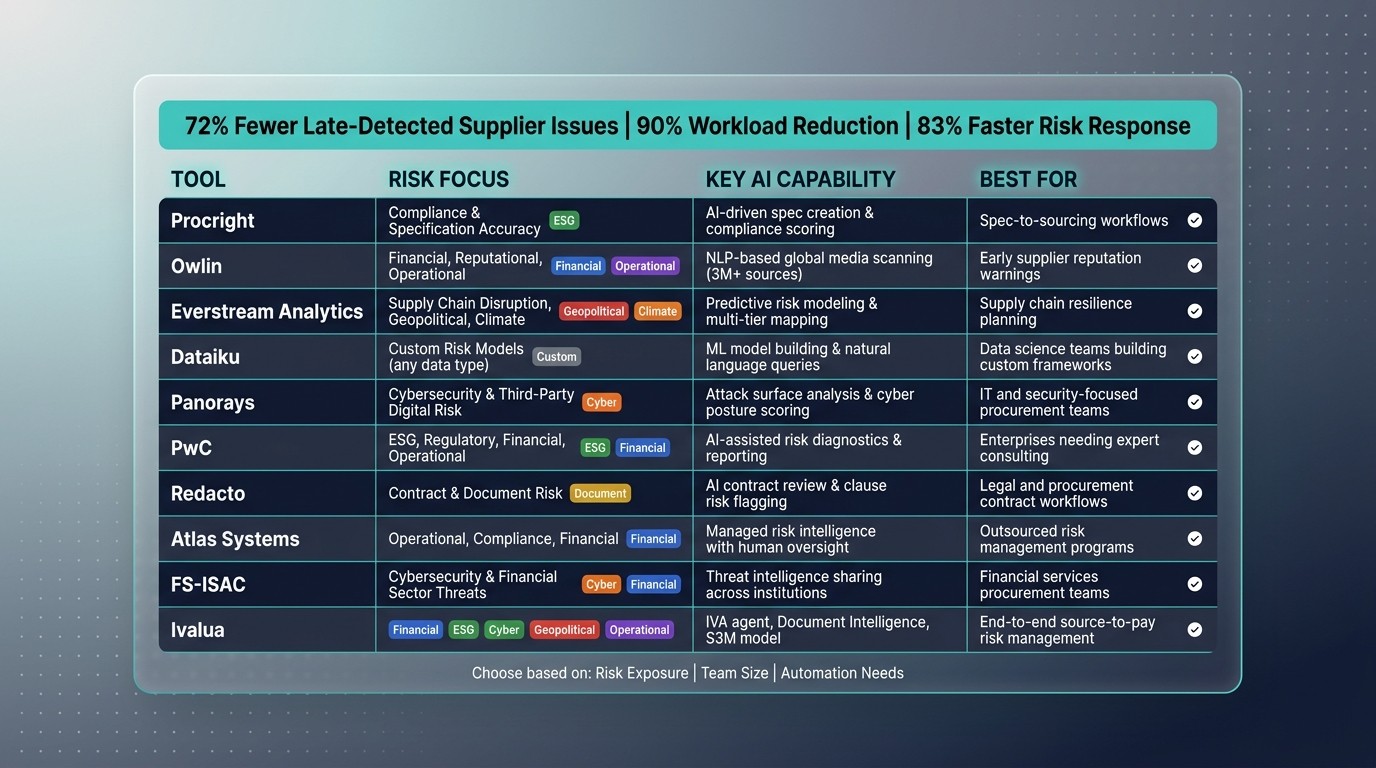
Top 10 AI Tools for Supplier Risk Management: Side-by-Side Comparison
How AI Is Transforming Supplier Risk Management - CIPS x WNS Procurement Webinar
1. Procright
Procright is an AI-driven procurement tool designed to simplify supplier evaluations. By automating tasks like specification building and compliance checks, it enables teams to make quicker, data-based decisions. Let’s dive into how Procright achieves this through its advanced AI features.
Risk Coverage Areas
Procright tackles supplier risks across multiple dimensions. Its AI Comparison Engine meticulously reviews supplier data against specifications. This analysis pulls from diverse sources, including web pages, PDFs, and even video manuals. Each requirement is flagged as Yes, Partially, No, or Not Found, making it easy to identify gaps. These insights feed into a detailed risk analysis, supported by a refined scoring system.
AI Capabilities and Scoring
Procright’s scoring system evaluates suppliers based on risk-focused metrics, using the data it extracts. Here’s how it breaks down:
Risk Metric | Metric Description | Impact |
|---|---|---|
Product Maturity Score | Measures how well a product aligns with specs | Reduces technical mismatches and overlooked details |
Market Acceptance Rate | Tracks how widely the product is approved | Lowers the chance of procurement failures |
Local Support Availability | Evaluates access to qualified resources | Ensures faster issue resolution after purchase |
Corporate Maturity | Reviews supplier stability and longevity | Indicates long-term reliability and mitigates bankruptcy risks |
The platform lets you assign weights to specific requirements, ensuring that critical factors carry more influence in the final supplier score. This makes the scoring system adaptable to your organization’s unique priorities.
2. Owlin
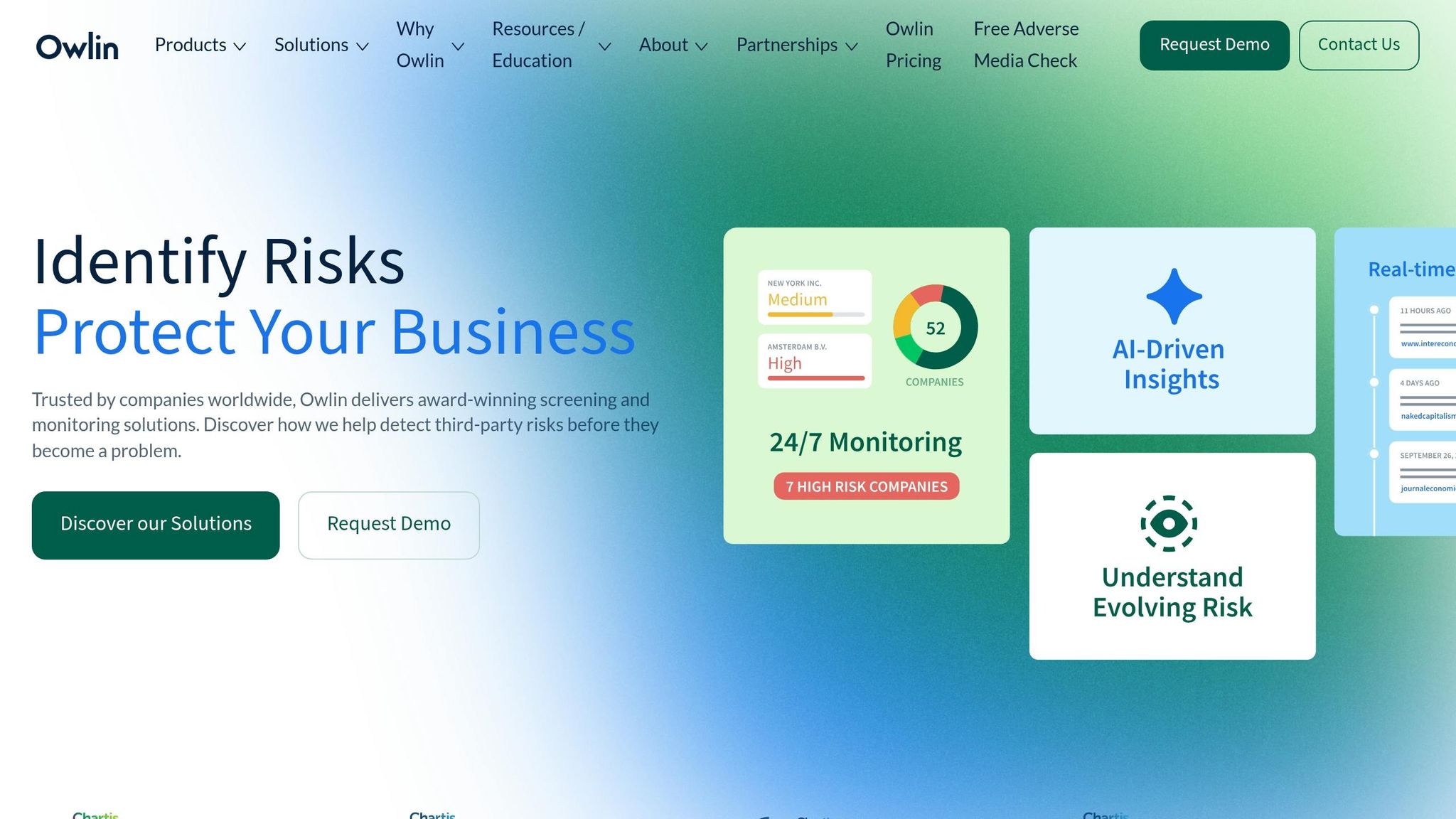
Owlin stands out as an AI-powered risk intelligence platform designed to transform procurement risk management. Unlike traditional methods that rely on periodic manual reviews, Owlin operates 24/7, scanning over 3,000,000 trusted global sources - including news outlets, regulatory filings, and consumer reviews - to detect emerging supplier risks in real time. This continuous monitoring approach using supplier risk monitoring AI tools aligns perfectly with proactive risk management strategies highlighted earlier.
Risk Coverage Areas
Owlin takes an "outside-in" approach to monitoring, focusing on unstructured data from the web rather than relying solely on traditional company databases. This makes it particularly effective for tracking smaller or regional suppliers that might be overlooked by standard registries.
Risk Category | What It Monitors |
|---|---|
Financial | Bankruptcy filings, credit downgrades, payment delays |
Compliance | Sanctions, PEPs, AML violations, regulatory actions |
ESG | Labor issues, environmental violations, human rights concerns |
Reputational | Negative media coverage, public sentiment, consumer complaints |
Operational | Geopolitical disruptions, legal disputes, supply chain interruptions |
AI Capabilities
Owlin employs Natural Language Processing (NLP) and Generative AI to analyze unstructured data in multiple languages. It then translates this information into clear, actionable risk scores paired with AI-generated summaries. Transparency is a key focus - Owlin avoids "black-box" analytics, ensuring users understand why a supplier is flagged.
Jesse Koreman, a Senior Financial Risk Analyst at Adyen, shared a practical example of Owlin’s impact:
"Recently, we had a retailer which had raised some questions. At some point, Owlin picked up articles showing that the retailer in question was going into administration or restructuring. This is often a bad sign for us because Adyen could become liable for the risk."
Procurement Benefits
Owlin integrates seamlessly across the supplier lifecycle, cutting down on manual tasks and allowing analysts to concentrate on risk mitigation. Its intelligence can also be embedded directly into existing GRC or Source-to-Pay (S2P) systems via API, enabling automated real-time updates. Chartis Research has recognized Owlin as a Category Leader in Adverse Media Monitoring Solutions for both 2024 and 2025, highlighting its ability to process large volumes of unstructured data effectively.
3. Everstream Analytics
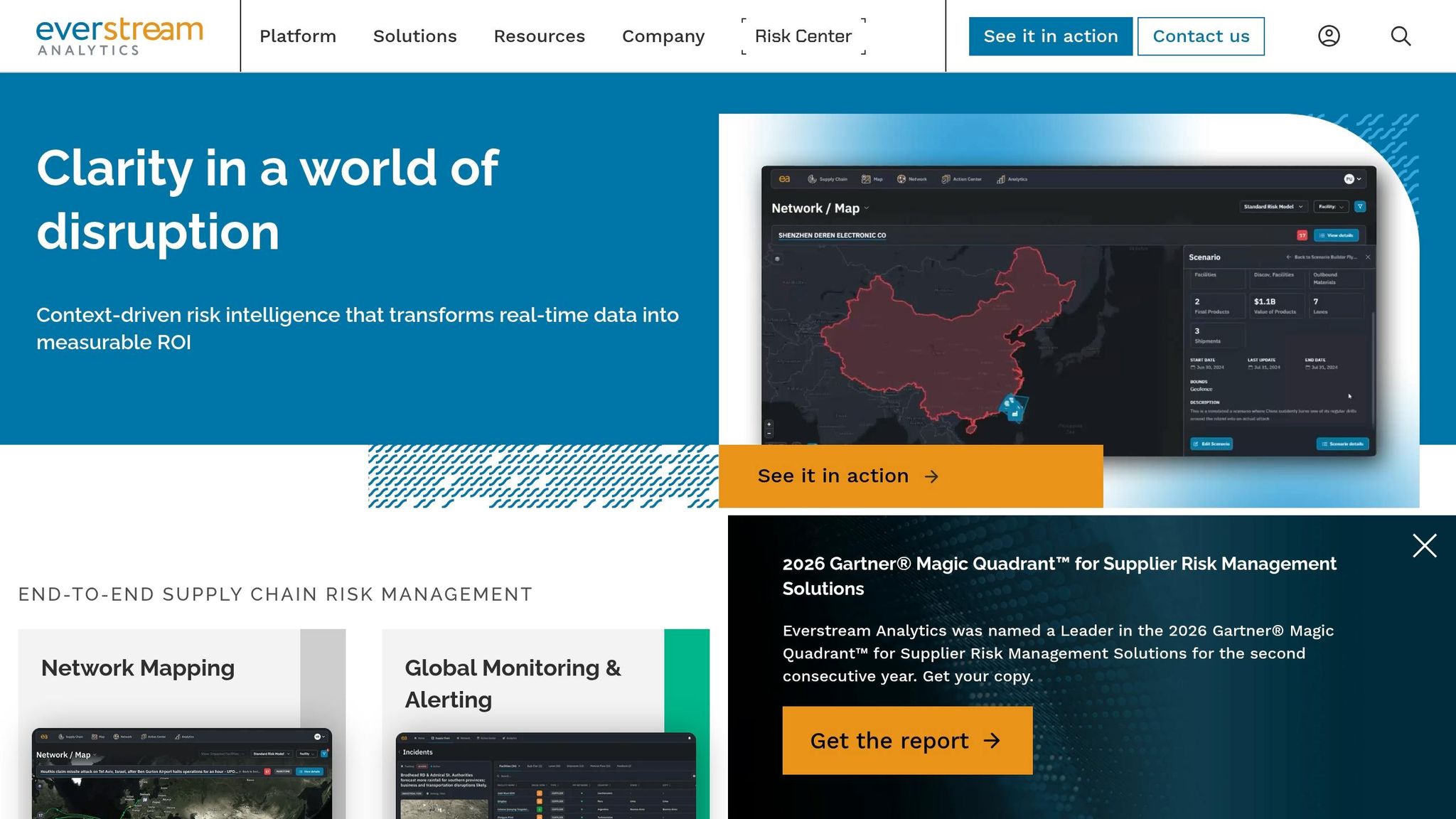
Everstream Analytics offers a fresh perspective on supplier risk management, focusing on the entire supply network rather than just direct (Tier-1) suppliers. Using AI, the platform maps out your entire supply chain, including hidden sub-tier relationships. It creates a digital twin of your network by analyzing billions of trade records and shipping data points. This approach uncovers dependencies that might otherwise remain hidden for years.
"We'd been working for four years trying to map our supply chain...They mapped our supply chain in days instead of years." - Former CSCO and SVP, Global Medical Device Manufacturer
Risk Coverage Areas
Everstream keeps tabs on over 50 risk categories, making it one of the most comprehensive platforms available. One of its standout features is climate projection modeling, which forecasts risks as far ahead as 2100. This capability supports both long-term sourcing strategies and immediate disruption responses.
Risk Category | Monitored Elements |
|---|---|
Natural Disaster & Climate | Earthquakes, hurricanes, floods, and long-range climate projections to 2100 |
Geopolitical | Trade wars, sanctions, political instability, and civil unrest |
ESG & Compliance | Forced labor (UFLPA), child labor, CSDDD mandates, and environmental violations |
Financial | Supplier bankruptcy, cash flow instability, and insolvency alerts |
Operational | Cyberattacks, infrastructure failures, and production capacity constraints |
By combining its extensive risk coverage with AI-driven insights, Everstream delivers precise monitoring and actionable data.
AI Capabilities and Monitoring Style
Everstream operates 24/7, using AI to cut through the noise and deliver alerts that are specifically relevant to your supply chain and shipments. The platform combines AI's processing power with human expertise to validate data, minimizing false positives and ensuring accurate alerts. This accuracy is often bolstered by AI data trading to fill critical information gaps. Its predictive modeling capabilities stand out, as the system analyzes historical trends and current market conditions to anticipate future risks. This gives procurement teams a critical advantage, allowing them to prepare for potential disruptions before they occur.
Procurement Benefits
The platform's advanced analytics deliver tangible results. For example:
Nissan avoided costs in the seven-figure range within six months of implementation. Over 200 users leveraged the platform to mitigate 90% of potential disruptions.
Danone integrated 60% of its procurement categories into Everstream, achieving 20% business growth through improved resilience and cutting response times to disruptions by five days.
During the 2024 floods in Germany, Molson Coors CEE used sub-tier mapping to identify that five Tier-1 suppliers relied on the same sub-tier manufacturer. This insight allowed them to secure inventory and prioritize supply lines, avoiding production stoppages.
Everstream's impact has not gone unnoticed. It was named a Leader in the 2026 Gartner® Magic Quadrant™ for Supplier Risk Management Solutions for the second consecutive year and earned a spot on the 2024 Inc. 5000 list of America's fastest-growing private companies.
4. Dataiku

Dataiku offers a dynamic AI platform designed to help procurement teams evaluate supplier risks effectively. With its conversational interface, teams can create Supply Chain Risk Agents and ask natural language questions like, "What’s the financial health of our top 10 suppliers?" The platform delivers near real-time insights, powered by advanced algorithms, to provide actionable intelligence across various risk dimensions.
Risk Coverage Areas
Dataiku evaluates suppliers using hundreds of performance metrics. It monitors internal factors like on-time delivery and contract compliance, alongside external factors such as geolocation, tariff changes, weather conditions, and news reports. These metrics help identify risks like liquidity issues or potential financial restructuring.
Using machine learning, Dataiku processes supplier documents at scale to uncover discrepancies - such as errors in country-of-origin data - that might signal fraud using AI tools for data validation. For example, an aerospace Tier 1 supplier used Dataiku to validate traceability for millions of components, significantly lowering the risk of non-compliant parts entering its supply chain.
AI Capabilities and Procurement Benefits
Dataiku goes beyond risk monitoring to enhance procurement workflows, ranking among the best AI procurement tools. It uses Retrieval-Augmented Generation (RAG) to extract precise, relevant information from supplier reports. Additionally, it translates natural language prompts into SQL queries, enabling analysts to explore complex datasets without needing advanced coding skills.
"Knowing when a key supplier is in the news and why can help identify the need for contingencies and alternates more quickly." - Christine Andrews and Romain Menini, Dataiku
5. Panorays
Panorays brings advanced cybersecurity monitoring to supplier risk management. This tool focuses on third-party cyber risk by evaluating supplier security postures. A standout feature is its Risk DNA framework, which creates a tailored profile for each supplier. This profile combines data from external attack surface assessments, internal questionnaire responses, and the importance of the supplier to your business.
Risk Coverage Areas
Panorays addresses a wide range of risks, including cybersecurity vulnerabilities, data privacy regulations like GDPR and CCPA, and compliance with frameworks such as DORA and NIS2. Its Supplier AI Risk Detection module identifies vendors using AI and evaluates risks tied to data usage, model behavior, and adherence to the EU AI Act. Additionally, it monitors geopolitical factors, such as regional conflicts and sanctions, which might disrupt supplier stability. Continuous monitoring ensures these risks are tracked in real time.
Monitoring Style
Panorays doesn’t stop at initial assessments - it provides ongoing monitoring of supplier risks. Real-time alerts notify users about changes like declining risk scores, new vulnerabilities, or exposed credentials. Its External Attack Surface Management (EASM) feature is particularly impressive, scanning hundreds of digital assets across a supplier’s environment in just a few hours.
"A supply chain risk assessment isn't a one-time audit. It's a living practice with continuous monitoring, periodic reassessments, and triggers for change – like a new vulnerability, a regulatory update, or a supplier in distress." - Dov Goldman, VP of Risk Strategy, Panorays
AI Capabilities and Procurement Benefits
Panorays uses machine learning to uncover hidden risks, such as 4th-to-Nth party suppliers and Shadow IT. Its Smart Match feature, powered by self-hosted AI and Gemini, auto-completes security questionnaires using verified data from uploaded SOC 2 certifications. These answers are then validated with NLP, comparing vendor claims against actual documentation and external findings. On top of that, Panorays integrates seamlessly with procurement and ERP systems like Coupa, SAP, NetSuite, and Oracle, ensuring vendor data and risk assessments stay aligned with your business processes.
6. PwC
PwC takes supplier risk management to the next level by combining cutting-edge technology with expert consulting. Their approach revolves around two AI-powered frameworks: Check Your Value Chain (CYVC) and Know Your Supplier (KYS). These tools help procurement teams manage risks across their entire supply chain - not just Tier 1 suppliers - by blending regulatory expertise, automation, and consulting insights. Together, these frameworks enable comprehensive risk management and continuous monitoring.
Risk Coverage Areas
PwC's solutions address a wide range of supplier risks, from cybersecurity threats and financial fraud to ESG issues and human rights violations. The CYVC platform focuses on compliance risks related to regulations like SCDDA, CSDDD, CBAM, and EUDR, while KYS targets concerns such as fraud, bribery, money laundering, child labor, and supplier over-reliance. Additionally, PwC's anti-fraud tools are designed to detect carousel fraud and uncover hidden relationships between employees and vendors.
Monitoring Style
PwC emphasizes continuous monitoring throughout the supplier lifecycle. The CYVC platform conducts daily automated risk assessments using diverse data sources. For organizations without the internal resources to manage this process, PwC offers a Managed Services option, where their experts oversee CYVC operations and provide custom risk reports tailored to the client's needs.
PwC underscores the importance of supplier risk management with this statement:
"Supplier risk management is no longer a nice-to-have, but essential for the survival of an organisation." - PwC Netherlands
AI Capabilities and Procurement Benefits
The CYVC framework leverages Generative AI to automatically classify and review supplier documentation, simplifying the management of certifications and legal requirements tied to new regulations. Meanwhile, the KYS framework uses advanced analytics to transform raw data into actionable risk scores.
A standout example of PwC's impact is their collaboration with Condor Flugdienst GmbH in 2024. PwC Germany helped the company implement CYVC to meet SCDDA compliance standards. This initiative not only optimized Condor's supply chain decisions but also earned them 1st place in the "Sustainability" category at the Best of Consulting Awards 2024.
"With Check Your Value Chain, we combine our current regulatory knowledge, technical expertise and industry know-how to ensure the efficient and practical implementation of various complex supply chain requirements." - Viktoria Demin, Director, Sustainability Services, PwC Germany
CYVC also integrates seamlessly with major enterprise systems. To guide procurement teams, PwC evaluates supplier risk management maturity across five stages - from Unstructured to World Class - helping organizations identify their current level and plan for improvements.
7. Tacto
Tacto, is an AI-driven platform designed to simplify and speed up supplier risk assessments. What typically takes weeks with manual processes can be accomplished in a fraction of the time using this tool.
Risk Coverage Areas
Tacto addresses a wide range of supplier risks, keeping an eye on compliance and operational performance. It monitors ESG requirements under frameworks such as LkSG and CSDDD, as well as product-specific regulations like REACH, RoHS, Conflict Minerals, CE marking, and WEEE. Beyond compliance, it evaluates financial stability, supplier performance, and environmental factors like CO₂ emissions linked to CBAM. These metrics form the foundation for its in-depth risk analysis.
AI Capabilities and Procurement Benefits
By using specialized AI agents, Tacto automates the review of contracts, financial statements, credit reports, certifications, and audit reports. This streamlined analysis provides procurement teams with faster, data-backed insights, freeing them to focus on strategic priorities.
8. Atlas Systems

Atlas Systems' ComplyScore® platform simplifies vendor risk assessments by automating the entire process - from initial intake to continuous monitoring and remediation. Leveraging AI, it auto-fills questionnaires with past vendor responses and security data, slashing the typical 45-day cycle to less than 10 days.
Risk Coverage Areas
ComplyScore® keeps a close eye on various risk factors, including cybersecurity threats, financial stability, operational performance, and regulatory compliance. It supports major frameworks such as GDPR, HIPAA, SOX, ISO 27001, SOC 2, PCI DSS, and DORA. For supply chain-specific risks, Atlas Verified expands the scope to include OFAC sanctions, FDA import alerts, vessel routing issues, and organic certification integrity. It even tracks real-time AIS shipment data to catch irregularities early.
AI Capabilities and Procurement Benefits
Explainable AI (XAI) provides detailed breakdowns of vendor ratings, covering cyber, financial, regulatory, and ESG factors. This transparency makes it easier to justify assessments during audits. AI tools also analyze uploaded documents, such as SOC 2 reports, to spot missing controls and suggest remediation steps - reducing review times from days to just hours.
Atlas Systems takes these AI-driven insights a step further by optimizing procurement assessments. For teams pressed for time, they offer TPRM as a Service, giving access to over 100 global experts who handle vendor outreach, assessments, and follow-ups. The results are impressive: organizations see assessment costs drop by 40–60% and achieve up to 95% vendor coverage, compared to manual methods.
"One of the key differentiators between Atlas and other governance, risk and compliance and 3rd party risk management tools is the ease of use of the Atlas solutions. Also from a total cost of ownership perspective, Atlas far exceeds those requirements in terms of being very cost efficient in delivering all this." - Izhar Mujaddidi, Senior Director, Cybersecurity, Carelon Behavioral Health
Highlighting its influence in the industry, Atlas Systems was named a Representative Vendor in the 2025 Gartner Market Guide for Third-Party Risk Management Technology Solutions.
9. FS-ISAC
FS-ISAC is a network driven by its members, designed to share critical insights about supplier risks in the financial services sector. It connects banks, credit unions, insurers, and payment processors, creating a collaborative space for exchanging supplier risk information. This complements the AI-based monitoring strategies discussed earlier.
Risk Coverage Areas
The network focuses on addressing cybersecurity and operational risks within the financial services supply chain. Members gain access to detailed insights about third-party supplier risks, which can be translated into actionable steps for managing those risks effectively.
Monitoring Approach
FS-ISAC operates through a collaborative model where members share risk-related insights. This approach allows for the early detection of supplier risks and facilitates quicker responses to incidents. By pooling knowledge, the network directly supports data-driven procurement decisions and enhances overall risk management.
Procurement Benefits
For procurement teams in financial services, FS-ISAC membership offers a streamlined way to manage supplier assessments. By relying on shared evaluations, teams can avoid redundant efforts, respond more quickly to supplier-related incidents, and maintain stronger relationships with critical vendors.
10. Ivalua
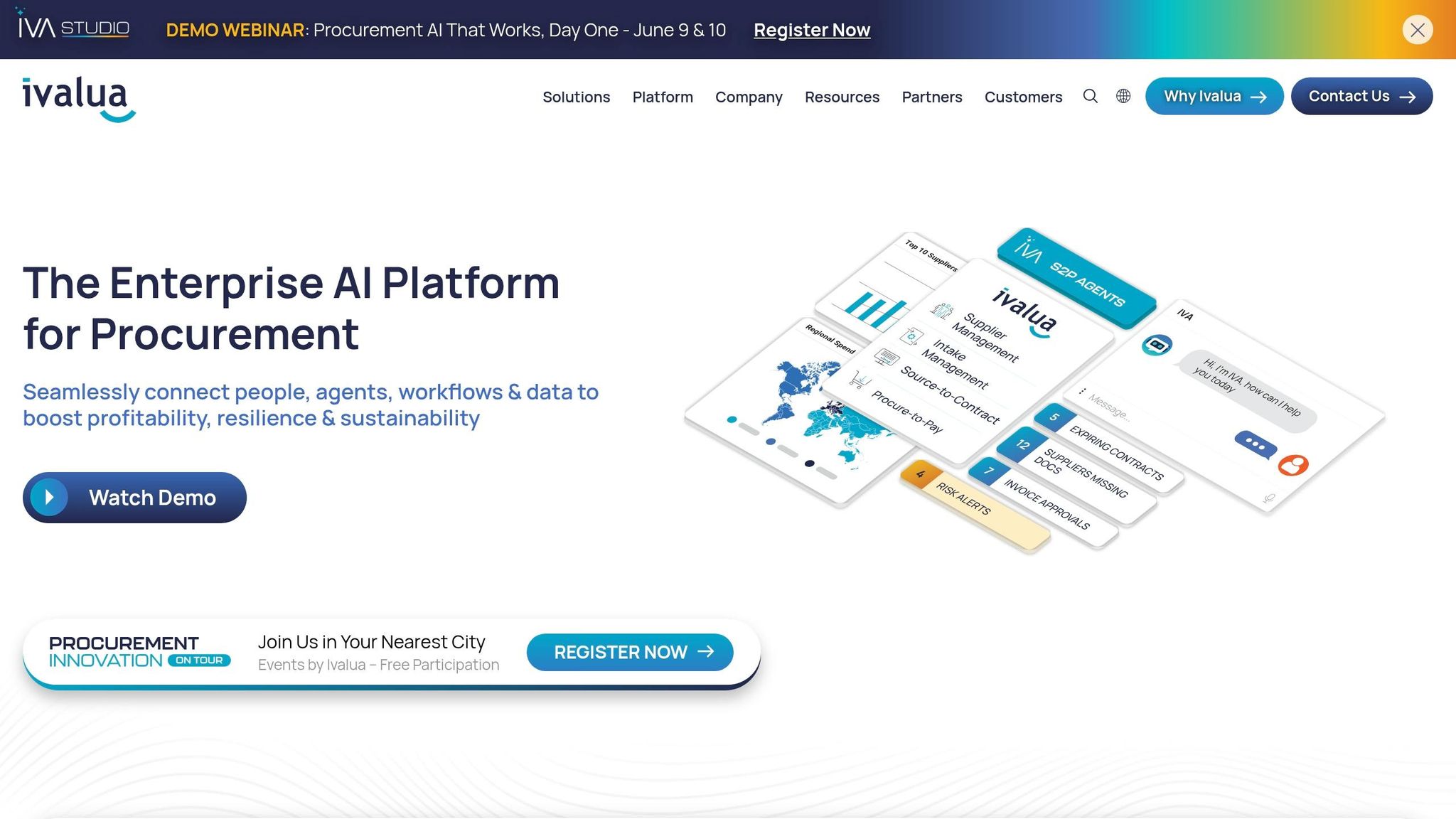
Ivalua is a source-to-pay platform designed to unify supplier data from multiple ERPs and business units into a single, reliable record. This gives procurement teams a consistent and clear view of their vendors, helping them compare hundreds of vendors to find the best fit.
Risk Coverage Areas
Ivalua addresses several types of supplier risks, including:
Financial stability: Tracks credit ratings, payment defaults, and bankruptcy risks.
Operational performance: Monitors issues like delivery delays and defect rates.
ESG and regulatory compliance: Ensures adherence to environmental, social, and governance standards.
Cybersecurity threats: Identifies potential vulnerabilities.
Geopolitical exposure: Assesses risks tied to global events.
Monitoring Style
The platform moves away from traditional manual reviews and instead focuses on continuous, predictive monitoring. Using AI, Ivalua detects early warning signs such as inconsistencies in lead times or missing certifications, enabling proactive risk management.
AI Capabilities
Ivalua's AI tools take risk management to the next level with several advanced features:
Intelligent Virtual Agent (IVA): Provides real-time alerts and automates tasks like document validation and approval routing.
Document Intelligence: Extracts compliance information directly from ESG reports, ISO certifications, and insurance documents, minimizing manual effort.
Smart Supplier Selection Model (S³M): Uses machine learning to simulate trade-offs between cost, risk, and sustainability, helping procurement teams make better sourcing decisions.
"IVA finds the details that scores hide - pulling from contracts, invoices, sourcing history, and performance data to surface what actually matters." - Ivalua
Procurement Benefits
The integration of AI into supplier risk management is proving to be a game-changer. According to McKinsey research from April 2025, using AI for compliance checks and invoice matching can reduce spending by 5–15%. Ivalua's own pilot programs have demonstrated savings of 4–10% with 96% accuracy. The platform has earned recognition as a Leader in both the Forrester Wave™: Supplier Value Management Platforms, Q3 2024 and the 2026 Gartner® Magic Quadrant™ for Source-to-Pay Suites, while maintaining a 4.7/5 rating on G2.
"With Ivalua, we realized tremendous speed-to-value and benefit from a simpler and more focused source-to-contract solution. We have already achieved 10x ROI in a very short time." - Arindam Sengupta, Global VP Strategic Sourcing & Procurement, Dole
Tool Comparison Table
To simplify the decision-making process, here's a side-by-side comparison of ten procurement tools. This table highlights each platform's focus, monitoring approach, key AI features, and the type of procurement teams that benefit most from using them. It's a quick way to identify which tool aligns with your risk management needs.
Tool | Risk Coverage | Monitoring Style | Key AI Capability | Best For |
|---|---|---|---|---|
Procright | Compliance, specification accuracy, product fit | On-demand and automated | automating product specifications, compliance scoring, transparent product comparison | Spec-to-sourcing workflows |
Owlin | Financial, reputational, operational | Real-time monitoring | NLP-based media scanning across global sources | Early warning on supplier reputation shifts |
Everstream Analytics | Supply chain disruption, geopolitical, weather | Continuous, predictive | Predictive risk modeling with multi-tier visibility | Supply chain resilience planning |
Dataiku | Custom risk models across any data type | Batch and real-time, configurable | ML model building, data pipeline automation | Data science teams building custom risk frameworks |
Panorays | Cybersecurity, third-party digital risk | Continuous automated scanning | Attack surface analysis, cyber posture scoring | IT and security-focused procurement teams |
PwC | ESG, regulatory, financial, operational | Advisory-led with AI augmentation | AI-assisted risk diagnostics and reporting | Enterprises needing strategic risk consulting |
Tacto | Contract and document risk | Document-level, on-demand | AI contract review and clause risk flagging | Legal and procurement contract workflows |
Atlas Systems | Operational, compliance, financial | Ongoing managed monitoring | Managed risk intelligence with human oversight | Outsourced supplier risk management programs |
FS-ISAC | Cybersecurity and financial sector threats | Community-driven, real-time | Threat intelligence sharing across financial institutions | Financial services supplier risk teams |
Ivalua | Financial, ESG, cyber, geopolitical, operational | Continuous, predictive | IVA agent, Document Intelligence, S³M sourcing model | End-to-end source-to-pay risk management |
This table makes it easier to pinpoint tools that address specific procurement challenges. For example, Panorays and FS-ISAC specialize in cybersecurity and are ideal for teams focused on digital risks. Meanwhile, PwC stands out for enterprises requiring a mix of AI tools and expert guidance to navigate complex supplier risks.
If your focus is on covering the entire procurement lifecycle, Procright and Ivalua make a strong case. Procright excels at the early stages, ensuring specifications are accurate, compliance is verified, and product comparisons are clear. On the other hand, Ivalua provides a broader scope, handling financial monitoring, ESG tracking, and predictive supplier health assessments further along the process.
Ultimately, the right tool depends on where your risk gaps lie and how comprehensive your procurement needs are.
Conclusion
AI tools have transformed how procurement teams handle supplier risk. Gone are the days of relying on outdated periodic reviews. Now, teams benefit from real-time, continuous monitoring that identifies issues before they escalate. In fact, organizations using AI-driven risk monitoring report 72% fewer supplier issues discovered too late and an 83% faster response to emerging risks. This shift allows procurement teams to focus on selecting tools more strategically.
To pick the right tool, start by answering three key questions: What’s your biggest risk exposure? How large is your team? And how much of the process do you want to automate?
Your organization’s size also plays a role in tool selection. Larger enterprises often require tools that integrate seamlessly with existing source-to-pay systems while covering a broad range of risks - financial, ESG, and operational. On the other hand, smaller teams may gain the most from tools that automate specific tasks like supplier onboarding, contract review, or ensuring specification accuracy.
No matter the size of your team, one principle stands out: choose tools that offer transparency. The best AI tools don’t just flag risks - they explain them. Look for features like transparent scoring, source-linked findings, and clear audit trails. These capabilities make it easier to defend decisions to internal auditors and regulators while ensuring you stay ahead of potential issues.
FAQs
What supplier risks should we prioritize first?
To address supplier risks effectively, tailor your risk framework to match your industry, the criticality of your products, and your organization's risk tolerance. Key areas to evaluate include financial stability, geopolitical exposure, operational resilience, and compliance history. These elements help identify potential vulnerabilities that could disrupt your operations.
Procright simplifies this process by offering clear compliance scores and data-driven insights. Its tools automate tasks like creating specifications and conducting compliance checks, enabling your team to focus on the suppliers that have the greatest impact on your business.
How do we validate AI risk scores for audits and compliance?
To ensure the reliability of AI supplier risk scores, focus on traceability and evidence-based evaluations. Start by maintaining immutable audit trails and searchable logs to document every action taken during the assessment process. This includes retaining all assessment responses and providing clear, transparent justifications for the AI-generated risk scores through detailed reports.
For any critical changes to these scores, implement approval workflows that require proper governance before adjustments are made. This helps maintain accountability and ensures that all modifications are well-documented and authorized.
Additionally, schedule regular reassessments to keep risk evaluations up to date. Connect the risk outputs directly to documented due-diligence requirements, ensuring every decision aligns with established standards and expectations. This approach not only strengthens trust but also ensures compliance with regulatory and organizational guidelines.
What data is needed to set up AI supplier risk monitoring?
To establish AI-driven supplier risk monitoring, start by defining a clear risk taxonomy. This could include categories like financial health, cybersecurity posture, and ESG (Environmental, Social, and Governance) factors. Ensure there are clear ownership roles and escalation protocols for managing these risks.
Next, gather both internal data and external signals. Internal data might include your organization's spend history, supplier performance metrics, and contract details. On the external side, look for insights from financial reports, regulatory databases, and alerts about cyber incidents.
Finally, create and maintain updated supplier profiles. These should include risk scores and triggers derived from the data you've collected. This approach ensures you're continuously monitoring and ready to respond to potential risks effectively.
Related Blog Posts
Try it on a real buy
Bring one category. Watch where the flags land.
We use a little analytics to see which pages actually help. Nothing else, no ad trackers.