AI in Search Optimization: Key Metrics Explained
Outlines new metrics for AI-driven search—citation share, branded search lift, NDCG/MRR—and how they affect procurement and business outcomes.
In this article
AI-driven search optimization is changing how businesses approach visibility in search results. Instead of just aiming for top-ranked links, the focus is now on being included in AI-generated answers from platforms like ChatGPT, Perplexity, and Google AI Overviews. This shift demands new metrics to measure success in this evolving landscape.
Key Takeaways:
New Metrics Matter: Traditional SEO metrics like click-through rate (CTR) are less relevant as AI-generated answers reduce organic clicks by 61%. Metrics like citation share, branded search lift, and AI-referred sessions are now critical.
AI's Role in B2B Buying: 94% of B2B buyers use AI tools during procurement, so optimizing product data for AI retrieval is essential to avoid being overlooked.
Performance Metrics:
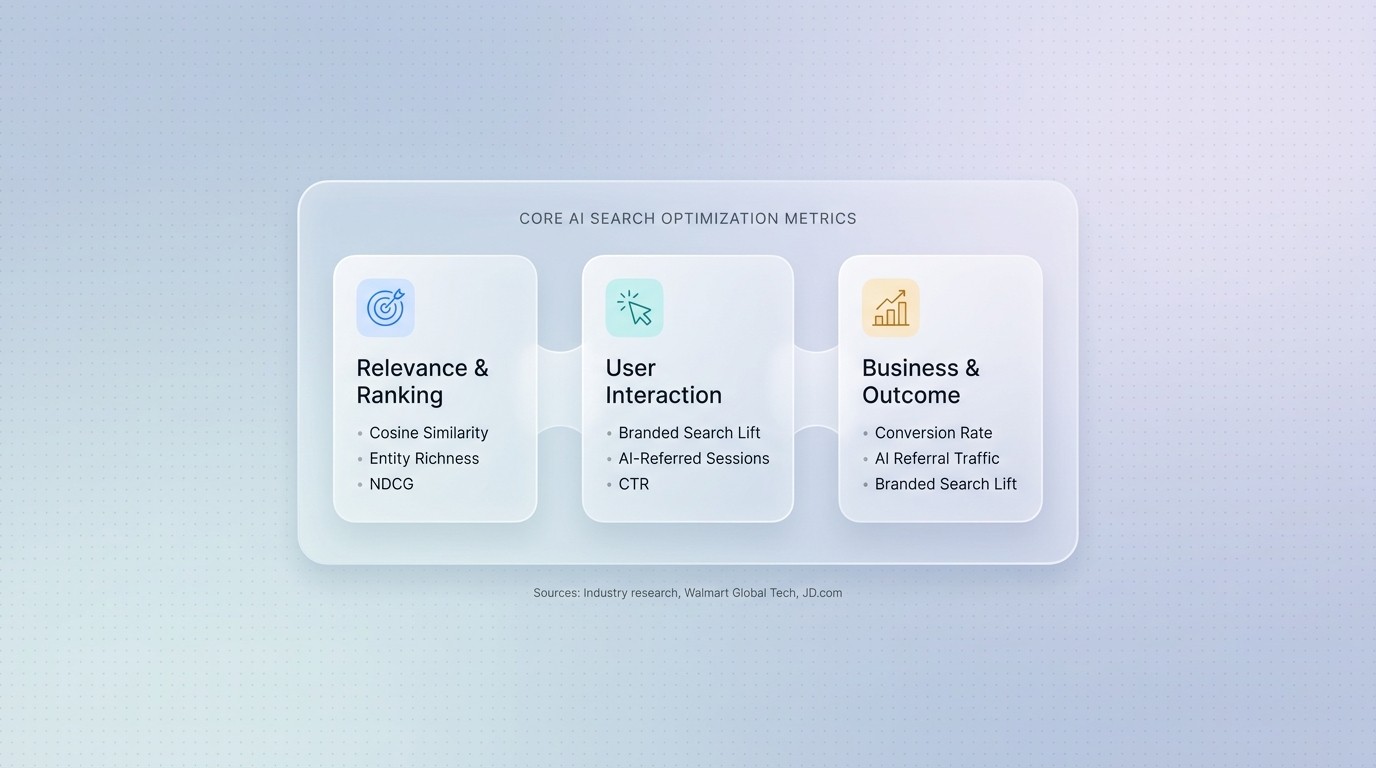
Relevance & Ranking: Tools like cosine similarity and NDCG measure how well content aligns with user intent.
User Interaction: Metrics like branded search lift and AI-referred sessions focus on engagement beyond clicks.
Business Outcomes: AI referral traffic and conversion rates highlight the commercial impact of AI visibility.
Procurement Impact: AI tools like Procright help businesses save time and money by improving supplier identification and compliance scoring, cutting sourcing cycles by 30–50%.
The shift to AI-driven search requires businesses to rethink their strategies and metrics to remain visible, accurate, and impactful in AI-generated answers.
AI Search Metrics vs. Traditional SEO: Key Stats & KPIs
Core Metric Categories in AI Search Optimization
Relevance and Ranking Quality Metrics
Relevance metrics measure how well an AI search system delivers results that align with a user's intent - moving beyond basic keyword matching. Tools like cosine similarity (which gauges the similarity between a query and content) and entity richness help determine if content qualifies for retrieval. While traditional metrics like NDCG remain important, they now operate within a semantic framework where understanding context and intent is key.
"AI systems do not reward rankings; they reward entity strength, semantic clarity, and content depth." - Ivica Srncevic, SRNA SEO
This shift means that content must be clear, well-structured, and enriched with meaningful context to stand out. Interestingly, 80% of LLM citations do not rank within the top 100 results on traditional Google searches.
While relevance focuses on aligning content with intent, user interaction metrics reveal how this alignment translates into actual engagement.
User Interaction and Behavior Metrics
Understanding user behavior is essential for evaluating AI search performance. While CTR has historically been the go-to metric for engagement, AI-driven search calls for a broader perspective. For instance, 93% of Google "AI Mode" searches end without any click to an external site.
"The click becomes optional. If you're only measuring traffic, you're measuring the part of the journey that's shrinking." - Emma Kessinger, Marketing Leader
Key metrics here include branded search lift, which tracks how often users search for a brand after encountering an AI-generated answer, and AI-referred sessions. Notably, traffic referred by AI converts 11x to 23x better than traditional organic visitors.
Business and Outcome Metrics
Building on user engagement, business metrics focus on the tangible commercial benefits of AI search visibility. Metrics such as conversion rates, AI referral traffic, and branded search lift help quantify the impact of AI-driven search on business outcomes, especially in enterprise and procurement contexts.
Here’s a quick breakdown of the three core metric categories and their key performance indicators:
Category | Focus | Key KPIs |
|---|---|---|
Relevance & Ranking | Matching content to user intent | Cosine similarity, entity richness, NDCG |
User Interaction | Engagement signals | CTR, branded search lift, AI-referred sessions |
Business & Outcome | Measuring commercial impact | Conversion rate, AI referral traffic, branded search lift |
Branded search lift, in particular, highlights the increase in direct brand searches after AI citations. Since traditional attribution models often miss these indirect conversions, it offers a more complete picture of the commercial benefits tied to AI search visibility. To see how these metrics translate into operational efficiency, you can book a demo of AI-driven procurement tools.
Key Metrics in Recent AI Search Research
Normalized Discounted Cumulative Gain (NDCG)
When it comes to procurement and product discovery, ranking metrics like NDCG are essential for evaluating how effectively AI procurement tools prioritize relevant results. NDCG examines a ranked list by considering both the relevance of each result and its position. It uses a logarithmic discount, meaning items further down the list contribute less to the overall score. The result is normalized to a value between 0 and 1, where 1 indicates a perfect ranking. A common focus is NDCG@K, which evaluates only the top K results.
In April 2026, Walmart Global Tech researchers Shasvat Desai and Md Omar Faruk Rokon implemented a unified supervision framework in their sponsored search system. By combining semantic and engagement signals, Walmart achieved a 5.7% improvement in NDCG@25, raising it from 0.867 to 0.916. They also increased Precision@25 by 10.5%.
"Our approach outperforms the current production system in both offline evaluation and online A/B tests, yielding consistent gains in average relevance and NDCG." - Shasvat Desai, Staff Data Scientist, Walmart Global Tech
Interestingly, even using relevance signals alone improved NDCG@25 by 5.4%, showing that semantic clarity plays the most critical role in ranking quality. Engagement signals, while helpful, serve as a secondary enhancement.
Next, let’s look at metrics that focus on how quickly relevant results are delivered.
Mean Reciprocal Rank (MRR) and Top-K Accuracy
In procurement and product discovery, the speed at which a system delivers the right result is just as important as ranking quality. Mean Reciprocal Rank (MRR) measures this by taking the reciprocal of the rank of the first relevant result. For example, a result ranked first scores 1.0, second scores 0.5, and third scores about 0.33. This metric is particularly effective for single-answer queries, as it emphasizes the importance of early relevance.
Top-K Accuracy (Recall@K), on the other hand, checks if a relevant result appears within the top K positions. Together, these metrics provide a fuller picture of retrieval performance.
"MRR is the cleanest signal when the application only reads the top result." - FutureAGI
In cases where users benefit from multiple valid options - such as procurement workflows - metrics like NDCG or Recall@K become equally important.
Now, let’s explore how user engagement adds another layer of insight into search quality.
Engagement-Based Metrics
Engagement metrics, such as clicks, add-to-carts, and orders, go beyond algorithmic relevance to highlight user behavior. These metrics are particularly useful for evaluating search performance in real-world settings like procurement and product discovery. However, engagement isn’t a perfect measure of relevance, as user actions might be influenced by factors like popularity, promotions, visual appeal, or price rather than actual relevance.
In Walmart’s 2026 study, engagement signals were weighted based on their importance - orders (1.5), add-to-carts (0.3), clicks (0.1), and views (0.01). This approach helped distinguish genuine user preferences from incidental interactions. Similarly, JD.com’s April 2026 study demonstrated how their RAD-DPO framework addressed "pseudo-negatives" caused by position bias. This framework led to a 0.34% increase in User Conversion Rate during a week-long A/B test, all while keeping prediction latency under 150 milliseconds.
Engagement metrics refine semantic relevance by focusing on items that genuinely capture user interest. By applying these signals only to results that meet a baseline relevance threshold, systems can avoid promoting popular but irrelevant items.
Methods for Evaluating and Tuning AI Search Systems
Offline Evaluation with Labeled Data
One way to evaluate AI search systems is by testing them offline with a fixed dataset of human-labeled queries and documents. This allows engineers to measure ranking accuracy using metrics like NDCG (Normalized Discounted Cumulative Gain) and MAP (Mean Average Precision) in a controlled setting.
The quality of the test set plays a crucial role here. A strong baseline typically includes 200–300 queries that reflect real-world usage and is updated every quarter. Research shows that smaller test sets - like one with 50 topics - can lead to an error rate of around 5% when detecting MAP differences of 5%. This suggests smaller sets might overstate a model's effectiveness.
A newer approach, called "LLM-as-a-judge," uses models like GPT-4 to score search results automatically. This method cuts down on the time and costs tied to manual labeling. In March 2026, researchers Sejal Jain and Promod Yenigalla introduced PROBES, a system powered by large language models (LLMs) for evaluating semantic search. PROBES categorizes relevance into fine-grained labels - such as exact, substitute, complement, or irrelevant - and achieves an Actionable Error Rate (AER) of 76% across 100 product categories.
Online Experimentation and A/B Testing
After offline evaluations, the next step is to test the model's performance with real users. A/B testing is a popular method for this, as it measures how users interact with the system in real time. Metrics like conversion rates, click-through rates, and add-to-cart actions provide insights that static datasets can't offer.
"Offline evaluation is essential; online A/B testing confirms real-world performance."
For instance, Walmart Global Tech reported a +0.99% boost in Add to Cart Rate and a +0.60% rise in ad impressions during A/B testing in April 2026. Similarly, in March 2026, JD.com deployed GenFacet, a generative faceted search framework, which led to a 42.0% increase in facet click-through rates and a 2.0% boost in user conversion rates through live testing on the JD App.
However, in e-commerce and procurement, conversion events can be rare, making it hard for standard A/B tests to achieve statistical significance quickly. To address this, Airbnb's search ranking team introduced an interleaving framework in August 2025. This method combines results from two rankers, enabling the identification of promising candidates with 50 times less traffic than traditional A/B tests require. It's also important to monitor latency, as slower response times can hurt user engagement.
Multi-Objective Optimization Across Metrics
Balancing multiple objectives is key to ensuring the overall efficiency of AI search systems. Focusing too much on a single metric can lead to regressions in other areas. For example, improving precision might reduce diversity, or more comprehensive re-ranking could increase latency.
One way to handle these trade-offs is by using a trade-off map. This document sets specific numerical thresholds - such as NDCG@10 ≥ 0.82 or P99 latency ≤ 180 ms - along with acceptable regression limits and a monitoring plan. Defining these benchmarks ahead of time removes subjective decision-making when results are mixed.
The aim is to operate on the Pareto frontier, where no single metric can be improved without negatively affecting another. In procurement, this balance is especially important. AI systems must interpret user intent accurately while deterministic rules ensure compliance with standards. Splitting responsibilities - using AI for language understanding and rules-based logic for technical decisions - helps achieve both flexibility and reliability. These methods ensure AI search systems perform well across both technical and operational requirements.
Applying AI Search Metrics to Procurement and Product Discovery
Mapping Metrics to Procurement Outcomes
The metrics used in AI search tools play a direct role in achieving the outcomes procurement and operations teams prioritize. These include how often the most relevant product appears first, how many valid options are presented, and how quickly teams can move from searching to making decisions.
For example, recall measures how well a system matches specifications. A low recall score means compliant products might be overlooked, leading to manual searches and delays in sourcing. Meanwhile, NDCG evaluates ranking quality, ensuring the most specification-compliant or cost-effective options appear at the top of search results. When these metrics improve, procurement teams can spend less time searching and more time deciding.
In April 2026, a global agricultural company used an AI tool to create supplier negotiation strategies and target pricing for a major capital project. This approach saved them 3%–5% and reduced the time to develop category strategies by an impressive 90%. Such efficiency gains stem from improved search and ranking metrics, which lay the groundwork for better compliance and greater transparency in procurement processes.
Compliance and Transparency Metrics
In addition to outcome-focused metrics, compliance and transparency measures are essential for maintaining procurement integrity. A search result that appears relevant but cannot be verified poses a significant risk.
One useful framework is the Comparable-Spec Index, which evaluates vendor comparisons across five dimensions: Coverage, Normalization, Citation, Confidence, and Decision-Readiness. Each dimension is scored from 0 to 4, with a maximum of 20 points. A score of 16 out of 20 is recommended for a "decision-ready" state. If the score falls between 12 and 15, the lowest-performing dimension - often Normalization or Confidence - should be addressed before presenting to stakeholders.
"Extraction without citations is unverifiable... an unauditable answer is operationally useless even when it happens to be correct." - Rhea Kapoor, Head of Procurement Research, SpecLens
One often-overlooked metric is citation traceability, which ensures every AI-extracted value links back to a specific source document and page. Tools like Procright tackle this by offering compliance scores and sourcing data from various formats such as web content, PDFs, and videos. This ensures that every recommendation includes an audit trail, avoiding black-box outputs. This level of traceability is becoming increasingly important as regulations like the EU AI Act, set to take effect on August 2, 2026, impose stricter compliance requirements. Automated compliance testing has already been shown to reduce manual errors by 85%.
Measuring Efficiency and Cost Impact
AI-driven procurement tools also focus on improving efficiency and reducing costs. These tools minimize manual reconciliation, avoid delays in decision-making, and capture missed savings opportunities. For instance, AI-powered specification intelligence can save approximately 8 hours per vendor comparison. Organizations that implement AI effectively can achieve additional savings of 3% to 7%.
The key to securing buy-in for these tools is linking efficiency gains to metrics that finance teams already track. As Sandeep Karangula, Co-Founder of MoleculeOne.ai, explains:
"The teams that get sign-off are not the ones with the biggest projected number. They are the ones who calculate honestly, report ranges, and tie every dollar to something finance can already track."
Cycle time reduction is a clear indicator of efficiency. For example, a 1,500-employee financial services firm used the Comparable-Spec Index to evaluate vendor comparisons. This process uncovered a normalization gap in IOPS block sizes that, if left unaddressed, would have delayed the architecture board's decision by two weeks. Catching such issues early not only saves time but also prevents unnecessary costs before contracts are finalized.
How to Measure Visibility in AI Search (LLMO Metrics Breakdown)
Conclusion: Using Metrics to Improve AI-Driven Search
The evolution from traditional keyword rankings to AI-driven search has reshaped how we define "good performance." Metrics like NDCG, MRR, recall, and citation traceability now go beyond benchmarking - they actively influence product discovery, vendor selection, and procurement decisions.
Visibility alone is no longer enough. As Mihir Naik, Senior PM (AI) at seoClarity, aptly states:
"Presence with a bad story is worse than no presence."
This highlights a critical point: having a prominent presence without solid, credible data can harm trust. In procurement, this becomes especially problematic. An AI system that suggests unsuitable products or lacks verifiable information introduces unnecessary risks. Metrics like the Comparable-Spec Index and citation traceability help close the gap between simply appearing in search results and being genuinely useful for decision-making.
These refined metrics play a key role in driving efficiency and boosting conversions in procurement workflows. By tracking metrics that combine visibility, quality, and measurable business outcomes, organizations can directly connect search performance to results that matter to financial stakeholders. This makes it clear that precise and verifiable metrics are not just helpful - they're essential for turning search optimization into a strategic advantage.
Platforms such as Procright illustrate this shift perfectly. By integrating compliance scoring with source traceability, they transform search optimization into a practical, operational tool. Every AI-driven insight is tied back to a verifiable source, ensuring that search optimization becomes a dependable cornerstone for procurement decisions.
FAQs
How do I measure AI visibility if clicks keep dropping?
To gauge AI visibility when clicks are dropping, it's important to look beyond just traffic and rankings. Pay attention to mentions in AI responses, brand search volume, and AI citation share of voice. For example, track how often your brand is mentioned in AI-generated answers and use tools like Google Search Console to monitor search volume trends.
You can also evaluate metrics like longer session durations, higher conversion rates, and an increase in direct searches. These indicators can offer valuable insights into your brand's visibility and user engagement, even when clicks decrease.
What’s the fastest way to track citation share across AI answers?
The fastest method is leveraging AI monitoring tools such as Profound, Otterly, or Athena Intelligence. These tools automate citation tracking across various engines, saving you time and effort.
If you prefer a manual approach, review 50–200 high-intent buyer queries weekly on platforms like ChatGPT or Claude. To calculate your share, divide the number of responses citing your brand by the total responses sampled.
For continuous analysis, set up regex filters in Looker Studio to monitor AI referral traffic through Google Analytics 4. This ensures you stay on top of how often your brand is being referenced.
Which metrics prove ROI for AI search in procurement?
Key metrics that highlight the return on investment (ROI) for AI-driven search in procurement include:
AI-referred traffic: This type of traffic converts at a rate 4.4 times higher than traditional organic traffic.
Engagement time: Users spend an impressive 8–10 minutes interacting with the content.
Three-layer attribution model: This model tracks key areas such as influenced pipeline, brand lift, and direct referral traffic.
When combined, these metrics paint a clear picture of measurable financial gains.
Related Blog Posts
Try it on a real buy
Bring one category. Watch where the flags land.
We use a little analytics to see which pages actually help. Nothing else, no ad trackers.