AI in Procurement: Data Extraction Benefits
AI extraction turns procurement documents into accurate, auditable data—slashing manual work, errors, and compliance risk.
In this article
AI data extraction cuts procurement work from hours to minutes and improves procurement accuracy at the same time. I’d boil the article down to this: if you’re still keying data from invoices, contracts, and supplier forms by hand, you’re paying more, moving slower, and leaving more room for errors and audit issues.
Here’s the short version in plain English:
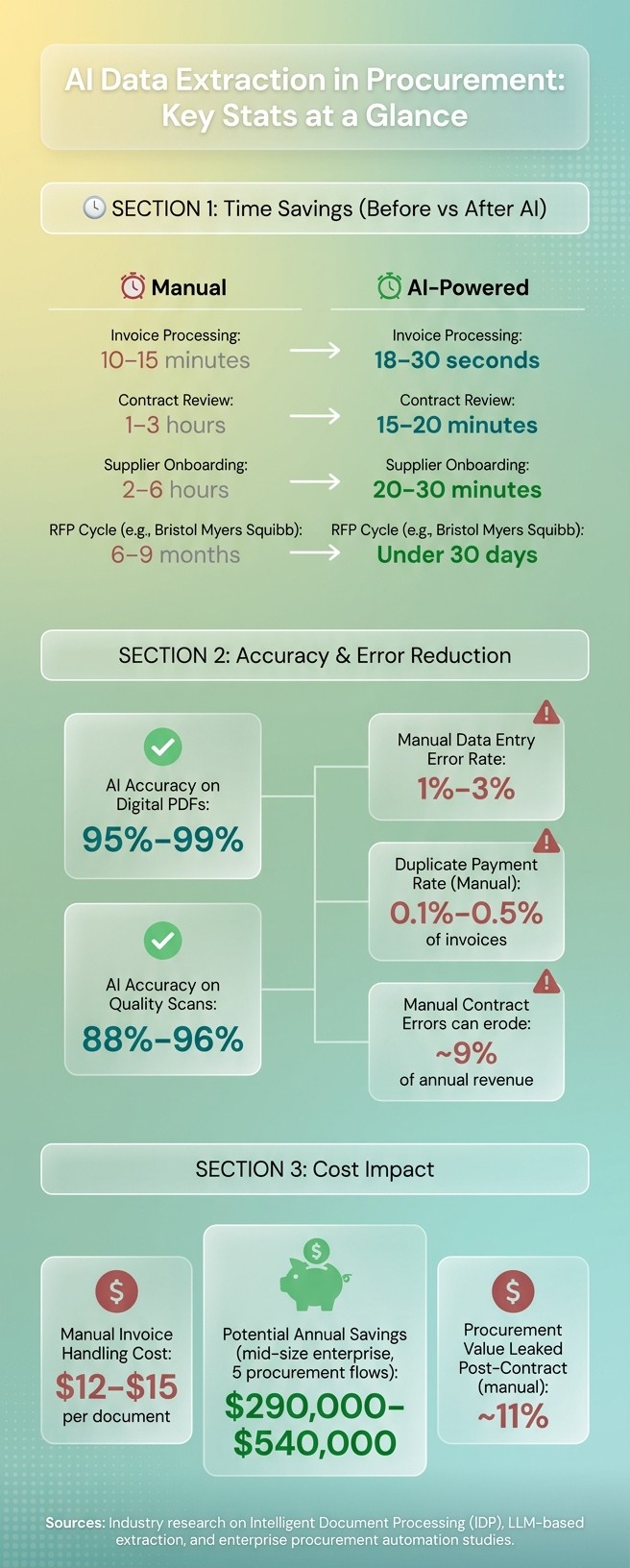
Invoices can drop from 10–15 minutes of manual work to 18–30 seconds
Contract review can go from 1–3 hours to 15–20 minutes
Supplier onboarding can shrink from 2–6 hours to 20–30 minutes
AI extraction often reaches 95%–99% accuracy on digital PDFs and 88%–96% on clean scans
Manual invoice handling often costs $12–$15 per document
A mid-size company may save $290,000–$540,000 per year by automating five core procurement document flows
What matters most is not just speed. Once data is pulled from PDFs, scans, and email attachments into a structured format, I can use it for ERP entry, 3-way matching, supplier checks, contract tracking, audit support, and spend analysis.
The article also makes one point very clear: good extraction improves control. It helps flag low-confidence fields, spot duplicate payments, check policy rules, trace data back to the source file, and send risky items to a person for review.
If I had to sum it up in one line: AI data extraction turns procurement documents into usable data, which means less manual work, fewer errors, and tighter process control.
AI vs Manual Procurement: Time, Cost & Accuracy Savings
How Studies Measure AI-Driven Data Extraction
Document Types and AI Technologies Covered in Research
Research on AI data extraction in procurement tends to look at the documents teams deal with every day: invoices, purchase orders, contracts, supplier specification sheets, RFP/RFQ responses, and onboarding files like W-9s and certificates of insurance. These are the high-volume, high-risk parts of procurement, so they also shape how researchers judge speed, accuracy, and compliance.
The best AI procurement tools in these studies follow a familiar pattern. OCR pulls text from documents, but template-based OCR tends to struggle when layouts shift. Computer vision helps by spotting structure like headers, tables, and totals. LLMs such as GPT-4 and BERT add context-aware extraction. For example, they can treat labels like "Inv. No." and "Reference" as the same field, and they can work with multi-language content. When teams combine these layers, researchers call the setup Intelligent Document Processing (IDP).
In day-to-day work, this kind of document intelligence means people spend less time checking routine fields and more time looking at exceptions.
Metrics Used to Measure Business Impact
Studies track business impact through accuracy, speed, and operating cost. AI extraction usually hits 95%–99% accuracy on digital PDFs and 88%–96% on quality scans.
Researchers usually group results into a few core metrics:
Metric | What It Measures |
|---|---|
Field-level accuracy (exact/fuzzy match, F1) | How precisely AI captures individual data fields |
Processing time per document | Speed from receipt to structured output |
Straight-through processing (STP) rate | Share of documents processed without human review |
Exception rate | Frequency of AI-flagged items needing manual handling |
Cost per document | Total processing cost including labor and technology |
Duplicate payment rate | Financial risk from repeated invoice approvals |
One 2025 study found 94% overall accuracy for LlamaExtractor, compared with 63% for Docling. Those numbers help frame the next section’s findings on time savings and accuracy gains.
Research Findings: Time Savings and Accuracy Gains
How AI Reduces Processing Time Across Procurement Workflows
AI can shave a lot of time off routine procurement work.
Invoice capture and matching, which often takes 10–15 minutes by hand, can be done in 18–30 seconds with AI. Contract data extraction drops from 1–3 hours of analyst time to 15–20 minutes. Supplier onboarding falls from 2–6 hours to 20–30 minutes.
A good example is Bristol Myers Squibb. The company used AI to cut its RFP cycle from 6–9 months to under 30 days, which let the team handle 10x more RFPs with 50% fewer outsourced resources.
What makes these gains stick? Lower setup work. Teams don’t have to build and maintain templates for every new document format.
Dimension | Manual Entry | Rule-Based (Template OCR) | AI Document Intelligence |
|---|---|---|---|
Processing speed | ~5 min per document | Seconds (if template exists) | 8–12 seconds per document |
Setup effort | None | 1–3 days per supplier | None (template-free) |
Exception rate | High (typos, fatigue) | High (fails on layout change) | Low (semantic understanding) |
Scalability | Requires added headcount | Moderate (high maintenance) | High (handles new formats) |
How AI Improves Data Accuracy and Reduces Downstream Errors
Speed only helps if the data is right. Otherwise, you just get bad data faster.
Manual data entry in procurement comes with a 1–3% error rate. Duplicate payments show up in 0.1–0.5% of all manually processed invoices. In a high-volume AP setup, that’s not a small glitch. It turns into lost money, cleanup work, and a pile of avoidable exceptions.
AI helps cut errors in places that cause the most trouble, including vendor names, invoice numbers, line items, quantities, prices, and tax totals. When those fields are wrong, teams run into payment disputes, failed 3-way matches, and bad spend classification. Better extraction at the start means fewer headaches later.
AI also reads documents and sends structured data into current workflows, which lets teams spend their time on the exceptions that need a person to step in.
The same pattern shows up in contract work, and the stakes can be even higher there. Manual contract management can erode nearly 9% of annual revenue, often because renewal deadlines get missed or pricing terms slip by during manual review. AI-assisted contract extraction cuts review time from 45 minutes to 5 minutes per document.
Document Type | Common Error Categories | AI Accuracy (Digital) | AI Accuracy (Scanned) |
|---|---|---|---|
Invoices | Wrong amounts, incorrect supplier fields, date misreads | 95–99% | 88–96% |
Contracts | Missing renewal dates, misinterpreted liability caps | High (semantic) | Moderate |
Packing slips | Quantity mismatches, unit of measure errors | 95%+ | 85–90% |
Vendor forms | EIN format errors, invalid bank routing numbers | 99% (with validation) | 90–95% |
Compliance, Risk Control, and Decision Quality
How Structured Data Supports Policy and Contract Compliance
Once extraction is accurate, it stops being just a speed tool and starts acting like a control layer. It saves time, yes, but it also improves compliance and helps people make better calls.
When AI pulls line items, PO references, and totals from invoices, it can feed the three-way match process on its own. In plain English, the three-way match can run automatically. That same structured output also makes contract and policy checks much easier to enforce. If extracted data falls outside preset limits, the system can flag it before anything moves further downstream.
Contract compliance follows the same pattern. AI extracts five key contract fields: signatory authority, effective dates, payment terms, renewal and termination terms, and regulatory clauses. Once those fields are structured, teams can watch an entire contract portfolio and track renewals automatically.
One place this shows up fast is non-standard clause detection. AI can surface unfavorable terms earlier in the review process, including automatic renewal clauses, high exit fees, or missing indemnity language.
How AI-Extracted Data Strengthens Audit Trails and Risk Detection
That same structure also makes audits easier to defend. Manual audits often depend on sampling and institutional memory. AI shifts that by creating a continuous, structured record from the moment a document enters the system.
Top AI procurement tools provide source-linked field citations. Every extracted data point links back to the exact spot in the original document. That gives reviewers a direct way to check the data behind approvals, disputes, and audits. If an auditor questions a payment term or a liability cap, the system can show where that figure came from, backed by tamper-resistant logs that trace each field to its source.
AI also helps spot problems that might otherwise sit in the dark for months. Non-compliant transactions, missing signature blocks, and outdated insurance certificates can be flagged at ingestion instead of showing up during an annual audit. Organizations typically leak around 11% of procurement value after a deal is signed because of missed savings and unenforced terms. AI helps bring those issues to the surface much earlier.
Compliance Outcome | Manual Process | AI-Driven Structured Data |
|---|---|---|
Non-compliant transactions | Often caught months later during audits | Flagged at upload via rule engines |
Audit findings | Based on manual sampling and institutional memory | Supported by tamper-resistant logs and citations |
Contract risk indicators | Hidden in fragmented PDFs and email threads | Surfaced via automated clause classification |
Renewal oversight | Missed deadlines lead to unwanted extensions | Proactive alerts based on extracted notice periods |
Low-confidence extractions should go to human review. That matters even more for high-risk clauses like indemnity limits and liability caps. Setting lower confidence thresholds for those fields helps make sure uncertain extractions reach a reviewer before moving downstream. That human-in-the-loop step is what makes the audit trail defensible.
Structured extraction turns procurement data into something teams can verify, monitor, and act on all the time.
How businesses use AI to extract data from documents | Triggre Agentify Masterclass
Conclusion: Why Data Extraction Matters for Modern Procurement
AI-driven data extraction helps procurement teams move faster, make fewer mistakes, and keep tighter control over process and policy. For digital documents, accuracy can hit 95%–99%. And compliance gaps can be flagged as soon as a document enters the system.
That matters because data extraction isn't just about pulling text off a page. Once procurement data is structured, teams can use it for specification comparisons, supplier evaluation, spend classification, and contract monitoring. Those jobs get much harder when the data is buried in PDFs, scans, and long email threads.
The same structured output can also feed day-to-day procurement work. Procright uses this structured-data model for specification creation, product discovery, and compliance scoring.
Key Takeaways for Procurement Leaders
Manual document handling slows teams down and creates errors that ripple through every step that follows. AI extraction helps fix the data quality issue at the source. That supports stronger governance, more defensible audits, and more confident purchasing decisions.
For a mid-size enterprise, automating extraction across five core procurement areas can save $290,000–$540,000 per year. AI extraction is the starting point for lower cost, lower risk, and better procurement decisions.
FAQs
How does AI extraction fit into our ERP workflow?
AI extraction connects messy supplier documents to your ERP. It pulls data from invoices and purchase orders, checks that data against your ERP’s required fields and formats, and then sends clean, machine-readable information into the workflows you already use.
That means your team can support processes like three-way matching, real-time purchase order updates, and inventory reconciliation without changing the ERP’s core financial controls or approval logic.
What documents are easiest to automate first?
In procurement, the easiest documents to automate first are the ones with highly structured data, like invoices. They usually follow a predictable layout, with vendor names, invoice numbers, line items, and totals in familiar places. That makes them a smart place to start if you want to cut down on manual data entry.
Other strong early candidates include purchase orders, goods received notes, and supplier specification sheets. AI-driven extraction can turn these documents into standardized, machine-readable data, which makes comparison, compliance checks, and ERP integration much easier.
When should humans review extracted data?
Humans should review extracted data when the system flags uncertain values or low-confidence fields. That extra check matters even more in complex sourcing cases, where interpretation and final judgment still depend on people.
Review also plays a key role in validating, questioning, or overriding AI results. It helps teams confirm compliance and quality standards, especially when checking against regulatory or environmental requirements.
Related Blog Posts
Try it on a real buy
Bring one category. Watch where the flags land.
We use a little analytics to see which pages actually help. Nothing else, no ad trackers.