How AI Validates Procurement Documents
How AI automates validation of procurement documents—boosting accuracy, speeding reviews, ensuring compliance and auditability.
In this article
AI simplifies procurement by automating document validation, saving time and reducing errors. Procurement teams handle countless documents daily - purchase orders, invoices, contracts, and more. Manually reviewing these is slow and prone to mistakes, but AI changes the game. Here's how:
Accuracy: Manual checks hit ~85% accuracy, while AI achieves up to 99.2%.
Speed: AI processes over 500 documents per hour, flagging only exceptions for human review.
Cost Savings: Companies can save over $75,000 annually and avoid $500,000+ in errors and fraud.
Compliance: AI ensures documents meet regulations (e.g., GDPR) and checks for risks like missing clauses or expired certifications.
AI uses tools like computer vision and language models to read and analyze documents, even with varied formats. It validates key data - prices, terms, certifications - against rules and policies, ensuring consistency and audit readiness. Platforms like Procright automate these tasks, allowing procurement teams to focus on decision-making instead of manual reviews.
AI-driven validation improves efficiency, ensures compliance, and saves money, making it essential for modern procurement.
Key Procurement Documents and What AI Checks
Types of Procurement Documents
Procurement documents come in various formats and carry different levels of risk. AI validation systems are designed to handle this diversity, covering everything from initial requests to final payment records.
These documents fall into several categories: pre-procurement, transactional, contractual, supplier onboarding, and technical. For example, pre-procurement documents like RFQs, RFIs, and Purchase Requisitions are reviewed to ensure they align with internal policies before any commitments are made. On the other hand, transactional documents - such as purchase orders, invoices, and receipts - undergo AI-driven three-way matching. This process compares POs, Goods Received Notes (GRNs), and invoices to identify discrepancies before they can cause issues.
Legal and contractual documents like MSAs, SLAs, and NDAs are examined for missing clauses and critical commercial terms. Similarly, supplier onboarding documents - including W-9 forms, Certificates of Insurance (COIs), and ISO certifications - are checked for accuracy in format, coverage amounts, and expiration dates. Meanwhile, technical documentation like specification sheets, Bills of Materials (BoMs), and product catalogs presents a unique challenge. These documents require detailed comparisons of technical values across various vendor formats and measurement units, making manual validation difficult.
Each of these document types demands tailored AI checks to meet their specific compliance requirements effectively.
Core Compliance Areas
AI systems are built to ensure compliance across commercial, contractual, and technical aspects of procurement documents. For instance, when handling invoices and POs, AI focuses on commercial and pricing checks. This includes validating unit prices, volume discounts, and freight terms against agreed-upon rates. For contracts, AI scans for clauses related to indemnity, liability caps, and audit rights. Supplier onboarding packets are scrutinized for tax identifiers, insurance coverage details, and certification expiration dates to ensure they meet audit standards.
Regulatory compliance is another essential focus. AI systems cross-check documents against regulations like GDPR, HIPAA, SOC 2, and ISO 9001, depending on the supplier's industry and the nature of the engagement. Financial fraud prevention is also a key feature, with AI flagging issues like duplicate invoices or unauthorized changes to bank account details. These controls are especially valuable in high-volume environments, where errors and fraud can easily slip through.
Here’s a summary of how AI aligns document types with specific validation checks:
Document Category | Document Types | Checks |
|---|---|---|
Transactional | Invoices, POs, Quotes | 3-way matching, price and quantity variances, tax compliance |
Compliance | W-9, COI, ISO Certificates | EIN format, coverage amounts, expiration dates |
Contractual | MSAs, SLAs, NDAs | Liability caps, payment terms, mandatory clauses |
Technical | Spec sheets, Catalogs, BoM | Unit normalization (e.g., kW to HP), technical gaps |
Logistics | Packing slips, GRNs | Short shipments, item code matching, delivery reconciliation |
A growing trend in 2026 is specification intelligence, a specialized AI feature that extracts, normalizes, and compares technical KPIs across documents from different vendors. This capability resolves unit mismatches automatically, allowing seamless comparisons - for instance, converting kilowatts from one supplier to horsepower from another. Rhea Kapoor, Head of Procurement Research at SpecLens, describes its role:
"Specification intelligence is the procurement layer that extracts, normalizes, and compares technical specs across vendor documents - sitting between intake/orchestration and source-to-pay."
Platforms like Procright integrate these layers of validation - covering commercial, regulatory, and technical checks - to give procurement teams a clear and auditable view of their documents' compliance status.
AI Compliance Checklist Verification Demo – Vera by Arthur & Co
Preparing Procurement Documents for AI Validation
When it comes to ensuring AI systems deliver accurate compliance validation, the groundwork lies in properly preparing procurement documents. Without clean, consistent, and well-structured documents, even the most advanced AI systems can falter. Deloitte highlights this issue, noting that 74% of procurement leaders admit their data isn't ready for AI processing. This lack of preparation often causes AI deployments to fall short of their potential.
Standardizing Document Formats
AI thrives on clarity and structure. To help it perform effectively, start by creating a clear document taxonomy. This involves distinguishing document types (e.g., price sheets, amendments) from their functions (e.g., pricing, legal obligations, technical details). Doing so ensures the AI applies the correct logic for data extraction. For instance, tagging the original RFP as the "requirement spine" allows for seamless mapping of vendor responses.
Consistency is key. Standardize units and terminology to avoid confusion - terms like "redundant configuration" and "high availability", which mean the same thing, should be mapped clearly. Document versioning is equally important. Assigning version keys ensures that amendments are linked to their base contracts, preventing outdated terms from being treated as current.
Digitizing and Structuring Documents
For AI to process older contracts, faxed forms, or scanned invoices, these documents need to be digitized. Modern AI systems rely on advanced computer vision and language models to interpret layouts, making them capable of recognizing that terms like "Inv. No." and "Reference" refer to the same field, no matter where they appear. Preprocessing steps - like deskewing and de-noising scanned documents - can significantly improve accuracy.
AI tools can achieve field accuracy rates between 95–99% for digital PDFs and 88–96% for high-quality scans. To ensure transparency, link every extracted value back to its source document. This traceability is essential for verification and auditing purposes.
"Extraction without citations is unverifiable... an unauditable answer is operationally useless even when it happens to be correct." - Rhea Kapoor, Head of Procurement Research, SpecLens
Defining Validation Rules and Reference Data
The reliability of AI validation hinges on clearly defined rules. Fixed compliance checks for insurance, certifications, and regulatory language should be strictly enforced. Beyond these checks, reference data must include standardized units, a controlled vocabulary for supplier identifiers, and a requirements matrix that classifies items as mandatory, desirable, or optional.
Confidence thresholds play a crucial role. Setting thresholds around 0.90 ensures uncertain values are flagged for human review, while stricter thresholds should apply to critical fields like pricing and signatures. Platforms such as Procright use layered validation logic to provide procurement teams with transparent, auditable compliance scores.
Step-by-Step: How AI Validates Procurement Documents
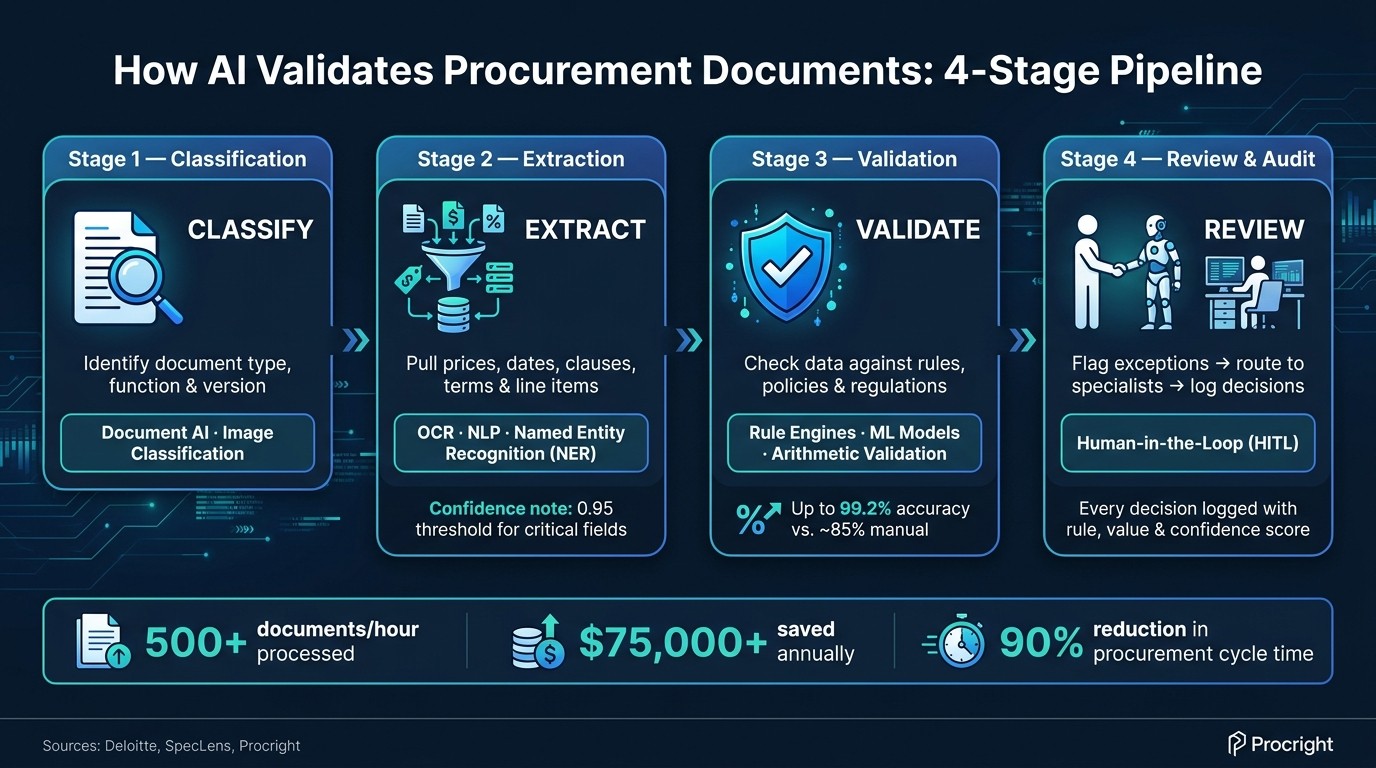
How AI Validates Procurement Documents: 4-Stage Pipeline
AI validation of procurement documents follows a structured pipeline of three interconnected stages - classification, extraction, and validation - with each step building on the outcomes of the previous one.
Classifying Incoming Documents
When a document is received, the AI first determines its category, such as solicitation or amendment, and its specific function, like pricing or legal commitment. It also assesses its version status to ensure outdated information isn’t processed. By leveraging image classification, modern AI systems handle various document formats seamlessly, even when they lack standardized templates, addressing the key differences between manual and AI procurement.
Extracting Key Data Fields
Once classified, the system zeroes in on extracting essential data. Using layout-aware analysis and Named Entity Recognition (NER), AI identifies critical elements such as tables, headers, signature blocks, line items, and specific values like unit prices, delivery terms, renewal dates, liability caps, and certification references. This step also standardizes vendor-specific terminology, making comparisons more straightforward. For sensitive fields like pricing and signatures, a confidence threshold of 0.95 is recommended. Any values below this threshold are flagged for human review.
"The real problem is not recognition alone; it is designing a reviewable, traceable data-capture pipeline that fits procurement policy and operational reality." - Jordan Mercer, Senior SEO Content Strategist, OCRByte
Running Validation Checks
After extraction and normalization, the AI enforces compliance by validating the data. A combination of rule engines and machine learning models ensures arithmetic consistency, checks adherence to policies, and flags potential anomalies in language or terms. Documents that pass validation proceed automatically, while flagged ones are directed to specialists - pricing discrepancies go to procurement operations, and missing signatures are sent to legal teams. Every decision is logged with details such as the extracted value, the violated rule, and the model's confidence score. This creates a transparent and auditable process that aligns with compliance standards.
"A flag that says a clause is 'risky' is only useful if you can show which language triggered it, what policy or rule it violated, and how confident the model was when it made that call." - Maya Chen, Senior SEO Content Strategist
The table below highlights the technologies and focus areas at each stage:
Step | Focus | Technology Used |
|---|---|---|
Classification | Identifying document type and version | Document AI, Image Classification |
Extraction | Retrieving prices, dates, clauses, terms | OCR, NLP, Named Entity Recognition |
Validation | Checking data against rules and policies | Rule Engines, Arithmetic Validation |
Review | Resolving flagged anomalies | Human-in-the-Loop (HITL) review |
Platforms like Procright utilize this multi-layered approach to provide clear compliance scores, helping procurement teams understand precisely where a document succeeded, failed, and why.
Technologies That Power AI Document Validation
OCR and Document AI
In procurement compliance, the first step is turning documents into machine-readable formats. Traditional OCR (Optical Character Recognition) extracts raw text from scanned documents. Modern Document AI, however, takes it a step further by analyzing the layout of a page. It can identify and differentiate elements like tables, columns, and signature blocks.
Why does this matter? Basic OCR might pull a number from an invoice but fail to clarify if it’s a unit price or a subtotal. Document AI, on the other hand, uses spatial context to make these distinctions. This advanced capability allows for 75–85% touchless processing of standard procurement documents, such as invoices and purchase orders.
"Document intelligence feeds the ERP; it does not replace the ERP." - eZintegrations
Once the text is extracted, the next hurdle is interpreting it accurately.
NLP and Machine Learning
After extracting text, Natural Language Processing (NLP) and Machine Learning (ML) step in to interpret its meaning. These technologies identify critical procurement terms like product names, delivery terms, and liability caps. They also map vendor-specific language to match a buyer's standard terminology.
ML models are particularly useful for comparing vendor responses to original specifications, flagging missing or incorrect details before a human review. By 2026, 43% of procurement organizations are expected to deploy AI capabilities - almost double the adoption rate from the previous year.
"Specification intelligence is the procurement layer that extracts, normalizes, and compares technical specs across vendor documents." - Rhea Kapoor, Head of Procurement Research, SpecLens
This interpretation process lays the groundwork for enforcing strict compliance rules, as discussed below.
Rule Engines and Integration Frameworks
Rule engines ensure compliance by applying fixed business logic. For example, they verify certifications and check arithmetic accuracy to ensure policies are followed.
On the integration side, AI validation tools connect seamlessly with ERP systems like SAP S/4HANA, Oracle Fusion, and NetSuite through REST APIs. This allows for real-time data synchronization without interrupting workflows. Platforms such as Procright combine layout-aware extraction, semantic normalization, and rule-based checks to deliver clear compliance scores. These scores not only show a document's status but also highlight areas that need attention, ensuring transparency and accuracy throughout the process.
Deploying and Monitoring AI Validation in Procurement
Setting Up AI Validation
When implementing AI validation, resist the urge to automate everything at once. A gradual rollout works best, starting with high-volume, low-risk documents like NDAs before tackling more complex agreements such as Master Service Agreements (MSAs). A practical approach involves a 90-day plan divided into three phases: discovery (weeks 1–4), building and shadow testing (weeks 5–8), and full production (weeks 9–12).
During the build phase, run the AI in shadow mode to compare its decisions with those of human reviewers. Once the AI demonstrates reliable accuracy, start using it for low-risk documents, expanding to more complex ones over time.
A key architectural principle is to separate machine judgment from policy judgment. The AI's role is to identify what a clause states, while a deterministic rule engine determines whether it aligns with company policies. This separation simplifies troubleshooting when issues arise. After deployment, keep a close eye on the system's performance to catch and address any problems early.
Tracking Performance and Refining the System
Ongoing monitoring and data-driven adjustments are critical to ensuring the AI stays aligned with operational needs. Metrics like cycle time, exception rates, and contract leakage provide a clear picture of success. For context, poor contract compliance can cost businesses 8% to 9% of annual contract value. Automated compliance tools can cut that leakage by 20% to 25%.
Regularly check for data, concept, and process drift - ideally on a monthly basis. Additionally, every instance where a human reviewer overrides the AI should be logged with a reason code, such as "false positive", "policy exception", or "legal carve-out." These corrections serve as valuable training data to improve the model over time.
"The real competitive advantage isn't just speed. It's having intelligence that never stops working for your business." - Briceson Jones, Director of Procurement Optimization, PRGX
Maintaining Governance and Audit Trails
Alongside performance monitoring, strong governance is essential for audit readiness. Every validation event should log critical details, including the source document, the OCR version used, the model version, and the specific rule set applied. This level of detail ensures results are reproducible during an audit.
Store provenance data in a format that allows for quick and efficient audits. When an audit request comes in, it should trigger an evidence packet containing the clause, its location, confidence score, and approver - without requiring access to the original document.
"Treat every extracted clause like a software artifact. If you cannot trace its source, version its logic, explain its confidence, and show who approved it, it is not ready for audit." - Avery Collins, Senior SEO Content Strategist
For U.S. companies working with international suppliers, governance must also address regulatory flow-down requirements. Starting August 2, 2026, the EU AI Act will require GPAI providers to clearly define roles for providers and deployers in contracts and maintain logs that comply with Article 12. Preparing your audit trail now can save you from costly adjustments down the line.
Conclusion: What AI Means for Procurement Compliance
AI has reshaped procurement validation, turning what used to be time-consuming tasks - like cross-checking invoices, locating missing clauses, and verifying supplier certifications - into processes that take mere hours instead of weeks. Companies leveraging AI-driven validation have reported impressive results, such as a 90% reduction in procurement cycle time and up to 99% accuracy in extracting technical specifications, compared to about 85% accuracy with manual entry.
Manual reviews often miss critical details like auto-renewal clauses, unit mismatches, or subtle policy deviations. AI, on the other hand, identifies these issues consistently and at scale. Automated policy checks have been shown to cut procurement violations by over 70%, while early adopters of AI have seen 15–30% cost savings and a 40–60% reduction in manual processing time. These improvements not only make the procurement process faster but also more dependable and easier to audit.
Another game-changer is the ability to create documented, timestamped audit trails. These trails enhance decision-making, with 68% of Chief Procurement Officers citing improved analytics and decision-making as the top benefit of AI - ranking it even higher than productivity gains. With every decision being traceable and explainable, teams can confidently justify why a supplier was approved or why a contract required additional attention.
"It's not just about getting more done; it's about making better decisions." - Payhawk
Platforms like Procright illustrate this transformation by integrating automated specification analysis, compliance scoring, and transparent sourcing into a single, streamlined workflow. The aim isn’t to replace human judgment but to enhance it, providing procurement teams with accurate and comprehensive information. This means fewer surprises and decisions that are easier to defend and stand behind.
FAQs
What’s the best first document type to automate with AI validation?
A pricing document or supplier quote is a great starting point for automation with AI validation. These documents often include essential cost and risk details, which can be buried in non-standard formats like tables or fine print. Automating their analysis simplifies the process of breaking down complex data - think volume discounts or freight terms - into easy-to-understand comparisons.
Procright makes this process seamless by evaluating specifications, comparing products, and providing clear compliance scores. This gives you the clarity and confidence needed to make informed, data-driven decisions.
How does AI handle messy scans and different invoice or contract layouts?
AI handles messy scans and layouts with a multi-layered document intelligence system. First, OCR technology turns images into readable text. Then, vision models step in to analyze the layout, identifying elements like tables, headers, or other structural features. Finally, large language models interpret the extracted text, recognizing that different formats or labels can represent the same concept. This template-free system allows for accurate processing of various document types without needing manual adjustments or constant template updates.
What data and rules are needed for AI to validate documents accurately?
AI systems need a solid framework to effectively validate procurement documents. This includes clearly defined requirements, consistent validation rules, and a comprehensive requirements matrix. The matrix should detail every specification, acceptable ranges or values, and the type of evidence needed - such as datasheets or certifications.
Additionally, a schema is essential to specify which fields to extract, like unit price, technical specifications, or other key metrics. With these inputs in place, tools like Procright can identify missing information, analyze data, and generate compliance scores with precision.
Related Blog Posts
Try it on a real buy
Bring one category. Watch where the flags land.
We use a little analytics to see which pages actually help. Nothing else, no ad trackers.