AI Procurement Maturity Model: 5 Levels
How procurement teams move from manual buying to AI-led, audit-ready decisions across five maturity levels.
In this article
If your procurement team still relies on email, spreadsheets, and copied specs, you're likely paying for it in delays, weak product choices, and audit risk.
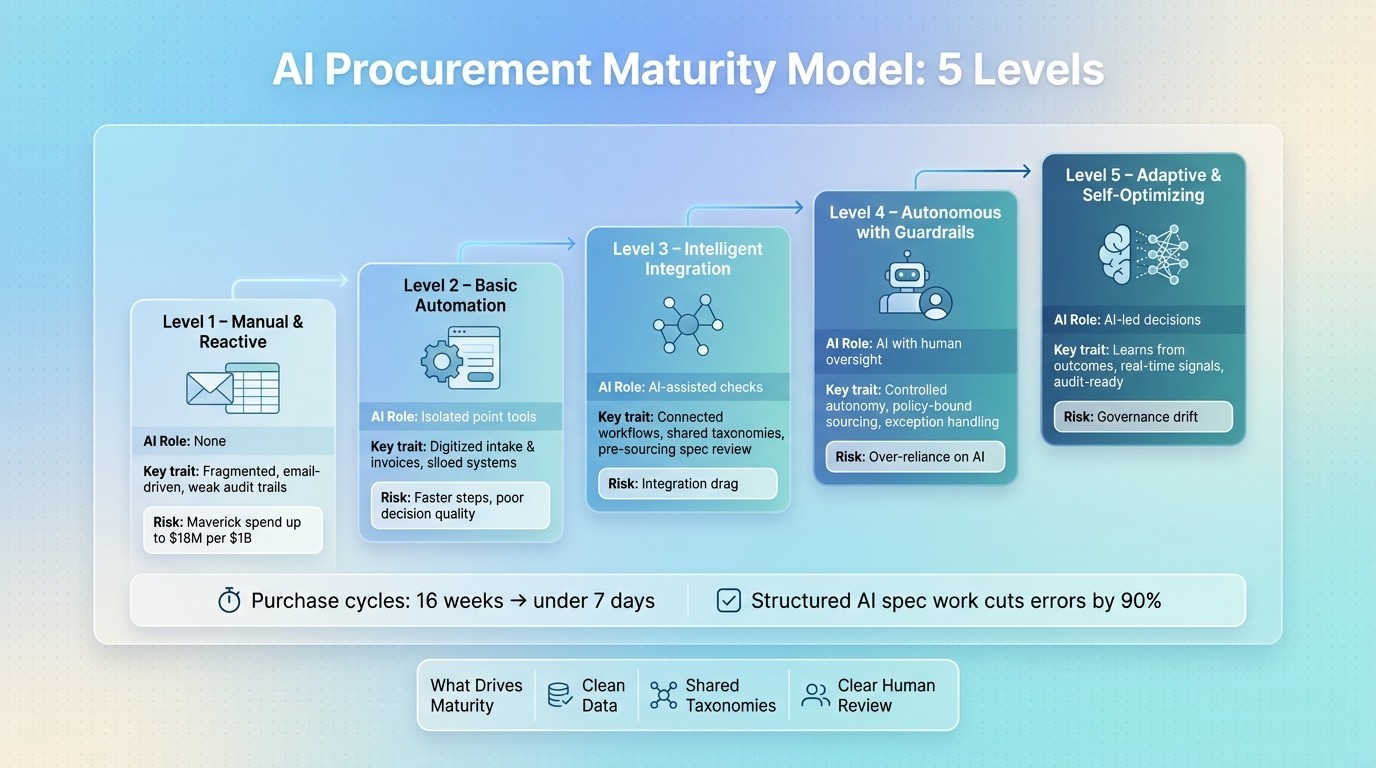
I’d boil this model down to one simple idea: it shows how a team moves from manual buying to AI-supported spec writing, product checks, and compliance review. And the gap between low and high maturity is large: major purchase cycles can drop from 16 weeks to less than 7 days, while structured AI-led spec work can cut errors by 90%.
Here’s the full picture in plain English:
Level 1: Manual, reactive buying with siloed files and weak audit trails
Level 2: Basic automation for intake, invoices, and routing, but decisions still sit in separate systems
Level 3: Connected workflows where AI starts checking requirements, supplier data, and product fit before sourcing begins
Level 4: AI handles routine sourcing steps inside policy limits, while people review exceptions and set rules
Level 5: AI learns from results, supplier performance, and demand signals to guide faster, traceable decisions
The article also makes three points that matter most to me:
Poor procurement usually breaks in spec writing, product review, and compliance checks
Better maturity depends on clean data, shared taxonomies, and clear human review
Moving up works best one level at a time, not through a big system jump or tool migration
AI Procurement Maturity Model: 5 Levels Explained
REV 2025: Gopinath “GP” Polavarapu, Jaggaer, on Building an AI Maturity Model for Procurement
Quick Comparison
Level | How work gets done | AI role | Main supplier risk |
|---|---|---|---|
1 | Manual and fragmented | None | Vague specs, maverick spend, weak records |
2 | Digitized tasks | Small point tools | Faster steps, but poor decision quality |
3 | Connected systems | AI-assisted data validation checks | Data and workflow integration issues |
4 | Controlled autonomy | AI with human guardrails | Too much trust in AI without review |
5 | Learning system | AI-led decisions | Governance and policy drift |
What I like about this model is that it doesn’t treat maturity as a badge. It treats it as a workflow problem. You look at how your team works today, find the weak spot, and fix the next stage first.
Levels 1 and 2: Manual buying to basic automation
These first two levels show procurement with little or no AI support. The work is slow, split across tools, and mostly reactive.
Level 1: Manual and reactive procurement
At Level 1, procurement runs through email threads, PDF attachments, and spreadsheets. Approvals bounce around inboxes, and compliance checks depend on whoever happens to remember the rule.
The clearest sign of Level 1 is maverick spend. People skip procurement because the process feels too slow or too confusing. That can add up fast: maverick spend can reach 1.8% of annual spend, or $18 million on $1 billion.
Teams also tend to reuse last year's template or pull language from a vendor datasheet. That leaves key requirements vague. And once specs are weak, product review and compliance review become much harder later in the workflow.
Vague specs create a domino effect. Vendors fill in the gaps with their own assumptions, evaluations take longer, and audit trails end up thin.
Level 2: Automated point solutions and partial visibility
Level 2 makes things faster, but it doesn't make decisions much better.
At this stage, teams digitize intake, invoices, dashboards, and routing. Requisitions move faster, and visibility improves a bit.
But the core problem is still there. Sourcing, contracts, supplier records, and product data live in separate systems. This fragmentation is a hallmark of procurement silos that prevent strategic decision-making. That gap is what later levels fix by linking specifications, product data, and compliance checks.
Some teams also try AI copilots for drafting or routing. But those tools stay on the edges. They help with tasks, not decisions. So the system is more digital, but it's still not decision-connected. That's what sets up the move to integrated AI in Levels 3 to 5.
Signal | Level 1: Manual | Level 2: Partial Automation |
|---|---|---|
Primary tools | Email, spreadsheets, PDFs | Intake forms, invoice automation, spend dashboards |
Data state | Siloed data with no governance | Partial visibility; separate systems |
Spec quality | Copied templates, vendor datasheets | Still manual, slightly more structured |
AI usage | None | Isolated copilots for drafting or routing |
Audit trail | Fragmented across inboxes | Incomplete; no linked decision trail |
Levels 3, 4, and 5: Integrated AI to adaptive procurement
From Level 3 onward, AI stops handling one-off tasks and starts shaping connected decisions across the procurement process.
Level 3: Intelligent integrated automation
Level 3 deals with fragmentation by linking sourcing, contracts, supplier records, and multi-source product data inside one governed workflow. That link gives AI the governed data layer it needs to match requirements, suppliers, and products with far more consistency.
Once spend data is clean and taxonomies are shared, AI can check requirements against supplier and product data before sourcing begins. That matters. It can spot missing requirements early, before a spec ever reaches a vendor. It can also review product data against required specs before a human review starts, which cuts down on back-and-forth later.
The team dynamic shifts too. Procurement professionals start working across functions instead of staying in separate lanes. And as the system keeps surfacing gaps people often miss, trust in AI-assisted decisions starts to grow.
Level 4: Autonomous procurement with human guardrails
Level 4 adds controlled autonomy. AI can carry out routine sourcing steps, but only within policy limits. A good example is automatic re-ordering for steady categories like MRO or commodity stock, where the system tracks demand trends and delivery times and alerts a buyer only when a transaction falls outside a set threshold.
At this stage, buyers spend less time pushing paperwork and more time setting the rules. They become decision architects, shaping the policies AI follows and stepping in for exceptions.
AI can also score vendor claims line by line, flag contradictions, and point out missing evidence. From there, the system starts moving beyond bounded execution and into continuous improvement.
Level 5: AI-led adaptive procurement
Level 5 is adaptive procurement. AI learns from outcomes, demand signals, supplier performance, and compliance data. It then spots and ranks opportunities based on spend variability and savings patterns.
Human teams shift their attention to governance, complex negotiations, and model oversight. Every decision is audit-ready and traceable to its source.
Signal | Level 3: Integrated | Level 4: Autonomous | Level 5: Adaptive |
|---|---|---|---|
Core function | Connected intake-to-pay workflows | Controlled autonomy for routine sourcing | Self-optimizing, proactive opportunity ID |
Data source | Clean spend & shared taxonomies | Real-time web, PDF, and video evidence | Historical outcomes & market signals |
Human role | Cross-functional collaborator | Exception handler & policy designer | Governance & complex negotiator |
Cycle time | Days/Weeks | Hours/Days | Minutes/Real-time |
These capabilities change how teams write specs, benchmark products across sectors, and check compliance.
How AI changes specification, product review, and compliance work
AI-led specification creation and product matching
At Levels 1 and 2, teams often copy old specs and patch them together from whatever files they can find. That usually leads to guesswork. Requirements end up shaped by what vendors already sell, not by what the business needs.
AI changes the starting point. Instead of handing someone a blank template, the system works like an experienced procurement interviewer. It asks the follow-up questions people often miss: load tolerances, compatibility limits, and overlooked compliance standards. It can also pull from scattered source files - PDFs, technical manuals, and old DOCX documents - and turn them into one consistent, measurable specification. Structured templates can cut procurement errors by as much as 90%.
Product matching changes too. Rather than leaning on vendor-supplied datasheets alone, AI reviews web pages, manuals, and video evidence to match product attributes against each spec line. Every requirement is then marked as Yes, Partially, No, or Not Found, with a cited source attached. By Level 3 and above, vendor clarification loops are often the first task to shrink.
Transparent compliance verification and scoring
Once requirements are measurable, compliance can be scored line by line and tied back to source evidence. When an auditor asks why a product was chosen, "it looked like the best fit" doesn't hold up. A cited, item-by-item compliance record does.
AI-driven compliance verification scores products against each line in a specification instead of giving only one overall match percentage. Each finding links to its source, whether that's a page in a technical manual or a timestamp in a product demo video. So if someone wants to check a compliance claim, they can trace it back to the original evidence. The same goes for anyone reviewing the decision later.
Human reviewers still play the final role. They adjust scores, flag exceptions, and approve the outcome. The AI points out contradictions and missing evidence; the team decides how to handle them. That keeps the process fast and ready for audit.
Where Procright fits in Levels 4 and 5
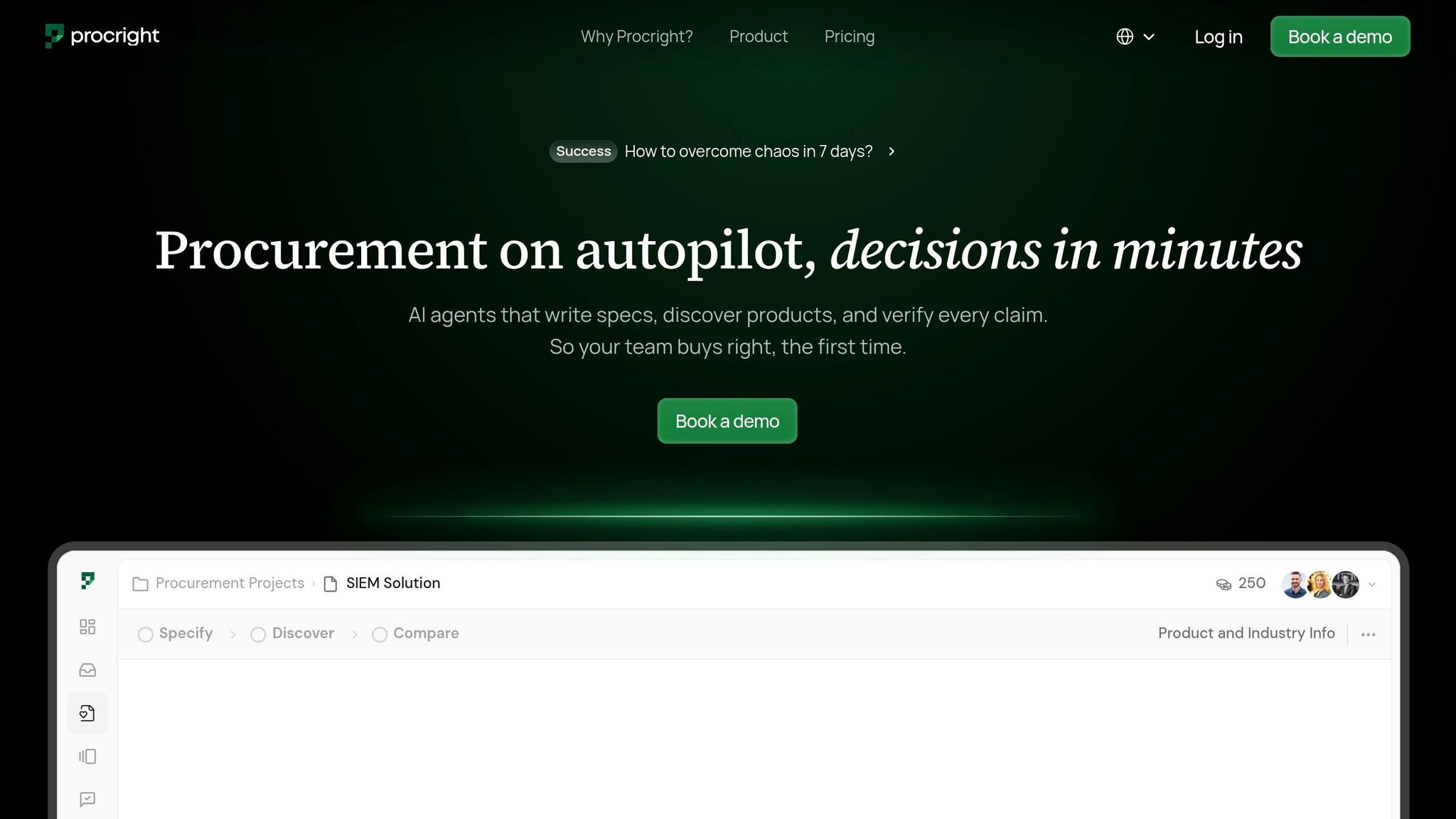
These workflows also show where Procright fits in mature procurement. Procright supports pre-purchase work: defining requirements, finding products, and checking compliance before approval.
At Levels 4 and 5, that matters most. Teams are no longer reading every datasheet by hand. Instead, they act as guardrails, reviewing AI-generated recommendations backed by cited evidence. Procright handles the research and scoring, while procurement professionals make the final call.
How to assess your current level and move up
Cross-level comparison table: benchmark your team across all 5 levels
The five levels only help if you can honestly place your own process on the map. The table below is meant to do exactly that: show where your team stands now, and point to the next control point to fix.
Maturity Level | Role of AI | Process Characteristics | Data Maturity | Team Habits | Operational Risks |
|---|---|---|---|---|---|
Level 1: Manual | None | Reactive, fragmented, ad hoc judgment | Missing or siloed; reliance on guesswork | Email, spreadsheets, and reactive follow-up | Faulty budget planning; technical gaps |
Level 2: Basic Automation | Point solutions | Point tools; siloed data | Standardized templates; digital records | Using e-procurement for basic tasks | Vendor-supplied data bias |
Level 3: Intelligent | AI assistant | Connected workflows; AI-assisted checks | Standardized taxonomies; cross-departmental data | Collaborative spec-writing; data-driven procurement decisions | Integration drag; administrative delays |
Level 4: Autonomous | AI with human guardrails | Item-by-item compliance with cited evidence | Real-time data; cited evidence for every claim | Reviewing AI-generated recommendations | Over-reliance on AI without human review |
Level 5: Adaptive | AI-led | Self-correcting workflows; decisions in minutes | Fully cited and audit-ready | Strategic relationship and exception management | Governance or policy misalignment |
This table makes one thing plain: every team has a weak spot somewhere. Maybe your data is scattered. Maybe your checks happen too late. Maybe the process looks organized on paper, but falls apart when a live RFP goes out.
A few blunt questions can help you place your team with more accuracy:
Can you prove where the data for your last major decision came from?
Does your current process catch requirement gaps before the RFP leaves the building?
Use the table to rank your team by current behavior, not by where you want to end up. That distinction matters more than most teams think.
The step-by-step path from Level 1 to Level 5
Once you know your level, the path up gets simpler. Don’t try to jump three stages at once. Move one level at a time.
Level 1 → 2: Bring fragmented PDFs, DOCX files, and spreadsheets into one system. Then standardize your taxonomies so spend and supplier data can be compared without a mess of manual cleanup.
Level 2 → 3: Stop recycling old templates and hoping they still fit. Add AI-assisted specification writing that interviews stakeholders and flags missing load tolerances, technical requirements, and compliance standards before sourcing starts.
Level 3 → 4: Ask for cited evidence for every compliance claim. That means moving away from broad aggregate scores and toward item-by-item verification.
Level 4 → 5: At Level 5, the buyer shifts from doing every check by hand to setting policy and managing exceptions. For that to work, AI governance has to be clear. Teams need defined rules for when people review, override, or escalate AI recommendations. For U.S. enterprise and government teams, auditability matters. Every AI-supported decision should produce a defensible record that can survive scrutiny years later.
Conclusion: Key signs of mature AI procurement
The point of this model isn’t the label. It’s the next process change the label points to.
Maturity shows up in better decisions, clearer traceability, and less manual effort. The best way to use this model is as an operating roadmap, not a scoring exercise. Each level reflects a concrete set of process changes, data standards, and team habits. Moving up means making those changes on purpose, one stage at a time.
FAQs
How do I know which level my team is really at?
Compare your team’s current habits with how much you rely on manual work versus AI-driven workflows.
At lower levels, teams often work from specs that are incomplete, vague, or copied from old documents. In many cases, vendors end up shaping the requirements, which can skew the whole process from the start.
At higher levels, AI helps collect stakeholder input, spot gaps, and match specifications to standards. That changes the process in a big way. Instead of running subjective vendor “beauty contests,” teams can make objective, audit-ready decisions backed by transparent scoring and cited evidence.
What data do we need before AI can improve procurement?
AI works best when teams start with complete, well-defined requirements. In procurement, things often go off track at the specification stage. If the input is vague, the output will be too. That’s why AI needs structured data that spells out exactly what the organization needs.
This means moving away from incomplete templates and guesswork and toward audit-ready specifications. AI can then spot missing requirements, like capacity limits or compatibility standards. Those details turn a fuzzy request into measurable data, which makes product discovery more accurate and compliance scoring more objective.
What is the safest first step to move up one level?
The safest first step is to improve the quality of your specification document. When requirements are vague or incomplete, the steps that come after in procurement tend to fall apart.
The shift is simple: move away from templates or "organized guessing" and toward an evidence-based specification process. With Procright, teams can spot missing technical details and line up around shared standards before going to market. That gives you a more complete record - and one you can defend during discovery and evaluation.
Related Blog Posts
Try it on a real buy
Bring one category. Watch where the flags land.
We use a little analytics to see which pages actually help. Nothing else, no ad trackers.