AI in Procurement: Specification Filtering Explained
AI plus rule-based checks extract, normalize, and score supplier specs to shorten cycles, enforce compliance, and clean catalogs.
In this article
AI-based specification filtering helps me cut supplier lists faster, block noncompliant products earlier, and rank options with less manual review. In procurement, that matters because manual spec comparison can take 15–25 hours per cycle, and manual extraction errors can hit 30%–40%.
Here’s the short version:
I need clean, structured product data before any AI filter can work well.
I should treat technical specs and certifications as hard pass/fail checks.
I can use AI to extract specs from PDFs, emails, and datasheets, then standardize units like inches to millimeters or HP to kW.
I still need rule-based checks for ranges, tolerances, and compliance.
I should expect value in shortlisting, policy checks, catalog cleanup, and spend analysis.
I need proof for every score, such as a source document, page, and section reference.
I should track results with metrics like cycle time, off-spec buys, reclaimed hours, and avoided error costs.
Put simply: AI helps me find products that fit the requirement, not just products that share the same keywords.
What stood out to me most is this: AI does the language work, but rules do the final check. That split matters because a product can sound like a match and still fail on voltage, temperature range, lead time, or UL status.
A few numbers frame the case well:
50% shorter procurement cycles have been reported
15%–30% lower costs have been reported
Manual proposal comparison can drop from 8+ hours to about 20 minutes
The article boils down to one message: good filtering starts with good data. If supplier specs are missing, buried in PDFs, or listed in mixed units, AI will not fix the decision by itself. It will only process the mess faster.
So when I think about specification filtering in procurement, I’d keep the workflow simple:
Turn supplier inputs into structured fields
Normalize names, units, and ranges
Apply hard compliance rules
Rank the products that pass
Keep an audit trail for every result
That’s the core idea behind the full article.
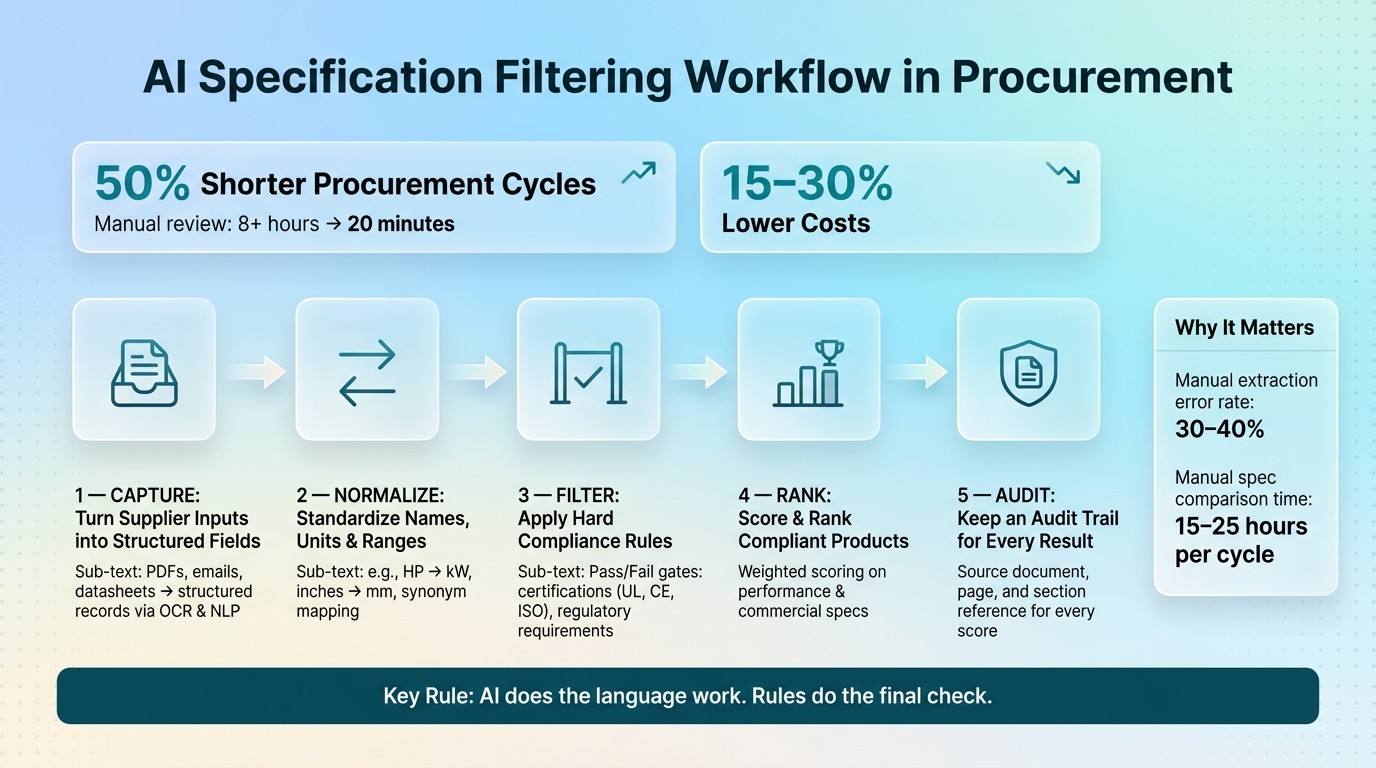
AI Specification Filtering Workflow in Procurement
How AI Makes Procurement Work Faster (and Smarter)
The Building Blocks: Specifications, Attributes, and Data Quality
AI filtering only works when specs, attributes, and units are structured in a way the system can compare. That setup shapes three things: what the system can match, what it can rank, and what it has to throw out.
What Counts as a Specification in a Sourcing Decision
Not every product detail should affect filtering. In procurement, specs usually fall into four practical groups, and each one plays a different part in the process.
Specification Type | Data Format | Unit Examples | Role in AI Filtering |
|---|---|---|---|
Technical | Numeric / Range | Voltage (V), Dimensions (in) | Core matching logic; determines physical fit |
Performance | Numeric / Boolean | Operating Temp (°F), Throughput | Checks whether the product meets functional needs |
Regulatory | Categorical / Boolean | Mandatory compliance check; pass/fail gate | |
Commercial | Numeric / Date | Price (USD), Lead Time (days) | TCO calculation and availability ranking |
A simple way to think about it: technical and regulatory specs should act as pass/fail gates. Performance and commercial specs should help rank the shortlist.
That only works if those categories are tied to a shared attribute model. If one supplier lists voltage as a single number and another lists it as a range in a different field, the filter can’t compare them cleanly.
Why Structured Attributes and Taxonomies Matter
Raw product data, by itself, doesn’t filter well. For AI to compare items across dozens of suppliers, the data has to sit inside a shared field structure. In plain English, every product needs the same fields, the same format, and the same units.
Classification systems like UNSPSC codes help make that happen at scale. They give each product category a standard identity. Then the attribute model sets the rules for which fields are required, which are optional, and what kind of value each field should hold, such as an exact number, a range, or a categorical flag like "yes/no."
The difference between exact values, ranges, and categorical fields matters a lot more than it seems at first glance. Say a filter is set to match exactly 120V. A product rated 110–127V should still qualify. But it won’t if the system treats the requirement as an exact-match field instead of understanding that 120V falls inside that range.
That’s where many teams get tripped up. The data may look fine to a person skimming a spec sheet, but the system needs clear logic built into the attribute model. Otherwise, good products get screened out for the wrong reason.
Common Data Issues That Weaken Filtering Results
Even with a solid attribute model, the incoming data is often messy. The usual trouble spots are:
Missing fields
Inconsistent naming
Specs buried inside free-text PDFs
Manual specification extraction carries a 30–40% error rate. That means a meaningful share of sourcing decisions may be based on data that is incomplete or wrong.
If the extraction step isn’t structured, those products can’t be compared with confidence. The fix starts at intake. Standardized RFP templates that require vendors to submit data in defined formats, with stated units and test conditions, cut down cleanup work before AI filtering even starts.
One rule should be firm here: missing certification data should block a match. It shouldn’t slip through as “incomplete” and stay in play.
Once the data is structured and normalized, AI can apply parsing and scoring logic to the product set.
How AI Performs Specification-Based Product Filtering
Parsing and Normalizing Product and Specification Data
Once structured attributes are in place, AI can pull supplier data at scale. And that matters, because supplier info rarely shows up in one clean format. It can come from PDFs, emails, scanned datasheets, and catalog entries. NLP and named entity recognition (NER) pull key fields like part numbers, voltage ratings, certifications, and operating temperatures straight from those raw documents.
Then the system lines up units and synonym labels against one shared attribute model. That's what makes direct product comparison possible. Otherwise, two technically equivalent products can look like completely different items.
Extraction finds the requirement. Rule-based validation decides whether it passes.
Matching Logic, Tolerances, and Compliance Scoring
After normalization, the system applies matching logic in layers. First come the hard filters for non-negotiable requirements, such as mandatory certifications or regulatory rules. A product either passes or it doesn't. Then range matching checks whether values fall inside allowed tolerances, such as 80 GSM ± 2%. From there, weighted scoring ranks the remaining options by priority.
The result is a compliance score that highlights strong matches and sends borderline items to review.
AI Method | What It Does | Where It Fits in Filtering |
|---|---|---|
NLP / NER | Extracts specs from unstructured text and documents | Parsing stage; intake and supplier documents |
Ontology Mapping / Taxonomy Alignment | Standardizes products against predefined taxonomies like MasterFormat or UNSPSC | Attribute alignment before matching begins |
Semantic Matching / LLMs | Understands meaning, not just keywords | Finds equivalent specs across different terminology |
Rule Engine | Applies hard filters and range tolerances | Pass/fail gates and tolerance checks |
Weighted Scoring | Ranks shortlisted products by priority | Final ranking and compliance score output |
Semantic matching helps the system spot equivalent terms across supplier documents.
Where Filtering Fits in Day-to-Day Procurement Work
In day-to-day procurement, these steps turn supplier responses into a ranked shortlist. During product discovery, AI filtering shows only the products that meet the active requirements. During sourcing, the same logic scores vendor responses against the requirement matrix, which cuts down the manual side-by-side spreadsheet work.
For review and approval, the evidence trail matters just as much as the score. Modern AI filtering systems attach source citations - document name, page number, and section reference - to every match. So when a stakeholder asks why Vendor A ranked above Vendor B, the buyer can point to specific data instead of relying on a judgment call.
That kind of transparency makes approvals faster and gives procurement teams a record they can stand behind if a decision gets questioned. The output then feeds product discovery, sourcing, and approval without extra spreadsheet work.
Procright can combine extraction, normalization, comparison, and compliance scoring into one ranked shortlist.
Where Specification Filtering Delivers Value in Procurement
Once product data is parsed and scored, the payoff shows up in three areas: discovery, compliance, and catalog quality.
Product Discovery and Sourcing Decisions
At the start of a sourcing event, AI specification filtering cuts a large product set down to a shortlist by checking each item against the mandatory requirements. Anything that doesn't meet the bar gets filtered out before the team spends time on review.
If no product meets every requirement, AI can flag the closest matches and show exactly which specs fall short. That ranking makes trade-offs clear. Teams can see which products fully comply and which ones miss certain requirements. The same scoring also keeps noncompliant options out of the review queue.
Compliance, Policy Enforcement, and Risk Control
Compliance failures in procurement often come from custom procurement workflow challenges like slow, uneven manual review, not buyers choosing to ignore policy. AI filtering closes that gap by applying the same logic to every vendor document.
It also catches unanswered requirements and vague claims like "available in a future release", which can look compliant at first glance. For regulated categories, AI can verify certifications such as ISO, CE, or UL against issuer databases instead of taking a vendor claim at face value. Audit trails make each decision easier to defend during an audit or internal review. The same normalized data also helps improve catalog quality and spend visibility.
Catalog Management and Spend Visibility
A procurement catalog is only as good as the data behind it. When vendor entries use different terms, inconsistent units, or duplicate records, the catalog gets harder to trust - and so does the analysis built on top of it. AI filtering cleans vendor records and removes duplicates, which makes direct comparisons possible.
That opens the door to a more useful view of spend. Instead of grouping purchases only by vendor name or a broad category, teams can analyze spend by technical attributes, find off-contract spend, and spot consolidation opportunities.
Procright automates product discovery and compliance verification with transparent compliance scores, helping teams move from broad supplier lists to defensible shortlists.
Implementing AI Specification Filtering and Measuring Results
Once filtering gives you a shortlist, the next step is simple in theory but harder in practice: turn that shortlist into a workflow your team can repeat, review, and defend.
How to Build the Workflow from Inputs to Decisions
After filtering cuts down the vendor list, procurement still needs a clear process for capture, normalization, scoring, and approval.
Workflow Layer | Typical Data Sources | AI Operations | Procurement Output |
|---|---|---|---|
Capture | PDFs, Word docs, Excel files, URLs | Document intake, OCR and layout extraction | Structured requirement record |
Normalize | Vendor datasheets, technical specs | Unit conversion (e.g., HP to kW), terminology mapping | Normalized comparison matrix |
Logic & Scoring | RFP baseline, compliance rules | Per-item compliance scoring, gap detection | Compliance scores (Yes / No / Partial) |
Decision | Market data, supplier records | Risk flagging, TCO calculation | Shortlist recommendation with audit trail |
These layers make one thing clear: capture, normalization, and scoring should be tested as a system, not as separate parts.
Normalization is where many teams run into trouble. One vendor may list output in HP, another in kW. One may use a product term your team never uses internally. If you compare those records as-is, the results can get messy fast. Standardize units and labels before scoring anything.
What to Evaluate Before Adopting an AI Solution
Use that same capture-to-decision flow as your pilot checklist. Before you commit to a platform, test it in a category with high spec volume and a lot of complexity. That’s where weak spots show up.
Evaluation Criteria | Pilot Checks |
|---|---|
Extraction Accuracy | Does the AI correctly identify values buried in footnotes or complex multi-column tables? |
Unit Handling | Can the system automatically convert industry-specific units (e.g., PSI, GSM, IOPS) without manual input? |
Explainability | Does every compliance score link directly to a specific page or paragraph in the source document? |
Integration | Can the tool connect with your existing ERP or catalog systems and push validated data downstream? |
Governance | Can you set non-negotiable exclusions the AI cannot override, with a clear audit trail for approvals? |
Time-to-Value | Can the team run a full vendor comparison in under 30 minutes during the first week of use? |
This part matters more than it may seem. If a buyer can’t trace a score back to the exact source, that score is tough to defend in an approval review or supplier discussion. Procright links each score to the source document, which helps keep compliance calls auditable.
Conclusion: Key Outcomes Procurement Teams Should Expect
Strong results from AI specification filtering depend on one thing more than anything else: the quality of the data going in.
Teams tend to get the best results when they:
turn informal requests into a buyer-controlled specification record
define must-have and nice-to-have requirements upfront
normalize units before comparison
keep catalog attributes clean and trusted
Skip that prep work, and AI won’t clean up the mess for you. It will just process the same inconsistencies at scale.
After rollout, the next job is measurement. You want to know if the workflow is improving speed, compliance, and spend quality. Reported results include 50% shorter procurement cycles and 15%–30% lower costs. Manual vendor proposal comparison can also drop from 8 hours or more to about 20 minutes. Review those metrics every month or quarter so you can confirm value and spot weak areas early.
Metric | Data Source | Review Cadence |
|---|---|---|
Cycle Time Reduction | Sourcing project logs (start to award) | Monthly |
Off-Spec Purchase Rate | Quality assurance / returns data | Quarterly |
Cost of Avoided Errors | Rework logs, expedited shipping costs | Quarterly |
Reclaimed Hours | Timesheets or process-tracking software | Monthly |
Specification Alignment | % of purchases matching must-have criteria | Quarterly |
FAQs
What data do I need before AI filtering works well?
Start with a clear, documented baseline for your procurement needs. Build a structured requirements matrix that covers technical specifications, performance metrics, compliance certifications, support needs, and budget limits.
It also helps to split must-haves from nice-to-have features. Past data and well-defined technical criteria give the AI a stronger frame to work from. That means it can suggest missing requirements, spot gaps in draft specifications, and help keep the process consistent from start to finish.
How does AI handle mixed units and spec ranges?
AI handles mixed units and spec ranges by normalizing data into one consistent format, so you can compare products side by side without the usual mess. It detects the source unit, applies the right conversion, and turns each value into your preferred standard.
For spec ranges, it parses technical documents to pull out and line up operating or performance limits. Procright uses this to score compliance item by item, so each product is judged against the documented requirements on the same basis.
Which procurement specs should be pass/fail?
Must-haves and deal-breakers should be treated as pass/fail criteria. They’re non-negotiable, so if a product misses them, it shouldn’t move forward.
Nice-to-haves are different. They matter, but they aren’t make-or-break requirements, so they shouldn’t be used as strict pass/fail filters.
Procright supports this approach by letting teams assign importance levels and review clear compliance scores.
Related Blog Posts
Try it on a real buy
Bring one category. Watch where the flags land.
We use a little analytics to see which pages actually help. Nothing else, no ad trackers.