AI vs. Traditional Procurement: Cost Analysis
Compare AI-driven vs manual procurement costs — lower PO/invoice costs, fewer errors, faster payback and higher ROI.
In this article
If I look at total cost over time, AI-led procurement is usually cheaper than traditional procurement when analyzed through a total cost of ownership lens. The reason is simple: manual work costs more per PO and invoice, creates more errors, and lets off-contract spend and contract leakage build up in the background.
Here’s the short version:
PO processing: about $50 to $150 manually vs. about $5.60 with AI
Invoice processing: about $12 to $15 manually vs. $2 to $4 with AI
Error correction: about $53 per error
Off-contract spend loss: often 12% to 18%
AI setup cost: often $200,000 to $750,000 in year one for mid-market firms
Payback window: often 3 to 6 months
First-year ROI for spend analytics: often 300% to 500%
What this means for you:
If your team still runs on email, spreadsheets, and older ERP workflows, your costs are not just labor costs.
You also pay for rework, slow sourcing, weak spend visibility, and missed savings.
AI shifts cost toward software, integration, and review controls, but it cuts per-transaction cost and spots spend drift much earlier.
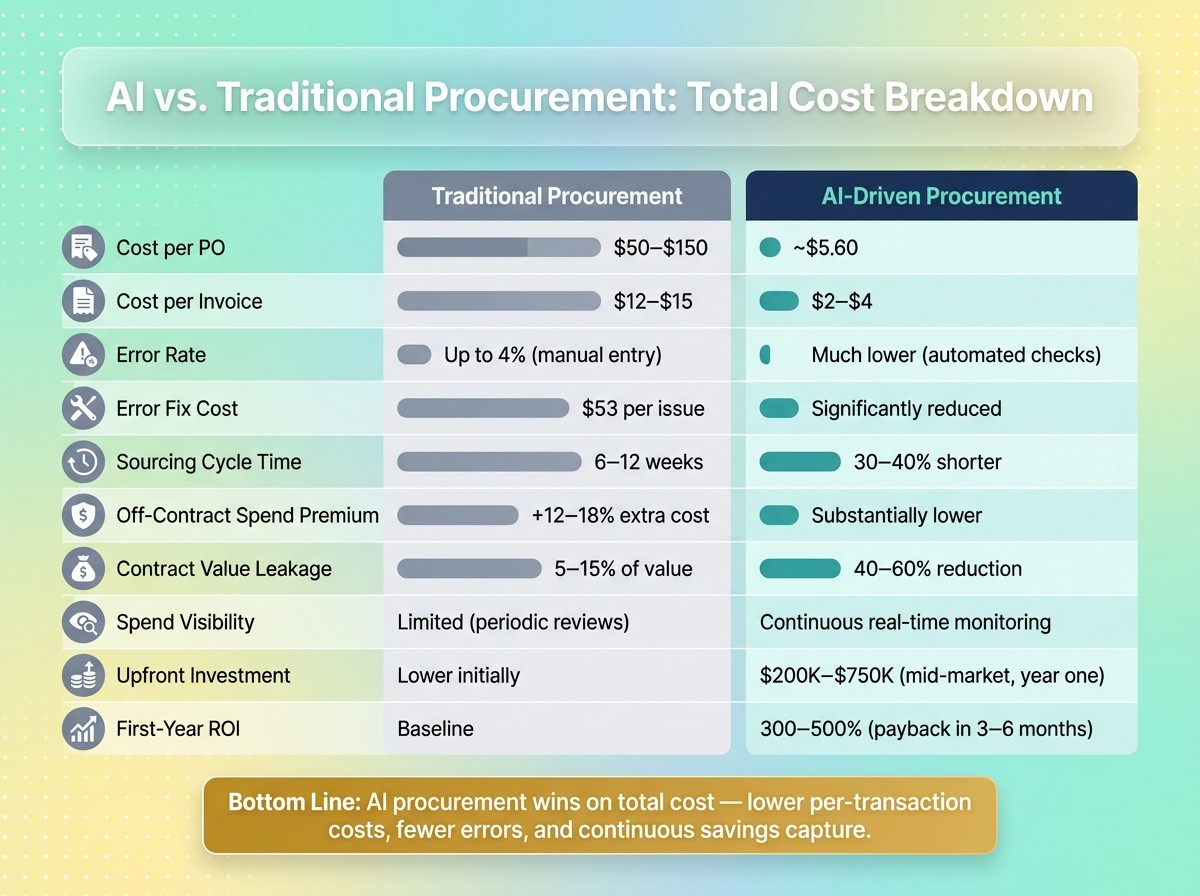
AI vs. Traditional Procurement: Cost Comparison at a Glance
Procurement Under Pressure: Disruption, AI, and the New Operating Model
Quick Comparison
Cost area | Traditional procurement | AI-driven procurement |
|---|---|---|
PO cost | $50 to $150 | ~$5.60 |
Invoice cost | $12 to $15 | $2 to $4 |
Error rate | Up to 4% manual entry | Much lower with automated checks |
Error fix cost | $53 per issue | Lower due to fewer manual mistakes |
Cycle time | 6 to 12 weeks for sourcing | 30% to 40% shorter |
Spend visibility | Often limited | Continuous monitoring |
Higher | Lower | |
Contract leakage | 5% to 15% of value | 40% to 60% lower |
Upfront cost | Lower at first | Higher at first |
Long-term cost | Often higher | Often lower |
Bottom line: if I compare upfront price alone, manual vs. AI procurement costs can be deceptive. But if I include labor, mistakes, leakage, and delayed savings, AI often wins on total cost.
Where Costs Build Up in Traditional Procurement
Traditional procurement often runs on email, spreadsheets, and older ERPs. Those systems log transactions, but they don’t do much to help people make better decisions in the moment. That’s where costs start to pile up.
Manual Processing Costs and Labor Burden
In a manual setup, every purchase order moves through several handoffs. Each handoff adds time, effort, and cost. U.S. benchmarks put manual PO processing at $14 to $54 per transaction, and some estimates climb to $150 per PO when the process gets more complex.
At $85/hour in fully loaded labor, even a modest transaction count can turn into a big yearly expense. And that’s just the direct labor piece. It doesn’t include time spent chasing approvals, following up in email, or fixing data entry problems after the fact.
A lot of that effort goes to simple purchases that don’t move the business forward in any meaningful way. About 70% of procurement time goes to routine, low-value purchases that account for only 2% of spend. So the team stays busy, but not on the work that would help trim costs or negotiate better deals.
Errors, Rework, and Off-Contract Spend
Errors don’t just slow things down. They trigger rework, delay payments, and add avoidable expense. The average downstream cost to catch and fix a single invoice or PO error is $53. Manual data entry has an error rate of up to 4%, and 47% of procurement errors come straight from manual input.
In manual workflows, the same problems tend to show up again and again:
transcription errors
matching errors
missing requirements
Each one creates extra work and can stall the payment cycle.
Policy gaps make the problem worse. If employees can’t quickly find approved suppliers, they buy somewhere else. That off-contract buying adds 12% to 18% in extra cost on every dollar spent off-contract. In MRO categories, about 79% of purchases go off-contract in manual environments. That’s not a small leak. It’s more like leaving the faucet on all day.
The Limits of Periodic Spend Reviews
Periodic spend reviews have one big flaw: they show the problem after the money is already gone. Teams export ERP data, clean it by hand, and build static reports. By the time a trend appears, the overspend has already happened.
Only 27% of companies that rely on manual procurement have full visibility into spending. That leads to missed discounts, missed chances to combine purchases, and auto-renewals that quietly roll over in the background.
There’s also a simple way to put a dollar figure on the issue. Take your monthly transaction volume, multiply it by a 4% error rate, and then multiply that by a $53 rectification cost. In many cases, that quick math makes the case for automation faster than any industry benchmark.
AI cuts these costs by automating validation, routing, and spend monitoring. Specialized AI tools for data validation further reduce these risks by catching discrepancies before they reach the ERP.
AI-Driven Procurement: Cost Structure and Savings
AI-driven procurement uses machine learning and automated workflows to handle more of the procurement cycle, from specification creation and product discovery to compliance verification. That changes where the money goes. Instead of leaning so hard on manual work, teams put more spend into software, data infrastructure, and process governance. The cost mix looks different, and the next section compares that shift side by side.
Upfront and Ongoing AI Procurement Costs
The biggest expense is usually integration and data prep, not the software license. In many cases, data preparation and ERP integration cost more than the subscription itself. For mid-market organizations, first-year investment covering software, integration, and data prep usually falls between $200,000 and $750,000. Enterprise deployments can hit $3,000,000 or more.
After launch, costs continue in a few clear areas:
Platform subscription fees
Usage fees for AI processing
Human review for exceptions and AI decision checks
Annual maintenance usually lands at 15% to 20% of the license cost. So yes, AI can cut labor-heavy work, but it also moves spend toward software, integration, and governance.
A simple rule of thumb helps here: budget $20,000 to $500,000 per use case for ERP integration, and don't base your plan on the vendor's list price alone.
Lower Transaction Costs, Faster Cycles, and Fewer Errors
Once AI is in place, the math changes fast. AI-assisted invoice processing cuts the cost per invoice from $12–$15 to $2–$4, while automated processing rates reach 98% to 99%. In plain English, most invoices move through with no human touch unless the system flags something.
Cycle times shrink too. AI agents can read unstructured inputs like PDFs, emails, and handwritten notes, which removes the manual cleanup work that slows old-school procurement flows. That means buyers spend less time typing, reformatting, and chasing exceptions. They get more time for supplier relationships and category strategy.
Those gains matter most when you stack them against labor costs, compliance risk, and maverick spend. That's where the day-to-day payoff starts to show up.
Continuous Trend Analysis and Savings Capture
AI doesn't wait for a quarterly review. It runs spend analysis all the time, classifies spend, flags anomalies, and surfaces savings opportunities in real time.
The returns can be hard to ignore:
Spend analytics AI usually delivers 300% to 500% first-year ROI, with payback in 3 to 6 months
Supplier-price benchmarking through AI can surface 4% to 12% in negotiation leverage
SKU-level demand forecasting can cut excess inventory by 8% to 18%
Continuous contract health monitoring can reduce contract leakage by 40% to 60%
Procright uses this always-on analysis across specifications, product discovery, and compliance. That helps teams compare options more quickly and lock in savings sooner.
AI vs. Traditional Procurement: Side-by-Side Cost Comparison
The cost gap shows up fastest when you look at labor, compliance, and how much savings a team can keep over time. The big difference is continuous monitoring. AI-driven procurement spots spend drift earlier, which helps turn one-off wins into gains that keep showing up.
Direct Costs: Labor, Transactions, and Rework
Top-performing procurement organizations spend about $5.60 per purchase order processed, while manual-heavy teams spend over $50. Most of that gap comes from manual handoffs and extra touchpoints.
Cost Factor | Traditional Procurement | AI-Driven Procurement |
|---|---|---|
Cost per PO | $50–$150 (manual) | ~$5.60 (top performers) |
Cost per Invoice | $12–$15 | $2–$4 |
Rework cost per PO | $14–$54+ | Lower |
Sourcing cycle time | 6–12 weeks | 30%–40% shorter cycle times |
Rework is one of those costs that can sneak up on a team. CAPS Research found that 85% of quote comparison time goes to data logistics - locating, transferring, and normalizing values from documents - instead of actual analysis. That means people spend most of their time moving data around rather than making decisions. AI cuts a lot of that drag.
Labor savings matter, but they matter more when they also cut rework and shrink cycle times.
Indirect Costs: Compliance, Risk, and Maverick Spend
The bigger savings often come from costs that don't show up neatly on an invoice. Every dollar of maverick spend brings an added cost of 12% to 18%, and traditional procurement can produce 20% to 30% more maverick spend due to fragmented data silos.
Contract leakage shows the same pattern. Traditional procurement loses 5% to 15% of contract value because of weak compliance and missed renewals. With continuous monitoring, AI can cut that leakage by 40% to 60%.
Indirect Cost Factor | Traditional | AI-Driven Procurement |
|---|---|---|
Maverick spend rate | 20%–30% higher | 30% lower maverick spend |
Contract compliance rate | 56.2% (median) | 79.5% (best-in-class) |
Contract value leakage | 5%–15% of value | 40%–60% reduction |
Risk monitoring | Periodic reviews | Continuous monitoring of news, sanctions, and financial filings |
This is where the math starts to tilt. If off-contract buying keeps slipping through, or renewals get missed, the losses stack up fast.
Short-Term Investment vs. Long-Term Return
Traditional procurement can seem cheaper at first glance. But once you factor in labor, error correction, and compliance gaps, that early cost edge starts to fade.
AI usually needs more money up front. Mid-market organizations often invest $200,000 to $750,000 in year one, but spend analytics by itself typically delivers 300% to 500% first-year ROI with payback in 3 to 6 months.
There’s also a timing difference that matters. AI keeps finding new savings through real-time spend classification and contract monitoring. Traditional procurement tends to find savings in batches during review cycles. That gap in timing changes the economics, because savings found sooner are easier to keep.
Using AI Trend Analysis to Improve Procurement Economics
What Machine Learning Catches That Manual Analysis Misses
Manual spend reviews usually look at only the top 10–20 spend categories. That means the long tail often goes unchecked.
AI looks across the full spend portfolio instead. It can flag outliers, duplicate buys, and supplier sprawl in real time. It can also spot price differences for the same item across locations, which manual reviews almost never catch. The result is simple: hidden spend becomes visible sooner, and that gives teams a better shot at finding savings earlier.
How Procright Supports Cost Control and Compliance
That kind of visibility matters most before buying starts, when spec gaps can still be fixed without a mess later on.
Procright moves analysis upstream, before the PO is raised. Its AI checks draft specs for missing requirements, then matches products to those specs using source-linked citations before sourcing begins, which cuts down on downstream rework. Every product gets scored line by line against the specification, with citations that point to the source data used.
At this stage, automated compliance checks can reduce procurement violations by more than 70%. AI-powered spec comparison can also cut manual review time by 40% to 60%.
Conclusion: Which Model Lowers Total Procurement Cost
Traditional procurement can look cheaper at first glance. But labor-heavy processing, error correction, off-contract spend, and compliance gaps add cost over time.
AI-driven procurement may need more upfront investment, but the math can shift fast. Automation cuts transaction costs, continuous monitoring catches leakage earlier, and better pre-purchase decisions help teams avoid rework. Spend analytics alone usually delivers a first-year ROI of 300% to 500% with payback in 3 to 6 months.
The right comparison is total cost over time, not upfront price. The lowest total cost comes from catching spend drift before it turns into waste.
FAQs
How do I calculate procurement ROI?
Use this formula: Procurement ROI = (Total procurement benefits − procurement operating costs) ÷ procurement operating costs × 100.
To make the business case believable, start with your current baseline. Put numbers on costs like the average cost per purchase order, the cost per invoice, and sourcing cycle time.
Then layer in gains across four areas:
Efficiency
Effectiveness
Experience
Exposure
After that, subtract platform and implementation costs. Last, apply a realization haircut to your projected savings so the estimate stays grounded.
When does AI procurement make financial sense?
AI procurement makes financial sense when teams need to cut costs, reduce risk, or move faster without adding headcount.
It’s a strong fit for high-volume manual work like data gathering, specification drafting, and product discovery. That kind of work can eat up up to 60% of an analyst’s time.
Using Procright to automate specification creation and compliance verification can cut wrong-choice procurement risk by 90%. In many cases, returns show up within 3 to 9 months, with annual ROI of 500% or more.
What costs are usually hidden in manual procurement?
Manual procurement often costs more than it seems at first glance. The purchase price is only part of the story.
A lot of the extra cost comes from repetitive admin work: data entry, email-based approvals, and invoice matching. That work adds labor overhead fast. And small mistakes add up too, with error rates of 1% to 3% per field leading to rework that can get expensive.
When the process is fragmented, the problem gets worse. Teams are more likely to create maverick spend, which means buying outside negotiated contracts. Those purchases can cost 15% to 27% more. On top of that, companies often deal with delays, missed early-payment discounts, compliance risks, and employee burnout.
Related Blog Posts
Try it on a real buy
Bring one category. Watch where the flags land.
We use a little analytics to see which pages actually help. Nothing else, no ad trackers.