AWS Enterprise Discount Program: A 2026 Procurement Guide
The AWS EDP challenge is not finding the biggest discount. It is forecasting how much spend actually qualifies after carve-outs and overlapping private pricing.
In this article
Six weeks before fiscal year-end, Maya, a cloud procurement lead at a fintech, opens an email from AWS and finds a 30-slide EDP term sheet waiting for her. It mentions a base commit, a discount tier schedule, and several pages of legal language. Her platform team has already bought Savings Plans, finance wants a defensible forecast, and AWS is asking for a decision within two weeks.
Maya's real problem isn't finding the largest discount percentage. She needs to know how much of her forecast will actually qualify after carve-outs, overlapping private pricing, Marketplace treatment, and existing commitments. That calculation, not the headline rate, determines whether the deal creates savings or a costly shortfall.
The EDP Conversation Most Procurement Teams Underestimate
Maya starts with the wrong question because the term sheet encourages it: “What discount tier can we get?” The better question is, “What portion of our expected AWS bill can the agreement touch?”
Her finance partner has forecast growth across compute, databases, storage, networking, and newer workloads. Her engineering team has a different view. Some workloads may move regions, some may be replaced, and several teams already use Savings Plans. The AWS account team has also indicated that certain services and purchases may sit outside the discount structure.
That creates four decisions before anyone negotiates the percentage:
Define the eligible pool. Separate spend that qualifies from Marketplace purchases, support charges, service-specific agreements, and other exclusions.
Reconcile existing commitments. Savings Plans and Reserved Instances can change the effective cost of covered workloads before the EDP discount is applied.
Test the forecast. A committed annual run rate should come from durable consumption, not experimental projects or optimistic migration assumptions.
Protect the downside. The agreement must explain what happens when business units leave, workloads migrate, or eligible spend falls below the commitment.
Maya's term sheet is therefore a starting document, not a finished commercial answer. A discount schedule can look attractive while applying to a much smaller base than procurement expects. The reverse can also happen. A modest rate applied across a large, eligible pool may outperform a more aggressive offer with extensive carve-outs.
Practical rule: Never approve an EDP from the discount matrix alone. Approve it only after finance can trace the committed baseline from raw billing data to contract language.
The first internal meeting should include procurement, cloud finance, engineering, and the AWS account owner. Each group sees a different risk. Procurement focuses on terms, finance focuses on liability, engineering understands workload behavior, and the account team knows which services AWS will include or exclude.
Maya's next deliverable isn't a negotiation email. It's an eligibility schedule that maps every meaningful spend category to one of three positions: included, excluded, or subject to written confirmation. Until that schedule exists, the apparent savings are only an estimate.
What the AWS Enterprise Discount Program Actually Is
Think of an EDP like a negotiated electricity arrangement for a large household. You agree to maintain a baseline level of usage, and the supplier gives you a better rate for the consumption covered by the agreement. The value comes from committing with confidence, not from buying reserved physical capacity.
AWS's Enterprise Discount Program, commonly called an EDP, is a private pricing agreement. AWS also commonly uses the name Private Pricing Agreement, or PPA, for this commercial structure. The buyer commits to a minimum annual or total AWS spend across eligible usage, and AWS applies negotiated discounts at the billing level. Mission Cloud's explanation of AWS EDP structure describes the arrangement as a multi-year agreement tied to committed spend and eligible usage.
That distinction matters. An EDP doesn't require the engineering team to deploy workloads in a different way. It isn't a capacity reservation, and it doesn't replace workload-level instruments such as Savings Plans or Reserved Instances. It changes the commercial rate applied to qualifying usage under the billing relationship.
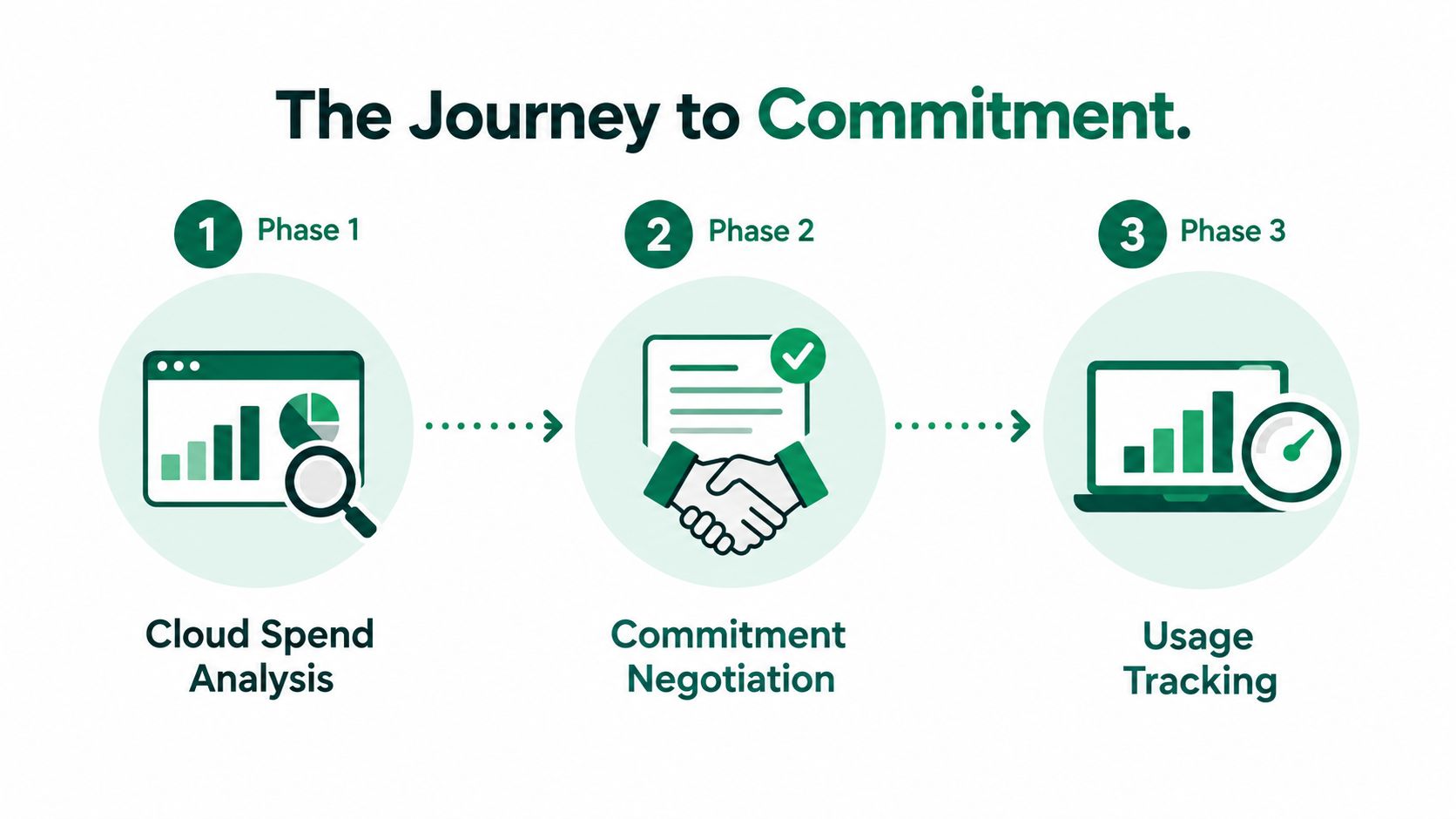
The three parts buyers must separate
The commitment is the minimum spend AWS expects over the agreed period. Industry guidance commonly places EDP eligibility around about $1 million in annual AWS spend, with agreements often lasting one to five years. Those figures are market guidance rather than a universal public AWS threshold, so buyers should treat them as indicators for opening the conversation, not as an entitlement.
The discount is the negotiated reduction applied to eligible AWS usage. It usually appears as a service or category matrix, not as one flat rate for every invoice line. The matrix is only useful when procurement understands the definitions beneath each category.
The eligible pool is the amount that can count toward the commitment and receive the negotiated treatment. Many models fail here. Marketplace purchases, Support, particular SKUs, and service-specific private pricing may be treated differently. The contract, not a sales presentation, controls the result.
Before signature, ask AWS to provide a written eligibility schedule. It should identify services, billing dimensions, Marketplace treatment, credits, support charges, existing private pricing, and any exclusions. If a line cannot be classified from the agreement, model it as excluded until AWS confirms otherwise in writing.
The AWS EDP is attractive because it can deliver billing-level savings without forcing a redesign of the cloud estate. It becomes dangerous when procurement mistakes broad service coverage for broad economic coverage.
The commercial question is simple: what percentage of forecast spend remains eligible after every carve-out and overlapping discount is removed?
The following video provides additional context on the commitment journey and the relationship between spend analysis, negotiation, and usage tracking.
Commercial Terms That Shape an EDP Deal
An EDP deal has four commercial levers: term, commitment, eligibility, and discount schedule. The headline percentage matters only after procurement determines how much forecast spend can receive it.
Term length
EDP agreements commonly run for one to five years, according to CloudForecast's AWS EDP guide. A longer term can support a deeper discount, but it also extends the period in which the buyer must defend the forecast. Match the term to the cloud roadmap, not only to the rate AWS offers for signing longer.
A migration that changes the service mix may justify a shorter term or staged commitment. A stable workload base, strong consumption visibility, and limited architectural change can support a longer agreement and give procurement more negotiating power.
Minimum commitment
The minimum commitment is the amount finance must be prepared to consume or settle under the agreement. Set it from durable, EDP-eligible spend after Savings Plans, existing private pricing, exclusions, and other instruments are removed. A product launch without approval, an acquisition without a completed plan, or a migration without an accountable owner does not belong in the liability baseline.
Build at least two forecast cases:
Defensible case: Spend supported by active workloads, approved roadmaps, and repeatable demand.
Upside case: Growth that may occur, but is not required to avoid a shortfall.
The commitment should survive the defensible case. Use the upside case to strengthen the negotiation, not to justify a liability finance cannot comfortably carry.
Eligible spend definition
Eligibility determines realized savings more directly than the stated discount. AWS may describe coverage by service category while excluding particular billing lines, Marketplace purchases, Support, or usage already governed by another private pricing arrangement. Savings Plans can also reduce the portion of spend that remains available for EDP treatment.
Model the forecast in layers and calculate the eligible share only after every carve-out and overlapping instrument is applied:
Spend layer | Procurement treatment |
|---|---|
Clearly eligible AWS usage | Include in the committed baseline |
Savings Plans or other discounted usage | Model the interaction before counting savings |
Service-specific private pricing | Confirm whether it stacks, replaces, or overrides |
Marketplace purchases | Obtain written eligibility and accounting treatment |
Support and other charges | Treat as separate until expressly included |
Experimental or uncertain workloads | Keep outside the base case |
The useful question is not how much AWS spend exists. It is how much remains EDP-eligible after these deductions. If the agreement does not define a billing line clearly, classify it as excluded until AWS confirms its treatment in writing.
Discount schedule
Published market benchmarks place EDP discounts at roughly 3% to 7% for entry-level commitments, 7% to 12% for growth-sized deals, and 10% to 18% for larger enterprise and strategic commitments. The CloudForecast guide also observes a broader range of about 5% to 20% off most AWS spend, while Redress Compliance's AWS procurement coverage reinforces that deal scope, carve-outs, and existing pricing arrangements affect the discount a buyer can realize. These figures are negotiation benchmarks, not AWS promises or universal market rates.
Use the schedule as a set of scenarios, not as a marketing slide. For each tier, calculate savings against net eligible spend, then test the result against conservative consumption, service exclusions, Savings Plans, and existing commitments.
Review growth ramps, annual true-ups, renewal increases, overage treatment, and end-of-term rights with the same scrutiny. A higher tier can lose its value if the agreement forces steep annual increases or offers no relief when a major workload exits.
Eligibility Signals and the Path to Signature
AWS usually wants evidence that a customer can sustain a meaningful commitment before spending time on a detailed EDP proposal. The strongest signals are a durable AWS run rate, a broad account or regional footprint, executive sponsorship, and a credible explanation of how usage will develop.
Procurement shouldn't wait for AWS to request the evidence. Prepare it before the first commercial call.
Build the internal evidence pack
Start with the Cost and Usage Report and reconcile it to the general ledger. Remove unallocated spend, identify duplicate account mappings, and separate credits from consumption. Then classify usage by service family, account, region, workload owner, and financial treatment.
Engineering should mark each workload as stable, scaling, migrating, replacing, or experimental. Finance should set a forecast ceiling and document which assumptions require board approval, acquisition completion, or product adoption. This gives the negotiating team a common version of reality.
Keep these artifacts ready:
Account structure: Payer account, linked accounts, business owners, and organizational changes.
Workload roadmap: Planned migrations, retirements, expansions, and region changes.
Architecture evidence: Diagrams that show where durable consumption will sit.
Forecast model: Eligible, excluded, and uncertain spend separated by period.
Commitment register: Existing Savings Plans, Reserved Instances, and private pricing agreements.
Expect friction at predictable points
The AWS account team may begin with discovery, then move to a pricing simulation. The process often stalls when AWS and the buyer use different definitions of eligible spend, when finance hasn't approved the forecast ceiling, or when security and legal reviews begin too late.
A clean review sequence assigns an owner to each stage:
Procurement validates the commercial assumptions.
Engineering validates workload and service eligibility.
Finance approves the commitment range and downside case.
Legal reviews term, renewal, termination, and true-up language.
Security and compliance review the operational obligations.
An authorized executive signs only after the eligibility schedule is attached.

The signature stage should confirm more than the discount. It should confirm which payer accounts are covered, how newly acquired or divested accounts are treated, whether Marketplace purchases count, and how AWS calculates drawdown. If those points remain in email rather than the contract, they aren't reliable controls.
Negotiation Tactics That Move Real Savings
The headline discount is a lagging indicator. The buyer creates value earlier by shaping the eligible base, controlling the commitment floor, and choosing a term the business can support.
Start negotiations with a written position, not an open-ended request for “the best rate.” Your position should contain:
A conservative and aggressive forecast: Show the range without hiding the downside.
A carve-out register: List services, purchases, and agreements that may not qualify.
An overlap analysis: Map Savings Plans, Reserved Instances, and private pricing to the same workloads.
A tier curve: Define the rate you expect at each commitment level.
A walk-away point: State the maximum commitment finance will approve.
Negotiate the clauses that affect the outcome
Ask for a clear annual measurement method and a defined true-up date. The contract should explain whether overage receives the negotiated rate, whether it contributes to future commitment, and how unused commitment is treated.
Request relief for events the buyer cannot reasonably control. Useful concepts include a growth ramp, treatment of divestitures, workload migration provisions, and a review right when AWS changes eligibility rules. Don't assume AWS will volunteer these protections.
Service credits also deserve attention. Clarify whether credits reduce the amount counted toward the commitment, reduce the invoice, or are handled separately. The same applies to Marketplace purchases. “Counts toward commit” is not the same as “receives the EDP discount.”
Negotiation position: Trade term length for discount depth, trade a ramp for a higher later-year commitment, and trade renewal certainty for a cap on escalation.
Track the negotiation with metrics that reveal the underlying economics:
Metric | Why it matters |
|---|---|
Discount on net-eligible spend | Prevents excluded usage from inflating the apparent rate |
Effective rate by workload family | Shows whether existing commitments change the result |
Forecast covered by the minimum commit | Measures shortfall exposure |
Eligible spend subject to confirmation | Identifies unresolved contract risk |
Spend outside the EDP | Shows how much of the bill remains unmanaged |
A structured should-cost analysis can help procurement separate supplier pricing from the underlying consumption assumptions. That distinction is important because AWS can offer a better tier while the buyer's baseline remains overstated.
Don't lead with every concession at once. Ask first for the commercial rate at the defensible commitment, then request a ramp, then address renewal caps and structural protections. Keep each concession conditional. A longer term should buy more than a promise of partnership.
Comparing EDP With Savings Plans and Private Pricing
Choosing the right mix requires more than comparing discount percentages. Procurement should examine eligibility overlap, flexibility, and forecast exposure.
Dimension | EDP | Compute Savings Plans | Reserved Instances | Private Pricing Agreement |
|---|---|---|---|---|
Commit term | Negotiated term, commonly one to five years | Defined commitment to eligible compute usage | Defined reservation for qualifying capacity or usage | Negotiated private terms for specified services or spend |
Eligible services | Broad, but contract-specific | Compute scope defined by the plan | Specific instance or service scope | Narrower service or commercial scope |
Flexibility | Depends on written eligibility and account structure | More flexible across qualifying compute than an instance-specific reservation | More rigid because coverage follows reservation rules | Depends on the negotiated agreement |
Discount interaction | Billing-level discount on eligible usage | May apply alongside EDP treatment for covered compute | May apply alongside EDP treatment for covered usage | Can stack, replace, or conflict depending on contract language |
Main risk | Minimum commitment and carve-outs | Paying for coverage after workload demand changes | Coverage mismatch or unused reservation | Overlap, conflicting floors, and unclear precedence |
Accounting focus | Committed spend and true-up | Usage commitment and amortization | Reservation utilization and amortization | Service-specific pricing and precedence rules |
Savings Plans generally make sense for compute-heavy workloads where the buyer wants flexibility across qualifying usage. Reserved Instances can fit workloads with stable technical characteristics, but they can constrain future architecture decisions. EDP is broader, yet that breadth makes the eligibility schedule and minimum commitment more important.
The stacking trap appears when teams treat every instrument as independent. A platform group may buy Savings Plans for a workload, finance may count the same underlying demand in the EDP forecast, and a service team may negotiate private pricing for a specialized service. The commitments can coexist, but the buyer must verify how each layer affects the bill and the commitment calculation.
A private agreement for a niche service may improve pricing, but it can also sit outside the EDP base or alter the applicable floor. Never assume that a private rate automatically enhances the EDP economics. Ask which price prevails, what spend counts, and whether the same usage is being counted twice in the forecast.
The decision should reflect workload composition and confidence. Use EDP for durable eligible breadth, Savings Plans where compute demand is reliable but placement may change, Reserved Instances where the technical footprint is stable, and private pricing where a service warrants separate treatment. Finance should also decide whether the organization prefers a simpler operating model or is prepared to manage several overlapping commitment instruments.
The same discipline applies here. Compare scope, exclusions, renewal mechanics, and realized cost, not just the advertised rate.
Shortfall Risk and Audit-Ready Contract Controls
Signing the EDP doesn't finish procurement. It starts the control period.
A shortfall develops when eligible consumption falls below the contracted baseline. The risk increases when the original model included spend that later becomes excluded, moves under a separate private agreement, or disappears with a divested business. Attribution errors can make the problem worse by assigning the same usage to an EDP, a Savings Plan, and a service-specific price arrangement without a consistent accounting rule.
Make reconciliation a standing process
Reconcile actual eligible spend against the original baseline every quarter. Don't rebuild the forecast from the current invoice alone. Preserve the assumptions used at signature, then explain each variance by account, service, workload, and eligibility status.
Assign named owners:
Forecast owner: Maintains the consumption model and documents changes.
Tagging owner: Ensures accounts and workloads retain usable allocation metadata.
Contract owner: Maintains the eligibility schedule and records amendments.
Dispute owner: Coordinates billing questions and tracks response deadlines.
Tagging governance matters because an unallocated account can hide a migration, acquisition, or service change until the shortfall is already difficult to correct. Require business-unit approval before changing the ownership or classification of material spend.
Put change controls into the agreement
The contract should define how AWS treats divestitures, acquisitions, account transfers, workload exits, and major service substitutions. Ask for written carve-out definitions and require annual re-approval of the eligibility schedule. If the business changes materially, the buyer should have a documented path to request relief rather than relying on informal account-team discretion.
A signed agreement should sit alongside a live procurement contract management framework, with version control for amendments, owners, renewal dates, and evidence of approvals. Audit readiness isn't a year-end exercise. It's the ability to show, at any point, why the commitment was reasonable and how actual usage is being measured against it.
A Procurement Playbook for Closing the Right EDP Deal
The right EDP decision comes down to three questions:
What spend is genuinely eligible? Remove carve-outs, overlapping private pricing, already-discounted usage, and uncertain projects before setting the baseline.
What term matches the roadmap? Choose a term that reflects migration, divestiture, and architecture risk, not just the deepest available tier.
What discount depth can the forecast support? A smaller defensible commitment is preferable to a larger promise that depends on unapproved growth.
Before signing, flag overlapping Savings Plans, Savings Plan coverage above the committed baseline, unclear Marketplace treatment, renewal escalation, change-of-control language, and missing end-of-term rights. Require the final model to reconcile to the contract's definitions, not to the assumptions in the AWS presentation.
Use the first ninety days after signature as a verification period:
Confirm the payer accounts and services in scope.
Reconcile the first invoices to the eligibility schedule.
Test how Savings Plans and private pricing appear in the calculation.
Record excluded spend and update the forecast.
Establish a recurring drawdown review with finance and engineering.
For organizations that need an evidence-backed record across complex supplier decisions, Procright's procurement business case guidance provides a useful model for connecting assumptions, approvals, and commercial rationale.

The buyer who wins an EDP negotiation isn't the one who obtains the most impressive percentage. It's the one who knows exactly which dollars qualify, which commitments overlap, and which contract controls protect the forecast after the signature.
Procright helps procurement teams turn complex sourcing assumptions into an evidence-backed, audit-ready decision record, including supplier comparisons, specification gaps, commercial deviations, and cited supporting documents. Use Procright to structure your AWS EDP business case, challenge the term sheet, and give finance a traceable basis for approving the right commitment.
Try it on a real buy
Bring one category. Watch where the flags land.
We use a little analytics to see which pages actually help. Nothing else, no ad trackers.