What Is a Procurement Contract: A Clear Guide
A procurement contract locks in what the buyer receives, how payment works, and what happens when things go wrong. Building one that lasts is the hard part.
In this article
You're probably dealing with some version of this right now. A stakeholder wants to move fast, a supplier says “we can do that,” and the paperwork starts piling up: quote, statement of work, email approvals, draft terms, redlines, maybe a purchase order. Then someone asks a basic question that suddenly isn't basic at all: what is a procurement contract, exactly?
If you're new to category management, confusion starts. People use “procurement” to mean the whole buying exercise. Legal talks about the contract. Finance looks for the approved commitment. Audit wants the record that explains why the award happened and what was agreed. Those are related, but they're not the same thing.
The simplest way to think about it is this. Procurement is the process of finding, evaluating, and selecting a supplier. A procurement contract is the enforceable agreement that locks in what the buyer will receive, what the supplier must deliver, how payment works, and what happens when things go wrong.
That sounds straightforward. In practice, it isn't. The hard part isn't defining the contract. The hard part is building one that survives delivery changes, invoice disputes, compliance reviews, and stakeholder memory six months later.
Table of Contents
Why Procurement Documents Turn Into Disputes
A common failure starts before anyone signs anything.
The business team asks for “implementation support.” Procurement requests quotes. Three suppliers reply, each interpreting the work differently. One assumes remote delivery. Another includes travel. A third promises a faster timeline but limits warranty support. Everyone thinks they're bidding on the same requirement. They aren't.
Then the buyer selects a supplier based on price, and the arguments begin. Was training included? Does “go-live support” mean one week or one month? If a deliverable fails testing, who fixes it and at whose cost? If those points live only in scattered emails, the buyer has paperwork, but not a clear contractual position.

Routine paperwork is not the same as contract control
A quote tells you what a supplier offered. A requisition tells you what an internal user requested. A purchase order can create commercial obligations in some settings, but on its own it often doesn't resolve the hard questions around acceptance, liability, warranties, or change control.
A proper procurement contract does something different. It turns a messy buying conversation into a scope-bounded, enforceable commitment. It sets a shared reference point both sides can return to when memory, pressure, or incentives start pulling in different directions.
Practical rule: If a term would matter during a dispute, it shouldn't live only in email.
That matters for audit too. The contract becomes the record of what was bought, from whom, under what terms, and with what approved obligations. In large public-procurement data, contracts are clearly not a niche record type. The Global Contract-level Public Procurement Dataset aggregates more than 72.6 million contracts from 42 countries, covering 1.83 million buyers and 10.15 million suppliers, with a combined published value of about USD 16.8 trillion. It also shows services account for USD 6.48 trillion and works for USD 3.35 trillion across the published records, which shows how central contracts are to public purchasing at scale (Global Contract-level Public Procurement Dataset).
What disputes usually reveal
Most contract disputes aren't caused by dramatic bad faith. They usually expose one of these quieter failures:
Loose scope: The buyer described the need broadly, and the supplier filled the gaps in its own favor.
Conflicting documents: The quote says one thing, the draft terms another, and the final order references both.
Missing acceptance rules: The parties never agreed how to confirm that the work was complete.
Unclear commercial fallback: Nobody documented what happens if dates slip, components change, or performance drops.
That's why the right answer to “what is a procurement contract” isn't “it's a document you sign.” It's the document that prevents the buying file from collapsing into arguments later.
What a Procurement Contract Actually Is
The cleanest distinction is this. Procurement is the process. The contract is the instrument.
Procurement covers the workflow: requirement definition, supplier discovery, competition, evaluation, negotiation, approval, and award. The procurement contract sits at the point where discussion turns into legal obligation.
A public-sector definition captures the structure well. A procurement contract is a written, pecuniary-interest agreement between a contracting authority and an economic operator. In plain language, one side provides goods, services, or works, and the other side pays for them. That reciprocal exchange is what makes the arrangement enforceable and auditable (public contract concept explanation).

The mental model that helps most
New buyers often blur four separate things:
Item | What it does | What it does not do |
|---|---|---|
Requirement | Describes the need | Bind the supplier by itself |
Sourcing process | Selects the supplier | Replace contract terms |
Purchase order | Authorizes a purchase | Fully govern complex obligations |
Procurement contract | Defines enforceable obligations | Fix weak specifications after the fact |
That distinction matters because many teams treat an award decision as if it settles the same issues the contract is supposed to settle. It doesn't. Selection answers “who won.” The contract answers “what exactly did both sides agree to do?”
Some of the naming also creates noise. Depending on the organization, you'll see purchase agreement, supplier agreement, and vendor agreement used for roughly the same instrument. The labels vary. The core function doesn't. One useful explanation of that distinction also makes the point that procurement is the broader process, while the contract is the enforceable agreement that fixes obligations (procurement process versus contract explanation).
Here's a short explainer if you want a quick visual reset before going deeper:
Why “written” matters in real operations
In day-to-day work, the word written does a lot of heavy lifting. It means the final obligations should be captured in a controlled form that can be reviewed, approved, retrieved, and enforced later. That's especially important when organizations self-host software or operate mixed legal and technical environments. In those cases, teams often need to read not just the commercial contract but related operating documents such as license terms for self hosting, because the practical use rights can affect support, deployment, and risk allocation.
The contract is where the sourcing story stops being persuasive and starts being provable.
That's also why public institutions increasingly publish contract history in machine-readable systems. Canada's federal contract-history files have been online since January 2009, the CanadaBuys and OCDS pilot extends related records back to 2012, U.S. federal acquisition data is published by fiscal year starting in 2005, and USAspending contract action records exceed 70 million going back to FY2008 (public procurement publication milestones). The larger lesson isn't the dates. It's that modern procurement expects contracts to be traceable through award, amendment, and performance.
Key Clauses That Make Procurement Contracts Work
A procurement contract works because of its clauses, not because someone uploaded a PDF.
If you want fewer disputes, read each clause by asking one question: what failure is this clause designed to control? That approach is far more useful than treating contract review as a legal formatting exercise.
Start with the clauses that stop scope drift
The first group of clauses deals with basic delivery control.
Scope and deliverables: These define what the supplier is providing. If scope is vague, every later disagreement gets harder.
Acceptance criteria: These tell both sides how the buyer will confirm that goods or services meet the requirement.
Delivery and milestones: These anchor timing, dependencies, and handoff points.
Pricing and payment terms: These reduce arguments about what is billable, when invoices can be submitted, and what must happen before payment.
For services, I usually tell new category managers to read scope and acceptance together. If you define one without the other, you leave room for “completed” work that the business can't really use.
Then deal with performance and failure
Once the basics are clear, focus on the clauses that govern underperformance.
A practical set often includes:
Warranties, which address what the supplier stands behind and for how long.
Service levels, which matter when the contract covers response times, uptime commitments, or support obligations.
Remedies, which define what the buyer can require if performance falls short.
Escalation and termination rights, which matter when a relationship is failing but still active.
This is also where data and privacy obligations often need contract language that is specific enough to operate. If the supplier handles personal or regulated data, teams often review model data processing agreement clauses to make sure processing, security, sub-processors, and incident handling are covered in enforceable terms.
A weak remedy clause tells the supplier you care about performance. A strong remedy clause tells them what happens if it slips.
Risk transfer is a real commercial lever
Many buyers think risk sits in the insurance schedule and nowhere else. That's a mistake. Risk allocation is built into operational clauses too.
Guidance on contractual risk management notes that title and risk of loss can transfer at different milestones, and in U.S. federal settings risk can remain with the contractor until delivery or acceptance depending on shipment terms. The same guidance also points to clauses such as indemnification, hold harmless, and waiver of subrogation as ways to shift liability exposure away from the buyer (contractual risk management guidance).
Here's the practical mapping:
Clause area | Failure it addresses |
|---|---|
Acceptance | Supplier says work is done, buyer disagrees |
Warranty | Defects show up after delivery |
SLA | Service quality drops after go-live |
Indemnity | Third-party claims create buyer exposure |
Risk of loss | Goods are damaged before handoff is complete |
Change control | Scope shifts without commercial agreement |
A new category manager doesn't need to draft every clause from scratch. But you do need to know why each one exists. Otherwise you'll negotiate away protections you only realize you needed when a project is already off track.
Fixed-Scope Versus Agile Procurement Contracts
Some categories reward precision up front. Others punish it.
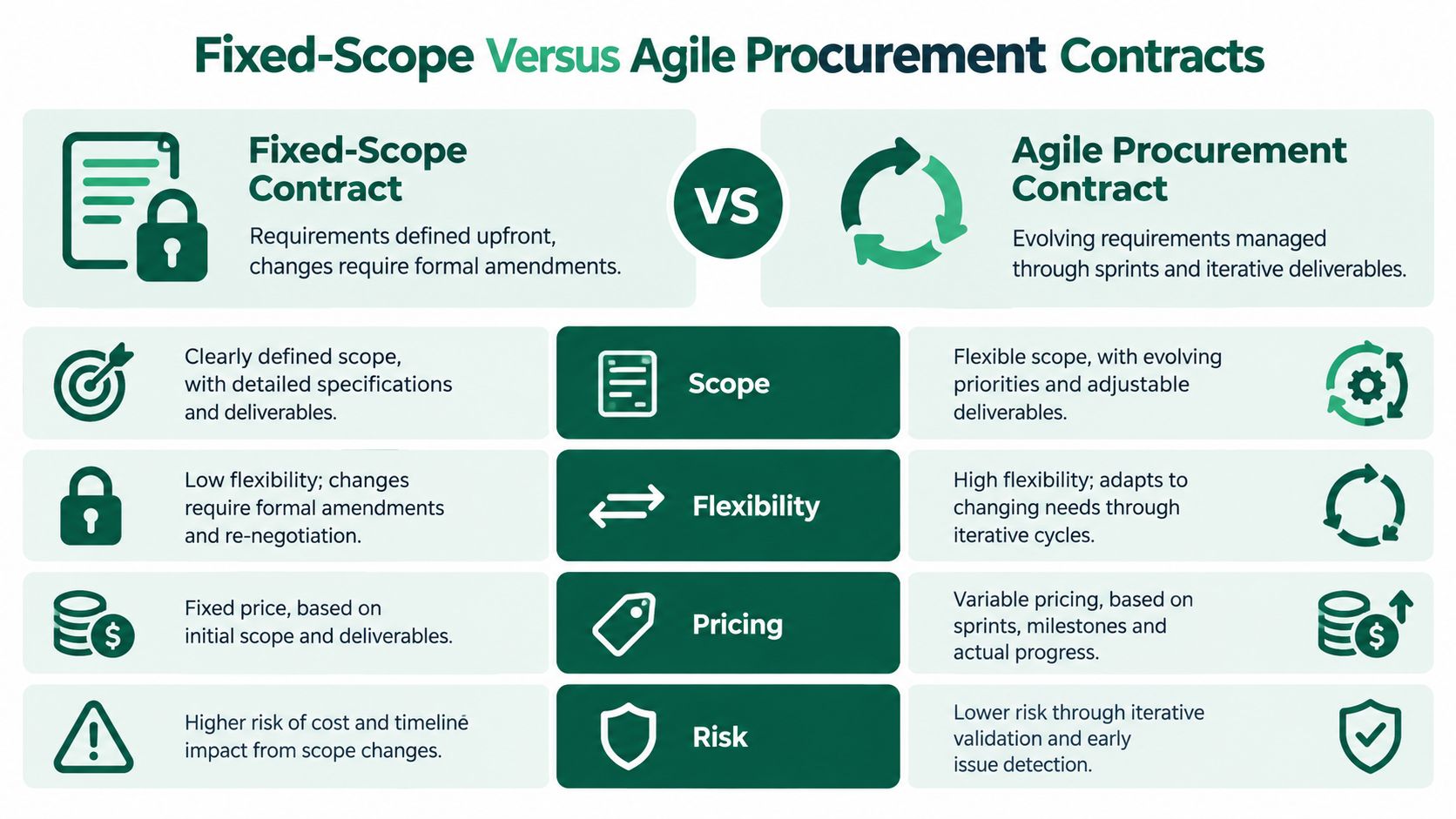
If you're buying a standard item with stable specifications, a fixed-scope contract often works well. If you're buying software configuration, specialist services, or anything likely to evolve during delivery, a rigid contract can create constant amendment friction.
When fixed scope is the right tool
A fixed-scope contract is strongest when you can define the requirement clearly before award. Think hardware, facilities work with settled drawings, or established service bundles.
In those cases, the contract usually benefits from:
Detailed specifications
Firm pricing rules
Formal variation procedures
Clear delivery and acceptance checkpoints
The advantage is control. The trade-off is that every meaningful change tends to require paperwork, approvals, and commercial renegotiation.
When flexibility lowers risk
Agile or flexible contracting is useful when requirements will become clearer during delivery rather than before it. Recent guidance on procurement contracts increasingly highlights phased deliverables, compliance terms, performance KPIs, remedies, and drift-risk controls because many categories no longer fit a simple fixed-spec model (agile procurement contract guidance).
That doesn't mean “keep it loose.” It means structure the contract differently. Instead of pretending everything is known on day one, you define:
Phase gates
Decision rights
Backlog or requirements validation rules
Substitution and approval procedures
Amendment paths that don't break governance
A good comparison point is the sourcing path that led to the deal. If your team used different supplier engagement stages to narrow options, it helps to understand the distinctions among RFP, RFI, and RFQ, because contract flexibility should match the certainty level created during sourcing.
The real mistake teams make
The mistake isn't choosing fixed scope or agile. The mistake is using fixed-scope language for work that will obviously move, then handling change informally.
That's when trouble starts. A supplier substitutes components without explicit approval. The business adds features in workshops. Milestones slip, but nobody resets acceptance criteria. The signed contract still reflects an older reality, and both sides begin managing off side conversations.
Use rigid contracts for stable needs. Use flexible contracts for evolving needs. Don't use one structure and behave like you picked the other.
Creating Audit-Ready Contract Records
A signed contract isn't the whole record. It's the center of the record.
If audit asks why a supplier was selected, why another was excluded, or why a requirement changed before award, the contract alone won't answer those questions. You need the surrounding evidence to be just as disciplined as the final agreement.
Build the file before you need to defend it
The best contract files start early. They capture what the buyer originally asked for, where the gaps were, how suppliers were assessed, and why key decisions were made.
That usually means preserving:
Specification history, including what changed and why
Supplier questions and clarifications
Evaluation logic, especially where suppliers were eliminated
Commercial deviations, such as non-standard warranties or delivery assumptions
Approval evidence, showing who accepted the risk
A practical pre-award control is to tighten supplier diligence before drafting final terms. A structured vendor due diligence checklist before a contract exists helps teams document what they verified before moving from evaluation into commitment.
Audit readiness is really continuity
When people hear “audit-ready,” they often think about a neat folder for later review. I think of continuity instead. Could another person pick up this file next year and understand why the contract says what it says?
That's where versioning and drift detection matter. If the locked requirement said one thing but the supplier's final proposal changed another, someone should be able to trace that difference and see whether it was accepted.
Here's a simple test:
Question | If the answer is no, the record is weak |
|---|---|
Can you show what requirement was issued to suppliers? | You can't prove the baseline |
Can you show why a supplier was removed? | You can't defend fairness or logic |
Can you show when terms changed? | You can't explain commercial drift |
Can you show who approved the exception? | You can't assign accountability |
Tools help when they preserve evidence, not just files
Spreadsheets, shared drives, CLM systems, and sourcing platforms can all support this work if they preserve traceable decisions. The useful features are the unglamorous ones: version history, centralized clarifications, structured comparison, and source-linked rationale.
One option in that category is Procright, which supports specification drafting, supplier comparison, evidence-backed compliance checks, and spec drift detection as part of the sourcing record. The key point isn't the tool name. It's that the system should help you preserve a defensible trail from first draft to final award rather than leaving the story split across inboxes.
If your contract record depends on someone remembering why a deviation was accepted, the record isn't complete.
Building Stronger Procurement Contracts Over Time
Strong procurement contracts rarely come from one perfect draft. They come from repeated learning.
A team gets better when it reviews where disputes started, which clauses were stressed, and which supplier behaviors weren't controlled well enough. Over time, that should change the way you write scopes, define acceptance, approve exceptions, and track amendments.
The habits that actually improve contracts
A few habits matter more than long playbooks:
Lock specifications earlier: Not before stakeholder input is ready, but before supplier interpretations start spreading.
Track drift against accepted terms: If supplier documents move away from the approved baseline, flag it before signature.
Preserve elimination rationale: If a supplier loses for a real reason, keep that reason in the file.
Close the loop with performance data: Contract drafting improves when post-award results feed back into future templates.
Supplier follow-through is part of that feedback loop. A disciplined supplier performance management approach helps procurement teams connect what was promised in the contract with what was delivered after signature.
The bigger point is simple. A procurement contract is both a commercial agreement and a compliance artifact. Teams that treat it as a living, traceable instrument build more trust with finance, legal, audit, and the business. Teams that treat it as final paperwork usually end up rediscovering the same preventable problems.
If you want help turning sourcing decisions into a traceable contract record, Procright supports specification drafting, supplier comparison, evidence-backed scoring, and audit-ready documentation across the path from first draft to final award. It's built for procurement teams that need to reduce ambiguity before signature, not just store files after the fact.
Try it on a real buy
Bring one category. Watch where the flags land.
We use a little analytics to see which pages actually help. Nothing else, no ad trackers.