How to Break Down Price Quotes and Compare Offers
In this article
You're staring at two quotes that look close enough to approve. One has a lower headline price, the other has a longer service list, and both suppliers swear they're competitive. Then the first invoice lands, and the “small” extras, setup, support, freight, taxes, and add-ons, turn the cheaper quote into the more expensive one.
That's why a price breakdown matters. In procurement, a true cost price breakdown means splitting the total into individual elements and expressing each one as a value or percentage of the total, so you can see what's inside the number and what's missing from it (procurement analytics overview). The better question is rarely “What's the price?”, it's “What is not included?”
A clean breakdown doesn't just help you negotiate. It gives you audit-ready evidence, a fair comparison across vendors, and a way to test whether the quote is missing major cost drivers before you get locked in. If you're already working through estimating workflows, a tool like Exayard construction estimating software can be useful context for how disciplined line-item costing works in practice.
Table of Contents
Why Breaking Down a Price Changes Everything
Two suppliers can quote the same project and produce very different invoices. One may include delivery, setup, and early support in the base price. Another may leave those costs outside the headline figure. The second quote appears cheaper until the work starts and those exclusions become payable.
What the headline number hides
A price breakdown changes the decision from “Which quote is lower?” to “Which offer covers the required outcome?” It exposes scope differences, excluded work, and costs that arrive later in the contract or lifecycle. Public-sector buying in the EU alone was estimated at €5.26 billion annually in the 2022 EU Public Procurement Scoreboard (procurement analytics overview), so small differences in included services can materially affect large purchasing programs. Commercial buyers face the same issue at a different scale.
The comparison should extend beyond the initial order. Include implementation, training, maintenance, replacement parts, support, renewals, and disposal where they apply. A supplier with a higher starting price may deliver the lower all-in cost if the competing offer excludes work your team must later buy elsewhere.
The breakdown also gives you a practical basis for testing supplier pricing. The U.S. General Services Administration states that hourly ceiling prices on Multiple Award Schedule contracts represent maximum vendor pricing for selected labor categories, giving buyers a reference for labor-rate comparisons (GSA pricing guidance). That reference becomes useful only when labor, hours, and related charges are visible.
Practical rule: treat every unexplained exclusion as a cost risk until the supplier confirms who owns it and what it will cost.
A structured quote makes negotiation more precise. You can challenge a labor rate, freight charge, support fee, or change-order trigger without arguing about the supplier's entire margin. Ask for the assumption behind each major line, then convert any scope difference into money before comparing awards. For teams reviewing construction or service estimates, Exayard construction estimating software provides useful context for disciplined line-item costing.
What to ask instead of just asking for price
Request the base price and a written list of exclusions. Ask what changes if the scope expands, delivery moves, usage increases, or the project runs longer. Require every vendor to answer in the same structure, with quantities, rates, assumptions, and one-time versus recurring charges identified.
A quote becomes actionable when you can trace its total through the full lifecycle and identify the cost of what it leaves out.
The Core Components Every Price Breakdown Needs
A supplier's total means little until you know what it includes and excludes. A quote can show a low unit rate while leaving installation, freight, support, or future usage outside the price. Build the breakdown around the full buying lifecycle, so scope differences become visible costs rather than surprises after award.

The core line items to demand
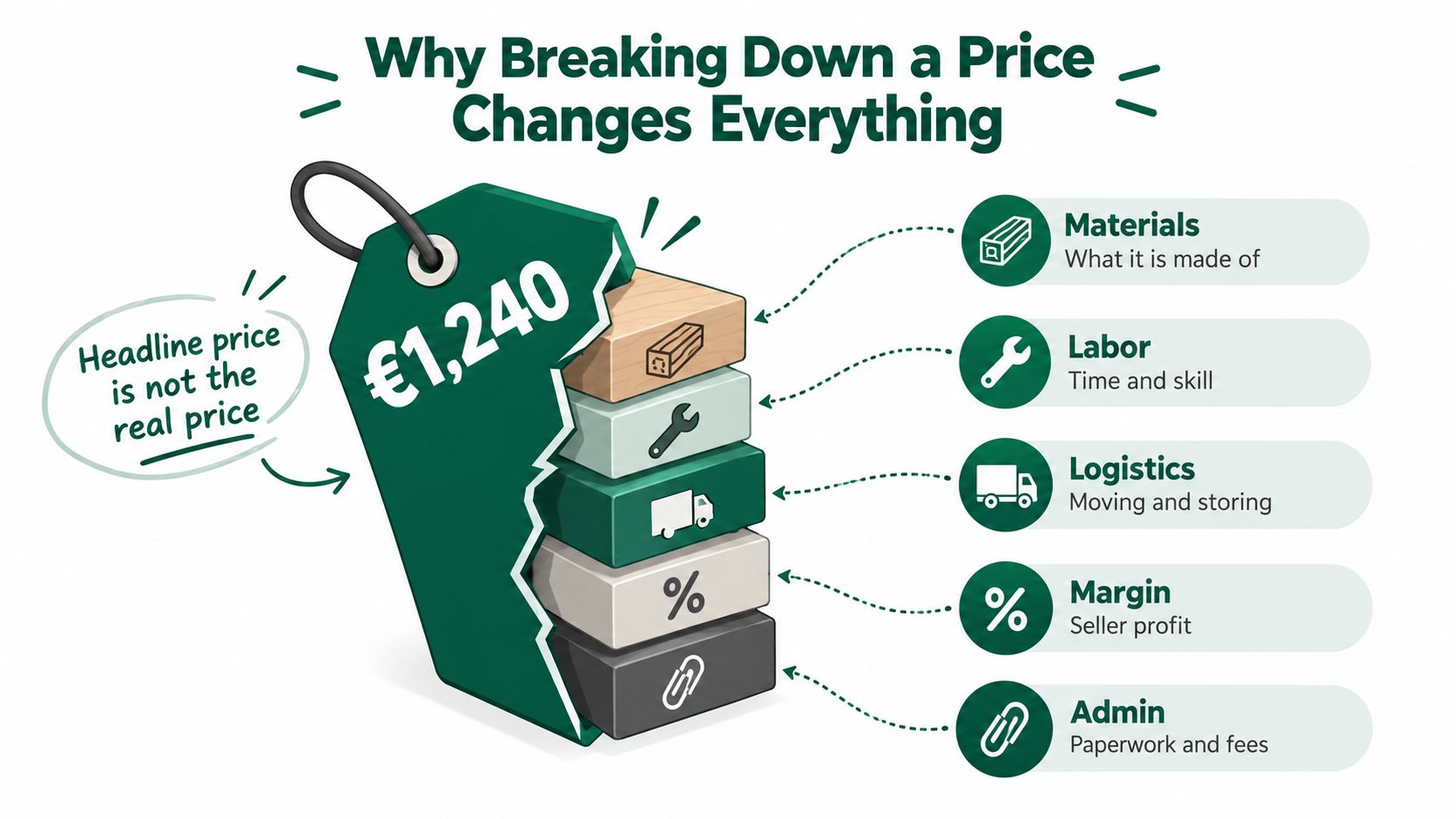
Request unit cost, materials, labor, overhead, and margin as separate lines. These show how the supplier builds the quoted price and where two offers use different assumptions. For hardware, separate components from assembly. For SaaS, separate subscription, implementation, and recurring support. For services, separate billable work from management overhead and profit.
Then require every cost that can sit outside the headline figure: taxes and duties, shipping and logistics, installation and implementation, training, support and warranty, and recurring fees. If a supplier calls the offer all-inclusive, ask for a written definition. “Included” should identify the quantity, service period, usage limit, and party responsible for any excess.
A useful line item shows its rate, unit, quantity, and pricing assumptions. “Project management” leaves too much room for interpretation. “Project management, 12 hours at the agreed rate, phase one only” gives you a basis for comparison and a clear trigger for extra charges.
Review the exclusions with the same care as the included work. Ask who pays for site preparation, data migration, storage, regulatory charges, replacement materials, and changes to the delivery schedule. These omissions often explain why a lower quote costs more across implementation, operation, and renewal.
For a practical reference on how costs can be organized, browse the cost structure resource.
A strong breakdown shows the included work, the excluded work, and the money attached to each gap.
A simple RFQ checklist
Unit pricing: show per-item, per-hour, or per-license rates.
Material detail: name grade, specification, and substitute risk.
Labor detail: show role, rate, expected hours, and responsibility.
Logistics detail: separate freight, handling, storage, installation, and delivery assumptions.
Recurring charges: list support, renewals, usage-based fees, and termination costs.
Exclusions: state what is outside scope and provide a rate or method for pricing it.
When every supplier answers in this structure, the quote becomes a lifecycle comparison rather than a sales document. You can see what each offer buys, what it leaves out, and which apparent price advantage disappears once the scope is aligned.
How to Break Down Any Quote Into Comparable Line Items
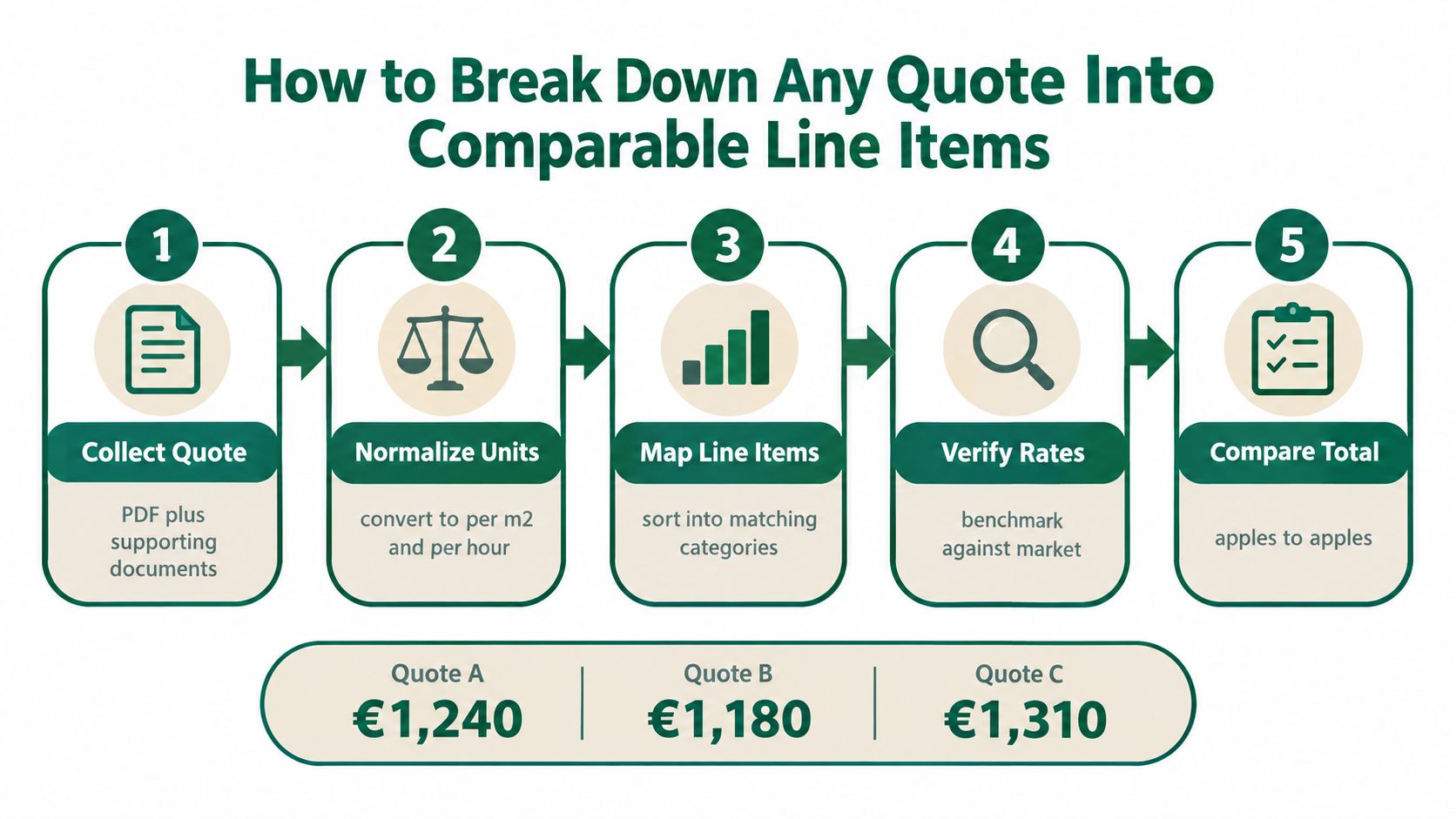
The work starts when you turn a messy quote into something you can compare side by side. Don't begin with the total. Begin with the supporting documents, the scope, and any assumptions the supplier made while pricing it. If those aren't in the package, ask for them before you do anything else.
Normalize before you compare
The first task is simple, but buyers skip it all the time. Convert every quote into the same units, the same quantities, and the same service period. A quote priced per m2 can't be compared cleanly with one priced per hour until both sit inside the same frame.
After that, separate one-time costs from recurring costs. Implementation, setup, onboarding, migration, and training often sit in the first bucket. Support, licenses, maintenance, storage, and renewals usually sit in the second. If you mix them, the cheapest first-year offer can become the most expensive long term.
Now rebuild the quote in a table. Capture the cost element, what it covers, the value, and the share of the total. That structure makes it easier to see where a supplier is lean and where they're vague. It also gives you a cleaner basis for notes, approvals, and later audit review.
For side-by-side comparison, I like to use a matrix that forces each vendor into the same rows. A comparison template like the comparison matrix works well because it keeps the structure fixed while the content changes.
What to do when the quote is bundled
Bundled discounts look attractive until you need to know what you're buying. If a supplier offers a package price with “everything included,” ask them to split out the bundle anyway, then show the discount as a separate line. That way you can see whether the discount is real value or just a pricing shape.
If the supplier leaves a line vague, push for specificity without sounding combative. Try wording like, “Please separate labor, materials, logistics, and any recurring charges so we can compare this against other offers on an equal basis.” That keeps the tone professional and usually gets a better response than asking them to “justify” the price.
Good rule: transparency is more useful than the lowest headline number, because transparency lets you challenge the right part of the quote.
You can also document assumptions directly in the comparison table. If one vendor excludes freight, mark it. If another includes training for only one session, mark it. Once those assumptions are visible, the quote becomes auditable instead of arguable.
Comparing Offers and Calculating True Total Cost
Once the quotes are broken into matching rows, the comparison gets much clearer. The question is no longer which vendor wrote the lowest number, but which vendor gives you the lowest true total cost under the same scope and operating conditions. That's where most buying teams finally see the spread.
Turn scope differences into money
Start by normalizing for quantity, timing, payment terms, and service levels. A slower delivery date can create internal delay costs. A shorter warranty can shift risk back onto your team. A quote with longer payment terms may feel easier on cash flow, while one that demands early payment changes the economics even if the invoice total looks identical.
For procurement teams, should-cost analysis is the useful reality check here. The method uses a four-step bottom-up approach, identify product specifications, research market rates for materials and labor, build a detailed cost model, and compare the result against supplier quotes to expose pricing gaps and negotiation levers (should-cost analysis guidance). That does not mean every quote should match your estimate exactly. It means you now know where the gap sits and whether it's explainable.
A lot of hidden cost lives outside the base line. SaaS and services quotes often leave out implementation, integration, premium support, migration, compliance add-ons, and training. If those appear later, the quote that looked lean at award time can become the expensive one in month two.
The right way to compare is to calculate first-year total cost and, when the purchase repeats or renews, the likely lifecycle cost as well. That's usually where recurring fees and scope creep do the most damage. A low entry price with expensive operating terms is still a high-cost deal.
Build a decision matrix, not just a price table
A price table shows the numbers. A decision matrix shows the decision. Give transparency its own score, because the most complete quote is often the safest one to award even if it isn't the absolute cheapest.
If you're comparing complex proposals, platforms like Procright's total cost of ownership guidance can help you keep the structure disciplined. The important part is not the tool itself. It's forcing every vendor into the same commercial reality before anyone signs.
Common Mistakes That Weaken Your Price Breakdown
Most weak breakdowns fail for the same reasons. The buyer accepts a lump sum, never asks for the missing sub-lines, and then treats the result as if it were fully comparable. That's how bargaining power disappears before negotiation even starts.

The errors that cost you leverage
The first mistake is over-aggregation. If labor, logistics, and management sit inside one line, you can't challenge the part that's off. The fix is to request a deeper split, especially where overhead or delivery work is likely to be distorted.
The second mistake is skipping independent benchmark checks. A breakdown is only useful if you compare it to something outside the supplier's own explanation. If the supplier says the rate is fair, that's not enough. You still need a market reference or a should-cost model to test it.
The third mistake is using the breakdown as a weapon. If buyers treat every detail like a trap, suppliers stop sharing useful information and start protecting themselves. The better move is to ask for transparency in a collaborative tone and focus on total cost drivers, not just price cuts.
The fourth mistake is poor documentation. If the source, date, and assumption behind each line aren't captured, the breakdown loses value as soon as the conversation moves on. That becomes a problem during approval, award review, or audit.
Suppliers answer more clearly when they know you're comparing options fairly, not fishing for a reason to reject them.
What strong disclosure looks like
Strong breakdowns are itemized, dated, and tied to the source of each figure. They separate categories instead of blending them. They also show where the quote depends on scope, schedule, or service conditions, so you can see what changes the final number.
That's the standard to push for. Not perfection, just enough structure that the offer can stand up beside another offer without guesswork.
Putting Your Breakdown to Work for Negotiation and Award
A breakdown earns its place when it changes the award decision. Once each line is clear, you can separate fixed costs from optional charges, question weak explanations, and push back without turning the supplier discussion into a dispute. The comparison should cover the full lifecycle, including costs the quote leaves outside its headline price.
Use the breakdown to choose the right negotiating point
If labor is high, test the role mix, hours, and deliverables. If logistics is high, examine the shipping method, storage plan, installation assumptions, and responsibility for delays. If recurring fees dominate, compare the renewal, support, and exit costs rather than judging year one alone.
A should-cost view provides a calm reality check. See this should-cost analysis guide for a four-step build. It will not replace supplier pricing, but it can show whether the quote broadly fits the work or whether one component needs a harder conversation. A supplier may hold the headline price while adjusting support, timing, included services, or a scope boundary.
The strongest negotiation point is often an omission. Ask who pays for setup, changes, travel, training, maintenance, data migration, or work outside the stated assumptions. Convert each difference into a cost before comparing offers. A lower quote can become the more expensive award once excluded work and future renewals are included.
Record the reasoning while the decision is being made. Note what was excluded, normalized, estimated, or accepted as a supplier assumption. The award file should explain the choice, not merely repeat the selected price.
Procright can support that evidence trail by drafting specifications, comparing suppliers, and capturing citations behind answers. This keeps the breakdown connected to source documents instead of leaving the rationale in a spreadsheet that becomes difficult to verify later.
Keep the closing checklist tight
Lock the scope: compare quotes built on the same requirements and service conditions.
Request missing lines: ask suppliers to split bundled or vague costs.
Validate rates: test labor, materials, logistics, and recurring fees against market logic.
Model total cost: include setup, renewals, support, exclusions, and likely changes.
Document the award: keep assumptions, sources, and negotiation outcomes with the decision.
Use the framework on the next live quote. Breaking down price early helps prevent small omissions from becoming expensive surprises.
For a structured way to compare quotes, preserve evidence, and maintain an audit-ready decision trail, visit Procright. It helps procurement teams turn supplier responses into documented comparisons and defensible awards.
Try it on a real buy
Bring one category. Watch where the flags land.
We use a little analytics to see which pages actually help. Nothing else, no ad trackers.