5 Data Security Risks in Procurement Platforms
One weak point in procurement platforms—access, integrations, encryption, logging, or suppliers—can expose bids, payments, and contracts.
In this article
Procurement platforms can store bids, contracts, bank details, tax records, invoices, and employee data in one system. That makes them a high-value target. If I had to boil this article down, I’d say the biggest risks come from bad access control, weak integrations, poor encryption, thin logging, and supplier-side gaps.
Here’s the short version:
Stolen logins can expose pricing, contract terms, and payment data
Unsafe system connections can let bad actors change approvals, invoices, or bank details
Weak data protection can leave stored files, backups, and transferred records open
Missing audit logs and slow response plans can let fraud sit in the system for months
Supplier and third-party access can become the weak point, especially since 40% of attacks in the cited research involved vendor breaches
A few controls do the most work first:
MFA
Role-based access
Scoped APIs
TLS 1.2/1.3
Immutable audit logs
Time-limited supplier access
Research cited in the article also points to two numbers that stand out: 67% of firms saw more cyberattacks, and stolen credentials were tied to nearly 50% of breaches. That’s why procurement security is not just an IT issue. It affects sourcing, approvals, payments, audits, and supplier trust.
Quick comparison
Risk | What can go wrong | First step I’d take |
|---|---|---|
Access issues | Login misuse, exposed bids, exposed bank data | MFA + least-privilege access |
Integration gaps | Changed invoices, fake POs, payment rerouting | Lock down APIs and secrets |
Weak encryption | Readable files, backups, and traffic | Encrypt data at rest and in transit |
Poor logging | Fraud with little audit trail | Turn on immutable logs and alerts |
Supplier gaps | Vendor account misuse, data leaks | Check vendors before access is granted |
If you want the plain-English takeaway, it’s this: one weak point can affect the whole buying process, so the safest path is to lock down identity, system connections, data protection, audit trails, and supplier access from the start.
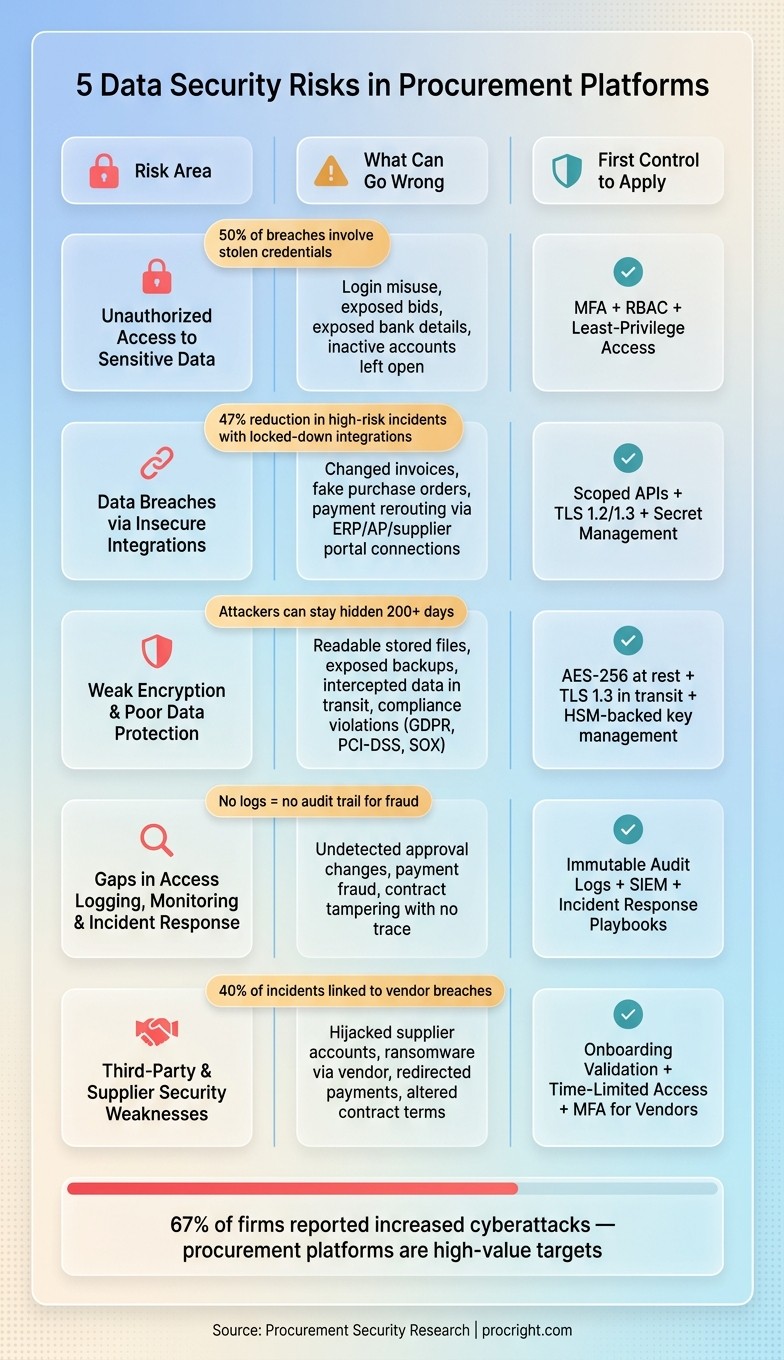
5 Data Security Risks in Procurement Platforms: Risks, Impacts & Controls
Supply Chain Threat Protection: How to Detect Real Vendor Identity Compromise with SpyCloud
1. Unauthorized Access to Sensitive Procurement Data
Unauthorized access often starts with stolen credentials. In 2023, stolen credentials were involved in nearly 50% of all breaches. That matters a lot in procurement, because these platforms often store bank details, bids, pricing, and contract terms.
The risk gets worse when access isn't updated after role changes or offboarding. If an employee leaves or moves to a new role, their account can stay active when procurement tools aren't tied to a centralized identity provider. Those inactive accounts can sit open far longer than they should.
When bids, pricing, bank details, credentials, or evaluation scores are exposed, the damage can spread fast. It can open the door to fraud, weaken your position in negotiations, and make audits much harder to defend.
A few controls help cut this risk:
Require MFA
Enforce RBAC and least privilege
Revoke access automatically through centralized identity management when roles change or employees leave
Strong login controls still fail if data moves through weak integrations.
2. Data Breaches and Insecure Integrations
After account takeover, integrations are often the next way in. Procurement platforms connect to ERP systems, AP tools, supplier portals, and HR systems. Every connection adds another opening. If those links aren't locked down with scoped APIs, managed secrets, and TLS 1.2 or 1.3, data moving between systems can be intercepted or changed.
That matters because a lot of sensitive information travels through these connections: supplier bank details, negotiated pricing, contract terms, competitive bid responses, and employee PII. When a breach hits, it doesn't just expose records on paper. It can also throw day-to-day work off track. A weak integration point can let attackers override approvals, create fraudulent purchase orders, or tamper with invoice data. In AP, they may change invoice or bank details and reroute payments.
Worse, these breaches don't always show up right away. Undetected integration breaches can expose data and alter transactions for months.
Integration failures tend to hit a few parts of procurement workflow automation the hardest:
Procurement Workflow | Exposed Data | Impact |
|---|---|---|
Sourcing | Competitive bids, pricing | Bid rigging; loss of competitive advantage |
Approvals | Credentials, workflow rules | Fraudulent POs; unauthorized spend |
Contracts | Legal terms, PII, shadow data | |
Payments | Bank details, invoices, tax IDs | Payment fraud; duplicate payments |
To cut risk, teams should use scoped APIs, secret management, TLS 1.2/1.3, AES-256, and maker-checker approvals for high-risk actions such as supplier bank detail changes. Companies that locked down integrations and added automated controls saw a 47% reduction in high-risk incidents across supplier master and invoice workflows.
Even then, secure integrations can still leak data if encryption at rest or in transit is weak.
3. Weak Encryption and Poor Data Protection
When integrations start moving data across systems, encryption has to do its job. Procurement platforms need to protect data at rest, in transit, and in backups.
Use AES-256 for data at rest and TLS 1.3 for data in transit. Backups need that same protection. If backup media gets stolen or leaked, a company can lose its clean recovery path after a breach.
The data at risk usually falls into a few key groups:
Data Category | Specific Data at Risk | Impact of Poor Protection |
|---|---|---|
Financial | Bank details, payment credentials, invoices | Financial fraud, unauthorized transfers |
Commercial | Contracts, pricing, competitive bids | Loss of negotiation leverage, trade secret exposure |
Intellectual Property | Proprietary designs, formulas, tech specs | IP theft, loss of competitive advantage |
Personal | Employee IDs, supplier contact info | Phishing, identity theft, privacy law violations |
Strategic | Spend analytics, supplier performance scores | Manipulation of supply chain decisions |
Here’s the hard part: attackers can stay hidden for more than 200 days. That gives them plenty of time to read or exfiltrate data. And if there’s no real-time spend analysis and behavioral monitoring, someone using approved supplier credentials can quietly move through unencrypted data for months without setting off alarms.
Weak encryption also creates a direct compliance problem. Rules like GDPR, PCI-DSS, and SOX expect strong data protection and audit controls. If there are gaps, teams can run into penalties, failed audits, and lost supplier trust.
Use HSM-backed key management so intercepted data stays unreadable.
Encryption reduces exposure. Logging and alerts show when someone is misusing access.
4. Gaps in Access Logging, Monitoring, and Incident Response
Encryption protects data. Logging and monitoring show you what people actually do with it. Without that layer, a procurement platform turns into a black box. Things happen, but no one can retrace them. And when there are no detailed logs or alerts, suspicious activity may sit there quietly until fraud or data loss has already happened, making supplier risk monitoring with AI tools essential for real-time detection.
This gets risky fast. If logs don't record supplier bank detail changes, approval routing changes, bulk exports, or off-hours access, bad approvals can slide through without anyone noticing—a risk mitigated by AI tools for data validation that flag inconsistencies automatically. An attacker can change payment details or tweak contract terms and leave little to no trail. That gives them room to change supplier records, approvals, or exports before anyone spots the pattern.
The table below shows the records procurement teams often miss and why they matter:
Record Category | What to Capture | Why It Matters |
|---|---|---|
User Access | Authentication events, MFA attempts, session IDs, and IP addresses | Detects credential misuse and unauthorized access |
Supplier Data | Changes to vendor bank details, contact information, and tax identifiers | Flags potential payment fraud or vendor impersonation |
Approvals | Purchase request approvals, contract approvals, and approval routing changes | Identifies unauthorized or manipulated approvals |
Configuration | Changes to user permissions, role assignments, and security settings | Catches privilege escalation before it causes damage |
Data Activity | Bulk data exports, document downloads, and file deletions | Reveals data exfiltration attempts |
Audit logs also need to be immutable. If an admin can delete or edit log entries, the audit trail stops being trustworthy. That creates problems for internal investigations and for compliance checks tied to SOX, GDPR, and PCI-DSS.
Incident response has a similar weak spot. Many procurement teams don't have playbooks for fraud, account takeover, or vendor-breach incidents. Detection on its own isn't enough. The response plan has to fit procurement workflows, or the team loses time when every minute counts.
A solid setup usually includes:
Playbooks for fraud, payment rerouting, and contract tampering
Centralized log collection in a SIEM
Quarterly reviews of access logs and security settings to find expired access and odd activity
These controls get even more important when suppliers, admins, and external tools introduce new audit gaps.
5. Third-Party and Supplier Security Weaknesses
A procurement platform is only as secure as its weakest supplier connection. You can lock down your own systems, set strong internal controls, and still end up exposed through a vendor account. Supplier portals, APIs, and email-based workflows all create entry points that attackers test again and again. Research shows that 40% of those incidents were linked to vendor breaches. That makes supplier security a direct procurement risk, not a side issue.
The hard part is that suppliers don’t all follow the same security standards. Some use weak login controls. Some still lack MFA. And that gap can make a breach much easier. If an attacker gets into a supplier account, they can move through procurement workflows using what looks like normal access. From there, they may pull contracts, pricing data, or payment details without setting off early alarms.
Once a supplier account is taken over, the problem doesn’t stop at data loss. It can spill into day-to-day operations fast. A ransomware attack on a supplier can shut down procurement systems, slow supply deliveries, and throw off production schedules. A hijacked vendor account can also be used to redirect payments or alter contract terms.
This is why the work has to start before onboarding. Risk-rank suppliers before they get access. For high-risk vendors, require MFA, clear data-handling terms, breach-notification deadlines, and time-limited access. Those controls matter most at the front door, before a supplier ever touches procurement data.
The table below shows where third-party connections often fail and what data may be exposed:
Connection Type | Primary Security Risk | Typical Data Exposed |
|---|---|---|
Supplier Portals | Weak authentication, credential theft | Contracts, pricing, PII |
ERP Integrations | API vulnerabilities, unauthorized lateral movement | Financial records, tax info, account data |
Email/Manual | Phishing, spoofing, interception | Invoices, bank detail changes, bids |
Cloud Connectors | Misconfigured permissions, data leakage | Spend analytics, project management data |
Where to Apply Security Controls First
These five risks don't all matter in the same way. Start with identity, integrations, logging, and supplier access.
First, lock down identity and access. After that, secure every API and integration link with scoped authentication and automated provisioning. Then cut the time attackers can stay hidden. Real-time monitoring and immutable logs help spot suspicious activity before it turns into fraud or data loss. Supplier checks should follow close behind: validate supplier security by comparing products for compliance during onboarding and use segmented, temporary credentials.
The summary below maps each risk to the first control to apply.
Risk Area | Procurement Data Affected | Most Relevant Safeguards |
|---|---|---|
Unauthorized Access | Supplier bank details, pricing, contracts | |
Insecure APIs/Integrations | Data in transit between connected systems | TLS 1.2 or 1.3, AES-256, scoped API authentication, automated provisioning |
Logging and Monitoring | Audit trails, approval logs, transaction history | Real-time behavioral monitoring, immutable audit logs |
Encryption Gaps | PII, competitive bids, tax information | Encryption at rest, data masking, automated compliance checks |
Third-Party Vulnerabilities | Shared supplier data, internal system pathways | Onboarding validation, access segmentation, temporary credentials |
These controls cut exposure across access, integrations, logs, and supplier workflows.
Conclusion
Put together, these risks can stack up across the procurement lifecycle. One stolen credential, weak encryption setup, or poor monitoring process can turn a small gap into a full breach.
The answer is layered defense: access controls, encryption, monitoring, and supplier review each cover a different weak spot. No single control can do the whole job. A layered approach helps stop one mistake or failure from turning into a breach, protecting bids, payments, approvals, and supplier records. Supplier security review also needs to happen all the time, not just during onboarding.
For AI-powered procurement platforms like Procright, secure data handling is the base for reliable specification creation, product discovery, and compliance scoring.
In procurement, secure data is not a back-office issue. It supports every reliable decision.
FAQs
Why are procurement platforms a common target?
Procurement platforms are prime targets because they pull a lot of sensitive data into one place: payment credentials, supplier contracts, pricing details, and internal approvals.
They also plug into legal, finance, and supplier systems. That gives attackers more than one way in, and it opens the door to data theft, fraud, and supply chain compromise. On top of that, weak identity controls, orphaned accounts, and shadow procurement processes often leave gaps that are easy to exploit.
Which security controls should we implement first?
Start with the basics that cut down on unauthorized access and help protect data integrity:
Multi-factor authentication for all users
Role-based access control so employees only see what they need
Encryption for data in transit and at rest
Then build on that base with audit logging, secure supplier onboarding, and regular security testing.
How can supplier access create hidden security risks?
Supplier access can open the door to hidden security risks, especially when outside partners get broad permissions that no one is watching closely. It sounds harmless at first. But once a supplier has more access than they need, a small gap can turn into a big problem fast.
Weak sign-in practices make that risk even worse. Reused passwords, for example, can help attackers slip past defenses and get into sensitive procurement data without much friction.
The problem doesn’t stop there. Poorly set up supplier portals, third-party integrations that were never checked carefully, and weak API protections all create extra ways in. And when teams fail to review a supplier’s security posture or put firm limits on access, those issues can sit in the dark for months.
That’s when the damage starts to spread: data breaches, financial fraud, and day-to-day disruption that slows the business down.
Related Blog Posts
Try it on a real buy
Bring one category. Watch where the flags land.
We use a little analytics to see which pages actually help. Nothing else, no ad trackers.