FAQs on AI Product Recommendation Systems
How AI recommenders speed sourcing, enforce policy, and rely on clean data, explainability, and human review for safe rollout.
In this article
AI product recommendation systems can cut procurement cycle time by 30% to 50% and lower costs by 15% to 30% - but only when your data, rules, and review process are in place.
If I had to sum up the article in plain English, it’s this: these systems do more than suggest products. They rank items based on spec fit, supplier risk, price, lead time, contract status, and policy rules. And they work best when I treat them as decision support, not auto-pilot.
Here’s the short version:
What they do: Help buyers find the best-fit product from large catalogs
What they use: Product specs, supplier records, contract terms, purchase history, and buyer feedback
How they rank: Spec match, total cost, compliance, risk, and availability
What improves results: Clean item data, standard units, rule-based filters, and model retraining
What gets in the way: Missing attributes, weak taxonomy, low trust, and poor explainability
How to roll out: Start with a 3- to 6-month pilot, keep humans reviewing outputs, and watch metrics like cycle time, maverick spend, and exception rate
What governance means here: If ERP or policy blocks an item, the system should not suggest it
Where Procright fits: It connects spec writing, product discovery, and line-by-line compliance checks with source-backed proof
A few numbers stand out:
74% of procurement leaders say their data is not AI-ready
27% of SKUs fail completeness checks
23% fail accuracy checks
Teams should have 12–24 months of clean PO and invoice history
At least 80% of core fields should be filled before rollout
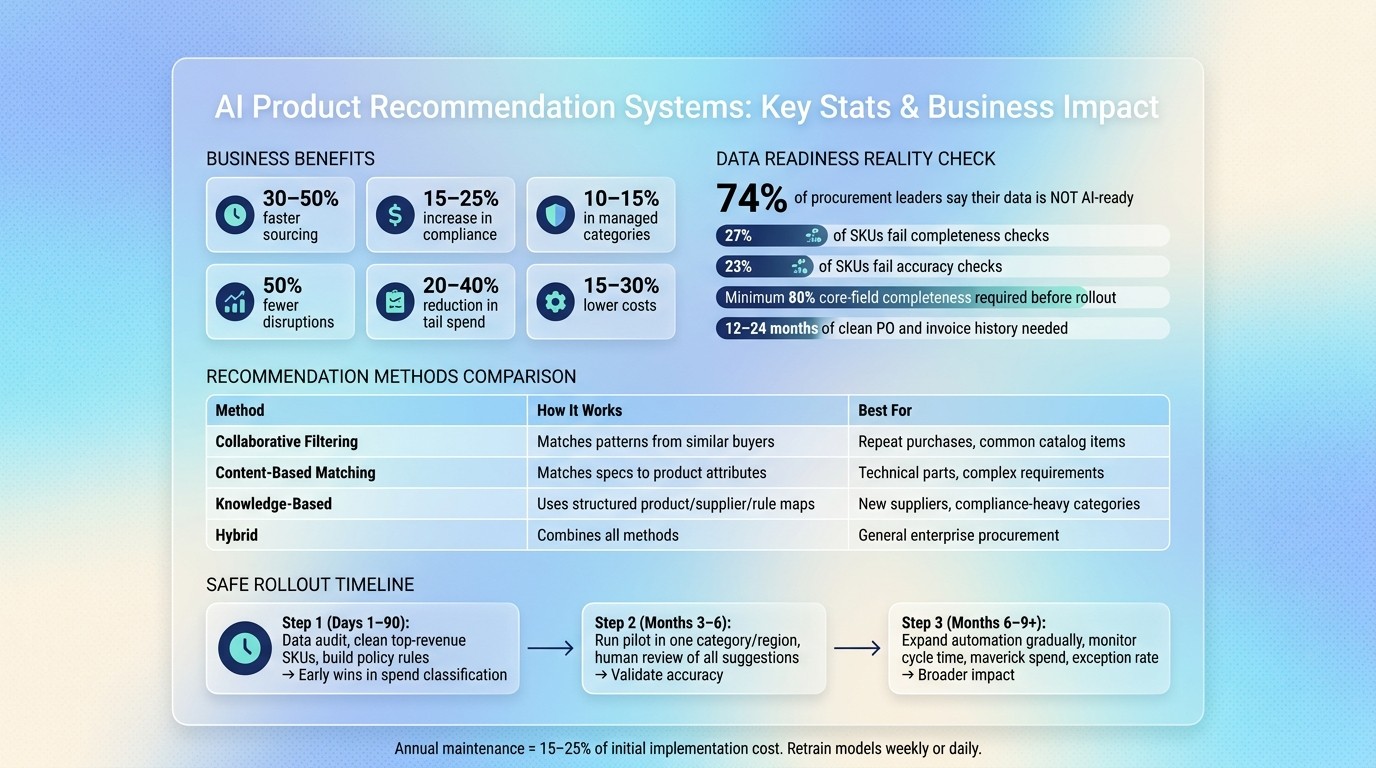
AI Procurement Recommendations: Key Stats & Business Impact
How Agentic AI Can Transform Procurement Outcomes W/ Nick Heinzmann
Quick Comparison
Area | What matters most |
|---|---|
Consumer recommenders | Clicks, interest, conversions |
Procurement recommenders | Specs, TCO, policy fit, supplier risk |
Best model setup | Hybrid approach: collaborative + content-based + rules where needed |
Top success factor | |
Main trust factor | Clear reason codes and audit logs |
Safe rollout path | Small pilot, human review, then gradual expansion |
So if you’re asking, “Do AI recommenders help in procurement?” my answer is: yes, if the system can prove fit, follow policy, and show why it made the recommendation. The rest of the article explains how that works in practice.
How AI Product Recommendation Systems Work
What Data the System Needs to Generate Useful Recommendations
Once the requirements are set, the system ranks options using three things: data, matching logic, and feedback.
At the center of it all is an item master. That means product details like material composition, dimensions, load capacity, and other technical specs. If those details aren't there, the system has no solid way to match a product to a need.
It also needs more than product data. Supplier records, contract terms, and historical purchase orders (POs) help the system understand your company's buying context. That includes who you're under contract with and what you've paid in the past. On top of that, behavioral signals help show intent. Searches, page views, shortlist saves, accepted recommendations, and rejections all tell the system what buyers are leaning toward.
Data standardization isn't optional here. Use the same currency, date, and unit formats across the catalog. If a product is missing a required attribute, it gets filtered out.
With those inputs in place, the model can compare options and rank the best fit.
Which Recommendation Methods Are Commonly Used
Most enterprise procurement systems use a hybrid approach that blends two main methods.
Collaborative filtering looks at patterns across similar buyers. If manufacturers in the same industry keep buying a certain type of safety equipment or software, the system may suggest that item to a similar buyer.
Content-based matching looks at the product's technical attributes. It compares the buyer's stated requirements with catalog attributes, which makes it a good fit when exact specs matter.
Each method has a weak spot. Collaborative filtering has trouble with new products that don't have purchase history yet. Content-based matching can become too narrow and show only near-identical items. Hybrid models help balance this out by using pattern data to surface options first, then spec data to narrow them to the ones that fit.
Knowledge-based systems take a different path. They use a structured map of products, suppliers, and rules. These systems work well in compliance-heavy procurement, especially when there's little purchase history to lean on. That can happen when a team is sourcing from a new supplier category or trying to find a replacement for a discontinued part.
Method | How It Works | Best For |
|---|---|---|
Collaborative Filtering | Matches you with similar buyers' patterns | Repeat purchases, common catalog items |
Content-Based Matching | Matches specs to product attributes | Technical parts, complex requirements |
Knowledge-Based | Uses a structured map of products, suppliers, and rules | New suppliers, compliance-heavy categories |
Hybrid | Combines the above methods | General enterprise procurement |
How Models Improve Through Feedback and Measurement
After launch, recommendation quality comes down to how buyers react to what they see. Clicks, accepts, rejects, and returns all feed back into the model and shape future rankings.
Not all signals carry the same weight. Purchases are the strongest signal. Accepted recommendations and add-to-cart actions come next. Clicks are weak signals, and returns work against a product.
Procurement teams can also track catalog coverage, which is the share of the item master that shows up in recommendations. If that number falls below 20%, the model is probably serving the same high-volume products again and again while newer items stay out of sight.
When that happens, the fix is usually pretty plain: clean up missing attributes and retrain the model on a set schedule, often weekly or daily.
Business Benefits and Limits of AI Recommendations in Procurement
Where Procurement Teams Gain the Most Value
The clearest win is faster sourcing. But there’s a catch: those gains depend on clean product data and clear policy rules.
Guided buying also helps push more spend onto contract because approved options show up as the default choice. That makes the right path the easy path.
Benefit | Practical Impact |
|---|---|
Cycle Time | 30–50% faster sourcing |
Compliance | 15–25% increase in on-contract spend |
Spend Control | 10–15% direct cost savings in managed categories |
Risk Reduction | 50% fewer supply chain surprises |
Tail-Spend Management | 20–40% reduction in unmanaged spend |
What Can Reduce Recommendation Quality or User Trust
The same things that make recommendations work well can also make them fall apart.
Recommendation quality depends more on data quality than model design. 74% of procurement leaders say their data is not AI-ready, and that gap shows up fast in the output. If product records are incomplete or catalogs don’t match from one source to another, the system has less to work with.
New categories can also be a weak spot. When there’s little purchase history, the system has less to learn from, so recommendations tend to be less sharp.
Trust starts to slip when recommendations feel like a black box. If buyers can’t see why one product ranked first, they’re less likely to follow the suggestion. This lack of transparency is a common hurdle in AI supplier scoring and ranking systems.
There’s also the risk of leaning too hard on price. Without guardrails, price-only ranking can steer buyers toward cheaper options that don’t deliver the best overall value. That’s why implementation and governance matter just as much as the model.
Implementation Requirements and Governance
Recommendation quality rises or falls on data and policy. So implementation starts there.
What Data and Systems to Prepare First
Before launch, bring PIM, ERP, and supplier files into one format. Then standardize units, naming, and category taxonomies.
Bad catalog data can stall deployment fast. 27% of SKUs fail completeness and 23% fail accuracy. And for recommendations to work well, at least 80% of core fields in purchase orders and supplier records should be filled in. That’s why a data audit before deployment can save a lot of cleanup later.
Prerequisite Area | Readiness Indicator | Ownership Area |
|---|---|---|
Product Data | 80%+ core-field completeness; standardized units/naming | PIM / Catalog Management |
Transaction History | 12–24 months of clean PO and invoice history | Finance / Procurement |
System Integration | IT / Systems Admin | |
Taxonomy | Hierarchical taxonomy with defined semantic relationships | Category Management |
Governance | Documented approval thresholds and preferred vendor lists | Procurement Governance |
A practical way to begin is to enrich the highest-revenue SKUs first, then expand from there. That keeps the first phase focused where the business impact is highest.
How to Align Recommendations with Procurement Policy
Once the data is ready, the next step is policy enforcement.
Recommendations need to follow procurement policy, not just match user intent. In practice, that means turning policy into rule logic: preferred supplier lists, approval thresholds, and restricted items should all be built into the system so they can be enforced automatically.
A useful way to think about this is risk-based classification. Low-risk decisions, like synonym expansion, can run with light oversight. Medium-risk decisions, like product recommendations, need tighter constraints. High-risk decisions, like substitution and pricing decisions, should trigger human-in-the-loop review.
And the rule should be simple: if ERP or policy blocks a purchase, the system must not recommend it.
Auditability matters just as much as accuracy. Every recommendation should include traceable logic, such as "recommended because it matches your equipment model", and the system should log decisions and applied policies for compliance review.
How to Start with a Low-Risk Rollout
After policy rules are in place, start with a limited pilot.
A 3- to 6-month pilot in one category, region, or process gives teams room to check model accuracy and test vendor claims before committing to a broader rollout. It’s a safer way to learn what works without flipping the whole operation at once.
Keep humans in the loop from day one. Start with AI surfacing suggestions that buyers review and approve, then increase automation only as accuracy proves out. Spend classification can show results within 60 to 90 days.
It also helps to plan for maintenance up front. Organizations usually spend 15–25% of initial implementation costs each year on model retraining and refinement. On top of that, teams should monitor for performance drift and policy misalignment on a continuous basis.
How Procright Supports AI-Driven Product Recommendation
Clean data and clear rules help, but procurement teams still need proof that a recommended product meets the spec. That’s where structured specification intelligence comes in. It gives teams a way to check each requirement against product evidence, which makes explainable specification matching the step between a recommendation and final approval.
Procright is an AI-powered procurement platform built around a three-stage workflow - Specify, Discover, and Compare. It matches finalized specifications to product documentation, including web pages, PDFs, and videos.
How Specification Creation and Product Discovery Connect
For teams that need strong recommendation quality and a clear policy trail, Procright links spec creation, discovery, and compliance verification in one flow. One of the biggest reasons recommendations fall apart is simple: the original spec is too vague or missing key details. Procright’s AI agent reviews draft specifications and flags missing technical requirements before the buying process moves ahead. Industry-specific templates are built to cut specification errors by up to 90%.
Once a specification is complete, the discovery engine matches each requirement line by line to documented product capabilities. It then ranks candidates by technical fit and reports a 99% technical match rate across individual specification details.
How Transparent Compliance Scoring Supports Decisions
After candidate products are found, Procright scores each product line by line and labels each item Yes, Partially, No, or Not Found. So instead of getting a black-box recommendation, teams can see where a product fits and where it misses the mark. Each score links back to its source document or timestamp, which gives buyers a traceable audit trail before approval.
Procright Capability | Procurement Outcome |
|---|---|
AI-Assisted Spec Writing | Eliminates technical gaps and overlooked details before going to market |
Smart Product Discovery | Ranks products based on documented technical fit rather than marketing claims |
Line-by-Line Compliance Scoring | Provides a documented, traceable basis for selection |
Transparent Source Citation | Shows exactly which document or video verified each requirement |
Partial Match Flagging | Highlights where further review or vendor clarification is needed |
Teams can also assign priority levels to the most important specification items, so scores reflect both business needs and technical requirements.
Conclusion: Key Takeaways for Procurement Teams
The earlier sections all lead to one plain rule: AI recommendations outperform manual methods only when clean data, policy logic, and explainable scoring line up.
If product attributes are incomplete or inconsistent, the system drops those items. So before rolling out any AI recommendation workflow, teams should get to at least 85% spend-classification accuracy and keep 12–18 months of clean transaction history ready.
Policy fit matters just as much. Preferred suppliers, approval hierarchies, and category restrictions need to be built into the system. If they aren't, people will work around it. And if users can't see why a recommendation showed up, trust fades fast. High-risk categories still need human review. Using a procurement checklist can help teams standardize these reviews.
That’s why it makes sense to start small. Run a 3- to 6-month pilot in one category or region. Many teams see early wins in 60 to 90 days, with broader impact showing up in 6 to 9 months.
What should you watch? Not just whether the tool produces suggestions, but whether those suggestions lead to better decisions. A few signals matter most:
Cycle time
Maverick spend rate
Exception frequency
Those metrics show whether the system is helping - or starting to drift.
The strongest procurement teams treat AI as decision support, not a replacement for judgment. They pair it with clean data, policy rules, transparent scoring, and human review.
FAQs
How much data is enough to start?
It depends on how your system is built. Methods that lean on dense interaction data, like collaborative filtering, usually need a lot of scale to work well. Content-based or knowledge-graph methods can do more with less because they use structured product data, technical documentation, and specific requirements.
At the start, the main job is getting your data clean, structured, and complete. Procright can help fill gaps in technical requirements and give you a clear way to compare products when historical interaction data is still thin.
Can AI recommendations work for new categories?
Yes. AI recommendation systems can work well in new categories when they focus on semantic relevance and attribute-level matching, not just past purchase data or keyword density.
With Procright, AI helps teams define procurement needs, draft technical specifications, and match requirements to actual product capabilities using verified technical data and transparent compliance scores.
How do buyers verify why an item was recommended?
Buyers can check the recommendation logic by reviewing the source material behind each product match. Procright points to the exact technical document, guide, or video used to assign a product’s compliance score, so every decision is traceable.
Instead of a black-box ranking, buyers get item-level compliance scores: Yes, Partially, No, or Not Found. That makes internal reviews and audits a lot easier.
Related Blog Posts
Try it on a real buy
Bring one category. Watch where the flags land.
We use a little analytics to see which pages actually help. Nothing else, no ad trackers.