AI Supplier Scoring: What Procurement Teams Need to Know
Implement AI supplier scoring: continuous risk and performance updates, explainability, data hygiene, governance, and pilot steps.
In this article
If you manage hundreds of suppliers, annual reviews are too slow. AI supplier scoring helps you update supplier risk and performance every 30 to 90 days, spot issues earlier, and give buyers a clear reason for each score.
Here’s the short version:
I’d use AI scoring to track cost, quality, delivery, financial health, and compliance in one place.
I’d treat the score as decision support, not the final decision.
I’d make sure the model shows why a score changed, not just the number.
I’d set human review rules for high-risk cases, missing data, and fast-moving events.
I’d fix supplier master data first, because bad records can spread bad decisions at scale.
A few numbers stand out:
U.S. procurement teams handle 286 vendors on average
Third-party breaches made up 30% of security incidents in 2025
Teams using AI-driven evaluation tools can handle 3x more RFPs
Many teams should target at least 70% data completeness before rollout
Here’s what matters most: the score is only useful if buyers see it inside the workflow - during prequalification, shortlist, award, and review.
What to focus on | What it means |
|---|---|
Data | One supplier record across ERP, CLM, and SRM |
Inputs | Internal performance data plus sanctions, credit, ESG, and news checks |
Model | Weighted scoring, risk tiers, and trend flags |
Controls | Override rules, version history, approver names, and timestamps |
Use | Pilot with 5 to 10 suppliers, then track adoption, exceptions, risk events, and savings |
In other words: AI supplier scoring can help you solve common challenges and make more consistent decisions, but only if the data is clean, the rules are clear, and each score links back to evidence.
How to Use AI for Supplier Risk Scoring in Procurement (5-Dimension Framework)
What AI supplier scoring is and how it works
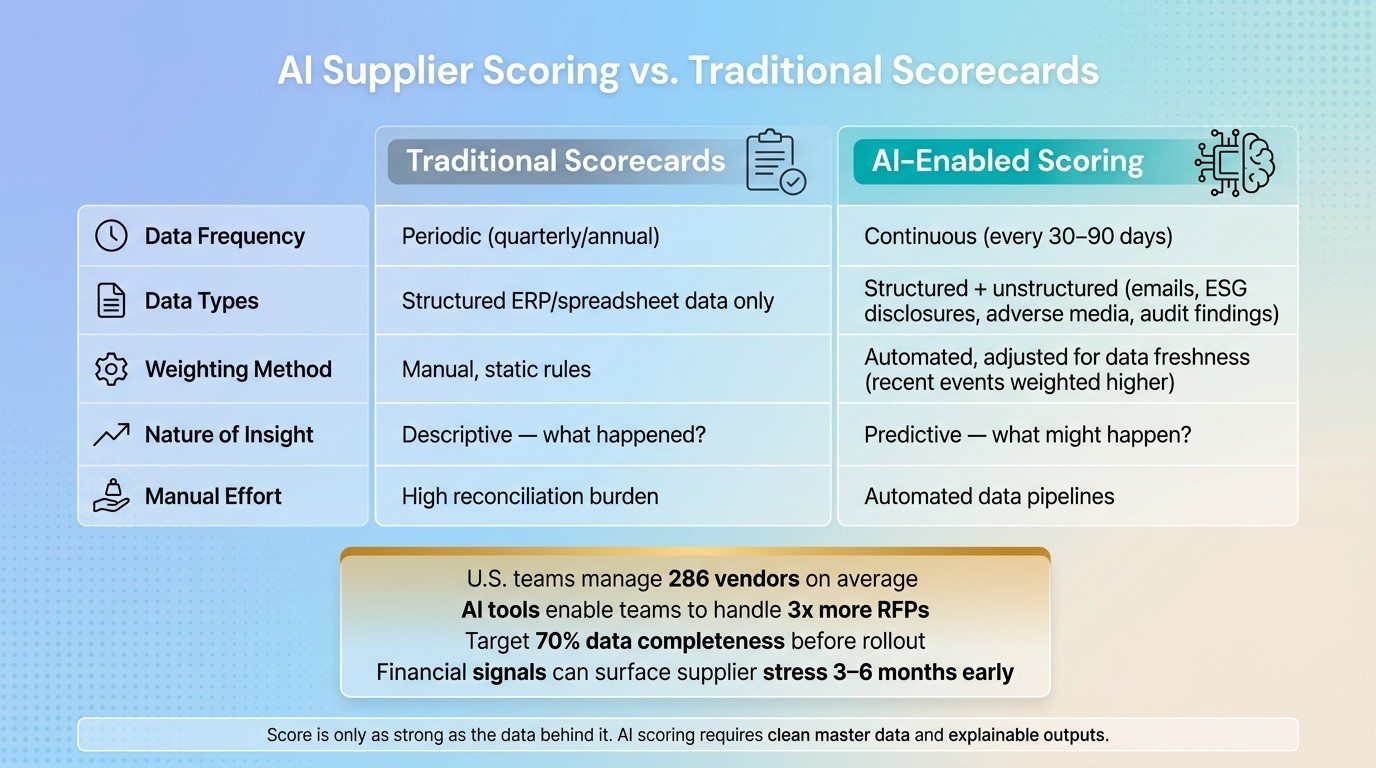
AI Supplier Scoring vs. Traditional Scorecards: Key Differences
AI supplier scoring turns internal and external supplier data into a current risk and performance score. In plain terms, it pulls in new signals, ties them to the right supplier, and updates the score as conditions shift.
The process usually follows four steps: signal ingestion, entity resolution, pattern detection, and automated weighting. Entity resolution is a big deal here. It connects aliases, subsidiaries, and parent companies to a single supplier record, so teams aren't judging the same company through three different names.
AI scoring versus traditional supplier scorecards
Traditional scorecards often depend on periodic ERP exports and manual cleanup. That means teams are usually working with snapshots. AI-enabled scoring goes further by processing both structured data and unstructured data on a continuous basis, including emails, audit findings, ESG disclosures, and adverse media.
The weighting changes too. Instead of using fixed rules, the model gives more weight to recent events and less weight to older ones as data ages. That makes the score more responsive to what's happening now, not what happened six months ago.
Feature | Traditional Scorecards | AI-Enabled Scoring |
|---|---|---|
Data frequency | Periodic (quarterly/annual) | Continuous |
Data types | Structured ERP/spreadsheet data | Structured + unstructured data |
Weighting | Manual, static | Automated, adjusted for data freshness |
Nature of insight | Descriptive (what happened?) | Predictive (what might happen?) |
Manual effort | High reconciliation burden | Automated data pipelines |
That gap matters. A score is only as strong as the data behind it.
The data behind a supplier score
A supplier score depends on the inputs feeding it. Most models pull from four broad dimensions: operational, quality, commercial, and compliance/risk.
Here’s what that usually includes:
Operational: on-time delivery, fill rates, lead times
Quality: defect rates, return rates, audit findings
Commercial: price variance, invoice accuracy
Compliance/risk: certifications, ESG indicators, financial health
For U.S. procurement teams, common performance benchmarks include an on-time delivery rate of 90% or higher, an order fill rate of 95% or higher, and an ASN accuracy of 98% or higher.
External signals matter just as much as internal records. financial health data, such as credit rating movements, debt-to-equity ratios, and cash flow trends, can surface liquidity stress 3 to 6 months before a potential failure. Add geopolitical exposure, sanctions list checks, and adverse media, and the picture gets sharper.
Among these dimensions, compliance and risk inputs carry the most weight because they directly affect supplier reliability and the team's audit position.
How compliance verification fits into the score
Compliance data belongs in the same score because it has a direct effect on supplier reliability and risk. It isn't a separate checklist sitting off to the side. It's built into the score itself.
AI can map evidence like SOC 2 reports, ISO 27001 certifications, and Data Processing Agreements to specific scoring criteria, then flag expiring certifications automatically. In many setups, compliance factors carry a large share of the overall score.
NLP can also scan audit reports and email escalations to spot patterns, like a string of minor non-conformances, that often show up before a major compliance failure.
These scores are most useful when teams define clear override rules and governance.
That matters because a score shouldn't run on autopilot. Teams still need clear rules for when to trust it and when a human should step in.
What procurement teams gain and where AI scoring falls short
Benefits for buyers and category managers
AI supplier scoring cuts review time and makes decisions more consistent. Teams using AI-driven evaluation tools can handle 3x more RFPs, and each supplier gets scored against the same weighted criteria no matter who runs the review.
That matters more than it may seem at first glance. In a manual process, two buyers can look at the same supplier and land on two different scores. AI scoring helps remove that drift across the supplier base. It also gives teams a stronger case when they need to explain a decision: if a score points to a compliance gap or delivery risk, there’s documented support behind it.
So the upside isn’t just speed. It’s earlier and more consistent compliance decisions, with clearer warning signs when compliance or delivery conditions start to change.
Limits, risks, and when to override the score
The biggest bottleneck is procurement data accuracy. If supplier records are messy, AI just turns those mistakes into faster mistakes. Teams should aim for at least 70% data completeness before implementation.
And here’s the hard part: bad data can spread fast. A manual process might contain an error to one buyer or one decision. An AI-driven workflow can push that same bad decision across hundreds of suppliers before anyone spots it. The result can look polished on the surface while still resting on weak or missing support.
That’s why data quality and explainability matter so much. Some calls simply shouldn’t be handed off to a score alone. Procurement teams should move a case to human review when:
business criticality outweighs the score
a new geopolitical shock or natural disaster hasn’t shown up in the data yet
a certification has expired but renewal is still pending
In regulated sectors like defense, black-box scores also create audit gaps. And that’s a problem no one wants to find during a review.
Manual scoring vs. AI-enabled scoring: comparison table
The tradeoff shows up most clearly in review, override, and audit needs.
Best use case | High-stakes, relationship-driven decisions | Continuous monitoring across all active suppliers |
Override trigger | Rarely formalized | Required when business criticality outweighs the score |
Main failure mode | Inconsistent scoring across buyers | Bad data scales fast; black-box scores leave audit gaps |
The next step is making the score auditable and maintainable.
Data, governance, and model design requirements
Once a score is in place, the next step is simple to ask but harder to answer: can you trust the data and the model enough to use that score for compliance decisions?
If the answer is shaky, the score is shaky too.
Data foundations procurement and IT teams need
Start with one supplier record across ERP, CLM, and SRM systems. This is where many teams run into trouble. The same supplier often shows up under slightly different names in different systems, which splits the picture and makes risk harder to read. Fixing that fragmentation is the first real prerequisite.
That means cleaning up duplicate records and standardizing names for sites, materials, and issue codes. It’s not glamorous work, but it’s the kind of work that keeps everything else from falling apart later.
The data mix should pull from both internal and external sources. That includes internal performance data, contract terms, compliance evidence, and outside risk feeds like sanctions, credit, ESG, and news signals. Newer data should carry more weight than old records. A supplier that looked fine six months ago can look very different today.
Ownership matters just as much as the data itself. If a certification expires or a new risk event shows up, someone needs to own that update. Otherwise, bad data just sits there and everyone keeps working off an old score. To stay audit-ready, every scoring change and policy update should be versioned with an approver and timestamp. Without that, scores lose both accuracy and auditability.
Once there’s a single supplier record, the next piece is the model itself: how it updates, how it ranks risk, and how clearly it shows its reasoning.
Model types, refresh frequency, and explainability
Use weighted scores, risk tiers, and trend flags together. Each one does a different job: one ranks suppliers, one sorts severity, and one spots declining risk trends early.
A common starting point looks like this:
On-time delivery: 40%
Quality: 30%
Cost: 20%
Service: 10%
Some events shouldn’t wait for the next scheduled refresh. They should trigger an immediate score update. If the model waits for the calendar in those cases, that delay creates the blind spot that causes trouble.
Every score also needs to be explainable. If nobody can explain why a score changed, most users will stop trusting it. And once trust is gone, the score gets ignored.
The model should keep the drivers behind each score change, so a buyer or compliance reviewer can see what moved it. Was it declining cash flow? Geopolitical news? Something else? That level of traceability is what makes the score defensible in an audit, especially in regulated sectors.
In plain English: a score can’t just say what changed. It needs to show why.
How Procright supports compliance scoring and traceability
This is where tools tied back to source documents make governance a lot more workable. Procright links compliance scores to source evidence, analyzing specifications and source documents to extract supplier claims and map them directly to procurement requirements.
Each compliance score links back to the exact evidence behind it, which gives teams a traceable path from evidence to decision during audits.
How to implement AI supplier scoring in procurement workflows
Once the model and governance rules are set, start small.
Start with a pilot and defined scoring criteria
Begin with one category or one business unit and test the process with 5–10 suppliers. That gives you enough data to check whether inputs flow the way they should and whether your scoring thresholds make sense.
For the pilot, set clear rules up front:
Pass/fail thresholds
Escalation rules
Override triggers
Then add compliance signals that fit the risk level of your category. That can include SOC 2 status, ISO 27001 certification, and sanctions screening. The point isn't just to collect this information. It's to make sure certifications, sanctions checks, and missing evidence show up early enough to shape the decision, not after the fact.
You should also use spend and supplier criticality to decide how often each supplier gets monitored.
A good pilot needs to prove two things. First, the score works. Second, people use it.
Measure results and embed scoring into daily decisions
After the pilot is live, track results across four areas to see if the rollout is doing its job:
KPI Category | Key Metrics |
|---|---|
Efficiency | Sourcing cycle time reduction, analyst hours saved |
Reliability | Score adoption rate, exception rate |
Quality/Risk | Non-compliance incidents, override frequency |
Financial Impact | Realized savings, price variance |
This is where many teams stumble. A score only matters if it shows up inside the decisions buyers already make every day: prequalification → shortlist → award → review.
If the score lives in a separate dashboard, it may look nice, but it won't shape behavior. Buyers need to see it at the exact moment they choose whether to move a supplier forward.
The simplest check is this: does the score appear when the buyer makes the decision?
If it doesn't change supplier choices, the workflow still isn't built in deeply enough.
Conclusion: Key takeaways for procurement teams
AI supplier scoring works best as decision support, not as the decision-maker. The score brings forward cleaner evidence and earlier risk signals, but procurement teams still own the judgment call.
Three factors tend to decide whether the rollout works:
Strong data foundations
Clear governance with named owners
A model that can explain its output
With those pieces in place, teams can shift from reactive annual reviews to continuous supplier intelligence, with risk signals refreshed every 30–90 days for critical suppliers. AI should surface the evidence; procurement should make the call.
FAQs
How accurate is AI supplier scoring?
AI supplier scoring can be highly accurate. Some platforms report over 95% first-draft accuracy.
Many tools also update risk and performance scores in real time. That gives teams a more current view of supplier health and makes decisions easier to trust.
What data should we clean up first?
Start by standardizing supplier records, removing duplicates, and checking that each record is complete. Bad data quality has a direct effect on supplier scoring and compliance checks.
When should a human override the score?
A human should make the final call, especially for supplier classification, audit frequency, and disqualification.
Treat AI output as a recommendation, not a final decision.
Related Blog Posts
Try it on a real buy
Bring one category. Watch where the flags land.
We use a little analytics to see which pages actually help. Nothing else, no ad trackers.