How AI Streamlines Procurement Requests
AI turns free-text procurement requests into complete, compliant specs, automates approvals and routing, and cuts handoff time to hours.
In this article
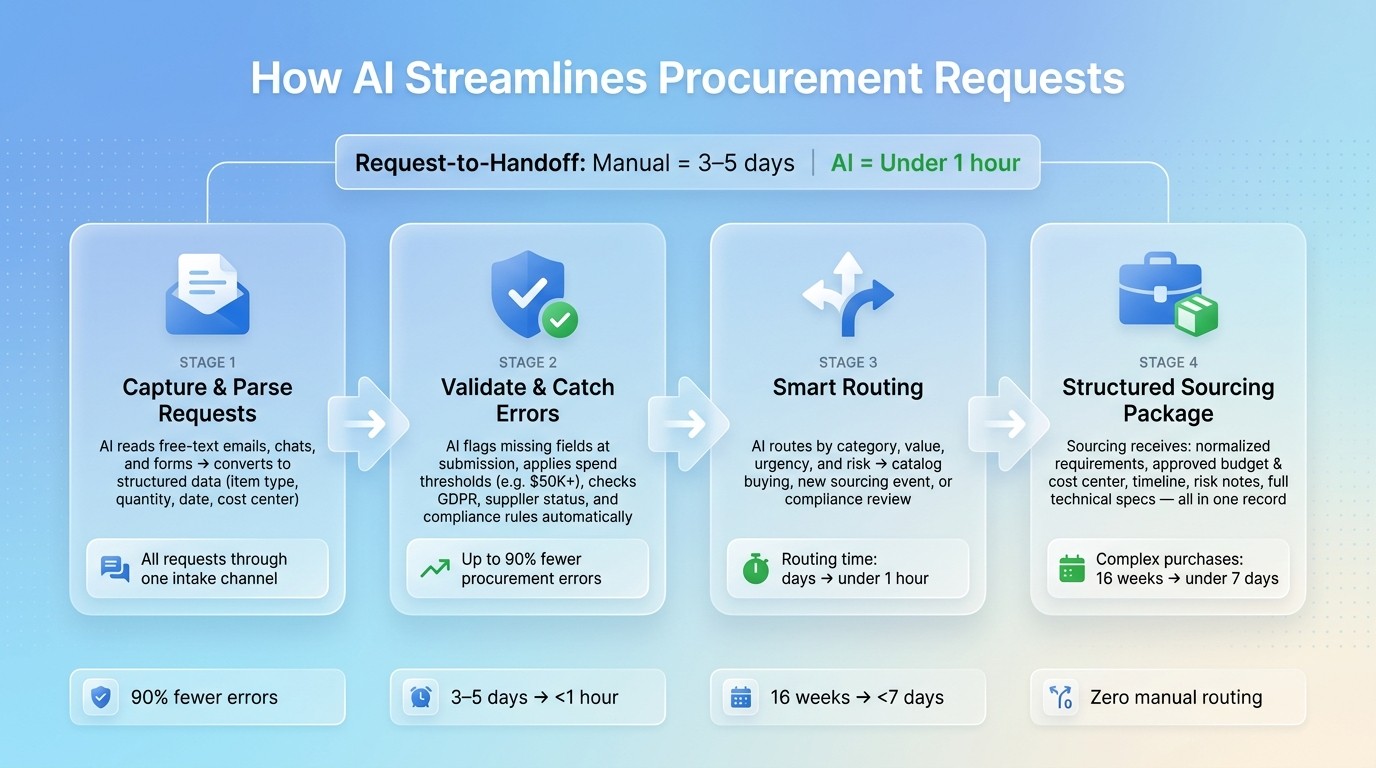
AI cuts procurement delays by fixing the intake step first. In many teams, requests that used to take 3–5 days to reach sourcing can move in under 1 hour, and some complex purchases can shrink from 16 weeks to under 7 days.
Here’s the short version: I see AI doing the most work in four places:
turning emails, chats, and form text into structured request data
finding missing fields before procurement has to review anything
applying approval and policy rules such as spend thresholds and supplier checks
routing each request to the right path and sending sourcing a clean package
That matters because most delays start with incomplete specs, unit mix-ups, missing cost centers, and approval confusion. Instead of letting those issues sit in an inbox, AI checks them at submission and asks for fixes right away.
A few numbers stand out:
Up to 90% fewer procurement errors with AI-guided spec creation
3–5 days to under 1 hour for request-to-handoff time
16 weeks to under 7 days for some complex tech buying cases
I’d sum it up like this: AI doesn’t fix procurement by replacing sourcing. It fixes the messy front end so sourcing gets a request that is complete, checked, and ready to move.
How AI Streamlines Procurement Requests: From Intake to Handoff
How AI Makes Procurement Work Faster (and Smarter)
Capture and parse procurement requests with AI
To cut the back-and-forth, send every request through a single intake channel. AI can then read free-text submissions and pull out the fields procurement needs. When all requests come through one place, teams get cleaner inputs and a much easier review process.
Convert free-text requests into structured procurement data
A request like "need 50 laptops by 09/15/2026" can be turned into structured fields such as item type, quantity, and due date. AI pulls each field and validates and standardizes procurement data before the request moves forward.
Use Procright to build complete specifications earlier in the process
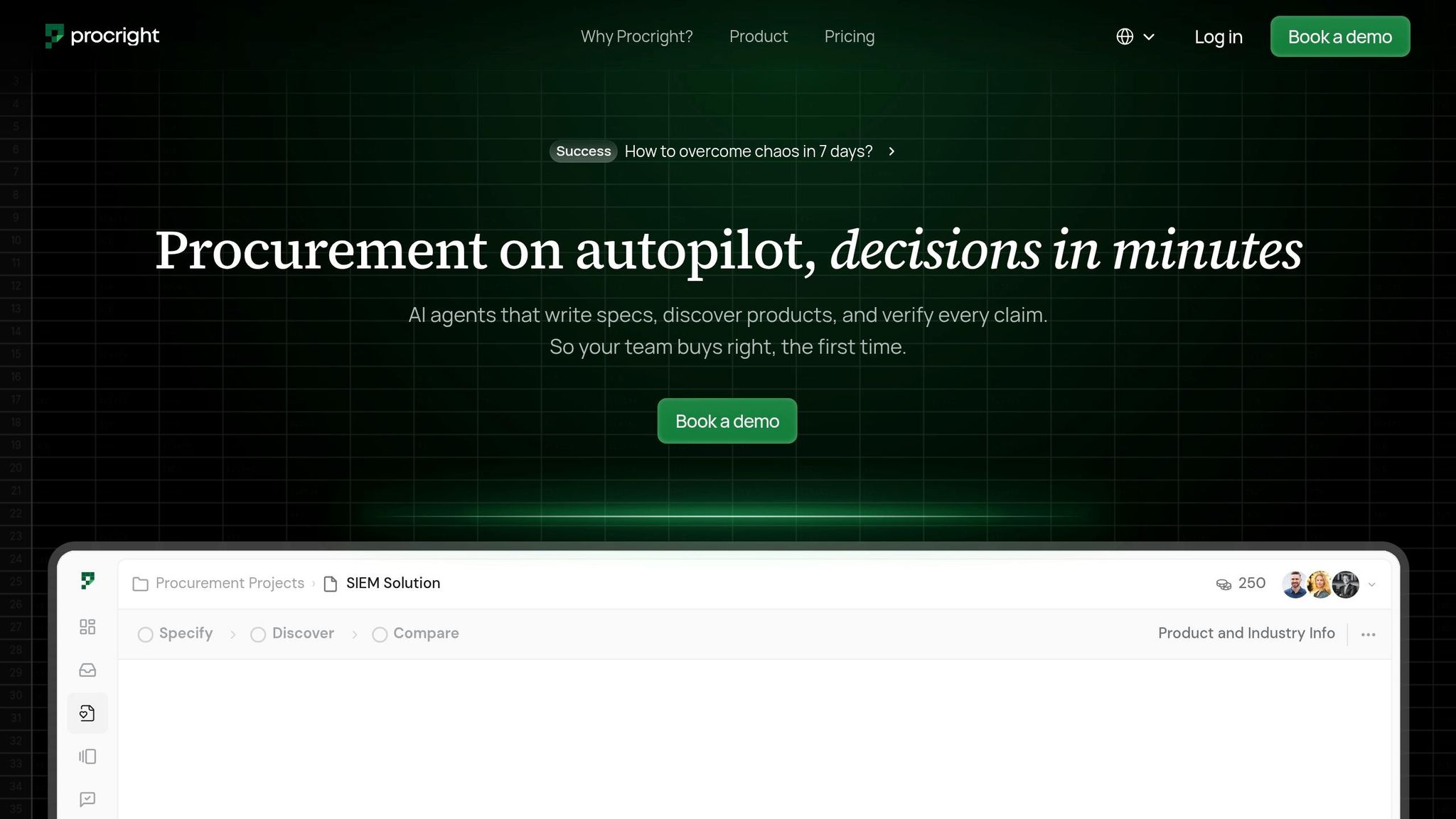
For complex requests, parsing by itself isn't enough. The next step is building a full specification. For technical purchases, AI should do more than pull fields - it should help finish the spec.
Procright interviews the requester to surface missing technical and compliance details before sourcing starts. It scores compliance against the spec, so sourcing teams get a clear starting point. That cuts clarification loops before sourcing begins.
Use AI checks to catch missing data and policy issues before review
Parsing is only the first step. AI also needs to check whether a request is complete and follows company rules before anyone in procurement looks at it.
Once the data is structured, AI can run those checks right away and stop bad requests from moving any further.
Flag missing fields before the request reaches procurement
AI can check requests in real time when someone hits submit. If a required field is blank or doesn't line up with the rest of the request, the system can ask the requester to fix it on the spot instead of passing the problem downstream.
That check can cover core fields like:
requester name
department
quantity
business justification
estimated budget
needed-by date
category-specific requirements
For technical requests, AI can go a step further. It can ask follow-up questions about load tolerances or compatibility standards, which helps fill in gaps before the request ever reaches procurement.
The payoff is hard to ignore: organizations using AI-guided specification creation have reduced procurement errors by as much as 90%.
Apply approval thresholds and compliance rules without manual checks
After validation, AI can apply policy rules automatically. A request over $50,000 can trigger extra approval, while a purchase outside preferred supplier status or contract coverage can trigger a contract check.
It can also review requests against category-specific rules. That includes GDPR, local data privacy, and IT security controls, all checked automatically against the request data.
This shifts compliant buying from a manual effort to the default path and cuts maverick spend.
For technical purchases, Procright can compare product capabilities against each spec line and surface a compliance score backed by evidence.
Once the request is checked and cleared, it can move straight into the right workflow.
Route requests to the right team and hand off clean sourcing packages
After validation, AI sends each request to the right owner and packages it for sourcing.
Send each request to the correct workflow automatically
AI routes each request based on category, value, urgency, and risk. If the request involves a preferred vendor, it goes to catalog buying. If it involves a new supplier or a missing contract, it triggers a sourcing event. And if the item carries higher risk, it goes through compliance or security review before moving ahead.
That shift can cut routing time from days to under an hour.
Give sourcing teams structured packages instead of raw request emails
Once routing assigns an owner, the handoff needs to arrive complete. This is where manual work often falls apart. Sourcing teams get raw request emails or half-filled forms, then spend time piecing together requirements before they can even begin sourcing.
AI cuts out copy-paste entry, manual triage, and incomplete handoffs. Instead of a messy email chain, sourcing teams receive a structured sourcing package with everything in one place:
Normalized requirements
Approved budget and cost center
Timeline
Risk notes
Complete technical specifications
All of that sits in a single structured record.
Measure results and choose the best starting use cases
Track cycle time, rework, and compliance improvements
Once you follow a procurement workflow automation checklist to streamline intake, routing, and handoff, the next step is simple: check if requests are moving faster and coming through cleaner.
Focus on four metrics:
Time from request submission to sourcing handoff
Number of clarification emails per request
Percentage of requests that arrive complete at intake
Monthly labor hours saved
These numbers tell you where the process is getting better and where work is still slipping through the cracks.
AI-powered requisition workflows can cut cycle times from 3–5 days to under one hour. And for complex technology purchases, the gap is even bigger: decisions that used to take 16 weeks can be made in under 7 days.
Metric | Manual | AI |
|---|---|---|
Request-to-handoff cycle | 3–5 days | Under 1 hour |
Complex purchase cycle | 16 weeks | Under 7 days |
Every clarification email matters. It’s not just another message in the inbox. It usually means the original request came in incomplete, unclear, or missing something important. That’s the kind of rework AI is meant to cut down.
Conclusion: Where AI removes the most manual work first
Start with the request types that slow teams down the most and trigger the most back-and-forth. High-volume, specification-heavy requests are the best first targets because they often include detailed requirements, repeated intake issues, and too much manual cleanup.
Across the full workflow, AI helps tighten intake quality, turn free-text requirements into structured data, flag missing fields early, run policy checks automatically, route requests to the right owner, and send over cleaner sourcing packages. For teams that need help at the spec stage, Procright handles specification creation and delivers transparent compliance scores.
FAQs
What requests benefit most from AI intake?
AI intake works best for complex technical purchases where mistakes can be expensive and requirements aren't always clear at the start. It's especially helpful for requests with detailed specs, like IT tools such as SIEM or EDR.
It helps surface missing details, close technical gaps, and make sure the final specification is complete, measurable, and audit-ready before sourcing starts.
How does AI handle incomplete or unclear requests?
AI works like a smart interviewer before procurement begins. It looks for gaps in the request, points out missing technical requirements, and suggests details that should be added based on the purchase type and the situation.
For example, if someone submits a request for a security system, the AI can spot missing specs around capacity or access control. It can then ask focused follow-up questions to fill in those blanks. That way, the final specification is complete, measurable, and standardized before any vendor is contacted.
What should teams measure after automating intake?
Teams should measure gains in process efficiency and decision quality.
That usually shows up in a few clear ways:
Shorter requisition cycle times
Less time spent on manual corrections
Fewer clarification emails
Better visibility into the requisition pipeline
It also helps to track how complete and accurate the first set of specifications is. If those specs come in cleaner from the start, teams can cut delays, reduce back-and-forth, and lower faulty procurement risk.
Taken together, these metrics show whether automation is trimming friction and helping teams plan with more confidence.
Related Blog Posts
Try it on a real buy
Bring one category. Watch where the flags land.
We use a little analytics to see which pages actually help. Nothing else, no ad trackers.